- ROARING TWENTIES
- RADIATION AND LEAD
- WILLIAM FAULKNER
- DRUGS THAT USED TO BE LEGAL
- ARSENIC IN COSMETICS
- WARREN HARDING (1921 - 1923)
- BLACK HOME SEIZURES
- CALVIN COOLIDGE (1923 - 1929)
- IMMIGRATION ACTS
- HERBERT HOOVER (1929 - 1933)
- FEDERAL RESERVE FAILINGS
- FRANKLIN ROOSEVELT (1933 - 1945) - THE GREAT DEPRESSION
- HUEY LONG (KINGFISH)
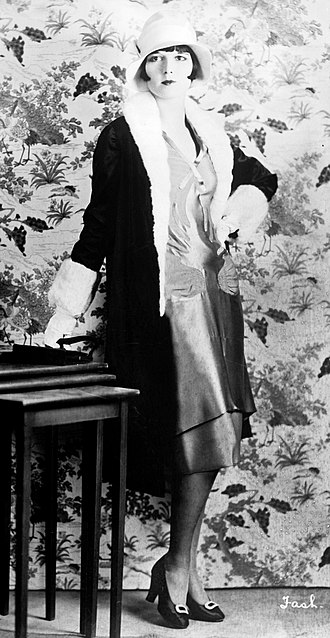 |
| flapper |
During the Roaring Twenties there was economic prosperity, although overproduction made agriculture a weak spot in the economy. Flappers were a subculture of young Western women prominent after the First World War and through the 1920s who wore skirts up to the knee, bobbed their hair and listened to jazz. People went to speakeasies to illegally drink alcohol during prohibition. The US and European nations saw significant economic growth. The presidencies of Warren G. Harding, Calvin Coolidge and Herbert Hoover happened during the Roaring Twenties, but allowed enough deregulation and overspeculation to lead to the Great Depression. In 1925 F. Scott Fitzgerald published The Great Gatsby. In it, the book's narrator, Nick Carraway, describes the rich couple Tom and Daisy Buchanan as "careless people" — "they smashed up things and creatures and then retreated back into their money or their vast carelessness or whatever it was that kept them together, and let other people clean up the mess they had made." Deregulation allowed the rich to be careless. In Echoes of the Jazz Age Fitzgerald wrote, "It was borrowed time anyway — the whole upper tenth of a nation living with the insouciance of a grand duc and the casualness of chorus girls."
RADIUM GIRLS
Marie Curie won the 1911 Nobel Prize in Chemistry for her discovery of the elements polonium and radium. From 1917 through the 1920s the radium girls were told to paint radium dials on watch faces and instruments with self-luminous paint, and to "point" brushes on their lips to give them a fine tip. They were told the paint was harmless, but became ill and got cancer from radiation poisoning. More than 50 died from it. Because the true nature of the radium had been kept from them, the Radium Girls also painted their nails, teeth, and faces for fun with the deadly paint. Many of the women developed anemia, bone fractures, and necrosis of the jaw, a condition now known as radium jaw. The owners and the scientists of US Radium, familiar with the element's effects, carefully avoided any exposure to themselves, using lead screens, masks and tongs around the material. 'Radithor', a medical drink sold over the counter until 1931, was said to bathe the user in "liquid sunshine." If drunk regularly, it contained enough radium to kill. Residues from US Radium's refineries were used to make sand for children's sand boxes.
UNITED STATES GOVERNMENT RADIATION EXPERIMENTS
After the discovery of radiation, the US government conducted the following radiation experiments on groups of people without their consent:
- injecting plutonium and other radioactive elements to mostly terminal patients
- feeding radioactive traces to children
- enlisting doctors to administer radioactive iron to impoverished pregnant women
- exposing US soldiers and prisoners to high levels of radiation
- irradiating the testicles of prisoners, which caused severe birth defects
Orphans were fed irradiated milk, and children and prisoners in Washington and Oregon state prisons were injected with radioactive materials. Much of the experimentation was carried out in order to assess how the human body metabolizes radioactive materials, information that could be used by the Departments of Energy and Defense in Cold War defense and attack planning.
LEAD IN PLUMBING
Lead has been used in plumbing since ancient times. In the US lead water pipes were allowed and, in some areas, required. In the 2010s, one-third of American communities still had lead service lines. In children, the effects of lead exposure include learning problems, slow growth, and lower IQ. In adults, low-level exposure can cause hypertension, cognitive issues, and reproductive harm. The "Lead and Copper Rule Improvements" regulation, issued by the United States Environmental Protection Agency (EPA) in October 2024, specifies an "action level" for lead at 0.010 mg/L. The 2024 regulation also requires public water systems to remove all lead pipes within ten years. The word plumbing comes from the Latin word plumbum, which means lead.
 |
| The Sound and the Fury |
William Faulkner was an author from Mississippi who wrote novels about his home state. Faulkner won a Nobel Prize in Literature. Two of his novels, A Fable and The Reivers, each won a Pulitzer Prize. The Sound and the Fury, set in the fictional county of Yoknapatawpha, Mississippi describes attempts by Dilsey, a black maid, to hold the Compson family together as it fell into decay. It includes multiple points of view. The following example of Faulkner's stream-of-consciousness style is from Faulkner's novel Absalom, Absalom!:

Just exactly like Father if Father had known as much about it the night before I went out there as he did the day after I came back thinking Mad impotent old man who realized at last that there must be some limit even to the capabilities of a demon for doing harm, who must have seen his situation as that of the show girl, the pony, who realizes that the principal tune she prances to comes not from horn and fiddle and drum but from a clock and calendar, must have seen himself as the old wornout cannon which realizes that it can deliver just one more fierce shot and crumble to dust in its own furious blast and recoil, who looked about upon the scene which was still within his scope and compass and saw son gone, vanished, more insuperable to him now than if the son were dead since now (if the son still lived) his name would be different and those to call him by it strangers and whatever dragon's outcropping of Sutpen blood the son might sow on the body of whatever strange woman would therefore carry on the tradition, accomplish the hereditary evil and harm under another name and upon and among people who will never have heard the right one; daughter doomed to spinsterhood who had chosen spinsterhood already before there was anyone named Charles Bon since the aunt who came to succor her in bereavement and sorrow found neither but instead that calm absolutely impenetrable face between a homespun dress and sunbonnet seen before a closed door and again in a cloudy swirl of chickens while Jones was building the coffin and which she wore during the next year while the aunt lived there and the three women wove their own garments and raised their own food and cut the wood they cooked it with (excusing what help they had from Jones who lived with his granddaughter in the abandoned fishing camp with its collapsing roof and rotting porch against which the rusty scythe which Sutpen was to lend him, make him borrow to cut away the weeds from the door-and at last forced him to use though not to cut weeds, at least not vegetable weeds — would lean for two years) and wore still after the aunt's indignation had swept her back to town to live on stolen garden truck and out of anonymous baskets left on her front steps at night, the three of them, the two daughters negro and white and the aunt twelve miles away watching from her distance as the two daughters watched from theirs the old demon, the ancient varicose and despairing Faustus fling his final main now with the Creditor's hand already on his shoulder, running his little country store now for his bread and meat, haggling tediously over nickels and dimes with rapacious and poverty-stricken whites and negroes, who at one time could have galloped for ten miles in any direction without crossing his own boundary, using out of his meagre stock the cheap ribbons and beads and the stale violently-colored candy with which even an old man can seduce a fifteen-year-old country girl, to ruin the granddaughter of his partner, this Jones — this gangling malaria-ridden white man whom he had given permission fourteen years ago to squat in the abandoned fishing camp with the year-old grandchild-Jones, partner porter and clerk who at the demon's command removed with his own hand (and maybe delivered too) from the showcase the candy beads and ribbons, measured the very cloth from which Judith (who had not been bereaved and did not mourn) helped the granddaughter to fashion a dress to walk past the lounging men in, the side-looking and the tongues, until her increasing perhaps fear; — Jones who before '61 had not even been allowed to approach the front of the house and who during the next four years got no nearer than the kitchen door and that only when he brought the game and fish and vegetables on which the seducer-to-be's wife and daughter (and Clytie too, the one remaining servant, negro, the one who would forbid him to pass the kitchen door with what he brought) depended on to keep life in them, but who now entered the house itself on the (quite frequent now) afternoons when the demon would suddenly curse the store empty of customers and lock the door and repair to the rear and in the same tone in which he used to address his orderly or even his house servants when he had them (and in which belly taught her embarrassment — or he doubtless ordered Jones to fetch from the showcase the ribbons and beads and candy) direct Jones to fetch the jug, the two of them (and Jones even sitting now who in the old days, the old dead Sunday afternoons of monotonous peace which they spent beneath the scuppernong arbor in the back yard, the demon lying in the hammock while Jones squatted against a post, rising from time to time to pour for the demon from the demijohn and the bucket of spring water which he had fetched from the spring more than a mile away then squatting again, chortling and chuckling and saying `Sho, Mister Tawm' each time the demon paused) — the two of them drinking turn and turn about from the jug and the demon not lying down now nor even sitting but reaching after the third or second drink that old man's state of impotent and furious undefeat in which he would rise, swaying and plunging and shouting for his horse and pistols to ride single-handed into Washington and shoot Lincoln (a year or so too late here) and Sherman both, shouting, ‘Kill them! Shoot them down like the dogs they are!' and Jones: ‘Sho, Kernel; sho now' and catching him as he fell and commandeering the first passing wagon to take him to the house and carry him up the front steps and through the paintless formal door beneath its fanlight imported pane by pane from Europe which Judith held open for him to enter with no change, no alteration in that calm frozen face which she had worn for four years now, and on up the stairs and into the bedroom and put him to bed like a baby and then lie down himself on the floor beside the bed though not to sleep since before dawn the man on the bed would stir and groan and Jones would say, ‘flyer I am, Kernel. Hit's all right. They aint whupped us yit, air they?' this Jones who after the demon rode away with the regiment when the granddaughter was only eight years old would tell people that he ‘was lookin after Major's place and n***ers' even before they had time to ask him why he was not with the troops and perhaps in time came to believe the lie himself, who was among the first to greet the demon when he returned, to meet him at the gate and say, ‘Well, Kernel, they kilt us but they aint whupped us yit, air they?' who even worked, labored, sweat at the demon's behest during that first furious period while the demon believed he could restore by sheer indomitable willing the Sutpen's Hundred which he remembered and had lost, labored with no hope of pay or reward who must have seen long before the demon did (or would admit it) that the task was hopeless-blind Jones who apparently saw still in that furious lecherous wreck the old fine figure of the man who once galloped on the black thoroughbred about that domain two boundaries of which the eye could not see from any point.

Colonists eased ailments with laudanum, a bitter elixir of alcohol and opium. In the 19th century, recreational smokers sought opium for euphoria and relaxation, while parents soothed restless and teething babies with opiate-laced syrups. Laudanum's principal use was as a pain medication and cough suppressant. Until the early 20th century, laudanum was sold without a prescription and was a constituent of many patent medicines. Women sipped opium tinctures for everything from menstrual cramps to anxiety. Another cure-all with alcohol and opium was Dr. Buckland's Scotch Oats Essence. In the US, the first national law concerning opium was the 1906 Food and Drug Act, which required the labeling of any product with opium in it. As a result of the labeling of opium products, the use of opium began to decline.
 |
| Calomel |
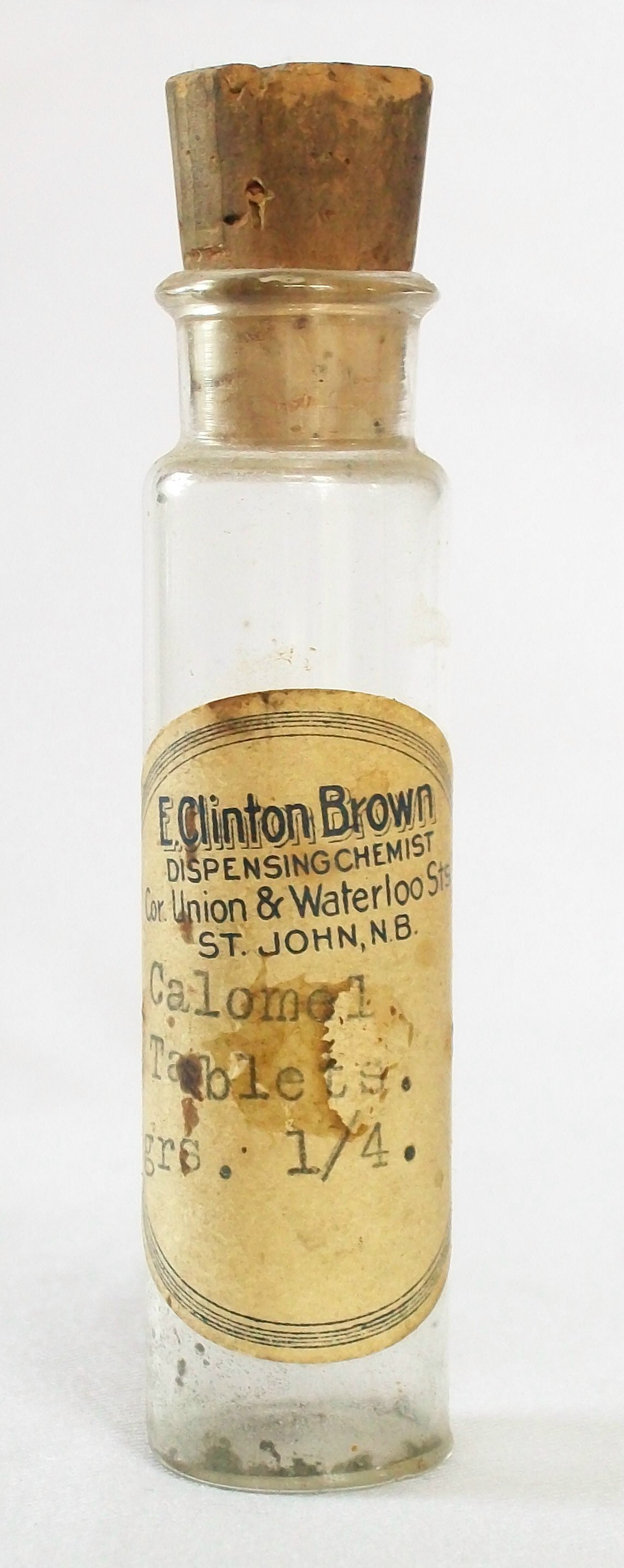
Calomel was used as a medicine from the 16th century through the early 20th century. By the 19th century, calomel was viewed as a panacea, or miracle drug, and was used against almost every disease, including syphilis, bronchitis, cholera, ingrown toenails, teething, gout, tuberculosis, influenza, and cancer. In 1853, Samuel Jackson described the harmful effects of calomel on children in his publication for Transactions of Physicians of Philadelphia. He noted that calomel caused gangrene on the skin, loss of teeth, and deterioration of the gums. Eventually, calomel's popularity began to wane as more research was done, and scientists discovered that the mercury in the compound was poisoning patients. During the 19th century, calomel was used to treat numerous illnesses and diseases like mumps, typhoid fever, and others — especially those that impact the gastrointestinal tract, such as constipation, dysentery, and vomiting. As mercury softened the gums, calomel was the principal constituent of teething powders until the mid-twentieth century. Babies given calomel for teething often suffered from acrodynia. Calomel, in high doses, led to mercury poisoning, which had the potential to cause permanent deformities and even death. Some patients experienced gangrene of the mouth generated by the mercury in the medicine, which caused the tissue on the cheeks and gums inside the mouth to break down and die. Some patients would lose teeth, while others were left with facial deformities.
A young German pharmacist's apprentice named Friedrich Wilhelm Adam Sertürner isolated one of opium's active ingredients in the early 1800s. He named the new compound morphine after Morpheus, the Greek god of dreams. It quickly became a standard painkiller used around the world. However, morphine use led to addiction. Like most other drugs, morphine became restricted to prescription only in 1914 and became illegal in 1970. However, morphine is still used as one of the most common and effective pain killers in modern medicine.
 |
| Bayer Heroin |
Heroin was first synthesized in 1874 by C. R. Alder Wright, an English chemist working at St. Mary's Hospital Medical School in London. A German chemist named Felix Hoffmann resynthesized heroin on August 21, 1897, just eleven days after he had synthesized aspirin. From 1898 through to 1910 diamorphine was marketed under the trademark name Heroin by Bayer as a cough suppressant similar to morphine. In 1924 the United States Congress banned its sale, importation or manufacture. According to the Atlantic, Sears sold two vials of heroin for $1.50 (some $50 today). The company even threw in a syringe, two needles and a heroin kit carrying case.
Cocaine is derived from the South American coca leaf. This leaf has been used traditionally by the local populace. Sucking on a few leaves provides locals with an effect similar to having strong coffee. In the 1860s German scientists found the active ingredient in the coca leaf and name it cocaine. Three years later cocaine came to the USA in wine and other products. People did not know what cocaine was but bought more products with it. The most famous product containing cocaine was Coca-Cola. Sigmund Freud used and prescribed cocaine (though he later became addicted and stopped using it).
Speed is a product of the 20th century. Initially it was developed as a sinus treatment (Benzedrine) and was referred to as "popping bennies." From here it became used recreationally and also work related as it enabled people to work longer and harder. During the Second World War, Hitler was said to use amphetamines as much as five times a day. It was also given to German troops to increase the effect of the Blitzkrieg.
 |
| Dr. Buckland's Scotch Oats Essence |
The 1906 Food and Drug Act is the first law that impacts drugs on a federal level. This law was in response to the "snake oil" sales of "cure-alls" which promised to cure most everything but did not provide a list of ingredients. Some of these cure-alls consisted of large amounts of morphine or alcohol. As a result, Congress passed the Food and Drug Act in 1906, which required the labeling of all ingredients in these patent medicines and cure-alls. Predictably, the result was a huge drop in the use of these substances once people knew what it is they were consuming. For example, one cure-all intended to cure tooth aches in children consisted almost entirely of cocaine.
The 1914 Harrison Tax Act was passed to make some drugs difficult to obtain. Various groups wanted to ban various drugs. Congress and most Americans at the time thought that a ban of any drug was unconstitutional as our constitutional guarantee of liberty gave us the right to consume any product we wished (which is why the prohibition against alcohol required a constitutional amendment rather than merely a law). The plan was to ban drugs by making them nearly impossible to obtain. The law required that you must pay a tax on drugs. To ensure that the tax was collected, you had to get the drugs from a doctor via prescription (all prescriptions were therefore registered with the tax office which enabled the government to track which doctors were prescribing which drugs). The Harrison Act included opium, heroin, and cocaine (but not marijuana). The law required that (for tax purposes) doctors must keep records and only prescribe these drugs for "medical necessity." In 1919 the Supreme Court ruled in Webb, et. al. v. United States that addiction was not a disease; as a result doctors were told there was no "medical necessity" for these drugs. Since all doctors prescribing these drugs had provided records of these prescriptions, thousands of doctors were then arrested for prescribing these drugs to addicts to maintain their habits. Constitutionally, this was questionable as regulating the medical practice is thought to be a state issue.
 |
| Dr. Campbell's Arsenic Wafers |
"Dr MacKenzie" was one of several brand names attached to arsenic products – similar "wafers" (pills) were sold under the names Dr Simms, Dr Rose and Dr Campbell. The wafers made the skin fashionably pale by destroying red blood cells. Although it was possible to build up a tolerance for arsenic by taking regular small amounts, it is no surprise that the cosmetic use of the substance did not always end happily. In July 1880 the Indianapolis Sentinel reported the case of "a young lady, handsome and intelligent," who had gradually lost her sight as a result of taking arsenic. Her engagement to a "young physician of good prospects" was on hold while he waited to find out if her sight could be restored. Deaths also occurred, such as that of 18-year-old Hildegarde Walton of St Louis, who died in 1911 having taken several boxes of wafers in an attempt to clear up a skin complaint. An ad for Dr. Mackenzie's read:
ONE BOX of Dr. MACKENZIE'S IMPROVED HARMLESS ARSENIC COMPLEXION WAFERS will produce the most lovely complexion that the imagination could desire, clear, fresh, free from blotch, blemish, coarseness, redness, freckles, or pimples. Post free for 4s. 6d. ; half boxes, 2s. 9d.- S. HARVEY, 5, Denman St., London Bridge, S. E. Use Dr. MacKenzie's ARSENICAL TOILET SOAP 1s. per Tablet; No. 2, unscented, 6d. per Tablet. Made from Purest Ingredients, and Absolutely Harmless. BEWARE OF THE MANY IMITATIONS. Have Dr. Mackenzie's or none.
MacKenzie's was the British version, while the main US brand was Dr Campbell's Safe Arsenic Wafers, which the proprietor supposedly used to cure his own sallow complexion.
|
| Warren Harding |
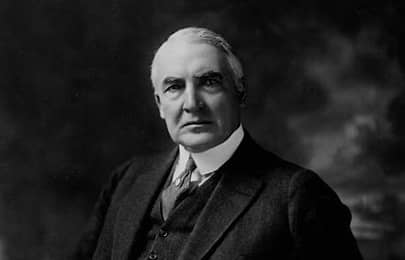
Harding was elected in 1921 and signed the Federal Highway Act of 1921. He won steel workers an eight hour work day, which was previously a twelve hour work day, seven days a week. He resolved strikes by coal miners and railroad workers. He condemned the Tulsa race massacre of 1921 when speaking to students at Lincoln University, a black college. He signed the Per Centum Act of 1921, which limited immigration from southern and eastern Europe, especially for Jews and Italians. He pardoned Eugene Debs and others who opposed World War I. He also cut taxes for the rich. Pledging a nostalgic "return to normalcy" following World War I, Harding won the presidency by the greatest popular vote margin to that time. He died during his third year in office and was succeeded by Vice President Calvin Coolidge.
In 1921, in a speech to a mixed-race audience in Birmingham, Alabama, Harding said that black Americans must have full economic and political rights, but that segregation was also essential to prevent "racial amalgamation" and that social equality was thus a dream that blacks must give up. He said, "Whoever will take the time to read and ponder Mr. Lothrop Stoddard's book on The Rising Tide of Color ... must realize that our race problem here in the United States is only a phase of a race issue that the whole world confronts."
Congress completed an initiative begun in the Wilson administration and established a budget system for the federal government; Charles G. Dawes was appointed first director of the budget. Then in 1921–22 the United States hosted the Washington Naval Disarmament Conference. Under the leadership of Secretary Hughes, the conference succeeded in getting the world's major powers to agree to halt the arms race in production of large naval vessels. Other achievements were a higher protective tariff (Fordney-McCumber) and lower taxes on business.
Early in 1923, Attorney General Daugherty disclosed to Harding that Charles Forbes, director of the Veterans Bureau, had been illegally selling government medical supplies to private contractors. After violently berating Forbes in the White House, Harding allowed him to leave the country to escape prosecution. Shortly thereafter Charles Cranmer, general counsel of the Veterans Bureau, committed suicide. Ten weeks later Jesse Smith, Daugherty's private secretary, also committed suicide-one day after a long conversation with Harding in the White House. Rumors had been circulating that Smith and a group known as the "Ohio Gang" had been profiting from a variety of corrupt activities.
On August 2, 1923, Harding died from heart failure. The nation plunged into mourning, little suspecting that the leader they eulogized as "an ideal American" would soon be revealed to have been the head of a very corrupt administration. Senate investigations uncovered Forbes's illegal financial dealings at the Veterans Bureau and pointed to Daugherty's collusion with the Ohio Gang. Far more serious was the unfolding of the Teapot Dome Scandal. In 1921 Interior Secretary Albert Fall had persuaded Harding to transfer authority over two of the nation's most important oil reserves-Elk Hills in California and Teapot Dome in Wyoming-from the Navy Department to the Department of the Interior. Fall then leased these reserves to private oil companies, netting for himself several hundred thousand dollars in gifts and loans. Fall and Forbes later received jail sentences for their crimes. Daugherty twice went on trial, the first resulting in a hung jury and the second in a not guilty verdict.
Harding was never personally implicated in the scandals, but he was aware of the actions of Forbes, Smith, and the Ohio Gang and failed to bring their corruption to light. By the mid-1920s the public began to regard Harding as a man who simply did not measure up to the responsibilities of his high office. Rumors of his heavy drinking in the White House (at a time when Prohibition was the law of the land) and of his involvement in extramarital affairs further degraded his reputation.
One reason blacks have less wealth accumulated is that the homes of blacks were seized if they were too close to a white school or neighborhood, so that black families couldn't accumulate intergenerational wealth through inheritance as much as whites. Jocelind Julien is a black woman whose family had her home seized in 1931 by the federal government's D.C. Commission. Because they were black. In the spot where it once stood is now a basketball court. "The Presence of this house, with its colored occupants, so close to a white school is a source of possible friction that is thought desirable to remove," Assistant Engineer Commissioner H.L. Robb wrote in the Evening Star. The new all-white Lafayette School was nearly constructed and they were the last to leave a once-vibrant black enclave. Similar seizures of black homes happened throughout the country.
 |
| Calvin Coolidge |
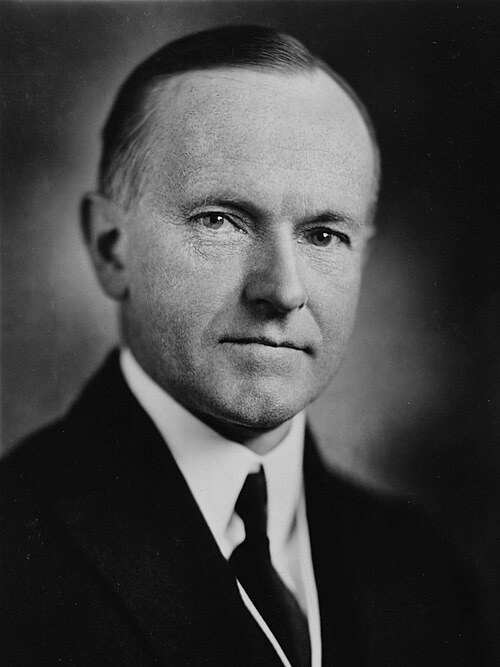
Calvin Coolidge became president after the death of Harding, and was elected in 1924. He supported women's suffrage. He also signed the Indian Citizenship Act of 1924 recognized the first Americans as citizens. However, a few states didn't allow Indians to vote until 1957. He also signed the eugenics-inspired Immigration Act of 1924 which, with its quotas favoring immigrants from northern and western Europe, sought to prevent America's ethnic composition from changing. He oversaw the Roaring Twenties, but his laissez-faire economic policies ended with the Great Depression, which began shortly after he left office. The Revenue Acts of 1924, 1926 and 1928 reduced taxes, especially on the rich, and spending was also reduced. The Dawes Plan offered economic relief to Germany. Coolidge opposed economic aid to agriculture. Coolidge supported racial equality during a period of heightened racial tension.
In 1921, newly elected president Warren G. Harding chose Andrew Mellon as his Secretary of the Treasury. Mellon would remain in office until 1932, serving under Harding, Calvin Coolidge, and Herbert Hoover, all three of whom were members of the Republican Party. Mellon sought to reform federal taxation in the aftermath of World War I. He argued cutting tax rates on top earners would generate more tax revenue for the government, but otherwise left in place a progressive income tax. Some of Mellon's proposals were enacted by the Revenue Act of 1921 and the Revenue Act of 1924, but it was not until the passage of the Revenue Act of 1926 that the "Mellon plan" was fully realized. The top tax rate was reduced from 50 percent to 25 percent. The bottom tax rate was reduced from 4 percent to 3 percent. He also presided over a reduction in the national debt, which dropped substantially in the 1920s. Mellon's influence in state and national politics reached its zenith during Coolidge's presidency.
Mellon was the key to the conservative, pro-business focus of the Coolidge administration. A multimillionaire himself, Mellon believed strongly that reducing taxes for the rich was the best way to expand the nation's wealth. He held that, as the rich invested funds that otherwise would have been taken away in taxes, new businesses would form and older enterprises would expand and that the result would be more jobs and greater national production. Under the leadership of Coolidge and Mellon, Congress sharply reduced income taxes and estate taxes.
One form of business enterprise, however, received almost no help from the Coolidge administration: agriculture. Farmers constituted the one group of producers clearly not participating in the decade's prosperity. Twice Congress passed the McNary-Haugen bill, calling for the federal government to purchase surplus crops. Twice (1927 and 1928) Coolidge vetoed it, and the economic woes of American farmers persisted well into the following decade. Coolidge also vetoed a bill offering a bonus to veterans of World War I; Congress overrode that veto in 1924.
A belief in small government has a long history in the US President Andrew Jackson opposed a national bank because he thought it would cause "our liberties to be crushed." President Grover Cleveland vetoed a Texas Seed Bill after a drought for similar reasons. President Franklin Pierce vetoed a bill that would allow mental hospitals to be built on state land, as he feared that allowing them would lead to "all sovereignty vested in an absolute consolidated central power, against which the spirit of liberty has so often and in so many countries struggled in vain."
Coolidge won on the campaign slogan "Keep cool with Coolidge." He was known as a man of few words. A Washington, D.C., hostess, who told him, "You must talk to me, Mr. President. I made a bet today that I could get more than two words out of you." Coolidge replied, "You lose." He also said, "The chief business of the American people is business."
The first naturalization law was passed in 1790, and allowed citizenship for any "free white person" of good character. The 1795 Act continued the 1790 Act limitation of naturalization being available only to "free white person[s]." The main change was the increase in the period of required residence in the United States before an alien can be naturalized from two to five years, and the introduction of the Declaration of Intention requirement, or "first papers", which required to be filed at least three years before the formal application, creating a two-step naturalization process. Aliens intending to naturalize had to go to their local court and declare their intention to do so at least three years before their formal application. In the declaration, the applicant would also indicate his understanding that upon naturalization he would take an oath not only of allegiance to the United States but also of renunciation of his former sovereign. In addition to the declaration of intention and oath of renunciation, the 1795 Act required all naturalized persons to be "attached to the principles of the Constitution of the United States" and be "well disposed to the good order and happiness of the same." The 1795 Act was superseded by the Naturalization Act of 1798, which extended the residency requirement to 14 years and notice period to five years. The 1798 Act was repealed by the Naturalization Law of 1802, which restored the residency and notice requirements of the 1795 Act.
Immigration laws began worldwide in the late 19th and early 20th centuries. Before this, there were few laws on immigration, although the Know Nothings were strongly opposed to immigrants. Black immigrants were allowed after the Civil War. In the late 19th century, American immigration laws were written to keep out criminals and those with infectious diseases, but then grew to include quotas. Chinese exclusion acts were the first laws restricting immigration in a major way, although immigration from Latin America would be the focus of later immigration restrictions. Immigration quotas based on eugenics were added to preserve "homogeneity." The quotas applied to nationalities, but favored nations in northern and western Europe at a time when there was discrimination against Asians, southern and eastern Europeans and Jews from eastern Europe and Russia.
The 1917 Immigration Act implemented a literacy test that required immigrants over 16 years old to demonstrate basic reading comprehension in any language. It also increased the tax paid by new immigrants upon arrival and allowed immigration officials to exercise more discretion in making decisions over whom to exclude. Finally, the Act reduced immigration from Asia.
The Emergency Quota Act of 1921 was formulated mainly in response to the large influx of southern and eastern Europeans and restricted their immigration to the United States. Although intended as temporary legislation, it proved, in the long run, the most important turning-point in American immigration policy because it added two new features to American immigration law: numerical limits on immigration and the use of a quota system for establishing those limits, which came to be known as the National Origins Formula.
The Emergency Quota Act restricted the number of immigrants admitted from any country annually to 3 percent of the number of residents from that country living in the United States as of the 1910 Census. That meant that people from northern and western Europe had a higher quota and were more likely to be admitted to the US than those from eastern or southern Europe or from non-European countries.
However, professionals were to be admitted without regard to their country of origin. Also, no limits were set on immigration from Canada, Newfoundland, Cuba, Mexico, or the countries of Central America and South America or "adjacent islands." The act did not apply to countries with bilateral agreements with the US or to Asian countries listed in the Immigration Act of 1917, known as the Asiatic Barred Zone Act. Based on the new formula, the number of new immigrants admitted fell from 805,228 in 1920 to 309,556 in 1921–22. The average annual inflow of immigrants prior to 1921 was 175,983 from northern and western Europe and 685,531 from other countries, mainly southern and eastern Europe. In 1921, there was a drastic reduction in immigration levels from other countries, principally southern and eastern Europe.
The Immigration Act of 1924, or Johnson–Reed Act, replaced earlier legislation by significantly reducing immigration from countries outside the Western Hemisphere. Immigrants from Asia were banned, and the total annual immigration quota for the rest of the world was capped at 165,000-an 80 percent reduction of the yearly average before 1914. The Act set quotas on the number of immigrants from every country outside Latin America. The act temporarily reduced the annual quota of any nationality from 3 percent of their 1910 population, per the Emergency Quota Act of 1921, to 2 percent as recorded in the 1890 census; a new quota was implemented in 1927, based on each nationality's share of the total US population in the 1920 census. According to the Department of State, the purpose of the act was "to preserve the ideal of US homogeneity." The use of the National Origins Formula continued until it was replaced by the Immigration and Nationality Act of 1965, which introduced a system of preferences, based on immigrants' skills and family relationships with US citizens or US residents.
By using quotas favoring immigrants from northern and western Europe, the Act restricted the number of Asians, Africans, Slavs and Jews. The limit for China, Bulgaria, Palestine and African countries was 100. 34,007 could come from England and Northern Ireland, but only 3,845 from Italy; 51,227 from Germany, but only 124 from Lithuania; 28,567 from the Irish Free State, but only 2,248 from Russia.
The Immigration and Nationality Act of 1952, also known as the McCarran–Walter Act, governs immigration to and citizenship in the United States. It came into effect on June 27, 1952. This law increased the quota for Europeans outside Northern and Western Europe and gave the Department of State authority to reject entries affecting native wages, eliminated 1880s bans on contract labor, set a minimum quota of one hundred visas per country, and promoted family reunification by exempting citizens' children and spouses from numerical caps. The law eliminated racial restrictions on who could be naturalized.
The Immigration and Nationality Act of 1965 abolished the national origins quota system, establishing a preference-based immigration system that prioritized family reunification and skilled immigrants

|
| Herbert Hoover |
In 1929 Herbert Hoover was elected as president. On October 1929 the Great Depression began. There was extreme economic deregulation in the years leading up to the Great Depression. Stocks could be bought on margin with borrowed money. There were no rules against insider trading. Florida swampland was for sale. In the 1920s Charles Ponzi duped investors with a postage stamp pyramid scheme. The Wall Street stock market crash led to runs on banks and bank holidays. Almost half of the banks failed, and unemployment went up to 25 percent. As the conservative Nobel prize-winning economist Milton Friedman said, the problem with the Great Depression is that they didn't save the banks. Deflation worsened the Depression.
Al Capone was a bootlegger and gangster who was guilty of the St. Valentine's Day massacre in which seven people from rival gangs were murdered in broad daylight. He attained notoriety during the Prohibition era as the co-founder and boss of the Chicago Outfit from 1925 to 1931. His seven-year reign as a crime boss ended when he was convicted on five counts of tax evasion and imprisoned at the age of 33. The fact that tax evasion was a crime that crossed state lines allowed the feds to arrest and convict him.
On March 3, 1931, the US Congress passed a joint resolution making The Star Spangled Banner the official national anthem of the United States, which President Herbert Hoover signed into law. The lyrics were from a poem written by Francis Scott Key about the the 1814 Battle of Baltimore at Fort McHenry during the War of 1812. The American Flag, which had 15 stars and stripes at the time, signalled that the British were defeated. Key's poem was set to the tune To Anacreon in Heaven. Congreve rockets used by the British had a "red glare." Francis Scott Key was a slaveowner who chose to free some of his slaves.
After the stock market crash of October 1929, President Hoover sought to prevent panic from spreading throughout the economy. In November, he summoned business leaders to the White House and secured promises from them to maintain wages. Hoover ordered federal departments to speed up their construction projects as a way of creating jobs, and asked state governors to expand their public works projects. He requested Congress approve a $160 million tax cut while doubling spending for public buildings, dams, highways, and harbors. The President would not, however, provide direct federal relief to the unemployed.
In 1930 a combination of drought and high winds led to the Dust Bowl from Texas to Nebraska, forcing people to leave their farms and compete for jobs in cities.
The Smoot-Hawley Tariff of 1930 resulted in trade wars, deepening the Depression. Smoot-Hawley was harmful not only for the US economy, tanking US exports to Europe from $2,341 million in 1929 to just $784 million in 1932, but also for global trade, which declined by 66 percent between 1929 and 1934, according to the US Office of the Historian. The effects of Smoot-Hawley were so negative that it marked the end of steep tariffs in American trade policy for the rest of the twentieth century.
Economic conditions improved in early 1931 until a series of bank collapses in Europe sent new shockwaves through the American economy, leading to additional lay-offs. President Hoover was criticized for almost every program he proposed. His public works projects, designed to create jobs, were characterized as wasteful government spending. His efforts to promote local relief programs and private charities, rather than asking Congress to create nationwide relief programs, were viewed as callous disregard for the unemployed. His programs proved inadequate, as the number of unemployed workers increased from 3 million in 1930 to 10 million in 1932.
When Hoover took office he said, "We in America are nearer to the final triumph over poverty than ever before in the history of any land." When the Depression began former President Calvin Coolidge said, "When more and more people are thrown out of work, unemployment results." He observed that "This country is not in good condition."
Hoovervilles were shanty towns built during the Great Depression by the homeless in the United States. They were named after Hoover, who was widely blamed for the Great Depression. Democrats coined other similar terms that were jabs at Herbert Hoover: "Hoover blankets" were old newspapers used as blanketing, a "Hoover flag" was an empty pocket turned inside out, "Hoover leather" was cardboard used to line a shoe when the sole wore through, and a "Hoover wagon" was an automobile with horses hitched to it (often with the engine removed).
Will Rogers described the Republican belief that money to the rich would "trickle down" to the rest. He said, "The money was all appropriated for the top in the hopes that it would trickle down to the needy. Mr. Hoover was an engineer. He knew that water trickles down. Put it uphill and let it go and it will reach the driest little spot."
The Emergency Relief and Construction Act was an amendment to the Reconstruction Finance Corporation Act which was signed on January 22, 1932. It created the Reconstruction Finance Corporation which released funds for public works projects across the country. The Brooklyn Navy Yard received an allotment of $880,000, marked for specific projects such as $215,000 for repairs and the maintenance of roofs, waterfront quays and docks, and Yard's railroad system. The biggest chunk, $855,000, was designated for a major overhaul of the power plant, to put in a new turbo generator, piping, boilers, and other engines. The Act was designed to be a temporary means of providing employment and all the positions created in the navy yard to service the projects were therefore classified as temporary. In another preview of New Deal spending, the government even authorized the Act funds to start building a number of destroyers in the navy yards.
According to the Department of Housing and Urban Development, "This was the government's first major involvement in the housing field. The RFC was authorized to make loans to private corporations providing housing for low-income families. Also in 1932, the Federal Home Loan Bank Board was established to make advances on the security of home mortgages and establish a Home Loan Bank System."
Yip Harburg was inspired by a soup and bread line in New York City to write the song Brother, Can You Spare a Dime?
Once in khaki suits,
Gee, we looked swell,
Full of that Yankee Doodle-de-dum.
Half a million boots went sloggin' through Hell,
I was the kid with the drum.
Say, don't you remember, they called me Al-
It was Al all the time.
Say, don't you remember I'm your pal-
Brother, can you spare a dime?
In 1924, Congress rewarded veterans of World War I with certificates redeemable in 1945 for $1,000 each. By 1932, many of these former servicemen had lost their jobs and fortunes in the early days of the Depression. They asked Congress to redeem their Bonus certificates early. Led by Walter Waters of Oregon, the so-called Bonus Expeditionary Force set out for the nation's capital. Hitching rides, hopping trains, and hiking finally brought the Bonus Army, now 15,000 strong, into the capital in June 1932. As deliberation continued on Capitol Hill, the Bonus Army built a shantytown across the Potomac River in Anacostia Flats. When the Senate rejected their demands on June 17, most of the veterans dejectedly returned home. But several thousand remained in the capital with their families. Many had nowhere else to go. Fearing rising disorder, Hoover ordered an army regiment into the city, under the leadership of General Douglas MacArthur. The army, complete with infantry, cavalry, and tanks, rolled into Anacostia Flats forcing the Bonus Army to flee. MacArthur then ordered the shanty settlements burned.
In the face of rising unemployment Hoover lost to Franklin D. Roosevelt in the general election. Hoover departed Washington on March 4, 1933.
The Federal Reserve was created on December 23, 1913, with the enactment of the Federal Reserve Act, after a series of financial panics (particularly the panic of 1907) led to the desire for central control of the monetary system in order to alleviate financial crises. Leaders of the Federal Reserve implemented policies that they thought were in the public interest. Unintentionally, some of their decisions hurt the economy. Other policies that would have helped were not adopted.
An example of the former is the Fed's decision to raise interest rates in 1928 and 1929. The Fed did this in an attempt to limit speculation in securities markets. This action slowed economic activity in the United States. Because the international gold standard linked interest rates and monetary policies among participating nations, the Fed's actions triggered recessions in nations around the globe. The Fed repeated this mistake when responding to the international financial crisis in the fall of 1931.
An example of the latter is the Fed's failure to act as a lender of last resort during the banking panics that began in the fall of 1930 and ended with the banking holiday in the winter of 1933.
One reason that Congress created the Federal Reserve, of course, was to act as a lender of last resort. Why did the Federal Reserve fail in this fundamental task? The Federal Reserve's leaders disagreed about the best response to banking crises. Some governors subscribed to a doctrine similar to Bagehot's dictum, which says that during financial panics, central banks should loan funds to solvent financial institutions beset by runs. Other governors subscribed to a doctrine known as real bills. This doctrine indicated that central banks should supply more funds to commercial banks during economic expansions, when individuals and firms demanded additional credit to finance production and commerce, and less during economic contractions, when demand for credit contracted. The real bills doctrine did not definitively describe what to do during banking panics, but many of its adherents considered panics to be symptoms of contractions, when central bank lending should contract. A few governors subscribed to an extreme version of the real bills doctrine labeled "liquidationist." This doctrine indicated that during financial panics, central banks should stand aside so that troubled financial institutions would fail. This pruning of weak institutions would accelerate the evolution of a healthier economic system. Herbert Hoover's secretary of treasury, Andrew Mellon, who served on the Federal Reserve Board, advocated this approach. These intellectual tensions and the Federal Reserve's ineffective decision-making structure made it difficult, and at times impossible, for the Fed's leaders to take effective action.
These differences of opinion contributed to the Federal Reserve's most serious sin of omission: failure to stem the decline in the supply of money. From the fall of 1930 through the winter of 1933, the money supply fell by nearly 30 percent. The declining supply of funds reduced average prices by an equivalent amount. This deflation increased debt burdens; distorted economic decision-making; reduced consumption; increased unemployment; and forced banks, firms, and individuals into bankruptcy. The deflation stemmed from the collapse of the banking system.

|
| Franklin Delano Roosevelt |
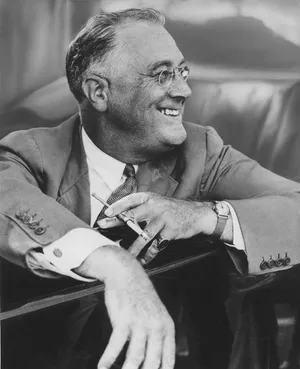
By inauguration day-March 4, 1933-most banks had shut down, industrial production had fallen to just 56 percent of its 1929 level, at least 13 million wage earners were unemployed, and farmers were in desperate straits. Franklin Delano Roosevelt (FDR) promised America a "New Deal." FDR's fireside chats and charisma reduced the influence of people like Father Coughlin, who ranted against Jews to an audience of millions of people. Even though he couldn't walk because of polio, Roosevelt was always depicted in public as a man of action. Roosevelt was rich but sided with the common man. Roosevelt was willing to experiment when dealing with the Depression. He said, "It is common sense to take a method and try it. If it fails, admit it frankly and try another. But above all, try something."
In his first inaugural address, when there were bread lines and soup kitchens, Roosevelt assured people that:
This great Nation will endure as it has endured, will revive and will prosper. So, first of all, let me assert my firm belief that the only thing we have to fear is fear itself-nameless, unreasoning, unjustified terror which paralyzes needed efforts to convert retreat into advance.
In December 1933, the Twenty-First Amendment ended Prohibition.
During the Great Depression, people wanted to be paid to work, so the New Deal paid people to do whatever they knew how to do. Some taught tap dancing. Others planted trees, or interviewed the last living former American slaves. Republicans called such New Deal efforts leaf raking operations or boondoggles, but to many they were a way to survive hard times. The Federal Theater Project, Federal Writers Project and Federal Arts Project funded the arts. Other New Deal programs were designed to prevent another Great Depression from happening again, such as FDIC, FSLIC and the SEC. Now, insider trading is illegal. Social Security was created to provide financial security for older Americans. The rich saw Roosevelt as a traitor to his class. In a speech he gave at Madison Square Garden in 1936, Roosevelt said, "They are unanimous in their hate for me-and I welcome their hatred."
A member of the Federal Theater Project was accused of being a communist. "You are quoting from this Marlowe. Is he a Communist?" That question was put by Joe Starnes, a congressman from Alabama, to Hallie Flanagan, director of the Federal Theater Project, at a hearing in 1938. At issue was un-American activity in organizations like Flanagan's, a New Deal program. "This Marlowe" was Christopher, the Elizabethan poet and playwright, who had died in 1593.
The National Recovery Administration (NRA) was created in 1933 by the National Industrial Recovery Act (NIRA) and allowed industries to get together and write "codes of fair competition." The codes were intended to help workers set minimum wages and maximum weekly hours, as well as minimum prices at which products could be sold. The NRA also had a two-year charter renewal and was set to expire in June 1935 unless it was renewed. In 1935, the US Supreme Court unanimously declared that the NRA law was unconstitutional, ruling that it infringed on the separation of powers under the United States Constitution. The NRA quickly stopped operations, but many of its labor provisions reappeared in the National Labor Relations Act (Wagner Act), passed later the same year. The long-term result was a surge in the growth and power of unions.
The Securities Act of 1933 requires every offer or sale of securities that uses the means and instrumentalities of interstate commerce to be registered with the SEC pursuant to the 1933 Act, unless an exemption from registration exists under the law. The 1933 Act requires issuers to fully disclose all material information that a reasonable shareholder would need in order to make up his or her mind about the potential investment.
The 1933 Federal Emergency Relief Administration (FERA) built on the Hoover administration's Emergency Relief and Construction Act. It was replaced in 1935 by the Works Progress Administration (WPA). FERA's main goal was to alleviate household unemployment by creating new unskilled jobs in local and state government. Jobs were more expensive than direct cash payments (called "the dole"), but were psychologically more beneficial to the unemployed, who wanted any sort of job for self-esteem.
The Civil Works Administration (CWA) created manual labor jobs during the winter of 1933-1934. The CWA was a project created under the Federal Emergency Relief Administration (FERA). The CWA created construction jobs, mainly improving or constructing buildings and bridges.
The Banking Act of 1933 established the FDIC to insure bank accounts. The FDIC was created to prevent the runs on banks that deepened the Great Depression.
The Tennessee Valley Authority (TVA) was created by Congress in 1933 as part of President Franklin D. Roosevelt's New Deal. Its initial purpose was to provide navigation, flood control, electricity generation, fertilizer manufacturing, regional planning, and economic development to the Tennessee Valley, a region that had suffered from lack of infrastructure and even more extensive poverty during the Great Depression than other regions of the nation. TVA was envisioned both as a power supplier and a regional economic development agency that would work to help modernize the region's economy and society. It later evolved primarily into an electric utility.
Because of agricultural overproduction there was widespread rural poverty. To reduce overproduction the Agricultural Adjustment Act (AAA) of 1933 was created to boost agricultural prices by reducing surpluses. The government bought livestock for slaughter and paid farmers subsidies not to plant on part of their land. The money for these subsidies was generated through an exclusive tax on companies that processed farm products. The Act created a new agency, the Agricultural Adjustment Administration, also called "AAA" (1933–1942), an agency of the US Department of Agriculture, to oversee the distribution of the subsidies. The Rural Electrification Act of 1936 (REA) provided federal loans for the installation of electrical distribution systems to serve isolated rural areas of the United States.
|
| FDR |
The Civilian Conservation Corps (CCC) was a voluntary government work relief program that ran from 1933 to 1942 in the United States for unemployed, unmarried men ages 18–25 and eventually expanded to ages 17–28. The CCC supplied manual labor jobs related to the conservation and development of natural resources in rural lands owned by federal, state, and local governments.
The National Housing Act of 1934 was passed in order to make housing and home mortgages more affordable. It created the Federal Housing Administration (FHA) and the Federal Savings and Loan Insurance Corporation (FSLIC). The Act was designed to stop the tide of bank foreclosures on family homes during the Great Depression. With this, Roosevelt used this act to fulfill his goal of a government program funded by private investments, avoiding the reliance on taxpayer funds. The passing of the bill alleviated unemployment by making credit more accessible through banks and lending organizations. Both the FHA and the FSLIC became the main federal agencies that worked to create the backbone of the mortgage and home-building industries until the 1980s. The FHA's guarantee against losses for mortgage lenders allowed for a system of regular monthly mortgage payments. All federal savings and loan associations were required to apply for insurance through the FSLIC; other building and loan associations whose capital was not impaired were also allowed to apply. The FSLIC was administered by the Federal Home Loan Bank Board (FHLBB).
During the 1980s the FSLIC became insolvent. The Financial Institutions Reform, Recovery, and Enforcement Act of 1989 (FIRREA) abolished the FSLIC, and it transferred the responsibility for savings and loan deposit insurance to the Federal Deposit Insurance Corporation (FDIC). The FSLIC Resolution Fund (FRF) was created to assume all the assets and liabilities of the FSLIC, which was to be funded by the Financing Corporation (FICO). As of 2020 the FDIC continued to administer the FRF, which has paid off the FICO debt but still collects money due from court judgments and terminated receiverships.
The Federal Housing Administration (FHA) is to provide insurance for mortgages originated by private lenders for various types of properties, including single-family homes, multifamily rental properties, hospitals, and residential care facilities. FHA mortgage insurance serves to safeguard these private lenders from financial losses. If a property owner defaults on their mortgage, FHA steps in to compensate the lender for the outstanding principal balance.
The Securities Exchange Act of 1934 is a law governing the secondary trading of securities (stocks, bonds, and debentures) in the United States of America. This is in contrast with the Securities Act of 1933, which does not regulate secondary trading of securities. The 1934 Act also established the Securities and Exchange Commission (SEC), the agency primarily responsible for the enforcement of United States federal securities law.
The Revenue Act of 1935 raised federal income tax on higher income levels by introducing the "Wealth Tax." It was a progressive tax that took up to 75 percent of the highest incomes (over $1 million per year). The Congress separately also passed new taxes that were regressive, especially the Social Security tax.
The Relief Appropriation Act of 1935 was a large public works program that included the Works Progress Administration (WPA), the National Youth Administration, the Resettlement Administration, the Rural Electrification Administration, and other assistance programs. These programs were called the "second New Deal." The programs gave Americans work for which the government would pay them. The goal was to help unemployment, pull the country out of the Great Depression, and prevent another depression in the future.
The Works Progress Administration (WPA; from 1935 to 1939, then known as the Work Projects Administration from 1939 to 1943) was an American New Deal agency that employed millions of jobseekers (mostly men who were not formally educated) to carry out public works projects, including the construction of public buildings and roads.
The Public Utility Holding Company Act of 1935 (PUHCA), also known as the Wheeler-Rayburn Act, was a US federal law giving the Securities and Exchange Commission authority to regulate, license, and break up electric utility holding companies. It limited holding company operations to a single state, thus subjecting them to effective state regulation. It also broke up any holding companies with more than two tiers, forcing divestitures so that each became a single integrated system serving a limited geographic area. Another purpose of the PUHCA was to keep utility holding companies engaged in regulated businesses from also engaging in unregulated businesses.
On May 27, 1935 the US Supreme Court issued its unanimous Humphrey's Executor v. United States decision. President Hoover appointed, and the Senate confirmed, Humphrey as a commissioner of the Federal Trade Commission (FTC). In 1933, President Roosevelt asked for Humphrey's resignation since the latter was a conservative and had jurisdiction over many of Roosevelt's New Deal policies. When Humphrey refused to resign, Roosevelt fired him because of his policy positions. However, the FTC Act only allowed a president to remove a commissioner for "inefficiency, neglect of duty, or malfeasance in office."The Court ruled in Humphrey's favor. Since Humphrey died shortly after being dismissed, his executor sued to recover Humphrey's lost salary. Humphrey's Executor established the precedent that the president can't fire executive branch employees without cause. However, in 2026 the US Supreme Court overturned Humphrey's Executor, allowing the president to fire federal employees without cause.
The Social Security Administration was established by the Social Security Act of 1935. It includes retirement, disability and survivor benefits. Employers and employees each currently pay 6.2 percent of wages up to the taxable maximum of $176,100 (in 2025), while the self-employed pay 12.4 percent.
The National Labor Relations Act of 1935, also known as the Wagner Act, is a foundational statute of United States labor law that guarantees the right of private sector employees to organize into trade unions, engage in collective bargaining, and take collective action such as strikes. Central to the act was a ban on company unions.
In 1936 the British economist John Maynard Keynes published The General Theory of Employment, Interest and Money, which seemed to justify Roosevelt's New Deal policies. The General Theory, as it has come to be called, suggested that a reduction in wage rates would not reduce unemployment; instead, the key to reducing unemployment was to increase government spending and to run a budget deficit. It popularized the idea that the government could "prime the pump" through spending to revive a stalled economy during a depression.
The Farm Security Administration (FSA) was a New Deal agency created in 1937 to combat rural poverty during the Great Depression in the United States. The FSA stressed "rural rehabilitation" efforts to improve the lifestyle of very poor landowning farmers, and a program to purchase submarginal land owned by poor farmers and resettle them in group farms on land more suitable for efficient farming. Reactionary critics, including the Farm Bureau, strongly opposed the FSA as an alleged experiment in collectivizing agriculture-that is, in bringing farmers together to work on large government-owned farms using modern techniques under the supervision of experts. After the Conservative coalition took control of Congress, it transformed the FSA into a program to help poor farmers buy land, and that program continues to operate in the 21st century as the Farmers Home Administration.
The Fair Labor Standards Act of 1938 is a United States labor law. It applies to employees engaged in interstate commerce or employed by an enterprise engaged in commerce or in the production of goods for commerce, unless the employer can claim an exemption from coverage. Against a history of judicial opposition, the depression-born FLSA had survived, not unscathed, more than a year of Congressional altercation. In its final form, the act applied to industries whose combined employment represented only about one-fifth of the labor force. In these industries, it banned "oppressive child labor" and set the minimum hourly wage at 25 cents, and the maximum workweek at 44 hours. Time-and-a-half or overtime pay is required when people work over forty hours a week. With changes, the Act currently applies to employers whose annual sales total $500,000 or more or are engaged in interstate commerce. Originally, the FLSA prohibited child labor; it has since been expanded to prohibit wage discrimination because of gender and age, and requires overtime pay for work over 40 hours per week.
A historian for the US Department of Labor tells a story that was repeated often back in the early 1930s before the passage of federal New Deal labor protections:
While President Franklin Roosevelt was in Bedford, Mass., campaigning for reelection, a young girl tried to pass him an envelope. But a policeman threw her back into the crowd. Roosevelt told an aide, "Get the note from the girl."
Her note read, "I wish you could do something to help us girls....We have been working in a sewing factory,... and up to a few months ago we were getting our minimum pay of $11 a week... Today the 200 of us girls have been cut down to $4 and $5 and $6 a week."
To a reporter's question, the President replied, "Something has to be done about the elimination of child labor and long hours and starvation wages [for women]."
The battle over working conditions and pay was particularly bitter in the South. As one Indiana congressman said during a 1937 debate on legislation to establish a minimum wage:
There are in the State of Georgia, canning factories working ... women 10 hours a day for $4.50 a week. Can the canning factories of Indiana, Connecticut, and New York continue to exist and meet such competitive labor costs?
The result - after considerable public pressure by FDR and Perkins - was the 1938 Fair Labor Standards Act (FLSA), which established the minimum wage, created boundaries on the ability of employers to exploit workers, and outlawed child labor
The Federal Crop Insurance Corporation (FCIC) was created in 1938. Initially, it was an experimental initiative, covering only major crops in key producing areas. The program remained limited until the Federal Crop Insurance Act of 1980, which expanded coverage to more crops and regions.
Many New Deal programs ended with the Great Depression. However, surviving programs include the Social Security Administration, FDIC, FSLIC, the Tennessee Valley Authority (TVA), the Federal Crop Insurance Corporation (FCIC), the Federal Housing Administration (FHA) and the Securities Exchange Commission (SEC).
In 1935 the A. L. A. Schechter Poultry Corp. v. United States US Supreme Court decision declared that parts of the National Industrial Recovery Act (NIRA) were unconstitutional. The Act included laws that would set maximum work hours and minimum pay for poultry workers and required that poultry and eggs be inspected. The press called it the "sick chicken" decision, in that it required the sale of uninspected chickens and eggs, including sick ones.
Roosevelt threatened to pack the Supreme Court in retaliation for Schechter. Roosevelt's court-packing scheme was unpopular, but effective. In its West Coast Hotel Co. v. Parrish decision the Court allowed a minimum wage law.
Unemployment fell from 25 percent in 1933 to 14 percent in 1937. Roosevelt thought that such a rapid drop in unemployment meant it was time to balance the budget. So he cut spending, and the Federal Reserve doubled reserve requirements for banks, tightening credit, and unemployment rose to 19 percent.
Before the Great Depression most blacks voted for Republicans, but during the Depression blacks saw that they were better off because of the New Deal, and voted for Democrats for the first time. Roosevelt was backed by a coalition of minorities and racist but otherwise progressive Southern whites. He felt that he wouldn't get enough votes for his New Deal without the South. The New Deal wasn't perfect for black Americans. Southern politicians tried with occasional success to exclude mostly black occupations from some New Deal benefits. Also, a New Deal attempt to help the housing industry included redlining, which excluded blacks from better neighborhoods. And New Deal attempts to curb overproduction to help farmers harmed black sharecroppers. Roosevelt opposed lynching, but felt that supporting an anti-lynching bill would break apart his coalition and threaten his New Deal policies. Still, most blacks benefitted from the New Deal, and supported Roosevelt.
Mexican migrants became scapegoats for the nation's economic struggles. Throughout the Southwest and Midwest, officials apprehended people of Mexican descent indiscriminately, including legal residents and US citizens, and forced them onto trucks, buses or trains bound for Mexico. As many as two million people were expelled; approximately 60 percent are believed to have been citizens.
The Good Neighbor Policy was implemented in 1933 by Roosevelt to establish friendly relations and mutual defense agreements with the nations of Latin America. To maintain peace and economic stability in the Western Hemisphere, Roosevelt's policy stressed cooperation, non-intervention, and trade instead of military force. The Good Neighbor Policy terminated the US Marines occupation of Haiti in 1934, led to the annulment of the Platt Amendment by the Treaty of Relations with Cuba in 1934, and allowed for the negotiation of compensation for Mexico's nationalization of foreign-owned oil assets to take place in 1938. Roosevelt's policies of military non-intervention in Latin America would be reversed by Presidents Harry Truman and Dwight D. Eisenhower after World War II.
The convict leasing system, otherwise known as slavery by another name, was abolished by President Franklin D. Roosevelt via Francis Biddle's "Circular No. 3591" of December 12, 1941.
Huey Pierce Long Jr. (August 30, 1893 – September 10, 1935), nicknamed "The Kingfish", was an American politician who served as the 40th governor of Louisiana from 1928 to 1932 and as a United States senator from 1932 until his assassination in 1935. He was a left-wing populist member of the Democratic Party and rose to national prominence during the Great Depression for his vocal criticism of President Franklin D. Roosevelt and his New Deal, which Long deemed insufficiently radical. As the political leader of Louisiana, he commanded wide networks of supporters and often took forceful action. A controversial figure, Long is celebrated as a populist champion of the poor or, conversely, denounced as a fascistic demagogue. As hardship from the Depression grew, Long advocated redistributing wealth from the rich to the poor in his Every Man a King and Share Our Wealth speeches. Once in office, he expanded social programs, organized massive public works projects, such as a modern highway system and the tallest capitol building in the nation, and proposed a cotton holiday. Once in office on May 21, 1928, Long moved quickly to consolidate power, firing hundreds of opponents in the state bureaucracy at all ranks from cabinet-level heads of departments to state road workers. Like previous governors, he filled the vacancies with patronage appointments from his network of political supporters. Every state employee who depended on Long for a job was expected to pay a portion of their salary at election time directly into his campaign fund. He was impeached in 1929 for abuses of power, but the proceedings collapsed in the State Senate. His opponents argued his policies and methods were unconstitutional and authoritarian. Long was elected to the US Senate in 1930 but did not assume his seat until 1932. He established himself as an isolationist, arguing that Standard Oil and Wall Street orchestrated American foreign policy. He was instrumental in securing Franklin Roosevelt's 1932 presidential nomination, but split with him in 1933, becoming a prominent critic of his New Deal. As an alternative, he proposed the Share Our Wealth plan in 1934. To stimulate the economy, he advocated massive federal spending, a wealth tax, and wealth redistribution. These proposals drew widespread support, with millions joining local Share Our Wealth clubs. Poised for a 1936 presidential bid, Long was assassinated by Carl Weiss inside the Louisiana State Capitol in 1935. His assassin was immediately shot and killed by Long's bodyguards. Although Long's movement faded, Roosevelt adopted many of his proposals in the Second New Deal.