- RACIAL VIOLENCE
- STANDARD OIL COMPANY MONOPOLY
- THE PROGRESSIVE ERA
- MUCKRAKERS
- THE BLUES
- THEODORE (TEDDY) ROOSEVELT (1901 - 1909)
- MOTHER JONES AND CHILD LABOR
- RULES FOR WOMEN TEACHERS
- WILLIAM TAFT (1909 - 1913)
- TAYLORISM
- WOODROW WILSON (1913 - 1921)
- WORLD WAR I
- WILSON'S MILITARY INTERVENTIONS IN LATIN AMERICA
- WOMEN'S SUFFRAGE
- PROHIBITION
- THE DAWES AND YOUNG PLANS
- THE FIRST RED SCARE
Thousands of minorities were lynched both before and after the Civil War until the success of the Civil Rights Movement, and some lynchings occurred after that. While lynchings happened before the Civil War, they became more frequent during Reconstruction because blacks were no longer viewed as valuable property. Some were burned alive, others were hanged or shot. The victims included many blacks and also Jews, Native Americans, Chinese immigrants and other minorities. Some whites were lynched for opposing white supremacy. Some lynch mobs took photos of themselves because they were certain that they would get away with lynchings. There were also multiple race massacres. The violence was rationalized by eugenics and various racist canards. Segregation and denial of voting rights existed in the South, and segregated schools existed in the Northern state of Kansas until 1954. Misgenation was illegal in many states before the US Supreme Court's Loving decision. Segregation laws were also called Jim Crow laws, perhaps after the slave song Jump Jim Crow.
Young Abraham Lincoln, in his Lyceum Address on January 27, 1838, said as follows about lynchings before the Civil War:

negroes, suspected of conspiring to raise an insurrection, were caught up and hanged in all parts of the State: then, white men, supposed to be leagued with the negroes; and finally, strangers, from neighboring States, going thither on business, were, in many instances subjected to the same fate. Thus went on this process of hanging, from gamblers to negroes, from negroes to white citizens, and from these to strangers; till, dead men were seen literally dangling from the boughs of trees upon every road side; and in numbers almost sufficient, to rival the native Spanish moss of the country, as a drapery of the forest.
Turn, then, to that horror-striking scene at St. Louis. A single victim was only sacrificed there. His story is very short; and is, perhaps, the most highly tragic, if anything of its length, that has ever been witnessed in real life. A mulatto man, by the name of McIntosh, was seized in the street, dragged to the suburbs of the city, chained to a tree, and actually burned to death; and all within a single hour from the time he had been a freeman, attending to his own business, and at peace with the world.

When Reconstruction collapsed with the withdrawal of Federal troops from the former Confederate states in 1877, the white supremacist wing of the Democratic Party dominated the South. Voting rights for black men in the former Confederate states were rescinded in courts and in state and local laws, and those rights were further restricted by poll taxes, literacy tests, intimidation, and fraud. The infamous "grandfather clause," which restricted voting rights to men who were allowed to vote, or whose male ancestors were allowed to vote, before 1867 was also a popular method of disenfranchising African American men — because they were not allowed to vote before the Fifteenth Amendment was ratified, the grandfather clause denied them their voting rights.
In 1883 the US Supreme Court's Civil Rights Cases decision held that private businesses could deny service to blacks. In 1896 the Court's Plessy v. Ferguson decision held that all segregation was legal as long as public facilities were "separate but equal." Public restaurants, drinking fountains, schools, bathrooms and other public places were separate but far from equal.
Even before the Civil War a racist pseudo-science was used to justify slavery. It described white men as being at the top and blacks as being at the bottom, with other races and white women described as being somewhere in between. What was different about eugenics is that it was based on improving the human race through selective breeding, sometimes combined with forced sterilization. Eugenicists believed that anyone, including some whites, could be inferior if they had physical or mental disabilities, were criminals or scored low on IQ tests. Racial minorities were also said to be inferior. Eugenics started in the United Kingdom and spread all over Europe, the US, Canada and Australia. Francis Galton first formulated the term eugenics in 1883, drawing on Evolution of the Species by his half-cousin Charles Darwin. Darwin strongly disagreed with this interpretation of his theory. Adolf Hitler praised eugenics in Mein Kampf in 1925 and emulated eugenic legislation for the sterilization of "defectives" that had been pioneered in the United States once he took power.
The nineteenth-century physician Horatio Robinson Storer, an early anti-abortion campaigner, lamented that "abortions are infinitely more frequent among Protestant women than among Catholic" and wondered whether America's western and southern territories would be "filled with our own children or by those of aliens?" The sociologist and eugenicist Edward Alsworth Ross argued that Japanese immigrants should be banned from entering the country and coined the term "race suicide."
In 1915 David Griffith released Birth of a Nation, a film that used advanced cinematic techniques to inspire a major rebirth of the Ku Klux Klan. It pioneered the use of close ups and fade outs. The film portrays its black characters (many of whom are played by white actors in blackface) as unintelligent and sexually aggressive toward white women. The Ku Klux Klan (KKK), a white supremacist hate group, is portrayed as a heroic force that protects white women and maintains white supremacy. In the film Gus, played by a white actor in black face, chased a white woman (Flora Cameron) to a cliff, which she jumped off of to her death to avoid Gus, who wanted to marry her. The Klan then lynched Gus for wanting to marry a white woman. When President Woodrow Wilson saw the film he said, "It is like writing history with lightning, and my only regret is that it is all so true."
In 1916 Madison Grant wrote The Passing of the Great Race, which Hitler later called his "Bible." The book inspired the 1921 Emergency Quota Act and the 1924 Immigration Restriction Act or Johnson-Reed Act. The 1924 Act completely banned immigration from Asia. The 1924 Act's quotas kept most Jews out during the Holocaust. It did not specify quotas by religion, but rather by national origin, using 1890 US census figures. Because most Jewish immigrants in the early twentieth century came from countries in Eastern and Southern Europe (especially the Russian empire), their "quota" was effectively the sum of all the national-origin allotments for those countries where Jews were a significant immigration group.
Grant's main concern was with the changing "stock" of American immigration of the early 20th century from Southern and Eastern Europe, as opposed to Western and Northern Europe). Grant promoted the idea of the "Nordic race" as the key social group responsible for human development. As an avid eugenicist, Grant further advocated the separation, quarantine, and eventual collapse of "undesirable" traits and "worthless race types" from the human gene pool and the promotion, spread, and eventual restoration of desirable traits and "worthwhile race types" conducive to Nordic society.
According to Grant:
A rigid system of selection through the elimination of those who are weak or unfit—in other words social failures—would solve the whole question in one hundred years, as well as enable us to get rid of the undesirables who crowd our jails, hospitals, and insane asylums. The individual himself can be nourished, educated and protected by the community during his lifetime, but the state through sterilization must see to it that his line stops with him, or else future generations will be cursed with an ever increasing load of misguided sentimentalism. This is a practical, merciful, and inevitable solution of the whole problem, and can be applied to an ever widening circle of social discards, beginning always with the criminal, the diseased, and the insane, and extending gradually to types which may be called weaklings rather than defectives, and perhaps ultimately to worthless race types.
The Rising Tide of Color: The Threat Against White World-Supremacy (1920), by Lothrop Stoddard, describes the collapse of white supremacy and colonialism because of the population growth among people of color, rising nationalism in colonized nations, and industrialization in China and Japan. To counter the perceived geopolitical threat, Stoddard advocated Nordicism, racial segregation, and restricting non-white immigration into white-majority countries, restricting immigration of non-members of the "Nordic race" to countries primarily containing members of the "Nordic race"; restricting Asian migration to Africa; and slowly giving independence to European colonies in Asia (including the Middle East). A noted eugenicist, Stoddard supported a separation of the "primary races" of the world and warned against miscegenation, the mixing of the races. Stoddard advocated a racial hierarchy which he believed needed to be preserved through anti-miscegenation laws. Stoddard wrote an essay about Italian Fascism, which he praised for its "realistic, pragmatic temper." "Men being thus unequal," he wrote approvingly, "democracy, in the ordinary sense of the word, is an unrealizable absurdity."
Stoddard was a member of the Ku Klux Klan, where his books were recommended reading. He was also a member of the American Eugenics Society. Stoddard argued that race and heredity were the guiding factors of history and civilization and that the elimination or absorption of the "white" race by "colored" races would result in the destruction of Western civilization. In The Revolt Against Civilization (1922), Stoddard put forward the idea that civilization places a growing burden on individuals, which leads to a growing underclass of individuals who cannot keep up and a "ground-swell of revolt." Stoddard advocated immigration restriction and birth control legislation to reduce the numbers of the underclass and promoted the reproduction of members of the middle and upper classes. Stoddard was one of several eugenicists who sat on the board of the American Birth Control League. While in Nazi Germany Stoddard, after observing several dysgenics trials at the court, said that the eugenics legislation was "being administered with strict regard for its provisions and that, if anything, judgments were almost too conservative" and that the law was "weeding out the worst strains in the Germanic stock in a scientific and truly humanitarian way."
In 1920, The Rising Tide of Color Against White World-Supremacy was positively reviewed and recommended by The New York Times: "Lothrop Stoddard evokes a new peril, that of an eventual submersion beneath vast waves of yellow men, brown men, black men and red men, whom the Nordics have hitherto dominated ... with Bolshevism menacing us on the one hand and race extinction through warfare on the other, many people are not unlikely to give [Stoddard's book] respectful consideration."
There were around a hundred race massacres.The Springfield race riot of 1908 consisted of events of mass racial violence committed against African Americans by a mob of about 5,000 white Americans and European immigrants in Springfield, Illinois, between August 14 and 16, 1908. Two black men had been arrested as suspects in a rape, and attempted rape and murder. The alleged victims were two young white women and the father of one of them. When a mob seeking to lynch the men discovered the sheriff had transferred them out of the city, the whites furiously spread out to attack black neighborhoods, murdered black citizens on the streets, and destroyed black businesses and homes. The state militia was called out to quell the rioting. At least 17 people died as a result of the riot: nine black residents, and eight white residents who were associated with the mob, six of whom were killed by crossfire or state militias and two who died by suicide. Personal and property damages, suffered overwhelmingly by black people, amounted to more than $150,000 (approximately $4 million in 2018), as dozens of black homes and businesses were destroyed, as well as three white-owned businesses.
The Chicago race riot of 1919 was a violent racial conflict between white Americans and black Americans that began on the South Side of Chicago, Illinois, on July 27 and ended on August 3, 1919. During the riot, 38 people died (23 black and 15 white). Over the week, injuries attributed to the episodic confrontations stood at 537, two-thirds black and one-third white; and between 1,000 and 2,000 residents, most of them black, lost their homes.
In a November 2, 1920 race massacre at Ocoee, Florida, between 30 and 35 blacks were killed when Mose Norman, a black farmer, tried to vote.
The largest race massacre was in Tulsa, Oklahoma. Tulsa used to be the Black Wall Street because so many blacks became wealthy. In 1921 city officials handed out guns to whites and told them to kill a n-word, which they did. During the course of eighteen terrible hours on May 31 and June 1, 1921, more than one thousand homes and businesses were destroyed, while credible estimates of deaths range from fifty to three hundred. By the time the violence ended, the city had been placed under martial law, thousands of Tulsans were being held under armed guard, and the state's second-largest African American community had been burned to the ground. One white man dropped a bomb from an airplane on a black neighborhood. The catalyst for the massacre was the false charge that a black man, Dick Rowland, had sexually assaulted a white woman in an elevator. Tulsa police deputized vigilantes, many of whom had military experience from the First World War. The Tulsa police department and local members of the National Guard, aided by white veterans of the American Legion, organized these white men into companies. Numbering from 10,000 to 25,000, this whipped-up militia shot and killed black residents, forced others into detention camps and ransacked the neighborhood before burning it. Scores of bodies were buried in a mass grave.
In 1898 black army private James Neely was shot to death for protesting when a Georgia soda fountain storekeeper refused to serve him. In the years between 1889 and 1903 an average of two blacks were lynched per week, hanged, burned, mutilated.
Mark Twain, in The United States of Lyncherdom, said, "The young woman was found murdered. Although it was a region of churches and schools the people rose, lynched three negroes—two of them very aged ones—burned out five negro households, and drove thirty negro families into the woods." He quoted the following description of a lynching in Texas:
The negro was taken to a tree and swung in the air. Wood and fodder were piled beneath his body and a hot fire was made. Then it was suggested that the man ought not to die too quickly, and he was let down to the ground while a party went to Dexter, about two miles distant, to procure coal oil. This was thrown on the flame and the work completed.
Leo Max Frank was one of several Jewish victims of lynching. He was wrongly convicted of the murder by strangulation of 13-year-old Mary Phagan, an employee in the National Pencil Factory in Atlanta, Georgia, where he was the superintendent. On April 26, 1913, at about noon, Mary Phagan, a 13-year-old employee of the National Pencil Company, went to the factory to collect her pay, which Frank gave to her. Soon after, she was sexually assaulted and brutally murdered. Newt Lee, a watchman, discovered her body in the factory’s basement about 3:30 am and reported it to police. Two notes, made to look as if she had written them, were found beside her body. On May 24, 1913, Frank was indicted on a charge of murder and the case opened at Fulton County Superior Court, on July 28. The investigation included the torture of witnesses. Press coverage surrounding the trial and subsequent appeals was sensationalized in a manner new to Atlanta by William Randolph Hearst, by a populist firebrand turned white supremacist, Tom Watson, and by others. The prosecution relied heavily on the testimony of Conley, a black man who described himself as an accomplice in the aftermath of the murder, and who the defense at the trial argued was, in fact, the murderer, as many historians and researchers now believe. Conley’s four affidavits—each new statement renouncing the last—developed the elaborate and, by all accounts, improbable story of his participation in a crime he attributed to Frank. Paradoxically, racism helped Conley, who held to his story over three days of cross-examination by some of Georgia’s best lawyers. Dismissing Conley's lies as a function of his race and believing that any black person would be incapable of remembering such a complex story unless it were true, the jury found Frank guilty on August 25. Governor John M. Slaton commuted Frank's sentence from death to life imprisonment. When the news broke the next morning, a mob sought Slaton at his home, prompting him to declare martial law. Later a fellow inmate cut Frank's throat with a butcher's knife; two other inmates who happened to be doctors rushed Frank to the prison hospital and participated in the surgery that narrowly saved his life. On August 16, 1915, he was kidnapped from prison by a group of armed men, and lynched at Marietta, Mary Phagan's hometown, the next morning. Amid international condemnation, many Georgians celebrated. Stores sold postcards and artifacts of the lynching. The perpetrators enjoyed impunity, their names kept secret throughout their lives. In contrast to the abrupt end of Slaton’s ascendant career, prosecutor Hugh Dorsey won the next two gubernatorial elections, and Watson was later elected to the US Senate. A group calling itself "The Knights of Mary Phagan" resurrected the KKK in 1915.
In 1918 Mary Turner was lynched for complaining about the lynching of her husband. A Georgia mob bound her feet, hung her upside down, and doused her with gasoline before setting her on fire. She was still alive and eight months pregnant when the mob took a butcher's knife, cut the baby from her body and crushed the baby's head, killing it. Mary's body was then riddled with bullets, killing her.
In 1931 nine black teenagers (the Scottsboro Boys) were accused of raping two white women. The women were ladies of the evening who later admitted to lying to keep themselves out of trouble. After multiple trials four of the nine were acquitted, four were sentenced to prison, one of whom was shot by a prison guard and disabled, and one was sentenced to death, jumped bail and later pardoned.
In 1955 Emmett Till was accused of flirting with store clerk Carolyn Bryant. A professor said that Carolyn admitted to lying about the incident, which she denied. Till was beaten, mutilated, shot in the head and then thrown into the Tallahatchie River. Three days after his abduction and murder, Till's swollen and disfigured body was found by two boys who were fishing in the Tallahatchie River. His head was very badly mutilated: he had been shot above the right ear, an eye was dislodged from the socket, there was evidence that he had been beaten on the back and the hips and his body weighted by a fan blade fastened around his neck with barbed wire. His face was unrecognizable due to trauma and having been submerged in water. An all-white, all-male jury (both women and blacks had been banned) acquitted both Milam and Bryant after a 67-minute deliberation; one juror said, "If we hadn't stopped to drink pop, it wouldn't have taken that long."
Some of the victims were whites who opposed white supremacy. These include John W. Stephens (1870), Andrew Goodman and Michael Schwerner (1964), James Reeb and Viola Liuzzo (1965) and Heather Heyer (2017). However, the vast majority of the victims were minorities.
While many victims were accused without evidence or due process of murder or rape, many others were lynched for small reasons. According to Ida B. Wells, many of the victims were lynched for reasons like "'mistaken identity,' 'insult,' 'bad reputation,' 'unpopularity,' 'violating contract,' 'running quarantine,' 'giving evidence,' 'frightening child by shooting at rabbits,' etc." In 1900 such small reasons accounted for more than half of the lynchings. In the 21st century hate crimes account for only about 5 to 20 murders per year among thousands of lesser hate crimes.
Other racial problems were redlining to keep blacks from buying homes in desirable neighborhoods, restrictive covenants to keep Jews out of such neighborhoods, and Jew quotas used by even Ivy League universities. Antisemitism existed in Europe, Russia and the US for centuries. There were pogroms in Europe and lynchings in the US. Jews fled pogroms in Russia only to find persecution in America. Hitler borrowed and amplified antisemitism, leading to the Holocaust.
The Tuskegee Study of Untreated Syphilis in the Negro Male was a study conducted between 1932 and 1972 by the United States Public Health Service (PHS) and the Centers for Disease Control and Prevention (CDC) on a group of nearly 400 African American men with syphilis. The purpose of the study was to observe the effects of the disease when untreated, despite the fact that, by 1947, penicillin was widely available and had become the standard treatment for syphilis. The men were not informed of the nature of the experiment, and more than 100 died as a result. The men were promised free medical care. While the men were provided with both medical and mental care that they otherwise would not have received, they were deceived by the PHS, who never informed them of their syphilis diagnosis and provided disguised placebos, ineffective methods, and diagnostic procedures as treatment for "bad blood." The study continued until 1972, when a leak to the press resulted in its termination on November 16 of that year. By then, 28 patients had died directly from syphilis, 100 died from complications related to syphilis, 40 of the patients' wives were infected with syphilis, and 19 children were born with congenital syphilis. In 1997, President Clinton issued a formal Presidential Apology.
The Great Migration was the movement of six million African Americans out of the rural Southern United States to the urban Northeast, Midwest, and West between 1910 and 1970. It was caused by poor economic and social conditions due to racial segregation and discrimination in the Southern states where Jim Crow laws were upheld. Lynchings motivated some of the migrants. When the Great Migration began, 90 percent of blacks lived in the South. At the end of it, half of them lived in the North.
Towns in many states, including states outside the South, had signs telling blacks to be out of town by sundown. According to author Kate Kelly, "there were at least 10,000 'sundown towns' in the United States as late as the 1960s." These sundown town rules were enforced through violence. The earliest law requiring blacks and Indians to be at home at night was An Act to Prevent Disorders in the Night passed by New Hampshire in 1714. Sundown towns and counties persisted until after the success of the Civil Rights Movement. Two examples of the road signs documented during the first half of the 20th century include:
In Colorado: "No Mexicans After Night"
In Connecticut: "Whites Only Within City Limits After Dark"
|
| Strange Fruit |
In some cities not only industrial jobs but even moving services were reserved for whites. A 1960 ad from Grenada, Mississippi read,
ALL WHITE HELP! BILL & REX MOVING SERVICE
"Strange Fruit," made famous by Billie Holiday, is a protest song against the lynching of African Americans. In 1937, the song was written by Abel Meeropol, a Jewish schoolteacher from the Bronx, under the pseudonym Lewis Allan. It was inspired by a photograph of the 1930 lynching of two black teenagers, Thomas Shipp and Abram Smith, in Marion, Indiana. The song was first recorded by Billie Holiday in 1939. Holiday's performance is credited with raising awareness about the horrors of lynching in America. The lyrics are as follows:
Southern trees bear a strange fruit
Blood on the leaves and blood at the root
Black bodies swinging in the Southern breeze
Strange fruit hanging from the poplar trees
Pastoral scene of the gallant south
The bulging eyes and the twisted mouth
Scent of magnolias, sweet and fresh
Then the sudden smell of burning flesh
Here is a fruit for the crows to pluck
For the rain to gather, for the wind to suck
For the sun to rot, for the tree to drop
Here is a strange and bitter crop
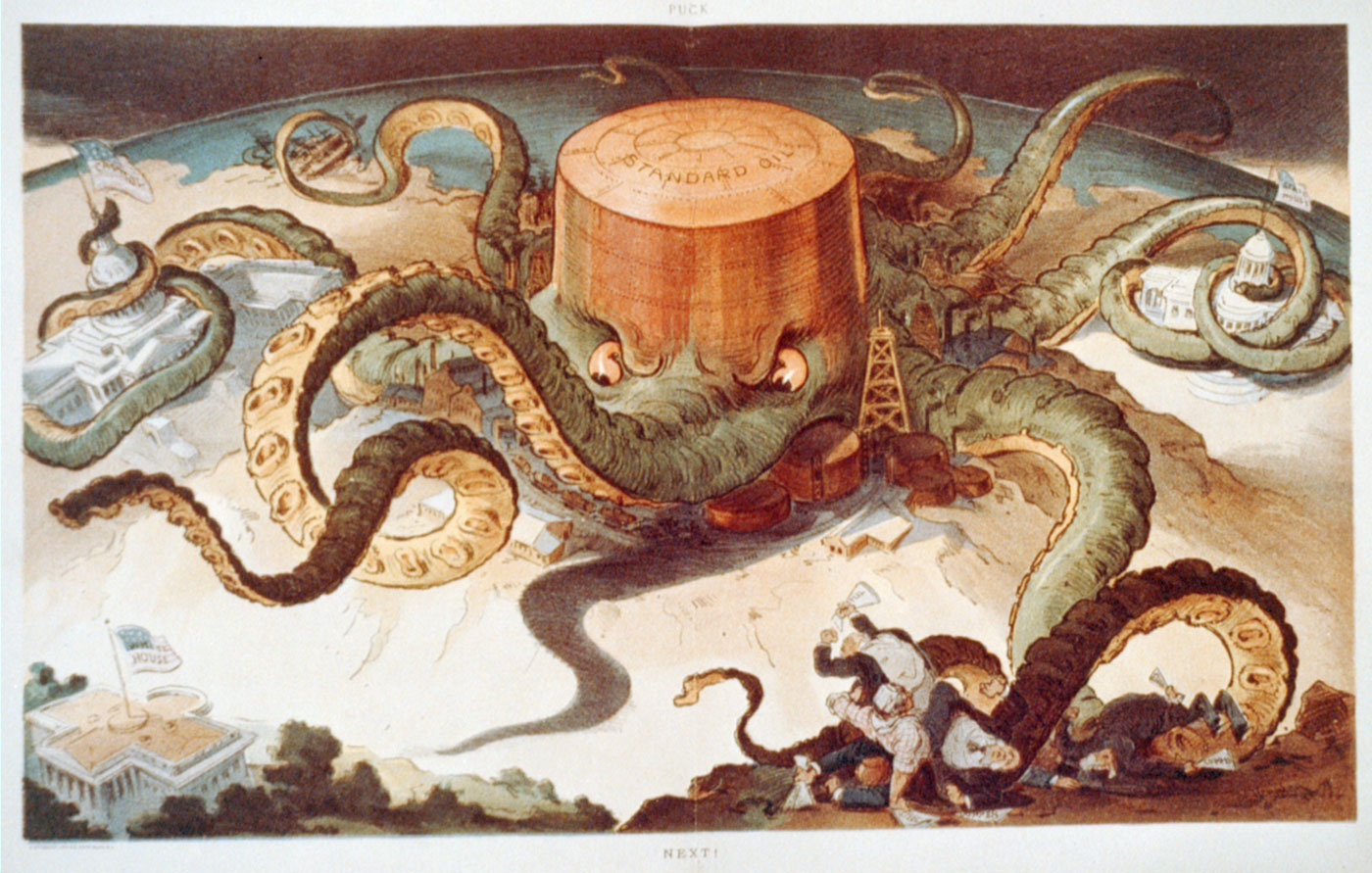
At the beginning of the 20th century Standard Oil Co. was one of the world's largest and most powerful corporations and its chairman, John D. Rockefeller, was the first billionaire. While people were divided about whether monopolies were good for society, exposés by the muckraker Ida Tarbell detailing the company's strong-arm practices against rivals, railroad companies and others eventually turned public opinion against it. In the 1870s Standard Oil went from controlling four percent of the market to controlling more than 90 percent of the market. It threatened suppliers and distributors who did business with its competitors and lowered the price in a region to put a competitor out of business before raising prices again. The United States Supreme Court endorsed the rule of reason enunciated by William Howard Taft in Addyston Pipe and Steel Company v. United States (1899), written when Taft had been Chief Judge of the United States Court of Appeals for the Sixth Circuit. The Court concluded, however, that the behavior of the Standard Oil Company went beyond the limitations of this rule. In 1911 the Court ruled that Standard Oil Trust be dissolved under the Sherman Antitrust Act and split into 34 companies.

|
| McClure's Magazine 1903 |
The Progressive Era (1890s–1920s) was a period in the United States characterized by multiple social and political reform efforts. Reformers during this era, known as Progressives, sought to address issues they associated with rapid industrialization, urbanization, immigration, and political corruption, as well as the concentration of industrial ownership in monopolies. Reformers expressed concern about slums, poverty, and labor conditions. Multiple overlapping movements pursued social, political, and economic reforms by advocating changes in governance, scientific methods, and professionalism; regulating business; protecting the natural environment; and seeking to improve urban living and working conditions.
Corrupt and undemocratic political machines and their bosses were a major target of progressive reformers. To revitalize democracy, progressives established direct primary elections, direct election of senators (rather than by state legislatures), initiatives and referendums, and women's suffrage which was promoted to advance democracy and bring the presumed moral influence of women into politics. For many progressives, prohibition of alcoholic beverages was key to eliminating corruption in politics as well as improving social conditions.
Another target were monopolies, which progressives worked to regulate through trustbusting and antitrust laws with the goal of promoting fair competition. Progressives also advocated new government agencies focused on regulation of industry.
The muckrakers were reform-minded journalists, writers, and photographers in the Progressive Era in the United States (1890s–1920s) who claimed to expose corruption and wrongdoing in established institutions. The muckrakers played a highly visible role during the Progressive Era. Muckraking magazines-notably McClure's of the publisher S. S. McClure-took on corporate monopolies and political machines, while trying to raise public awareness and anger at urban poverty, unsafe working conditions, prostitution, and child labor.
|
| Standard Oil Octopus |
Ida B. Wells, who first became a journalist in Memphis, Tennessee, fought against lynching in the South by exposing the brutal horrors of the practice in Southern Horrors: Lynch Law in All Its Phases in 1892, and a year or two later in A Red Record, which included statistical analysis of lynchings since Reconstruction. These landmark studies pushed the boundaries of long-form on-the-ground reporting.
Ida B. Wells' reports showed that lynchings were used primarily to terrorize black communities, not to punish criminal behavior as defenders of the practice claimed. Wells gave speeches throughout the United States and abroad on her work and held prominent roles in various civil rights organizations, including as cofounder of the NAACP (National Association for the Advancement of Colored People). Wells newspaper office was burned to the ground, and she was forced to move to Chicago after her own life became imperiled. In 1892 she published The Free Speech, which condemned the flaws in the United States justice system that allowed lynching to happen.
Jacob Riis photographed immigrant children who lived among the garbage dumps underneath the wharves in New York City. Riis' book How the Other Half Lives inspired many reforms for working-class Americans. In New York City, laws were passed that set codes for tenement house construction and fire safety regulations.
Ida Tarbell wrote about the monopolistic practices of John D. Rockefeller's Standard Oil Company, which destroyed small businesses, including her father's. In 1911, two years after Ida Tarbell's work debuted, the Supreme Court ruled to break up Standard Oil's monopoly, ruling the company had violated the Sherman Antitrust Act. The public reaction and the court case led Congress to pass several additional pieces of legislation, including the Hepburn Act in 1906, to oversee the railroads; the Mann-Elkins Act of 1910, which gave the Interstate Commerce Commission power over oil rates; and the formation of the Federal Trade Commission in 1914. She wrote The History of the Standard Oil Company.
Upton Sinclair became a socialist in 1903, and a year later set out to expose the mistreatment of workers in the meatpacking industry. The project would become the book The Jungle, one of the first works of fiction to lead directly to national legislation. The Federal Meat Inspection Act and the Pure Food and Drug Act of 1906 established the agency that eventually became the Food and Drug Administration in 1930. The book raised fundamental questions about the abuses of mechanized production. The Jungle describes the job of a pickler in a meat packing factory as follows:
It seemed that he [Antanas Rudkus] was working in the room where the men prepared the beef for canning, and the beef had lain in vats full of chemicals, and men with great forks speared it out and dumped it into trucks, to be taken to the cooking room. When they had speared out all they could reach, they emptied the vat on the floor, and then with shovels scraped up the balance and dumped it into the truck. This floor was filthy, yet they set Antanas with his mop slopping the "pickle" into a hole that connected with a sink, where it was caught and used over again forever; and if that were not enough, there was a trap in the pipe, where all the scraps of meat and odds and ends of refuse were caught, and every few days it was the old man's task to clean these out, and shovel their contents into one of the trucks with the rest of the meat!
Ray Stannard Baker published The Right to Work in McClure's Magazine in 1903, about coal mine conditions, a coal strike, and the situation of non-striking workers (or scabs). Many of the non-striking workers had no special training or knowledge in mining, since they were simply farmers looking for work. His investigative work portrayed the dangerous conditions in which these people worked in the mines, and the dangers they faced from union members who did not want them to work.
Lincoln Steffens published The Shame of the Cities (1904), which uncovered the corruption of several political machines in major cities. He published "Tweed Days in St. Louis," in which he profiled corrupt leaders in St. Louis, in October 1902, in McClure's Magazine. The prominence of the article helped lawyer Joseph Folk to lead an investigation of the corrupt political ring in St. Louis.
The Treason of the Senate: Aldrich, the Head of it All, by David Graham Phillips, published as a series of articles in Cosmopolitan magazine in February 1906, described corruption in the US Senate. This work was a keystone in the creation of the Seventeenth Amendment which established the election of Senators through popular vote.
The Great American Fraud (1905) by Samuel Hopkins Adams revealed fraudulent claims and endorsements of patent medicines in America. This article shed light on the many false claims that pharmaceutical companies and other manufacturers would make as to the potency of their medicines, drugs and tonics. This exposure contributed heavily to the creation of the Pure Food and Drug Act alongside Upton Sinclair's work. Using the example of Peruna in his article, Adams described how this tonic, which was made of seven compound drugs and alcohol, did not have "any great potency." Manufacturers sold it at an obscene price and hence made immense profits. His work forced a crackdown on a number of other patents and fraudulent schemes of medicinal companies.
Other muckrakers include:
- Paul Y. Anderson (August 29, 1893 – December 6, 1938) is best known for his reporting of a race riot and the Teapot Dome scandal.
- Louis D. Brandeis (1856–1941) – published his combined findings of the monopolies of big banks and big business in his 1914 book Other People's Money And How the Bankers Use It. Subsequently appointed to the Supreme Court (1916).
- Marion Hamilton Carter (1865-1937) - Pellagra and The Vampire of the South 1909 McClure's.
- Burton J. Hendrick (1870–1949) – The Story of Life Insurance May – November 1906 McClure's.
- Frances Kellor (1873–1952) – studied chronic unemployment in her book Out of Work (1904).
- Thomas William Lawson (1857–1924) Frenzied Finance (1906) on Amalgamated Copper stock scandal.
- Edwin Markham (1852–1940) – published an exposé of child labor in Children in Bondage (1914).
- Jessica Mitford (1917-1996) exposé, The American Way of Death (1998) (abusive American funeral industry practices)
- Gustavus Myers (1872–1942) – documented corruption in his first book The History of Tammany Hall (1901) unpublished, Revised edition, Boni and Liveright, 1917. His second book (in three volumes) related a History of the Great American Fortunes Chicago: Charles H. Kerr & Co., 1909–10; Single volume Modern Library edition, New York, 1936. Other works include History of The Supreme Court of the United States Chicago: Charles H. Kerr & Co., 1912. A History of Canadian Wealth Chicago: Charles H. Kerr & Co., 1914. History of Bigotry in the United States New York: Random House, 1943 Published posthumously.
- Frank Norris (1870–1902) The Octopus.
- Fremont Older (1856–1935) – wrote on San Francisco corruption and on the case of Tom Mooney.
- Drew Pearson (1897–1969) – wrote syndicated newspaper column Washington Merry-Go-Round.
- Charles Edward Russell (1860–1941) – investigated Beef Trust, Georgia's prison.
- John Spargo (1876–1966) – American reformer and author, The Bitter Cry of Children (child labor).
- John Kenneth Turner (1879–1948) – author of Barbarous Mexico (1910), an account of the exploitative debt-peonage system used in Mexico under Porfirio Díaz.
- Will Irwin – anti-Japanese racism.

|
| Robert Johnson |
Blues originated among African Americans in the Deep South around the 1860s. Blues has incorporated spirituals, work songs, field hollers, shouts, chants, and rhymed simple narrative ballads from the African-American culture. The blues form is ubiquitous in jazz, rhythm and blues, and rock and roll, and is characterized by the call-and-response pattern, the blues scale, and specific chord progressions, of which the twelve-bar blues is the most common. Blue notes (or "worried notes"), usually thirds, fifths or sevenths flattened in pitch, are also an essential part of the sound. Blues shuffles or walking bass reinforce the trance-like rhythm and form a repetitive effect known as the groove. Many elements, such as the call-and-response format and the use of blue notes, can be traced back to the music of Africa. The origins of the blues are also closely related to the religious music of the African-American community, the spirituals. The first appearance of the blues is often dated to after the ending of slavery, with the development of juke joints occurring later. It is associated with the newly acquired freedom of the former slaves. Chroniclers began to report about blues music at the dawn of the 20th century. The first publication of blues sheet music was in 1908. Blues has since evolved from unaccompanied vocal music and oral traditions of slaves into a wide variety of styles and subgenres. Blues subgenres include country blues, Delta blues and Piedmont blues, as well as urban blues styles such as Chicago blues and West Coast blues. World War II marked the transition from acoustic to electric blues and the progressive opening of blues music to a wider audience, especially white listeners. In the 1960s and 1970s, a hybrid form called blues rock developed, which blended blues styles with rock music.
In the early 20th century blues records were called "race records," but the blues led to Rock and Roll. For example, the Rolling Stones were directly influenced by blues singers Muddy Water, Robert Johnson, Johnny Lee Hooker and others. In December 1989, Hooker joined The Rolling Stones and Eric Clapton on stage at the Atlantic City Convention Center during the Stones' Steel Wheels tour to perform his classic hit "Boogie Chillen."

|
| Theodore (Teddy) Roosevelt |
Theodore "Teddy" Roosevelt was a trustbuster who broke up large monopolies by enforcing the Sherman Antitrust Act. He established national parks. He had Americans build the Panama Canal. Yellow fever and malaria were major problems when the canal was built. Roosevelt also signed the Pure Food and Drug Act of 1906. Before this Act, food manufacturers adulterated food to hide the taste and smell of rotten eggs, rotten meat, rancid butter and rancid ketchup. Medications such as Mrs. Winslow's Soothing Syrup for teething and colicky babies did not need to disclose that its product contained ingredients such as morphine and alcohol. In 1911 a loophole in the Pure Food and Drug Act was discovered when the Supreme Court ruled in US v. Johnson that the Act does not prohibit false therapeutic claims but only false and misleading statements about the ingredients or identity of a drug. Congress enacted the Sherley Amendment to overcome this ruling. The Sherley Amendment provided language prohibiting the intentional labeling of medication bottles or packaging with false therapeutic claims. For instance, due to this amendment, the FDA was able to prosecute the manufacturers of Mrs. Winslow's Soothing Syrup, due to continued false advertising regarding the curative effect of their product. The Meat Inspection Act of 1906 prevented the sale of rotten meat. Many drugs contained opium and some food processors used formaldehyde as a preservative. The acts ended such practices. Roosevelt won a Nobel Peace Prize in 1906 for brokering an end to the 1904-05 Russo-Japanese War. Roosevelt was criticized for inviting civil rights leader Booker T. Washington to the White House for dinner. Roosevelt settled a coal miners' strike by intervening on the side of the miners. He regulated the rates that railroads could charge for moving freight. Roosevelt once wrote of President Benjamin Harrison, "He is a coldblooded, narrow-minded, prejudiced, obstinate, timid old psalm-singing politician."

|
| Mrs. Winslows |
As a child, Roosevelt had suffered from severe asthma, and weak eyesight plagued him throughout his life. Through a program of physical exertion, he developed a strong physique and a lifelong love of vigorous activity. Roosevelt remained active in politics and again battled corruption as a member of the US Civil Service Commission (1889–95) and as president of the New York City Board of Police Commissioners. Appointed assistant secretary of the navy by President William McKinley, he vociferously championed a bigger navy and agitated for war with Spain. When war was declared in 1898, he organized the 1st Volunteer Cavalry, known as the Rough Riders, who were sent to fight in Cuba. Roosevelt was a brave and well-publicized military leader. The charge of the Rough Riders (on foot) up Kettle Hill during the Battle of Santiago made him the biggest national hero to come out of the Spanish-American War. His actions irked the party's bosses so much that they conspired to get rid of him by drafting him for the Republican vice presidential nomination in 1900, assuming that his would be a largely ceremonial role. Elected with McKinley, Roosevelt chafed at his powerless office until September 14, 1901, when McKinley died after being shot by an assassin and he became president. Elected in 1898, he became an energetic reformer, removing corrupt officials and enacting legislation to regulate corporations and the civil service. "I believe in a strong executive; I believe in power," he wrote to British historian Sir George Otto Trevelyan. "While President, I have been President, emphatically; I have used every ounce of power there was in the office. ... I do not believe that any President ever had as thoroughly good a time as I have had, or has ever enjoyed himself as much."
In 1902 he resurrected the nearly defunct Sherman Antitrust Act by bringing a lawsuit that led to the breakup of a huge railroad conglomerate, the Northern Securities Company. Roosevelt pursued this policy of "trust-busting" by initiating suits against 43 other major corporations during the next seven years. Early in his term, he also sought the creation of an agency that would have the power to investigate businesses engaged in interstate commerce (though without regulatory powers); the Bureau of Corporations was formally established in 1903. In 1902 Roosevelt intervened in the anthracite coal strike when it threatened to cut off heating fuel for homes, schools, and hospitals. The president publicly asked representatives of capital and labor to meet in the White House and accept his mediation. He also talked about calling in the army to run the mines, and he got Wall Street investment houses to threaten to withhold credit to the coal companies and dump their stocks. The combination of tactics worked to end the strike and gain a modest pay hike for the miners. This was the first time that a president had publicly intervened in a labor dispute at least implicitly on the side of workers. By 1904, 318 trusts with capital of more then $7 billion controlled 40 percent of US. manufacturing. Roosevelt characterized his actions as striving toward a "Square Deal" between capital and labor, and those words became his campaign slogan in the 1904 election.
Once he won that election-overwhelmingly defeating the Democratic contender Alton B. Parker by 336 to 140 electoral votes-Roosevelt put teeth into his Square Deal programs. He pushed Congress to grant powers to the Interstate Commerce Commission to regulate interstate railroad rates. The Hepburn Act of 1906 conveyed those powers and created the federal government's first true regulatory agency. Also in 1906, Roosevelt pressed Congress to pass the Pure Food and Drug and Meat Inspection acts, which created agencies to assure protection to consumers. The "muckrakers," investigative journalists of the era, had exposed the squalid conditions of food-processing industries.
In 1903, President Theodore Roosevelt, a Republican, asked the naturalist John Muir to guide him into the wilderness of California's Yosemite Valley. After three days and an unexpected snowstorm, the two men emerged, bedraggled but gratified. Camping beneath the valley's giant sequoias, Roosevelt later wrote, "was like lying in a great solemn cathedral, far vaster and more beautiful than any built by the hand of man." The 26th president went on to lay the groundwork for creating America's national parks. At Roosevelt's urging, Congress created the Forest Service (1905) to manage government-owned forest reserves, and he appointed a fellow conservationist, Gifford Pinchot, to head the agency. Simultaneously, Roosevelt exercised existing presidential authority to designate public lands as national forests in order to make them off-limits to commercial exploitation of lumber, minerals, and waterpower. Roosevelt set aside almost five times as much land as all of his predecessors combined, 194 million acres. In commemoration of Roosevelt's dedication to conservation, Theodore Roosevelt National Park in North Dakota and Theodore Roosevelt Island in Washington, D.C., a 91-acre wooded island in the Potomac River, were named in his honor.
In 1905 the US Supreme Court issued its Lochner v. New York decision, which struck down a law limiting work hours for bakers to 10 hours a day. The ruling claimed that "liberty of contract" prevented limits to hours of work.
Several times during Roosevelt's first years in office, European powers threatened to intervene in Latin America, ostensibly to collect debts owed them by weak governments there. To meet such threats, he framed a policy statement in 1904 that became known as the Roosevelt Corollary to the Monroe Doctrine. It stated that the United States would not only bar outside intervention in Latin American affairs but would also police the area and guarantee that countries there met their international obligations. In 1905, without congressional approval, Roosevelt forced the Dominican Republic to install an American "economic advisor," who was in reality the country's financial director.
Quoting an African proverb, Roosevelt claimed that the right way to conduct foreign policy was to "speak softly and carry a big stick." Roosevelt resorted to big-stick diplomacy most conspicuously in 1903, when he helped Panama to secede from Colombia and gave the United States a Canal Zone. Other examples of wielding the big stick came in 1906 when Roosevelt occupied and set up a military protectorate in Cuba and when he put pressure on Canada in a boundary dispute in Alaska.
|
| Bull Moose Party |
In Asia he was alarmed by Russian expansionism and by rising Japanese power. In 1904–05 he worked to end the Russo-Japanese War by bringing both nations to the Portsmouth Peace Conference and mediating between them. More than just to bring peace, Roosevelt wanted to construct a balance of power in Asia that might uphold US interests. In 1907 he defused a diplomatic quarrel caused by anti-Japanese sentiment in California by arranging the so-called Gentlemen's Agreement, which restricted Japanese immigration. In another informal executive agreement, he traded Japan's acceptance of the American position in the Philippines for recognition by the United States of the Japanese conquest of Korea and expansionism in China. Contrary to his bellicose image, Roosevelt privately came to favor withdrawal from the Philippines, judging it to be militarily indefensible, and he renounced any hopes of exerting major power in Asia.
From his bully pulpit, he crusaded against "race suicide," prompted by his alarm at falling birth rates among white Americans, and he tried to get the country to adopt a simplified system of spelling. Especially after a financial panic in 1907, his already strained relations with Republican conservatives in Congress degenerated into a spiteful stalemate that blocked any further domestic reforms. Roosevelt also moved precipitously and high-handedly to punish a regiment of some 160 African American soldiers, some of whom had allegedly engaged in a riot in Brownsville, Texas, in which a man was shot and killed. Although no one was ever indicted and a trial was never held, Roosevelt assumed all were guilty and issued a dishonorable discharge to every member of the group, depriving them of all benefits; many of the soldiers were close to retirement and several held the Medal of Honor. When Congress decried the president's actions Roosevelt replied, "The only reason I didn't have them hung was because I could not find out which ones ... did the shooting."
Theodore Roosevelt delivered the speech entitled Citizenship in a Republic at the Sorbonne in Paris on April 23, 1910. The speech is popularly known as The Man in the Arena.
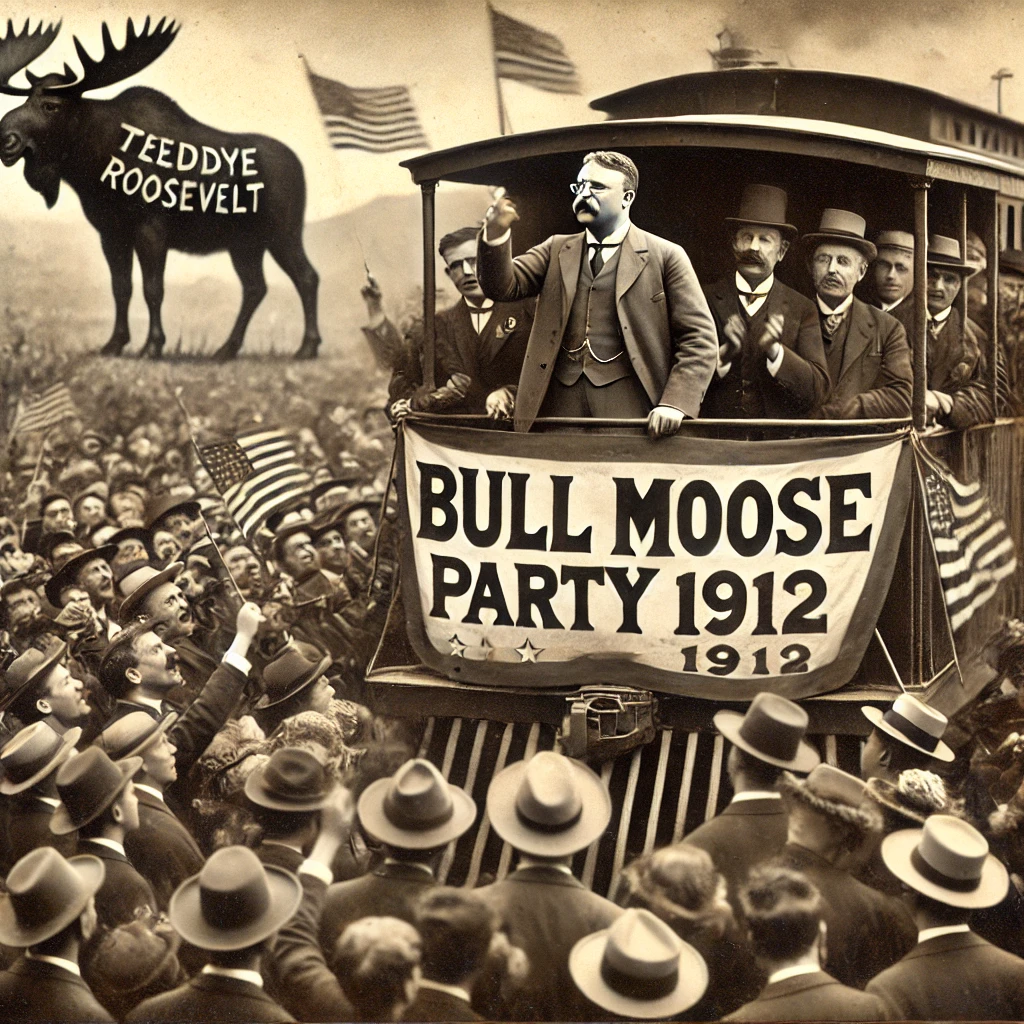
Both policy differences and personal animosity eventually impelled Roosevelt to run against Taft for the Republican nomination in 1912. When that quest failed, he bolted to form the Progressive Party, nicknamed the Bull Moose Party-in a letter to political kingmaker Mark Hanna, Roosevelt had once said "I am as strong as a bull moose and you can use me to the limit."
 |
| Child labor |
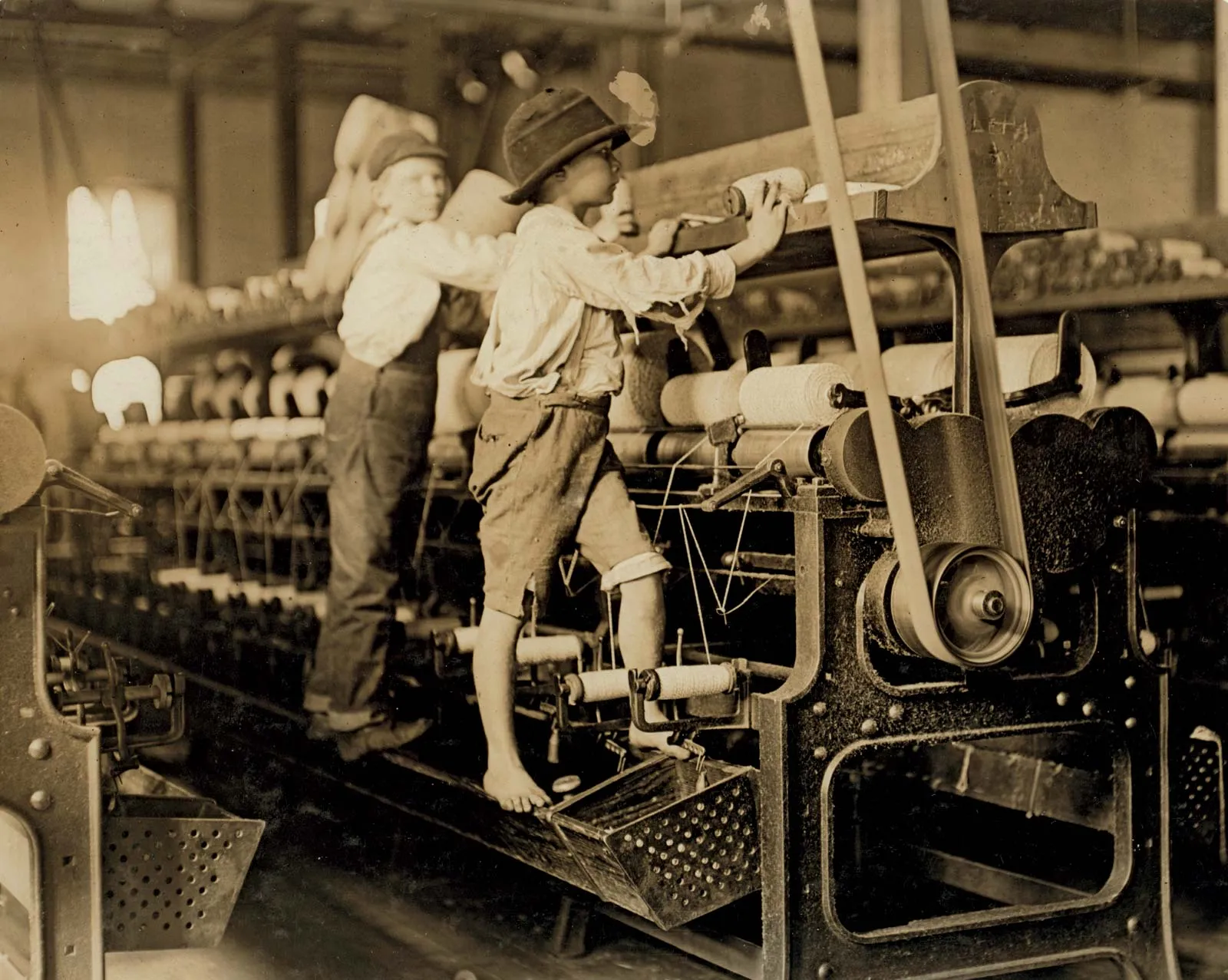
When the 20th century began, 284,000 children between the ages of ten and fifteen worked in mines, mills and factories. Mary G. Harris Jones (Mother Jones) fought to end child labor. In 1903, Jones organized children who were working in mills and mines to participate in her famous "March of the Mill Children", a 125-mile trek from Kensington, Philadelphia, to the summer house (and Summer White House) of President Theodore Roosevelt on Long Island (in Oyster Bay, New York). They had banners demanding "We want to go to school and not the mines!" and held rallies each night in a new town on the way with music, skits, and speeches drawing thousands of citizens.
As Mother Jones noted, many of the children at union headquarters were missing fingers and had other disabilities, and she attempted to get newspaper publicity for the bad conditions experienced by children working in Pennsylvania. However, the mill owners held stock in most newspapers. When the newspapermen informed her that they could not publish the facts about child labor because of this, she remarked "Well, I've got stock in these little children and I'll arrange a little publicity." Permission to see President Roosevelt was denied by his secretary, and it was suggested that Jones address a letter to the president requesting a visit with him. Mother Jones wrote a letter requesting a meeting, but never received an answer. Though the president refused to meet with the marchers, the incident brought the issue of child labor to the forefront of the public agenda. According to Jones, "Every day little children came in to Union Headquarters, some with their hands cut off, some with the thumb missing, some with their fingers off at the knuckle. They were stooped little things, round shouldered and skinny."
A town in Massachusetts had the following rules for teachers:
- Do not get married.
- Do not leave town at any time without permission of the school board.
- Do not keep company with men.
- Be home between the hours of 8 P.M. and 6 A.M.
- Do not loiter downtown in ice cream stores.
- Do not smoke.
- Do not get into a carriage with any man except your father or brother.
- Do not dress in bright colors.
- Do not dye your hair.
- Do not wear any dress more than two inches above the ankle.
 |
| William Howard Taft |
William Taft was president from 1909 to 1913. Taft easily defeated William Jennings Bryan for the presidency. Bryan urged a system of bank guarantees, so that depositors could be repaid if banks failed, but Taft opposed this, offering a postal savings system (allowing post offices to be used for savings) instead. As president, he focused on East Asia more than European affairs and repeatedly intervened to prop up or remove Latin American governments. Taft sought reductions to the Dingley Act tariff, then a major source of governmental income, but the resulting bill was heavily influenced by special interests. The result was the Payne-Aldrich tariff, which dropped rates in general only by about 5 percent, and it raised rates on such items as iron ore and coal. Taft continued and expanded Roosevelt's efforts to break up business combinations through lawsuits brought under the Sherman Antitrust Act, bringing 70 cases in four years (Roosevelt had brought 40 in seven years). Suits brought against the Standard Oil Company and the American Tobacco Company, initiated under Roosevelt, were decided in favor of the government by the Supreme Court in 1911.
Taft announced in his inaugural address that he would not appoint African Americans to federal jobs, such as postmaster, where this would cause racial friction. This differed from Roosevelt, who would not remove or replace black officeholders with whom local whites would not deal. Termed Taft's "Southern Policy," this stance effectively invited white protests against black appointees. Taft followed through, removing most black office holders in the South, and made few appointments of African Americans in the North.
At the time Taft was inaugurated, the way forward for African Americans was debated by their leaders. Booker T. Washington felt that most blacks should be trained for industrial work, with only a few seeking higher education; W. E. B. DuBois took a more militant stand for equality. Taft tended toward Washington's approach. According to historian Paolo E. Coletta, Taft let the African-American "be 'kept in his place' ... He thus failed to see or follow the humanitarian mission historically associated with the Republican party, with the result that Negroes both North and South began to drift toward the Democratic party."
The Mann–Elkins Act, also called the Railway Rate Act of 1910, was a United States federal law that strengthened the authority of the Interstate Commerce Commission (ICC) over railroad rates. The law also expanded the ICC's jurisdiction to include regulation of telephone, telegraph and wireless companies, and created a commerce court.
The March 25, 1911 Triangle Shirtwaist fire killed 146 garment workers, mostly women. A fire that began in a rag bin swept through the eighth, ninth and tenth floors of the factory. Fire station ladders could only reach up to the seventh floor. The stairways and exits were locked to prevent unauthorized breaks and to reduce theft, even though the law said the doors were to remain unlocked during work hours. Many of the dead were Jews and Italians. Some workers lept to their deaths, others were burned alive. According to the New York World, "The hair of some of the girls streamed up aflame as they leaped. Thud after thud sounded on the pavements."
There were more fires and accidents. Tens of thousands workers were killed from job related reasons each year. In 1904, 27,000 workers were killed on the job. Hat and cap makers got respiratory diseases, quarrymen were inhaling deadly chemicals and lithographic printers were getting arsenic poisoning.
In 1912 a New York State Factory Commission reported that Sadie, a healthy girl who worked in an embroidery factory, had an employer who replaced chalk or talcum powder with white lead powder mixed with rosin without her knowledge. According to the report,
Her hands and feet swelled, she lost the use of one hand, her teeth and gums were blue. When she finally had to stop work, after being treated for months for stomach trouble, her physician advised her to go to a hospital. There the examination revealed the fact that she had lead poisoning.
In 1912 the British passenger liner RMS Titanic sailed from Southampton, UK to New York City. Some said that the ship was unsinkable. The ship hit an iceberg in the North Atlantic, killing more than 1,500 of the passengers. The steel used in its hull became brittle in the freezing temperatures, making the damage from the iceberg much worse. The watertight compartments that were supposed to keep it afloat didn't extend high enough, allowing water to spill from one section to another. Also, there weren't enough lifeboats for everybody.
In 1911, Frederick W. Taylor published a book on "scientific management" that included increased mechanization, a finely detailed division of labor and piecework wage systems. Taylor broke each job down into its individual motions, analyzed these to determine which were essential, and timed the workers with a stopwatch. With unnecessary motion eliminated, the worker, following a machinelike routine, became far more productive.
In 1881, at age 25, he introduced time study at the Midvale plant. The profession of time study was founded on the success of this project, which also formed the basis of Taylor's subsequent theories of management science. Essentially, Taylor suggested that production efficiency in a shop or factory could be greatly enhanced by close observation of individual workers and elimination of waste time and motion in their operation. Though the Taylor system provoked resentment and opposition from labor when carried to extremes, its value in rationalizing production was indisputable.
 |
| Woodrow Wilson |
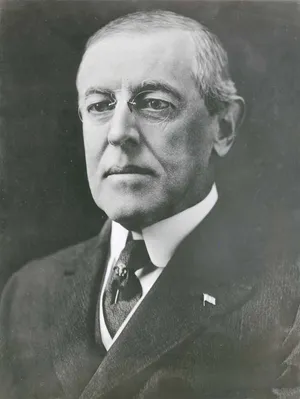
The Sixteenth, Seventeenth, Eighteenth and Nineteenth Amendments were passed during Woodrow Wilson's presidency. The Sixteenth Amendment legalized the IRS. The Seventeenth Amendment allows citizens to elect members of the US Senate. Before this, state governments appointed senators. The Eighteenth Amendment started Prohibition, outlawing the sale of alcohol. Women protested and went to jail and on hunger strikes, fighting for their right to vote. With the ratification of the Nineteenth Amendment, they won that right.
Wilson was an outspoken white supremacist. He authorized the widespread imposition of segregation inside the federal bureaucracy. After the Russian Revolution he used anticommunism as a pretext to surveil and undermine black newspapers, organizations and unions. He segregated the Navy and relegated blacks to kitchen and boiler work. Wilson vetoed a clause on racial equality in the Covenant of the League of Nations. His opposition to women's suffrage drew protests. Wilson was later persuaded to support the right of women to vote. At the outbreak of World War I in 1914, the US declared neutrality as Wilson tried to negotiate peace between the Allied and Central Powers.
The Revenue Act of 1913 or Underwood Tariff re-established a federal income tax in the United States and substantially lowered tariff rates. It replaced the lost revenue with a federal income tax of one percent on incomes above $3,000, affecting the richest three percent of the population. The Keating-Owen Act made it illegal to ship goods made by child labor. The US Supreme Court struck down the child labor law in its Hammer v. Dagenhart decision, legalizing child labor. Congress passed a law taxing businesses that use child labor, a law that the Supreme Court struck down in its Bailey v. Drexel decision. Child labor was finally ended in the 1930s. Wilson approved the goal of upgrading the harsh working conditions for merchant sailors and signed LaFollette's Seamen's Act of 1915. In 1916, the Jones Act led to the independence of the Philippines, which was completed in 1946. Also in 1916, Wilson purchased the Virgin Islands.
Wilson disliked the excessive government involvement in the Federal Farm Loan Act, which created twelve regional banks empowered to provide low-interest loans to farmers. Nevertheless, he needed the farm vote to survive the upcoming 1916 election, so he signed it.
Wilson next sought antitrust legislation to enhance the Sherman Antitrust Act of 1890. The Sherman Antitrust Act barred any "contract, combination ... or conspiracy, in restraint of trade," but had proved ineffective in preventing the rise of large business combinations known as trusts. An elite group of businessmen dominated the boards of major banks and railroads, and they used their power to prevent competition by new companies. With Wilson's support, Congressman Henry Clayton, Jr. introduced a bill that would ban several anti-competitive practices such as discriminatory pricing, tying, exclusive dealing, interlocking directorates and mergers and acquisitions where the effect may substantially lessen competition.
Since the Sherman Antitrust Act of 1890, courts in the United States had interpreted the law on cartels as applying against trade unions. This had created a problem for workers, who needed to organize to get equal bargaining power against their employers. The Sherman Act had also triggered the largest wave of mergers in US history, as businesses realized that instead of creating a cartel they could simply fuse into a single corporation, and have all the benefits of market power that a cartel could bring. The Clayton Act contained safe harbors for union activities. It exempts labor unions and agricultural organizations, saying "that the labor of a human being is not a commodity or article of commerce, and permit[ting] labor organizations to carry out their legitimate objective." Therefore, boycotts, peaceful strikes, peaceful picketing, and collective bargaining are not regulated by this statute. Injunctions could be used to settle labor disputes only when property damage was threatened.
Price discrimination typically helps increase the monopoly firm's profit by maximizing its total revenue. A monopolist charges some customers higher prices rather than a uniform fee for all buyers. Price discrimination among customers with inconsistent demands can minimize the risk of setting up a uniformly high price. A high price may mean that only a few customers can afford a product or service. Monopoly firms can charge higher fees to infrequent customers to increase the total revenue.
For competitive purposes, a monopolist may use forced buying, or "tie-in" sales, to gain sales in other markets where it is not dominant and to make it more difficult for rivals in those markets to obtain sales. This may limit consumer choice for buyers wanting to purchase one ("tying") product by forcing them to also buy a second ("tied") product as well. Typically, the "tied" product may be a less desirable one that the buyer might not purchase unless required to do so, or may prefer to get from a different seller. If the seller offering the tied products has sufficient market power in the "tying" product, these arrangements can violate the antitrust laws.
Exclusive dealing arises when a supplier restricts the buyer's ability to choose by placing limitations on the buyer's rights to select what, with whom, and where they deal. This is against the law in most countries, including the USA, when it has a significant impact of substantially lessening the competition in an industry. When the supplier owns the sales outlets, exclusive dealing is because of vertical integration. Where the outlets are independent, exclusive dealing is illegal.
Two or more corporations have interlocking directorates when they share members of their boards of directors or each shares directors with a third firm. A person that sits on multiple boards is known as a multiple director. Two firms have a direct interlock if a director or executive of one firm is also a director of the other, and an indirect interlock if a director of each sits on the board of a third firm.
This practice, although widespread and lawful, raises questions about the quality and independence of board decisions. In the United States, antitrust law prohibits interlocking directorates within the same industry over collusion concerns, though legal observers have noted that this has long been unenforced. In 2022, the Department of Justice signaled it would enforce laws on anti-competitive interlocking directorates, leading to the resignation of seven directors at five companies in October 2022.
As the difficulty of banning all anti-competitive practices via legislation became clear, Wilson came to back legislation that would create a new agency, the Federal Trade Commission (FTC), to investigate antitrust violations and enforce antitrust laws independently of the Justice Department. With bipartisan support, Congress passed the Federal Trade Commission Act of 1914, which incorporated Wilson's ideas regarding the FTC. One month after signing the Federal Trade Commission Act of 1914, Wilson signed the Clayton Antitrust Act of 1914, which built on the Sherman Act by defining and banning several anti-competitive practices.
A number of states passed laws regulating the wages and hours of workers, providing for factory safety inspections and protecting worker safety.
Between 1900 and 1933 the United States intervened in Cuba four times, in Nicaragua twice, in Panama six times, in Guatemala once and in Honduras seven times.
Wilson had a stroke in October 1919 that left him incapacitated. His wife and his physician controlled Wilson, and no significant decisions were made. Meanwhile, his policies alienated German- and Irish-American Democrats and the Republicans won a landslide in the 1920 election. In February 1924, he died at age 67. Into the 21st century, historians have criticized Wilson for supporting racial segregation, although they continue to rank Wilson as an above-average president for his accomplishments in office. Conservatives in particular have criticized him for expanding the federal government, while others have praised his weakening the power of large corporations.
The poet William Butler Yeats wrote The Second Coming to describe the upheaval caused by World War I.
Turning and turning in the widening gyre
The falcon cannot hear the falconer;
Things fall apart; the centre cannot hold;
Mere anarchy is loosed upon the world,
The blood-dimmed tide is loosed, and everywhere
The ceremony of innocence is drowned;
The best lack all conviction, while the worst
Are full of passionate intensity.
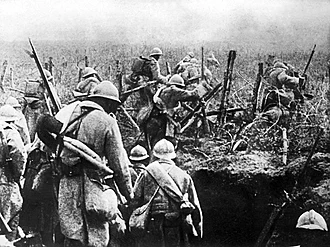
World War I lasted from 1914 to 1918. It resulted in an estimated 30 million military casualties, plus another 8 million civilian dead from war-related causes and genocide. The war was mainly caused by nationalism, as the Austrian Hungarian empire contained captive nationalities that wanted their independence. This led to political instability in the Balkans (particularly Bosnia, Serbia and Herzegovina). The spark that ignited World War I was struck in Sarajevo, Bosnia, where Archduke Franz Ferdinand—heir to the Austro-Hungarian Empire—was shot to death along with his wife, Sophie, by the Serbian nationalist Gavrilo Princip on June 28, 1914. Princip and other nationalists were struggling to end Austro-Hungarian rule over Bosnia and Herzegovina.
 |
| Battle of Verdun |
On July 5, Kaiser Wilhelm II secretly pledged his support, giving Austria-Hungary a "blank check" of assurance of Germany's backing in the case of war. The Dual Monarchy of Austria-Hungary then sent an ultimatum to Serbia, with such harsh terms as to make it almost impossible to accept. Serbia replied to the ultimatum on July 25, accepting most of its demands but protesting against two of them—namely, that Serbian officials (unnamed) should be dismissed at Austria-Hungary's behest and that Austro-Hungarian officials should take part, on Serbian soil, in proceedings against organizations hostile to Austria-Hungary. Though Serbia offered to submit the issue to international arbitration, Austria-Hungary promptly severed diplomatic relations and ordered partial mobilization. Wilhelm II of Germany learned on July 28 how Serbia had replied to the ultimatum. At once he instructed the German Foreign Office to tell Austria-Hungary that there was no longer any justification for war and that it should content itself with a temporary occupation of Belgrade. But, meanwhile, the German Foreign Office had been giving such encouragement to Berchtold that already on July 27 he had persuaded Franz Joseph to authorize war against Serbia.
War was in fact declared on July 28, and Austro-Hungarian artillery began to bombard Belgrade the next day. Both Russia and France predictably ignored these demands. On August 1 Germany ordered general mobilization and declared war against Russia, and France likewise ordered general mobilization. The next day Germany sent troops into Luxembourg and demanded from Belgium free passage for German troops across its neutral territory. On August 3 Germany declared war against France. In the night of August 3–4 German forces invaded Belgium. Thereupon, Great Britain, which had no concern with Serbia and no express obligation to fight either for Russia or for France but was expressly committed to defend Belgium, on August 4 declared war against Germany.
On September 5, 1914, Russia, France, and Great Britain concluded the Treaty of London, each promising not to make a separate peace with the Central Powers. During the four-year conflict, Germany, Austria-Hungary, Bulgaria and the Ottoman Empire (the Central Powers) fought against Great Britain, France, Russia, Italy, Romania, Canada, Japan and the United States (the Allied Powers). Colonies of European countries were drawn into the war.
Germany sought to avoid a two-front war through a Schlieffen Plan, which required defeating France before Russia could attack. Germany failed to avoid a two-front war, and was blamed for firing the first shot. In the First Battle of the Marne, fought from September 6-9, 1914, French and British forces confronted the invading German army, which had by then penetrated deep into northeastern France, within 30 miles of Paris. The Allied troops checked the German advance and mounted a successful counterattack, driving the Germans back to the north of the Aisne River. The defeat meant the end of German plans for a quick victory in France. Both sides dug into trenches, and the Western Front was the setting for a war of attrition that would last more than three years. There were battles with high casualty rates, trench warfare and poisonous chlorine gas, phosgene gas, mustard gas (sulfur mustard, a blistering agent) and tear gas (ethyl bromoacetate). Chlorine and phosgene gases were lethal. Major battles, including at Verdun, the Somme and Passchendaele, failed to break the stalemate on the Western Front.
The tank was invented during World War I as a way to break the stalemate of trench warfare. The first working tank, nicknamed "Little Willie," was built in 1915 by William Foster & Co. in Lincoln, England.
Baron von Richthofen or the Red Baron was a fighter pilot with the German Air Force during World War I. He is credited with 80 air combat victories. Richthofen was shot down and killed over France near Vaux-sur-Somme on April 21, 1918.
In 1915 Germany sank three American ships, and also sank the British ship RMS Lusitania, killing 1,198 passengers including 128 American citizens. Some ships carried weapons to allied countries, including the Lusitania, which was torpedoed by a German submarine and sank in 18 minutes. The German government attempted to find justifications for sinking the Lusitania. Special justifications focused on the small declared cargo of 173 tons of war materials on board the 44,000-ton displacement ship, and false claims that she was an armed warship and carried Canadian troops. The ship carried 1,248 cases of 3-inch shells, 4,927 boxes of cartridges (1,000 rounds in each box) and 2,000 more cases of small arms munitions. Even after the ship sank, Wilson was reelected on the slogan "He kept us out of war." After more German attacks on US ships, America declared war on Germany in 1917.
In 1915 the Chief of the German General Staff appointed Paul von Hindenburg and Erich Ludendorff to lead the campaign against Russia. They conquered Poland and inflicted huge losses on Russia, driving Russian armies back 250 miles from the position they started from.
 |
| Leon Trotsky |
Russian casualties were high on Germany's eastern front. Czar Nicholas assumed command of the Russian armies, leaving Alexandra in charge of running the country. Alexandra was under the influence of Grigori Rasputin, a Russian starets (holy man or mystic) who could arrest the bleeding of the hemophiliac tsarevich, Alexis. In April 1917, the German government arranged for Vladimir Lenin and a group of Russian revolutionaries to travel from Switzerland through Germany to Russia in a sealed train. Germany succeeded in its plan for using these Bolsheviks to destabilize the Russian government. The revolutionaries rode by train from Zurich station to Russia and overthrew the Czars during the Russian Revolution of 1917. Czar Nicholas II abdicated the throne, and the Provisional Government led by the Duma and soviets emerged. Mensheviks, Bolsheviks led by Lenin and anarchists competed for power, and Lenin won. Lenin withdrew Russia from the war. Lenin's Bolshviks defeated the Menshaviks and established a dictatorship. The Red Army, led by Leon Trotsky, fought a civil war against the Whites who supported the Czar. The political police, the Cheka, tortured, killed and imprisoned thousands. Under the terms of the Treaty of Brest-Litovsk, Soviet Russia was obliged to give up Ukraine, eastern Poland, Finland, the Baltic provinces (Latvia, Lithuania, and Estonia), Belorussia (Belarus), and other territories to Germany, while the Caucasus went to Turkey. The territory the Romanov tsars had gained over two centuries of imperialism was lost, some 290,000 square miles. The Russian Empire lost 64 per cent of pig-iron production, 40 per cent of coal and 24 per cent of steel.
|
| Germany after Treaty of Versailles |
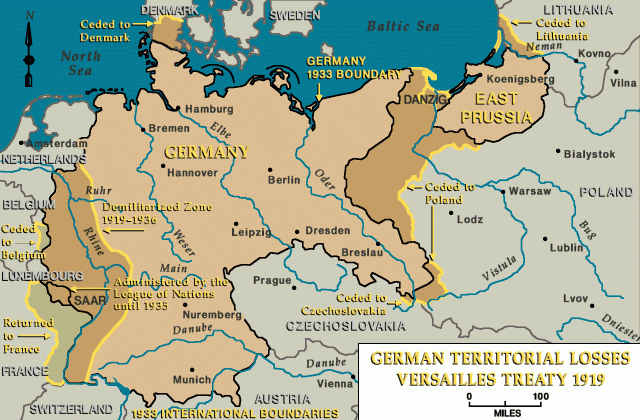
The Triple Alliance was defeated in 1918, and France wanted revanche, or revenge against Germany. The Treaty of Versailles included Article 231 (the War Guilt clause) blaming Germany for firing the first shot. All German troops were forced to withdraw east of the Rhine, the German fleet was to be surrendered to the Allies, vast amounts of military equipment had to be handed over, the Treaty of Brest-Litovsk had to be repudiated, the German High Seas Fleet and submarines had to be surrendered to the Allies and Germany was forced to pay $33 billion in reparations. The German army was restricted to 100,000 men; the general staff was eliminated; the manufacture of armored cars, tanks, submarines, airplanes, and poison gas was forbidden; and only a small number of specified factories could make weapons or munitions. Germany lost a tenth of its population and 13 percent of its territory including Alsace-Lorraine, which was ceded back to France, along with border territories of Eupen, Malmedy and Moresnet. The people of the Saarland were given the option of deciding whether to join France. The Rhineland was demilitarized. German forces were prohibited from entering the region, and Allied troops were stationed there to enforce the terms of the treaty. The Rhineland was a highly industrialized and strategic region in Germany, known for its coal mines, factories, and transportation networks. Northern Schleswig went to Denmark and Memel to Lithuania. Posen, much of West Prussia and Upper Silesia went to Poland. Danzig became a free city.
Woodrow Wilson's Fourteen Points advocated for self-determination of nations in Europe, although Wilson militarily intervened frequently in Latin America. However, self determination in Europe did not mean that Germany could unite with Austria, as the Treaty of Versailles didn't allow this. Germans thought that preventing German unification was unfair.
A German corporal named Adolf Hitler ranted against the Treaty of Versailles, Jews and Bolsheviks in German beer halls. Wilson fought for the League of Nations, which was established in 1920 by the Treaty of Versailles. The League of Nations led to the United Nations beginning June 26, 1945.
The misnamed Spanish Flu of 1918 killed more people than World War I. It probably started in Kansas. Tens of millions of people died from it. It lasted until about 1920.
Wilson militarily intervened in Latin America frequently. He sent troops into Haiti in 1915, the Dominican Republic in 1916, Cuba in 1917, Panama in 1918 and twice in Mexico. He hired two Japanese-Mexicans to try to poison Pancho Villa. He also militarily intervened on the side of the White Russian (anti-Bolshevik) forces against the Reds during the Russian Revolution, without success.
The Battle of Veracruz was a military conflict between the United States and Mexico that took place in the Mexican port city of Veracruz between April 21 to November 23, 1914. It began with the Tampico Affair, which was set off when nine American sailors were arrested by the Mexican government for entering off-limit areas in Tampico, Tamaulipas. The unarmed sailors were arrested when they entered a fuel loading station. The sailors were released, but the US naval commander Henry T. Mayo demanded an apology and a 21-gun salute. The apology was provided, but not the salute. In the end, the tensions culminated in US President Woodrow Wilson ordering the US Navy to prepare for the occupation of the port of Veracruz. While awaiting authorization from the US Congress to carry out such action, Wilson was alerted to a delivery of weapons for General Victoriano Huerta due to arrive in the port on April 21 aboard the German-registered cargo steamer SS Ypiranga. As a result, Wilson issued an immediate order to seize the port's customs office and confiscate the weaponry. The weapons had actually been sourced by John Wesley De Kay, an American financier and businessman with large investments in Mexico, and a Russian arms dealer from Puebla, Leon Rasst, not the German government, as newspapers reported at the time. Marines and soldiers continued to garrison the city until the US withdrawal on November 23, which occurred after Argentina, Brazil, and Chile became involved. Known as the ABC powers, they were the most powerful and wealthy countries in South America at the time. They were able to settle the issues between the two nations at the Niagara Falls peace conference. The Veracruz military intervention was done without the consent of Congress and was opposed by both sides of the Mexican Revolution.
When US Marines invaded Haiti in 1915, the US forced the Haitian legislature to accept our preferred president, then dissolved the Haitian legislature. The US forced Haitians to accept a constitution that was less democratic than the one it replaced. George Barnett, a US Marine general, said, "Practically indiscriminate killing of natives has gone on for some time."
As former Marine Corps General Smedley D. Butler said,
I helped make Mexico safe for American oil interests in 1914. I helped make Haiti and Cuba a decent place for the National City Bank boys to collect revenue in. I helped purify Nicaragua for the international banking house of Brown Brothers. ... I brought light to the Dominican Republic for American sugar interests in 1916. I helped make Honduras "right" for American fruit companies in 1903. Looking back on it, I might have given Al Capone a few hints.
The New Jersey constitution of 1776 enfranchised all adult inhabitants who owned a specified amount of property. Laws enacted in 1790 and 1797 referred to voters as "he or she," and women regularly voted. A law passed in 1807, however, excluded women from voting in that state.

|
| Women's Suffrage |
In 1848, the Seneca Falls Convention, the first women's rights convention, passed a resolution in favor of women's suffrage despite opposition from some of its organizers, who believed the idea was too extreme. By the time of the first National Women's Rights Convention in 1850, however, suffrage was becoming an increasingly important aspect of the movement's activities.
The first national suffrage organizations were established in 1869 when two competing organizations were formed, one led by Susan B. Anthony and Elizabeth Cady Stanton and the other by Lucy Stone and Frances Ellen Watkins Harper. After years of rivalry, they merged in 1890 as the National American Woman Suffrage Association (NAWSA) with Anthony as its leading force. The Women's Christian Temperance Union (WCTU), which was the largest women's organization at that time, was established in 1873 and also pursued women's suffrage.
Anthony actually succeeded in voting in 1872 but was arrested for that act and found guilty in a widely publicized trial that gave the movement fresh momentum. After the Supreme Court ruled against them in the 1875 case Minor v. Happersett, suffragists began the decades-long campaign for an amendment to the US Constitution that would enfranchise women.
One sign held by women when President Woodrow Wilson opposed giving them the right to vote read:
PRESIDENT WILSON IS DECEIVING THE WORLD
WHEN HE APPEARS AS THE PROPHET OF DEMOCRACY
PRESIDENT WILSON HAS OPPOSED THOSE WHO
DEMAND DEMOCRACY FOR THIS COUNTRY
HE IS RESPONSIBLE FOR THE DISENFRANCHISEMENT
OF MILLIONS OF AMERICANS
WE IN AMERICA KNOW THIS
THE WORLD WILL FIND HIM OUT.
In 1916, Alice Paul formed the National Woman's Party (NWP), a group focused on the passage of a national suffrage amendment. Over 200 NWP supporters, the Silent Sentinels, were arrested in 1917 while picketing the White House, some of whom went on hunger strikes and endured forced feeding after being sent to prison. Under the leadership of Carrie Chapman Catt, the two-million-member NAWSA also made a national suffrage amendment its top priority. After a hard-fought series of votes in the US Congress and in state legislatures, the Nineteenth Amendment became part of the US Constitution on August 18, 1920. It states, "The right of citizens of the United States to vote shall not be denied or abridged by the United States or by any State on account of sex."

|
| Anti-Carrie Nation card |
The American Temperance Society (ATS), formed in 1826, helped initiate the first temperance movement and served as a foundation for many later groups. By 1835 the ATS had reached 1.5 million members, with women constituting 35 percent to 60 percent of its chapters. The dry crusade was revived by the national Prohibition Party, founded in 1869, and the Woman's Christian Temperance Union (WCTU), founded in 1874.
In 1881 Kansas became the first state to outlaw alcoholic beverages in its Constitution. Arrested over 30 times and fined and jailed on multiple occasions, prohibition activist Carrie Nation attempted to enforce the state's ban on alcohol consumption. She walked into saloons, scolding customers, and used her hatchet to destroy bottles of liquor. Nation recruited ladies into the Carrie Nation Prohibition Group, which she also led. While Nation's vigilante techniques were rare, other activists enforced the dry cause by entering saloons, singing, praying, and urging saloonkeepers to stop selling alcohol. Other dry states, especially those in the South, enacted prohibition legislation, as did individual counties within a state.
Congress passed enabling legislation, known as the Volstead Act, to enforce the Eighteenth Amendment when it went into effect in 1920. Prohibition began on January 17, 1920, when the Volstead Act went into effect. A total of 1,520 Federal Prohibition agents (police) were tasked with enforcement.
To prevent bootleggers from using industrial ethyl alcohol to produce illegal beverages, the federal government ordered the denaturation of industrial alcohols, meaning they must include additives to make them unpalatable or poisonous. In response, bootleggers hired chemists who successfully removed the additives from the alcohol to make it drinkable. As a response, the Treasury Department required manufacturers to add more deadly poisons, including the particularly deadly combination referred to (incorrectly) as "methyl alcohol": 4 parts methanol, 2.25 parts pyridine base, and 0.5 parts benzene per 100 parts ethyl alcohol. New York City medical examiners prominently opposed these policies because of the danger to human life. As many as 10,000 people died from drinking denatured alcohol before Prohibition ended.
Another lethal substance that was often substituted for alcohol was Sterno, a denatured form of ethyl alcohol adulterated with methanol and a jelling agent, commonly known as "canned heat." Forcing the substance through a makeshift filter, such as a handkerchief, created a rough liquor substitute; however, the result was poisonous, though not often lethal.
Stores sold grape concentrate with warning labels that listed the steps that should be avoided to prevent the juice from fermenting into wine. Some drugstores sold "medical wine" with around a 22 percent alcohol content. In order to justify the sale, the wine was given a medicinal taste. Home-distilled hard liquor was called bathtub gin in northern cities, and moonshine in southern rural areas.
Prohibition ended with the ratification of the Twenty-first Amendment, which repealed the Eighteenth Amendment on December 5, 1933.
The Dawes Plan temporarily resolved the issue of the reparations that Germany owed to the Allies of World War I. Enacted in 1924, it ended the crisis in European diplomacy that occurred after French and Belgian troops occupied the Ruhr in response to Germany's failure to meet its reparations obligations. The Plan set up a staggered schedule for Germany's payment of war reparations, provided for a large loan to stabilise the German currency and ended the occupation of the Ruhr.
The Young Plan was a 1929 attempt to replace the 1924 Dawes Plan. Under the Young Plan, reparations were set at 36 billion Reichsmarks payable through 1988. Including interest, the total came to 112 billion Reichsmarks. The average annual payment was approximately two billion Reichsmarks (US$473 million in 1929). The plan came into effect on May 17, 1930, retroactive to September 1, 1929. In a parallel agreement, France agreed to withdraw its troops from the occupied Rhineland in 1930, five years earlier than called for in the Treaty of Versailles.
Due to the effects of the Great Depression, the Young Plan was suspended by the Hoover Moratorium in June 1931 and payments reduced by 90 percent at the Lausanne Conference in July 1932. The National Socialist government under Adolf Hitler made no payments after it came to power in 1933. However, Germany continued to pay interest on Dawes and Young bonds until 1939.
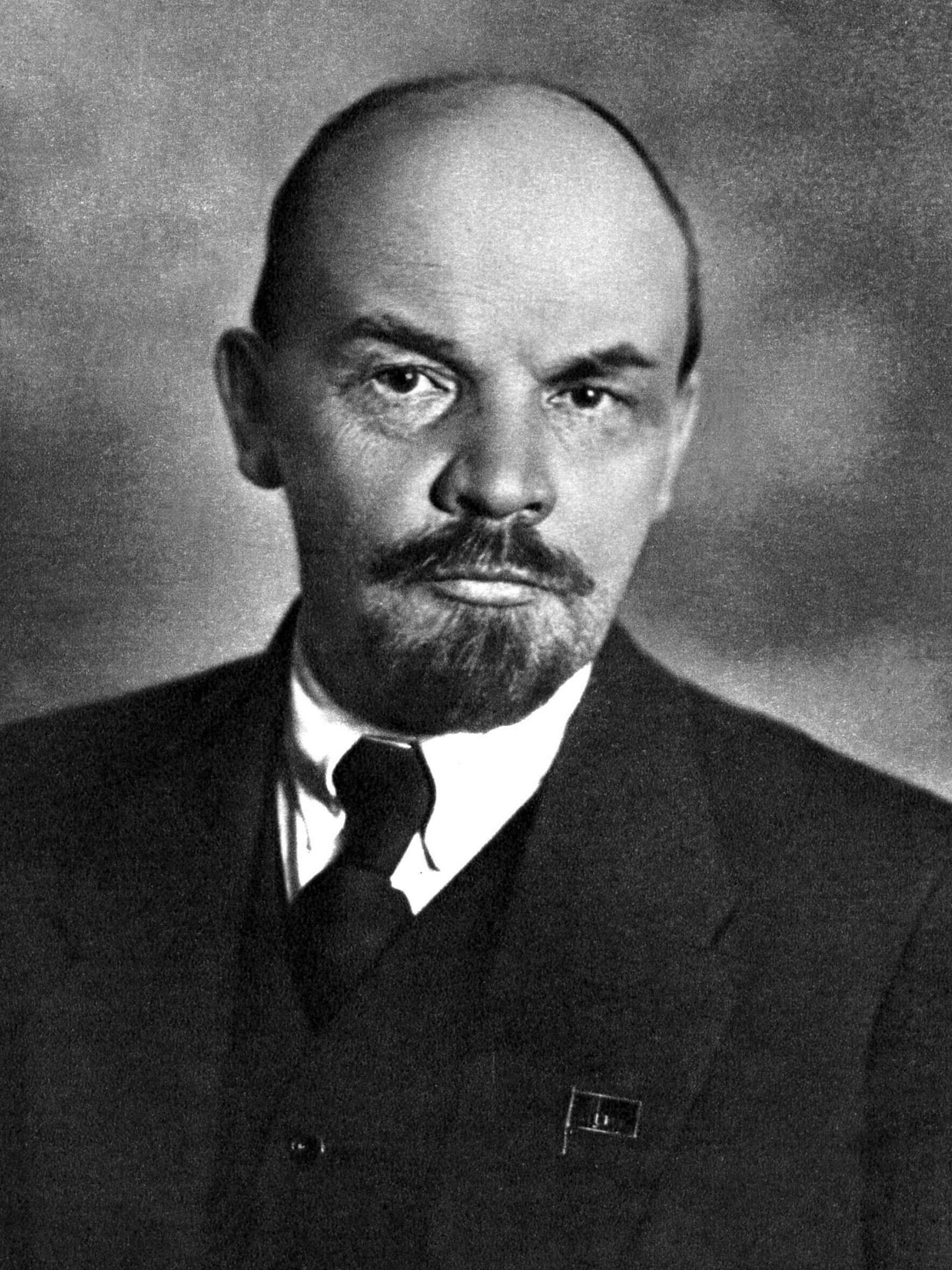 |
| Vladimir Lenin |
The Palmer Raids were a series of raids conducted from January 21, 1919 to April 1, 1920 by the United States Department of Justice under the administration of President Woodrow Wilson to capture and arrest suspected anarchists and communists, and deport them from the United States. The raids particularly targeted Italian and Eastern European Jewish immigrants with alleged leftist ties. The raids and arrests occurred under the leadership of Attorney General A. Mitchell Palmer, with 6,000 people arrested. Though 556 foreign citizens were deported, Palmer's efforts were largely frustrated by officials at the US Department of Labor, which had authority for deportations and objected to Palmer's methods.
The Palmer Raids occurred in the larger context of the First Red Scare, a period of fear of and reaction against communists and anarchists in the US in the years immediately following World War I and the 1917 Russian Revolution. American authorities saw the threat of communist revolution in the actions of organized labor, including such disparate cases as the Seattle General Strike and the Boston Police Strike and then in the bombing campaign directed by anarchist groups at political and business leaders.
The raids saw federal agents sweep through cities such as New York, Philadelphia and Detroit, where they made warrantless arrests of thousands of suspected radicals, many of them recent immigrants. Hundreds were detained in makeshift camps with abysmal conditions. At one such location, the historian Beverly Gage observes in her biography of J. Edgar Hoover, who was involved in planning the raids, 600 men were "jammed into barracks planned for 300, with no heat and dwindling food." At another, "800 prisoners had been stuffed into a windowless corridor with only one working bathroom and no beds."
The Wilson administration shut down some 75 newspapers and magazines it found too critical and censored several hundred specific issues of others. It threw into prison roughly a thousand Americans for a year or more - and a far larger number for shorter periods - solely for things they wrote or said. And the Justice Department chartered a nationwide vigilante group, the American Protective League. Its 250,000 members seized, roughed up and detained suspected draft evaders, violently broke up peace demonstrations, and joined government agents in raiding left-wing and labor organizations. In reaction to subversive and militant leftist actions in the United States, the United States Congress passed the Espionage Act in 1917, the Sedition Act of 1918, and the Immigration Act of 1918. The Espionage Act provided prison terms for up to 20 years to interfere with the operation or success of the military, and the Sedition Act forbade Americans to use "disloyal, profane, scurrilous, or abusive language" about the United States government, flag, or armed forces of the United States during war. What was called the Sedition Act were really 1918 amendments to the Espionage Act, which applied only in time of war. The Immigration Act of 1918, also known as the Dillingham-Hardwick Act, allowed the government to deport anarchists, communists, labor organizers and similar activists.
A Socialist named Charles Schenck passed out leaflets condemning the Conscription Act as a violation of the Thirteenth Amendment, which bans "involuntary servitude." Schenck was sentenced to six months in prison and appealed his conviction under the Espionage Act to the US Supreme Court. Schenck claimed that his First Amendment rights were violated. The unanimous opinion written by Oliver Wendell Holmes read,
The most stringent protection of free speech would not protect a man in falsely shouting fire in a theatre and causing a panic ... The question in every case is whether the words are used in such circumstances and are of such a nature as to create a clear and present danger that they will bring about the substantive evils that Congress has a right to prevent.
Robert Goldstein served 3 years in prison for producing The Spirit of '76, a film about the American Revolution that portrayed the British as our enemies, because the British had become our allies at the time.
Among those charged with offenses were: Austrian-American socialist congressman and newspaper editor Victor L. Berger, labor leader and five-time Socialist Party of America candidate Eugene V. Debs, anarchists Emma Goldman, Luigi Galleani and Alexander Berkman, former Watch Tower Bible & Tract Society president Joseph Franklin Rutherford (whose conviction was overturned on appeal), communists Julius and Ethel Rosenberg, Pentagon Papers whistleblower Daniel Ellsberg, Cablegate whistleblower Chelsea Manning, WikiLeaks founder Julian Assange, Defense Intelligence Agency employee Henry Kyle Frese, and National Security Agency (NSA) contractor whistleblower Edward Snowden. Although the most controversial amendments, called the Sedition Act of 1918, were repealed on December 13, 1920, the original Espionage Act was left intact. Between 1921 and 1923, Presidents Warren G. Harding and Calvin released all those convicted under the Sedition and Espionage Acts.
The law's vagueness was the tool that jailed thousands of war opponents, leftists and labor unionists. Big business had long been looking for excuses to imprison the unionists. The most famous political prisoner was Eugene V. Debs, a perennial Socialist candidate for president, who had won 6 percent of the popular vote in 1912. Six years later, for giving an anti-war speech from an Ohio park bandstand, he was sentenced to 10 years behind bars. Debs was convicted under the Espionage Act for saying, "The master class has always declared the wars; the subject class has always fought the battles." At his trial he said, "while there is a lower class, I am in it; while there is a criminal element, I am of it; while there is a soul in prison, I am not free." Debs was released after 32 months by President Warren G. Harding. Harding, who succeeded Wilson, stopped censorship and began releasing political prisoners, even inviting Debs to stop in at the White House on his way home. Harding said he enjoyed the Socialist leader's company, and, privately, he told a friend that Debs was right: The United States should never have entered the war.
The federal Espionage Act also enabled censorship, without using the word, by giving the postmaster general the power to declare a newspaper or magazine "unmailable." Before the internet, this meant a publication would have no way of reaching a broad national readership.
Postmaster General Albert Burleson, a right-wing former congressman from Texas, shut down the first newspaper even before the Espionage Act passed Congress. (It was the Rebel, of Hallettsville, Texas, which had criticized him for using prison labor on farmland he owned.) The very day the act went into effect, federal agents arrested anarchist leader Emma Goldman for agitating against the draft. By that point, the American Protective League had already injured many people when it broke up a peace rally in Chicago's Grant Park.
World War I provoked mass paranoia. Immigrants who spoke German at home were terrified to do so on the street because it could get them beaten up. American schools abruptly stopped teaching German, and around the country people set bonfires of German books - at least 19 times in Ohio alone. Families named Schmidt changed their names to Smith; the frankfurter became the hot dog. Then, in November 1917, the Bolsheviks seized power in Russia. Fearful of communist revolution spreading to the United States, Wilson's government and its vigilante allies began hunting down Soviet sympathizers, real and imagined.
Even though the war was the excuse for the Espionage Act, Burleson continued as postmaster general to ban publications for more than two years after the fighting ended. Vigilante violence continued as well. In November 1919, for instance, former congressman Ernest Lundeen mounted a stage in Ortonville, Minnesota, to give a speech. He got no further than "Ladies and gentlemen ..." when he was seized by a mob, angry that he had opposed the war. They marched him to a railway track and locked him in a refrigerator car of a freight train starting to pull out. Dissidents remained in prison by the hundreds, and there were calls for mass deportations of troublemakers. Wilson turned down appeals to release Debs, and in November 1920, the Socialist received more than 900,000 votes for president - while still in his cell at the Atlanta federal penitentiary. When Attorney General Palmer asked Wilson to pardon Eugene V. Debs, Wilson replied, "Never!"
When Wilson's special envoy Elihu Root, a former secretary of state, told a New York audience in 1917 that "there are men walking about the streets of this city tonight who ought to be taken out at sunrise tomorrow and shot for treason. ... There are some newspapers published in this city ... the editors of which deserve conviction and execution for treason," the New York Times gave him a three-column front-page headline and its editorial page praised his "great crystalline intellect."
Nicola Sacco and Bartolomeo Vanzetti were Italian immigrants and anarchists, controversially accused of murdering Alessandro Berardelli and Frederick Parmenter, a guard and a paymaster, during the April 15, 1920, armed robbery of the Slater and Morrill Shoe Company in Braintree, Massachusetts, United States. Seven years later, they were executed in the electric chair at Charlestown State Prison. Some historians consider their conviction unfair due to prejudice against immigrants and radicals.
After a few hours' deliberation on July 14, 1921, the jury convicted Sacco and Vanzetti of first-degree murder and they were sentenced to death by the trial judge. Anti-Italianism, anti-immigrant, and anti-anarchist bias were suspected by some as having influenced the verdict. A series of appeals followed, funded largely by the private Sacco and Vanzetti Defense Committee. The appeals were based on recanted testimony, conflicting ballistics evidence, a prejudicial pretrial statement by the jury foreman, and a confession by an alleged participant in the robbery. All appeals were denied by trial judge Webster Thayer and also later denied by the Massachusetts Supreme Judicial Court. By 1926, the case had drawn worldwide attention. As details of the trial and the men's suspected innocence became known, Sacco and Vanzetti became the center of one of the largest causes célèbres in modern history. In 1927, protests on their behalf were held in every major city in North America and Europe, as well as in Tokyo, Sydney, Melbourne, São Paulo, Rio de Janeiro, Buenos Aires, Dubai, Montevideo, Johannesburg, Mexico City and Auckland.
The frenzy gradually died away, but it left behind tens of thousands of wrecked lives and police forces at every level accustomed to regarding dissent as treason. In 1923 author Upton Sinclair began giving a speech in San Pedro, California, in support of a strike by the Marine Transport Workers Industrial Union, San Pedro Local 510. Police Captain Plummer shouted. "I'm taking you in if you utter a word." "My right to speak is protected by the US Constitution," Sinclair replied, reciting the First Amendment, and Plummer arrested and jailed him.