- POSSE COMITATUS ACT OF 1878
- JAMES GARFIELD (1881 - FOUR MONTHS IN OFFICE)
- STATUE OF LIBERTY
- CHESTER ARTHUR (1881 - 1885) - CHINESE EXCLUSION
- HUCKLEBERRY FINN
- GROVER CLEVELAND (1885 - 1889) - CHINESE EXCLUSION
- BENJAMIN HARRISON (1889 - 1893) - CHINESE EXCLUSION
- SHERMAN ANTITRUST ACT
- SUPREME COURT COMMERCE DECISIONS
- GROVER CLEVELAND (1893 - 1897)
- PLESSY V. FERGUSON
- HOW HAWAII BECAME A STATE
- THE DAWES AND CURTIS ACTS
- INDIAN WARS AND MASSACRES
- POPULIST MOVEMENT
- WILLIAM MCKINLEY (1897 - 1901)
- SPANISH-AMERICAN WAR
- MARK TWAIN'S COMMENTS ON AMERICAN IMPERIALISM
- OPEN DOOR POLICY
- HELEN KELLER
The Posse Comitatus Act is a federal law that was signed on June 18, 1878, by President Rutherford B. Hayes that limits the powers of the federal government in the use of federal military personnel to enforce domestic policies within the United States. Congress passed the Act as an amendment to an army appropriation bill following the end of Reconstruction and updated it in 1956, 1981 and 2021.
The Act originally applied only to the United States Army, but a subsequent amendment in 1956 expanded its scope to the United States Air Force. In 2021, the National Defense Authorization Act for Fiscal Year 2022 further expanded the scope of the Act to cover the United States Navy, Marine Corps, and Space Force. The Act does not prevent the Army National Guard or the Air National Guard under state authority from acting in a law enforcement capacity within its home state or in an adjacent state if invited by that state's governor. The United States Coast Guard (under the Department of Homeland Security) is not covered by the Act either, primarily because although it is an armed service, it also has a maritime law enforcement mission.
The title of the Act comes from the legal concept of posse comitatus, the authority under which a county sheriff, or another law officer, can conscript any able-bodied person to assist in keeping the peace.
The Act, § 15 of the appropriations bill for the Army for 1879 (found at 20 Stat. 152) was a response to, and subsequent prohibition of, the military occupation of the former Confederate States by the United States Army during the twelve years of Reconstruction (1865–1877) following the American Civil War (1861–1865).
The US Constitution places primary responsibility for the holding of elections in the hands of the individual states. The maintenance of peace, conduct of orderly elections, and prosecution of unlawful actions are all state responsibilities, according to any state's role of exercising police power and maintaining law and order, whether part of a wider federation or a unitary state. However, in the former Confederate States, many paramilitary groups sought to suppress, often through intimidation and violence, African-American political power and return the South to rule by the predominantly white Democratic Party. Although African Americans were initially supported by the federal government, as Reconstruction went on, that support waned. Following the bitterly disputed 1876 US presidential election and Compromise of 1877, Congressmen and Senators from the former Confederate States returned to Washington and prioritized prohibiting the federal government from reimposing control over their states. After President Hayes used federal troops to end the Great Railroad Strike of 1877, there was sufficient bipartisan support to pass what became the Posse Comitatus Act.
In 1880 James Garfield was elected as President. Four months later, he was assassinated. Before the Civil War, Garfield opposed the extension of slavery into the territories, and during the war, he commanded Union soldiers at Chickamauga and elsewhere. He believed in black equality and civil service reform. On July 2, 1881, while on his way to a family vacation in New England, Garfield was shot twice in the railroad station in Washington, D.C. by Charles J. Guiteau, a disappointed office seeker with messianic visions. The first shot only grazed Garfield's arm, but the second bullet pierced his back and lodged behind his pancreas. In a letter dated November 1880, Garfield had written, "Assassination can be no more guarded against than death by lightning and it is not best to worry about either."
 |
| Statue of Liberty |
In 1903, a bronze tablet that bears the text of Emma Lazarus' sonnet, "The New Colossus" (1883), was presented by friends of the poet. Lazarus was involved in aiding Jewish refugees to New York who had fled antisemitic pogroms in eastern Europe, and she saw a way to express her empathy for these refugees. The tablet reads:

Not like the brazen giant of Greek fame,
With conquering limbs astride from land to land;
Here at our sea-washed, sunset gates shall stand
A mighty woman with a torch, whose flame
Is the imprisoned lightning, and her name
Mother of Exiles. From her beacon-hand
Glows world-wide welcome; her mild eyes command
The air-bridged harbor that twin cities frame.
"Keep, ancient lands, your storied pomp!" cries she
With silent lips. "Give me your tired, your poor,
Your huddled masses yearning to breathe free,
The wretched refuse of your teeming shore.
Send these, the homeless, tempest-tost to me,
I lift my lamp beside the golden door!"

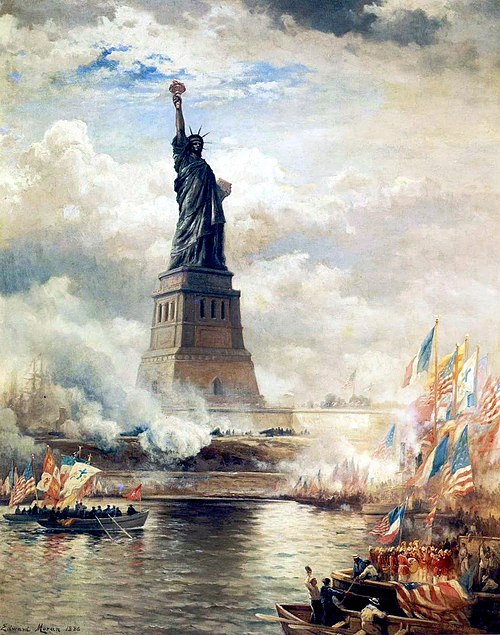
The Statue of Liberty is a sculpture on Liberty Island in New York Harbor, within New York City. The copper-clad statue, a gift to the United States from the people of France, was designed by French sculptor Frédéric Auguste Bartholdi and its metal framework was built by Gustave Eiffel. The statue was dedicated on October 28, 1886.
The statue is a figure of a classically draped woman. She holds a torch above her head with her right hand, and in her left hand carries a tabula ansata inscribed JULY IV MDCCLXXVI (July 4, 1776, in Roman numerals), the date of the US Declaration of Independence. With her left foot she steps on a broken chain and shackle, commemorating the national abolition of slavery following the American Civil War. After its dedication the statue became an icon of freedom and of the United States, seen as a symbol of welcome to immigrants arriving by sea.
The idea for the statue was conceived in 1865, when the French historian and abolitionist Édouard de Laboulaye proposed a monument to commemorate the upcoming centennial of US independence (1876), the perseverance of American democracy and the liberation of the nation's slaves.
 |
| Chester Arthur |
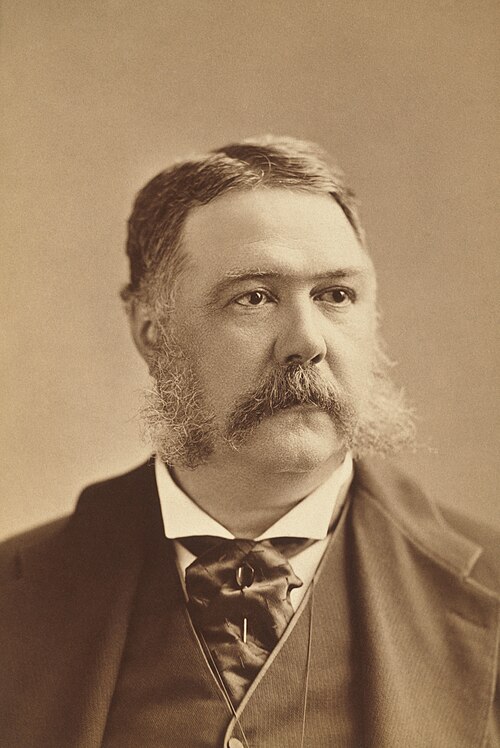
Arthur joined the Republican Party in the 1850s, became active in local politics, and served as quartermaster general of New York state's troops during the Civil War. Resuming his law practice in 1863, he became closely associated with Sen. Roscoe Conkling, the Republican boss of New York. In 1871, with Conkling's backing, Arthur was appointed customs collector for the port of New York City by Pres. Ulysses S. Grant. The New York customhouse, which brought in the bulk of the nation's tariff revenue, had long been conspicuous for flagrant use of the spoils system, by which Conkling's political supporters were rewarded with government jobs. Although Arthur collected the customs duties with integrity, he continued the practice of overstaffing the customhouse with employees whose chief qualification was loyalty to Conkling.
In 1877 newly elected President Rutherford B. Hayes, intent on reducing Conkling's patronage fiefdom, demanded the resignation of Arthur and others in the New York City customhouse. With Conkling's support, Arthur was able to resist Hayes for a time, but in July 1878 Hayes finally suspended him, and Arthur returned to the practice of law.
Widely regarded as Conkling's protégé, Arthur worked with his mentor at the Republican National Convention of 1880 to secure the renomination of Grant for a third term as president. When the convention deadlocked between the conservative Stalwart and liberal Half-Breed factions, delegates turned to dark-horse candidate James A. Garfield, and Arthur was nominated vice president as a conciliatory gesture to Conkling and the Stalwarts. The public, however, responded coldly to Arthur's nomination, viewing the former customhouse collector as unqualified for the nation's second-highest office.
When Garfield was assassinated by a disappointed office seeker who wanted the Stalwart Arthur to be president, public apprehension increased markedly. Arthur took the presidential oath on September 19, 1881, amid widespread belief that he, a spoilsman with no experience in shaping public policy, was unworthy of the office to which he had now tragically acceded. Said to have been deeply wounded by the public's low regard for him, Arthur proceeded to prove that he could rise above expectations. In 1882 he displayed surprising independence when he vetoed an $18 million rivers and harbors bill that contained ample funds for projects that could be used for political patronage. Yet it was Arthur's support for the Pendleton Civil Service Act (1883) that clearly showed how far he had come from his days as patronage purveyor at the New York customhouse. Commanding widespread support from the American people, who saw Garfield's assassination as a product of the corrupt spoils system, the Pendleton Act at last made a reality of civil-service reform, creating a merit-based system of appointment and promotion for a limited number of specified offices. Stalwarts, however, viewed Arthur's support for the measure as a betrayal.
The Angell Treaty of 1880 restricted the immigration of both skilled and unskilled laborers from China, but still allowed the immigration of white-collar professionals. It was more restrictive than the previous Burlingame Treaty, and laid the diplomatic groundwork for the the 1882 Chinese Exclusion Act. Arthur vetoed the Chinese Exclusion Act that would have suspended Chinese immigration for 20 years, as overly harsh. Still, he signed the next Chinese Exclusion Act in 1882, which suspended Chinese immigration for 10 years and prevented them from becoming citizens. The Act made exceptions for travelers and diplomats. The Act also denied Chinese residents already in the US the ability to become citizens and Chinese people traveling in or out of the country were required to carry a certificate identifying their status or risk deportation. It was the first major US law implemented to prevent all members of a specific national group from immigrating to the United States, and therefore helped shape twentieth-century immigration policy.
By 1880 there were about 75,000 immigrants from China living in California, almost one-tenth the total population. The novelist Bret Harte wrote the following obituary for one who was killed:
Dead, my revered friends, dead. Stoned to death in the streets of San Francisco, in the year of grace 1869 by a mob of halfgrown boys and Christian school children.
In conjunction with his secretary of the navy, William Eaton Chandler, Arthur recommended appropriations that would later help to transform the United States Navy into one of the world's great fleets. During Arthur's final year as president, the United States acquired a naval coaling station at Pearl Harbor in the Hawaiian Islands.
 |
| Huckleberry Finn |
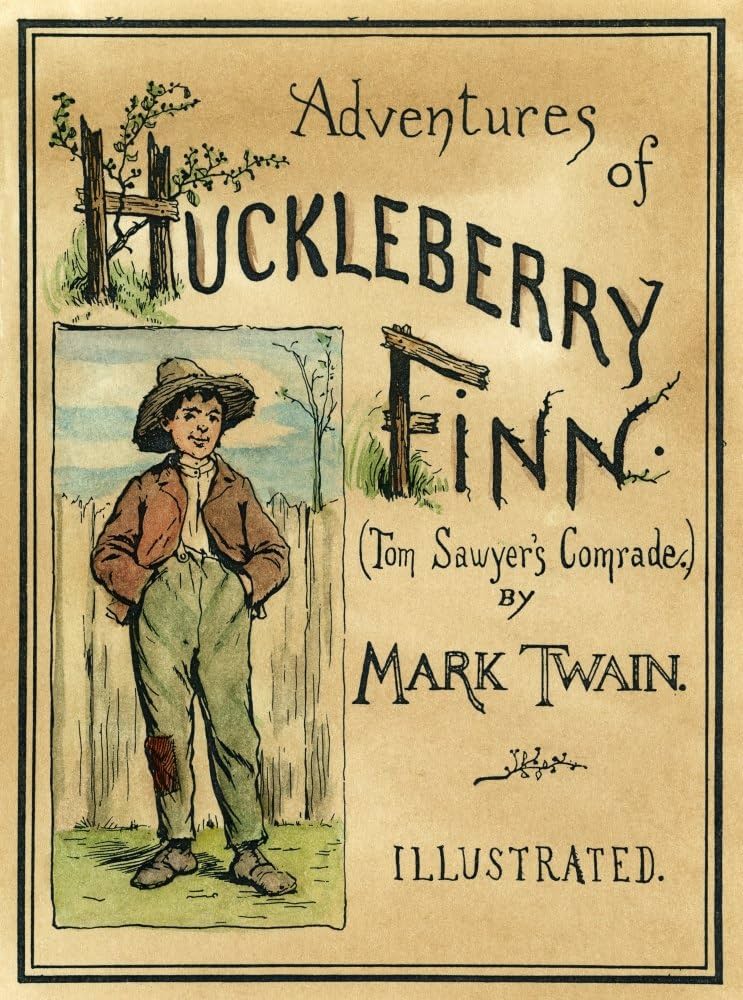
In 1884 Mark Twain published Huckleberry Finn, which is a novel about a child who helped a slave, Jim, to escape. Twain grew up in a slave-owning family in Missouri. Finn met a phony king who said, "Hain't we got all the fools in town on our side? And ain't that a big enough majority in any town?" Finn said that his phony king and duke weren't much worse than the real ones. Like many real Southerners, Finn had been taught that it was wrong to help a slave escape, but said that he would "go to hell" to save his friend.
In addition to his books, Twain made the following observations:
All you need in this life is ignorance and confidence; then success is sure.
Truth is stranger than fiction, but it is because fiction is obliged to stick to possibilities; truth isn't.
The world owes you nothing. It was here first.
The more I learn about people, the more I like my dog.
Giving up smoking is the easiest thing in the world. I know because I've done it thousands of times.
The reports of my death have been greatly exaggerated.
Never argue with stupid people, they will drag you down to their level and then beat you with experience.
Courage is resistance to fear, mastery of fear, not absence of fear.
Man is the only animal that blushes. Or needs to.
Get your facts first, and then you can distort them as much as you please.
A lie can travel half way around the world while the truth is putting on its shoes.
 |
| Grover Cleveland |
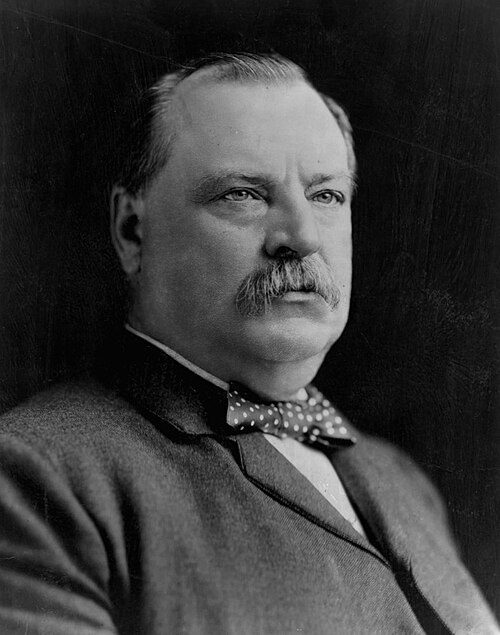
Democrat Grover Cleveland was the first president to win two non-consecutive terms in 1884 and 1892. In 1884 Cleveland defeated Republican James G. Blaine and won the White House. Because Blaine was accused of taking what amounted to a bribe from a railroad, Democrats used the campaign slogan "Blaine, Blaine, James G. Blaine, The Continental Liar from the State of Maine." Republicans accused Cleveland of having an illegitimate child with the slogan, "Ma, Ma, Where's my Pa."
Cleveland tried to move away from the spoils system and supported the gold standard. While some of his decisions were influenced by party concerns, more of Cleveland's appointments were decided by merit alone than was the case in his predecessors' administrations. Cleveland also reformed other parts of the government. In 1887, he signed an act creating the Interstate Commerce Commission. He and Secretary of the Navy William C. Whitney undertook to modernize the Navy and canceled construction contracts that had resulted in inferior ships. Cleveland angered railroad investors by ordering an investigation of Western lands they held by government grant. Secretary of the Interior Lucius Q. C. Lamar charged that the rights of way for this land must be returned to the public because the railroads failed to extend their lines according to agreements. The lands were forfeited, resulting in the return of approximately 81,000,000 acres. He vetoed hundreds of private pension bills for Civil War veterans. After a drought ruined crops in Texas he vetoed the Texas Seed Bill because of his belief in small government. He said that "though the people support the government, the government should not support the people." He said that federal aid "encourages the expectation of paternal care on the part of the government and weakens the sturdiness of our national character." However, Cleveland used the nation's gold surplus to pay off wealthy bond holders at $28 dollars above the $100 dollar value of each bond-a gift of $45 million. Cleveland and Treasury Secretary Daniel Manning stood firmly on the side of the gold standard, and tried to reduce the amount of silver that the government was required to coin under the Bland–Allison Act of 1878. However, they failed to repeal the Act. Because silver was worth less than its legal equivalent in gold, taxpayers paid their government bills in silver, while international creditors demanded payment in gold, resulting in a depletion of the nation's gold supply.
The Interstate Commerce Act of 1887 is a United States federal law that was designed to regulate the railroad industry, particularly its monopolistic practices. The Act required that railroad rates be "reasonable and just", but did not empower the government to fix specific rates. It also required that railroads publicize shipping rates and prohibited short haul or long haul fare discrimination, a form of price discrimination against smaller markets, particularly farmers in Western or Southern Territory compared to the official Eastern states. The Act created a federal regulatory agency, the Interstate Commerce Commission (ICC), which it charged with monitoring railroads to ensure that they complied with the new regulations.
Henry Huntly Haight was a white supremacist, and in the years after he was elected, racial violence was rampant in California. In his 1867 inaugural address as governor of California he said, "The opposition to giving the negro and Asiatic the ballot is not based upon prejudice or ill will against those races, but upon a conviction of the evils which would result to the whole country from corrupting the source of political power with elements so impure."
In Eureka, California, on February 6, 1885, two Chinese men got into a dispute and began firing guns at each other. One of them accidentally shot a white city councilman crossing the street. Shortly after, a mob of white residents stormed into the city's Chinatown chanting "Hang all the Chinamen!" and "Burn Chinatown!" City leaders, including the mayor, sheriff, and a Christian minister, intervened to prevent arson and murders, but white gangs looted Chinatown. And, within about 48 hours, local vigilantes rounded up Chinese residents - hundreds of people - forced them onto steamships bound for San Francisco, and told them to never return. It became known as "the Eureka method" of expulsion and was soon copied by neighboring cities.
Later that year, in Rock Springs, Wyoming, a fight broke out between some Chinese and white miners. This particular fight was over whether Chinese or white workers would get to work in a particularly lucrative mine. After the dispute, a white mob descended on Chinatown, murdered 28 Chinese miners and wounded 15 others. They drove the whole Chinese community out and set their homes and stores ablaze. The incident was dubbed "The Rock Springs Massacre."
A couple of months later white vigilantes - including Mayor Jacob Weisbach and other local political leaders - forcibly expelled all of Tacoma's Chinese residents, this time putting them on a train instead of boats. They then demolished Tacoma's Chinatown.
Over the years, Truckee, California's Chinatown was burned in a series of fires. In fact, after one such fire, the town forced its Chinese residents to build a new Chinatown across the Truckee River. This new Chinatown had no bridge, so they had to cross the river by ferry.
In the winter of 1885-86, a local lawyer and newspaper owner named Charles McGlashan was inspired by the cascade of purges across the West Coast. McGlashan pioneered what became known as "The Truckee Method," a boycott and harassment campaign against Chinese businesses and white businesses that employed Chinese people. The aim was to starve the Chinese out by eliminating their local economic opportunities and making their lives miserable. The campaign proved successful in ridding the town of Chinese residents and was copied by numerous other towns up and down California.
Throughout 1885 and 1886, more than 160 communities across the West Coast would expel their Chinese inhabitants.
In 1888, President Grover Cleveland - hoping to carry Western states in his upcoming reelection battle - signed into law another Chinese Exclusion Act that was harsher than the first one. This one prohibited all Chinese laborers from coming into the country - whether or not they had resided in the United States previously. The Scott Act was signed by US President Grover Cleveland on October 1, 1888. It was introduced to expand upon the Chinese Exclusion Act passed in 1882 and left an estimated 20,000-30,000 Chinese outside the United States at the time of its passage stranded, with no option to return to their US residence.
 |
| Benjamin Harrison |
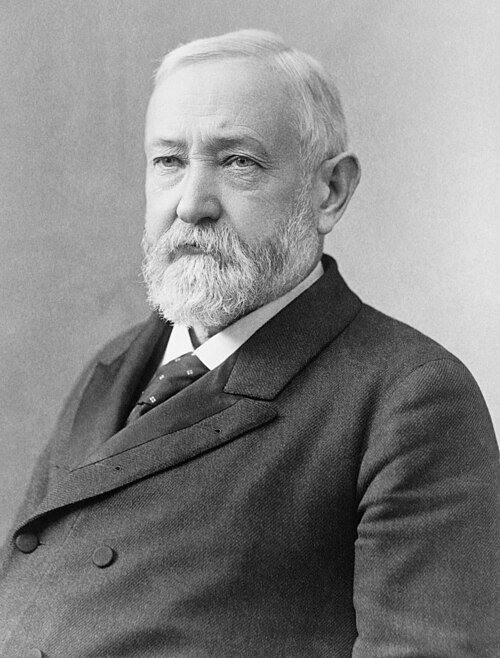
Four years later, with the Geary Act of 1892, Washington renewed Chinese exclusion for another ten years, expanded the power of the federal government to enforce anti-Chinese immigration laws, and implemented the registration and "passport" system that President Arthur had called "undemocratic and hostile to the spirit of our institutions." The Geary Act, signed by President Benjamin Harrison, extended the Chinese Exclusion Act of 1882 and added new requirements. The law required all Chinese residents of the United States to carry a resident permit, a sort of internal passport. Failure to carry the permit at all times was punishable by deportation or a year of hard labor. In addition, Chinese were not allowed to bear witness in court, and could not receive bail in habeas corpus proceedings.
The Geary Act was challenged in the courts but was upheld by the United States Supreme Court in an opinion by Justice Horace Gray in Fong Yue Ting v. United States (1893), with Justices David Josiah Brewer, Stephen J. Field, and Chief Justice Melville Fuller dissenting.
Benjamin Harrison was president in between Cleveland's terms in office. Harrison signed the McKinley Tariff of 1890 and the Sherman Antitrust Act. The McKinley Tariff raised import duties to almost 50 percent. He also helped create national forest reserves through an amendment to the Land Revision Act of 1891. In addition, Harrison substantially strengthened and modernized the US Navy. Cleveland defeated Harrison for reelection in 1892, due to the growing unpopularity of high tariffs and high federal spending.
The Chinese Exclusion Acts remained in force until partly modified by the Chinese Exclusion Repeal Act in 1943, which slightly opened up Chinese immigration and permitted naturalization.
The Chinese Exclusion Acts — and the mob violence, pogroms, boycotts, and other forms of expulsion — had their intended effect. In 1890, the US Census Bureau recorded 107,488 Chinese people living in the United States. In 1910, it was 71,531. The restrictions on Chinese immigration would not begin to be lifted until World War II.
A study indicates that the Chinese Exclusion Acts harmed the economy of Western states, except for mining.
The Sherman Antitrust Act of 1890 prohibits monopolies. It is named for Senator John Sherman, its principal author. The Sherman Act broadly prohibits 1) anticompetitive agreements and 2) unilateral conduct that monopolizes or attempts to monopolize the relevant market. The Act authorizes the Department of Justice to bring suits to enjoin (i.e. prohibit) conduct violating the Act, and additionally authorizes private parties injured by conduct violating the Act to bring suits for treble damages
The Sherman Antitrust Act of 1890 prohibits monopolies. It is named for Senator John Sherman, its principal author. The Sherman Act broadly prohibits 1) anticompetitive agreements and 2) unilateral conduct that monopolizes or attempts to monopolize the relevant market. The Act authorizes the Department of Justice to bring suits to enjoin (i.e. prohibit) conduct violating the Act, and additionally authorizes private parties injured by conduct violating the Act to bring suits for treble damages
The US Supreme Court issued decisions that weakened the Sherman Antitrust Act, except with regard to labor unions and strikes. In its 1895 US v. E. C. Knight Co. decision the Court held that a sugar refining company monopoly couldn't be regulated by the Act because the monopoly was in manufacturing, not commerce. However, the Court said that the Act could be used against interstate strikes because they were a restraint of trade. In its Pollock v. Farmers' Loan & Trust Company decision the Court held that it was unconstitutional to tax high incomes at a higher rate. The Court later refused to break up the Standard Oil and American Tobacco monopolies, claiming that they were not "unreasonable" restraints of trade.
The 1886 US Supreme Court Wabash, St. Louis & Pacific Railway Co. v. Illinois decision limited the right of states to regulate interstate commerce, leading to the creation of the Interstate Commerce Commission. The decision did away with 230 state laws regulating interstate commerce.
The Court also accepted the claim that corporations were persons and that their money was protected by the due process clause of the Fourteenth Amendment. At the same time, the Court defined the rights of blacks very narrowly. Of the cases brought before the Court between 1890 and 1910 regarding the rights of persons, 19 dealt with the rights of blacks and 288 dealt with corporations.
In 1892, Cleveland had campaigned against the Lodge Bill, which would have strengthened voting rights protections through the appointing of federal supervisors of congressional elections upon a petition from the citizens of any district. The Enforcement Act of 1871 had provided for a detailed federal overseeing of the electoral process, from registration to the certification of returns. Cleveland succeeded in ushering in the 1894 repeal of this law.
Shortly after Cleveland's second term began, the Panic of 1893 struck the stock market, leaving Cleveland and the nation to face an economic depression. The economic downturn from 1893 to 1898 was one of the worst in the nation's history. Unemployment in 1894 spiked to 18.4 percent, the highest level until the Great Depression. The Sherman Silver Purchase Act was repealed, which eventually led to the end of silver as a basis for US currency.
In 1895 the gold reserve in the US was depleted. A syndicate of bankers headed by J. P. Morgan & Company, August Belmont & Company, the National City Bank and others offered to give the government gold in exchange for bonds. Cleveland agreed. The bankers immediately resold the bonds and made $18 million in profit.
Even though Chinese Exclusion Acts reduced immigration from China, there was an increase in overall immigration during the 1880s and 1890s. Much of the immigration during these decades was from Eastern and Southern Europe. There were about 5 and a half million immigrants in the 1880s and 4 million in the 1890s. Economists claim that immigration increased rapid economic growth during this period. Some of these immigrants were used for child labor until laws were passed to outlaw child labor in the early 20th century. In 1880 there were 1,118,000 children under 16 and at work, one worker out of six.
When Cleveland took office, he faced the question of Hawaiian annexation. In his first term, he had supported free trade with the Hawaiian Kingdom and accepted an amendment that gave the United States a coaling and naval station in Pearl Harbor. A treaty of peace and friendship existed between the United States and Hawaii. In the intervening four years, however, Honolulu businessmen of European and American ancestry had denounced Queen Liliʻuokalani as a tyrant who rejected constitutional government. In January 1893 they overthrew her, set up a provisional government under Sanford B. Dole, and sought to join the United States. Cleveland opposed annexation.
There were 103 military interventions in foreign countries between 1798 an 1895. These include several invasions of Nicaragua as well as Argentina, Uruguay, China, Angola, Portuguese West Africa, Mexico and Hawaii.
In 1897 and 1898 German military forces occupied the Chinese port of Tsingtao at Kiaochow Bay and demanded a naval station there, with rights to railways and coal mines on the nearby peninsula of Shantung. Soon other European countries partitioned China.
Plessy v. Ferguson (1896), was a landmark United States Supreme Court decision ruling that racial segregation laws did not violate the US Constitution as long as the facilities for each race were equal in quality, a doctrine that came to be known as "separate but equal." The decision legitimized the many "Jim Crow laws" re-establishing racial segregation that had been passed in the American South after the end of the Reconstruction era in 1877.
The underlying case began in 1892 when Homer Plessy, a mixed-race man, deliberately boarded a whites-only train car in New Orleans. By boarding the whites-only car, Plessy violated Louisiana's Separate Car Act of 1890, which required "equal, but separate" railroad accommodations for white and black passengers. Plessy was charged under the Act, and at his trial his lawyers argued that judge John Howard Ferguson should dismiss the charges on the grounds that the Act was unconstitutional. Ferguson denied the request, and the Louisiana Supreme Court upheld Ferguson's ruling on appeal. Plessy then appealed to the US Supreme Court.
In May 1896, the Supreme Court issued a 7–1 decision against Plessy, ruling that the Louisiana law did not violate the Fourteenth Amendment to the US Constitution. It held that although the Fourteenth Amendment established the legal equality of whites and blacks, it did not and could not require the elimination of all "distinctions based upon color." The Court rejected Plessy's lawyers' arguments that the Louisiana law inherently implied that black people were inferior. It gave great deference to American state legislatures' inherent power to make laws regulating health, safety, and morals-the "police power"-and to determine the reasonableness of the laws they passed. Justice John Marshall Harlan was the lone dissenter from the Court's decision, writing that the US Constitution "is color-blind, and neither knows nor tolerates classes among citizens", and so the laws distinguishing races should have been found unconstitutional.
Plessy is widely regarded as one of the worst decisions in US Supreme Court history.
 |
| Hawaii |
From the time Captain James Cook found Hawaii to the 19th century about 90 percent of native Hawaiians died because they had little resistance to European diseases. In 1779, during his second visit to Hawaii, Cook was killed when a dispute with Native Hawaiians turned violent.
Walter Murray Gibson was the captain of a ship and became involved in gunrunning in the Caribbean. Later, he was jailed in the East Indies by the Dutch on charges of fomenting rebellion, was sentenced to death, but managed to escape from Weltevreden Prison in Java. He claimed receiving a vision while in prison to "build up a kingdom in these isles, whose lines of power shall run around the earth." In 1859, he went to Utah Territory and joined the Church of Jesus Christ of Latter-day Saints, persuading church president Brigham Young to allow him to establish a Mormon colony in the Pacific.
Gibson arrived in the Hawaiian Islands in 1861, and founded a colony among members of the LDS Church who were already in the islands. He purchased land on the island of Lanai with funds from the colony in his own name, but was excommunicated after an investigation by the church regarding accusations of preaching false doctrine, maladministration of the colony, and embezzlement of church funds. The proceedings leading to his excommunication were initiated by letters from Jonathan Napela and other Native Hawaiian church leaders to church headquarters in Salt Lake City. Upon excommunication, he expelled those who did not support him from his colony and church and began angling for secular political office and power.
In 1873, Gibson started his own newspaper to extol his virtues in English and Hawaiian called the Nuhou. He successfully ran for the House of Representatives in 1878 as a candidate of the King's Party, allying himself with King Kalakaua and portraying himself as the "voice of Hawaiians." In 1880 he bought the Pacific Commercial Advertiser .
In 1882, he was appointed Minister of Foreign Affairs, and then in May 1882, Prime Minister of the Kingdom of Hawaii by King Kalākaua. He also served on various boards, as Attorney General, Minister of the Interior, and Secretary of War. He often held several cabinet positions simultaneously, and at one point, the cabinet consisted of only him and Minister of Finance John Mākini Kapena, resulting in newspapers labeling him the "Minister of Everything."
 |
| Queen Liliʻuokalani |
In June 1887, local businessmen, sugar planters, and politicians backed by the Honolulu Rifles under Sanford Ballard Dole forced the dismissal of the cabinet of controversial Walter M. Gibson and forced the adoption of the 1887 Constitution of the Kingdom of Hawaii. The new documents limited voting rights to the literate males of Hawaiian, European, and American descent, while imposing income and wealth requirements to be eligible to vote for the House of Nobles. This effectively consolidated power among the elite residents of the island. In addition, the new Constitution minimized the power of the Monarch in favor of more influential governance by the cabinet. Dole and other lawyers of American descent drafted this document, which became known as the "Bayonet Constitution."
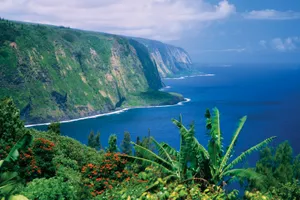
In 1887, a US naval base was established at Pearl Harbor as part of the new Hawaiian constitution. Sugar exports to the United States expanded greatly during the next four years, and US investors and American sugar planters on the islands broadened their domination over Hawaiian affairs. However, Queen Liliʻuokalani ascended to the throne on January 29, 1891, nine days after her brother's death. During her reign, she attempted to draft a new constitution which would restore the power of the monarchy and the voting rights of the economically disenfranchised. Threatened by her attempts to abrogate the Bayonet Constitution, pro-American elements in Hawaii overthrew the monarchy on January 17, 1893. A revolutionary "Committee of Safety," organized by Sanford B. Dole, staged a coup against Queen Liliʻuokalani with the tacit support of the United States. On February 1, Minister John Stevens recognized Dole's new government on his own authority and proclaimed Hawaii a US protectorate. The coup occurred with the foreknowledge of John L. Stevens, the US minister to Hawaii, and 300 US Marines from the US cruiser Boston were called to Hawaii, allegedly to protect American lives. Dole submitted a treaty of annexation to the US Senate, but most Democrats opposed it, especially after it was revealed that most Hawaiians did not want annexation.
President Grover Cleveland sent a new US minister to Hawaii to restore Queen Liliʻuokalani to the throne under the 1887 constitution, but Dole refused to step aside and instead proclaimed the independent Republic of Hawaii. In 1893 Theodore (Teddy) Roosevelt called failure to annex Hawaii "a crime against white civilization." He said, "All the great masterful races have been fighting races ... No triumph of peace is quite so great as the supreme triumph of war." Cleveland was unwilling to overthrow the government by force. His successor, President William McKinley, negotiated a treaty with the Republic of Hawaii in 1897. In 1898 the Spanish-American War broke out, and the strategic use of the naval base at Pearl Harbor during the war convinced Congress to approve formal annexation. Two years later Hawaii was organized into a formal US territory, and in 1959 entered the United States as the 50th state.
In the month before Cleveland's 1885 inauguration, President Arthur opened four million acres of Winnebago and Crow Creek Indian lands in the Dakota Territory to white settlement by executive order. Tens of thousands of settlers gathered at the border of these lands and prepared to take possession of them. Cleveland believed Arthur's order to be in violation of treaties with the tribes, and rescinded it on April 17 of that year, ordering the settlers out of the territory. Cleveland sent in eighteen companies of Army troops to enforce the treaties and ordered General Philip Sheridan, at the time Commanding General of the US Army, to investigate the matter.
President Grover Cleveland encouraged the idea of cultural assimilation, pushing for the passage of the Dawes Act, which would allow lands held in trust by the federal government for the tribes to instead be distributed to individual tribe members. While a conference of Native leaders endorsed the act, in practice the majority of Native Americans disapproved of it. Cleveland believed the Dawes Act would lift Native Americans out of poverty and encourage their assimilation into white society. It ultimately weakened the tribal governments and allowed individual Indians to sell land and keep the money. This would convert traditional systems of land tenure into a government-imposed system of private property by forcing Native Americans to "assume a capitalist and proprietary relationship with property" that did not previously exist in their cultures. Before private property could be dispensed, the government had to determine which Indians were eligible for allotments, which propelled an official search for a federal definition of "Indian-ness."
Although the act was passed in 1887, the federal government implemented the Dawes Act on a tribe-by-tribe basis thereafter. For example, in 1895, Congress passed the Hunter Act, which administered the Dawes Act among the Southern Ute. The nominal purpose of the act was to protect the property of the natives as well as to compel "their absorption into the American mainstream."
Native peoples who were deemed to be mixed-blood were granted US citizenship, while others were "detribalized." Between 1887 and 1934, Native Americans ceded control of about 100 million acres of land (as of 2019 the United States has a total 1.9 billion acres of land) or about "two-thirds of the land base they held in 1887" as a result of the act.
The "Five Civilized Tribes" (Cherokee, Chickasaw, Choctaw, Muscogee, and Seminole) in Indian Territory were initially exempt from the Dawes Act. The Curtis Act of 1898 extended the provisions of the Dawes Act to the "Five Civilized Tribes," required the abolition of their governments and dissolution of tribal courts, allotment of communal lands to individuals registered as tribal members, and sale of lands declared surplus. This law was "an outgrowth of the land rush of 1889, and completed the extinction of Indian land claims in the territory. This violated the promise of the United States that the Indian territory would remain Indian land in perpetuity," completed the obliteration of tribal land titles in Indian Territory, and prepared for admission of the territory land to the Union as the state of Oklahoma. The Dawes Act was amended again in 1906 under the Burke Act.
During the Great Depression, the Franklin D. Roosevelt administration passed the US Indian Reorganization Act on June 18, 1934. It prohibited any further land allotment and created a "New Deal" for Native Americans, which renewed their rights to reorganize and form self-governments in order to "rebuild an adequate land base."
There were dozens of major wars against Indian tribes, from the Arikara War in 1823 to the Battle of Bear Valley in 1918. These wars pushed Indians off of their land and onto small reservations. The United States signed more than 400 treaties with Indians, and violated all of them.
|
| Sitting Bull |
During the French and Indian Wars the Susquehannas, living peaceably in white towns, were murdered by their neighbors to collect their scalps. In 1860 California ranchers killed 185 out of 800 Wiyots, a tribe allied with whites, because the ranchers were angry at other tribe's cattle raids.
In 1825, Lewis Cass told Shawnees and Cherokees that if they would only move to new lands across the Mississippi, "The United States will never ask for your land there. This I promise you in the name of your great father, the President. That country he assigns to his red people, to be held by them and their children's children forever."
The Bear River Massacre was an attack by around 200 US soldiers that killed an estimated 250 to 400 children, women, and men at a Shoshone winter encampment on January 29, 1863. Some sources describe it as the largest mass murder of Native Americans by the US military, and largest single episode of genocide in US history. It took place in present-day Franklin County, Idaho near the present-day city of Preston on January 29, 1863. After years of skirmishes and food raids on farms and ranches, and colonial settlers displacing Shoshone from their ancestral lands, the United States Army attacked a large Shoshone community at the confluence of the Bear River and Battle Creek in what was then southeastern Washington Territory. Colonel Patrick Edward Connor led a detachment of California Volunteers as part of the Bear River Expedition against Shoshone chief Bear Hunter.
The Sand Creek massacre (also known as the Chivington massacre, the battle of Sand Creek or the massacre of Cheyenne Indians) was a massacre of Cheyenne and Arapaho people by the US Army in the American Indian Wars that occurred on November 29, 1864, when a 675-man force of the Third Colorado Cavalry under the command of US Volunteers Colonel John Chivington attacked and destroyed a village of Cheyenne and Arapaho people in southeastern Colorado Territory, killing and mutilating an estimated 70 to over 600 Native American people. Chivington claimed 500 to 600 warriors were killed. However, most sources estimate around 150 people were killed, about two-thirds of whom were women and children.
On January 23, 1870 an army detachment led by Col. Eugene M. Baker killed 173 members of Heavy Runner's band of Piegan Indians, largely women, old men and children. They were camped by the Marias River in Montana. Baker was looking for Piegan raiders, but found the wrong band, a village full of people sick and dying of smallpox. Although Baker was warned that this was the wrong band, he attacked anyway.
Western Apaches believed army promises that they would be safe if they settled in the Aravaipa Canyon near Tucson. Whites, vecinos (Spanish speakers) and the Tohono O'odham Indians accused the Apaches of being savage enemies of their homes. In 1871, all three groups killed about 150 Apaches, mostly women and children. They were either shot or had their skulls split by war clubs. No one was convicted of the Camp Grant Massacre.
The newspaper account of the massacre of a Pomo Indian village at Clear Lake, north of San Francisco, is as follows:
The troops arrived in the vicinity of the lake and came unexpectedly upon a body of Indians numbering between two and three hundred ... They immediately surrounded them and as the Indians raised a shout of defiance and attempted to escape, poured in a destructive fire indiscriminately upon men, women and children. They fell, says our informant, as grass before the sweep of the scythe.
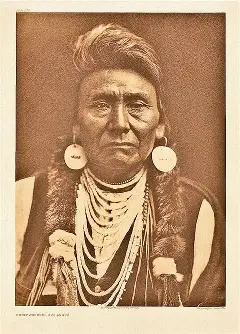
For over three months of the Nez Perce War, the Nez Perce deftly outmaneuvered and battled their pursuers, traveling more than 1,170 miles across present-day Oregon, Washington, Idaho, Wyoming, and Montana. One of those battles was led by Captain Perry and two cavalry companies of the US Army led by Captain Trimble and Lieutenant Theller, who engaged Chief Joseph and his people at White Bird Canyon on June 17, 1877. The Nez Perce repelled the attack, killing 34 soldiers, while suffering only three Nez Perce wounded. The Nez Perce continued to repel the Army's advances, eventually reaching the Clearwater River, where they united with another Nez Perce chief, Looking Glass, and his group, bringing the size of their party to 740, though only 200 of these were warriors. The final battle of the Nez Perce War occurred approximately 40 miles south of the Canadian border where the Nez Perce were camped on Snake Creek near the Bears Paw Mountains, close to present-day Chinook in Blaine County, Montana. A US Army detachment commanded by General Nelson A. Miles and accompanied by Cheyenne scouts intercepted the Nez Perce on September 30 at the Battle of Bear Paw. After his initial attacks were repelled, Miles violated a truce and captured Chief Joseph; however, he would later be forced to exchange Chief Joseph for one of his captured officers.
General Howard arrived on October 3, leading the opposing cavalry, and was impressed with the skill with which the Nez Perce fought, using advance and rear guards, skirmish lines, and field fortifications. Following a devastating five-day siege during freezing weather, with no food or blankets and the major war leaders dead, Chief Joseph formally surrendered to General Miles on the afternoon of October 5, 1877. By the time Joseph had surrendered, 150 of his followers had been killed or wounded. Sherman wanted to hang Chief Joseph. Instead, he broke General Miles' promise to the Nez Perce and exiled them to Indian Territory.
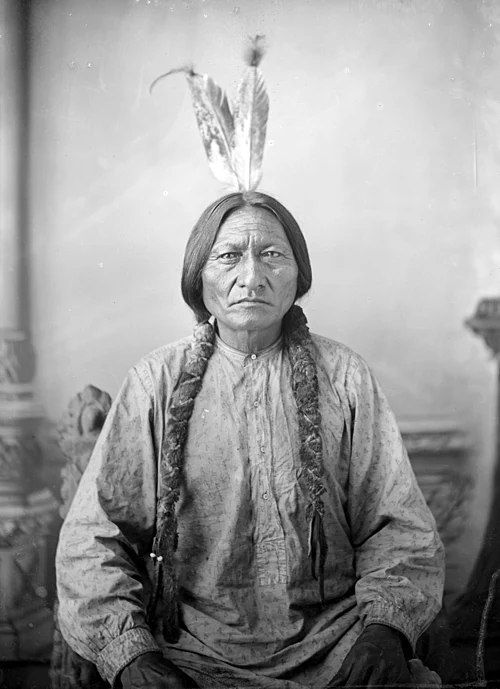
The Battle of the Little Bighorn, commonly referred to as Custer's Last Stand, was an armed engagement between combined forces of the Lakota Sioux, Northern Cheyenne, and Arapaho tribes and the 7th Cavalry Regiment of the United States Army. It took place on June 25–26, 1876, along the Little Bighorn River (which Indians called the Greasy Grass River) in the Crow Indian Reservation in southeastern Montana Territory. The battle, which resulted in the defeat of US forces, was the most significant action of the Great Sioux War of 1876.
|
| Chief Joseph |
The fight was an overwhelming victory for the Lakota, Northern Cheyenne, and Arapaho, who were led by Crazy Horse and Chief Gall, and had been inspired by the visions of Sitting Bull. The US 7th Cavalry, a force of 700 men, commanded by Lieutenant Colonel George Armstrong Custer (a brevetted major general during the American Civil War), suffered a major defeat. Five of the 7th Cavalry's twelve companies were wiped out and Custer was killed, as were two of his brothers, his nephew, and his brother-in-law. The total US casualty count included 268 dead and 55 severely wounded (six died later from their wounds), including four Crow Indian scouts and at least two Arikara Indian scouts.
The Wounded Knee Massacre involved nearly three hundred Lakota people killed by soldiers of the United States Army. More than 250 people of the Lakota were killed and 51 wounded (4 men and 47 women and children, some of whom died later). Some estimates placed the number of dead as high as 300. Twenty-five US soldiers also were killed and 39 were wounded (six of the wounded later died). The event occurred on December 29, 1890, near Wounded Knee Creek on the Lakota Pine Ridge Indian Reservation in South Dakota, following a botched attempt to disarm the Lakota people at the camp.
In the 1870s Congress ended the treaty system because of a backlash against the attempt by James Joy to use a treaty to transfer land from Osage Indians to his railroad. However, agreements that were similar to treaties continued to be negotiated. Columbus Delano and Zachariah Chandler were corrupt secretaries of the Interior Department who profited from the theft of Indian allotments. Commissioner of Indian Affairs Ely Parker sought to use the Board of Indian Commissioners to allow Indians to maintain distinctive communities within the larger nation. He was falsely accused of fraud and forced out, to be replaced by Francis Walker. Walker's policy was to avoid Indian wars by moving them to reservations where they would be fed and dependent on the government, "secluding Indians from whites for the good of both races." The same government that would provide for them would also keep them from leaving reservations. If they tried to escape they would be arrested and returned to reservations.
Sherman was no friend of the Indians, but he said, "We kill them if they attempt to hunt and if they keep within the Reservation, they starve." General George Crook blamed "greed and avarice on the part of whites" for Indian wars. General John Schofield called the Indian policy "greed and cruelty." Even Sheridan said, "we took away their country and their means of support, broke up their mode of living, their habits of life, introduced disease and decay among them, and it was for this and against this they made war. Could any one expect less?"
Buffalo were hunted almost to extinction, which harmed Indians. On the southern plains were the Comanches along with their Kiowa and Southern Cheyenne allies. On the northern plain the Lakotas, the most westerly group of Sioux, along with their Arapaho and Northern Cheyenne allies, controlled the lands north of the Platte River. Indians raided southward and hunters, Anglo liquor traders and horse thieves invaded Indian hunting grounds. Sherman and Sheridan fought in Indian wars. During the Red River War the army hunted down refugees, burned their villages and supplies, and captured their horses. The Indians fled to land promised them by a treaty and fought back when attacked. 71 Comanche, Kiowa and Cheyenne captives were sent to prison in Florida.
Without legal rights, acculturation can't be achieved. As Inmuttooyahlatlat (otherwise known as Chief Joseph) said, "We ask that the same law shall work alike on all men. If an Indian breaks the law, punish him by the law. If a white man breaks the law, punish him also. Let me be a free man—free to travel, free to stop, free to work, free to trade where I choose, free to talk and think and act for myself." For many years most courts refused to hear the testimony of Native Americans against whites.
According to John Toland, Hitler admired our concentration camps for Indians and "often praised to his inner circle the efficiency of America's extermination by starvation and uneven combat."
From 1860 to 1900 the population of the US grew from 31 million to 75 million. At the same time greater productivity allowed the percentage of Americans working in agriculture to go down from a majority to 40 percent. From 1860 to 1910 the US Army drove the Great Plains Indians out to make room out west for railroads and farms. A bushel of wheat went from taking three hours to produce in 1830 to ten minutes by 1900. Because of mechanization of farm equipment from 1840 to 1880, the number of hours to produce a bushel of wheat went from 233 to 152. For corn, the equivalent figures went from 276 to 180. The cost of farm machinery went up, and the price of crops went down. The fact that farmers had to borrow was the reason they wanted to pay in silver or paper money. When farmers couldn't afford to pay their debts, their farms were seized and they had to pay rent as tenant farmers. By 1880, 25 percent of farms were rented by tenants. During the Panic of 1877 farmers in Texas formed the first Farmers Alliance. These Alliances allowed farmers to form cooperatives and buy collectively to get lower prices. Cotton farmers sold cotton collectively, which they called "bulking."
In 1886 Populists in Texas drew up their Cleburne Demands for regulation of railroad rates, higher taxation of land held for purely speculative purposes and an increase in the money supply so that debts could be repaid with inflated dollars. In the South, 90 percent of farmers lived on credit. The Populist Party demanded an increase in the circulating currency (to be achieved by the unlimited coinage of silver), a graduated income tax, government ownership of the railroads, a tariff for revenue only, the direct election of US senators and other measures designed to strengthen political democracy and give farmers economic parity with business and industry. In the South, however, most farmers refused to endanger white supremacy by voting against the Democratic Party. Additional victories were won in the 1894 midterm election, but in 1896 the Populists allowed themselves to be swept into the Democratic cause by their mutual preoccupation with the Free Silver Movement.
 |
| William McKinley |
William McKinley was elected president in 1897. He was assassinated in 1901. He was known for the McKinley Tariff of 1890, the Dingley Tariff of 1897 and the Spanish-American War of 1898. The McKinley Tariff - sponsored by McKinley when he was a House member - proved so unpopular that it led to the Democratic landslide of 1892. America seized control over Puerto Rico, Guam, the Philippines and Cuba. Cuba was promised independence. The Kingdom of Hawaii was sovereign from 1810 until 1893, when resident American and European capitalists and landholders overthrew the monarchy. Hawaii was an independent republic from 1894 until August 12, 1898, when it officially became a US territory. Hawaii was admitted as a US state on August 21, 1959. International rivalries in the latter half of the century were settled by the 1899 Tripartite Convention in which Germany and the United States partitioned the Samoan Islands into two: American Samoa became a territory of the United States; the western islands, by far the greater landmass, became known as German Samoa.
The central issue of the presidential campaign of 1896 was the nation's money supply. McKinley ran on a Republican platform emphasizing maintenance of the gold standard, while his opponent — William Jennings Bryan, candidate of both the Democratic and Populist parties — called for a bimetallic standard of gold and silver. Bryan campaigned vigorously, traveling thousands of miles and delivering hundreds of speeches in support of an inflated currency that would help poor farmers and other debtors. Bryan, in his Cross of Gold speech, closed with "you shall not press down on the brow of labor this crown of thorns. You shall not crucify mankind on a cross of gold."
Wealthy Ohio industrialist Mark Hanna tapped big businesses for enormous campaign contributions while simultaneously directing a network of Republican speakers who portrayed Bryan as a dangerous radical and McKinley as "the advance agent of prosperity." McKinley won the election decisively.
In the brief Spanish-American War-"a splendid little war," in the words of Secretary of State John Hay-the United States easily defeated Spanish forces in the Philippines, Cuba, and Puerto Rico. Combat began early in May and ended with an armistice in mid-August. Under the Treaty of Paris, signed December 10, 1898, Spain relinquished Cuba and ceded to the United States the Philippines, Puerto Rico, and Guam. The Philippine-American War lasted from 1899 - 1902. Cuba gained independence on May 20, 1902 and the Philippines gained independence on July 4, 1946. Puerto Rico and Guam are still part of the US
September 6, 1901, while McKinley was shaking hands with a crowd of well-wishers at the exposition, Leon Czolgosz, an anarchist, fired two shots into the president's chest and abdomen. Rushed to a hospital in Buffalo, McKinley lingered for a week before dying in the early morning hours of September 14. He was succeeded by his vice president, the man Mark Hanna sneeringly referred to as "that damned cowboy," Theodore Roosevelt.
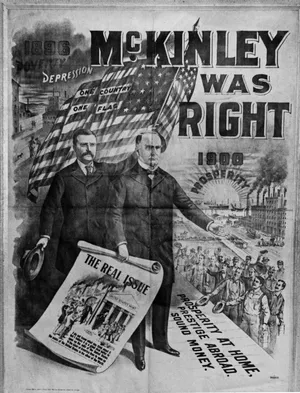 |
| McKinley Was Right |
The war originated in the Cuban struggle for independence from Spain, which began in February 1895. The Cuban conflict was injurious to US investments in the island, which were estimated at $50 million, and almost ended US trade with Cuban ports, normally valued at $100 million annually. On the insurgent side, the war was waged largely against property and led to the destruction of sugarcane and sugar mills. Of more importance than its effect on US monetary interests was the appeal to American humanitarian sentiment. Under the Spanish commander, Capt. Gen. Valeriano Weyler y Nicolau (nicknamed El Carnicero, "the Butcher"), Cubans were herded into so-called "reconcentration areas" in and around the larger cities; those who remained at large were treated as enemies. Spanish authorities made no adequate provision for shelter, food, sanitation, or medical care for the reconcentrados, thousands of whom died from exposure, hunger, and disease. These conditions were graphically portrayed for the US public by sensational newspapers, notably Joseph Pulitzer's New York World and William Randolph Hearst's recently founded New York Journal. Humanitarian concern for the suffering Cubans was added to the traditional American sympathy for a colonial people struggling for independence.
Riots in Havana in December led to the sending of the battleship Maine to that city's port as a precaution for the safety of US citizens and property. On the night of February 15, 1898, an explosion sank the Maine at her Havana anchorage, and more than 260 of her crew were killed. Responsibility for the disaster was never determined. A US naval board found convincing evidence that an initial explosion outside the hull (presumably from a mine or torpedo) had touched off the battleship's forward magazine. The Spanish government offered to submit the question of its responsibility to arbitration, but the US public, prompted by the New York Journal and other sensational papers in the grips of yellow journalism, held Spain unquestionably responsible. "Remember the Maine, to hell with Spain!" became a popular rallying cry. Hearst told a photographer that he would furnish the pictures, and Hearst would furnish the war. The Teller Amendment said that the US would not annex Cuba.
Spain agreed to end the reconcentration policy. Instead of accepting US mediation, it would seek the pacification of the island through the Cuban cortes about to be elected under the autonomy program. Spain, however, still refused to concede independence, which McKinley considered indispensable for restoration of peace and order in Cuba. The war was fought between April 21 - August 13, 1898 and ended in American victory.
On April 21, 1898 the US began a blockade of Cuba, and soon after Spain and the US declared war. The first blow fell in Manila Bay on May 1, 1898. Dewey, picked by Roosevelt for the command, led his squadron into the bay before dawn and in a leisurely morning engagement destroyed the anchored Spanish ships with naval gunfire. American casualties amounted to only seven slightly wounded men. Dewey remained in control of the bay while a military force was sent out to assist him in taking possession of the city of Manila. By the end of July some 11,000 US troops under Maj. Gen. Wesley Merritt had arrived in the Philippines, and on August 13 they occupied Manila.
A Spanish fleet of four armored cruisers and three destroyers, commanded by Adm. Pascual Cervera y Topete, steamed westward from the Cape Verde Islands. It was located in Santiago's harbour on the south coast of Cuba. The North Atlantic Squadron under Rear Adm. William T. Sampson and the so-called Flying Squadron under Commodore Winfield Scott Schley thereupon blockaded the harbour entrance. An army of regulars and volunteers—including Roosevelt's regiment of "Rough Riders" (minus their horses) and the buffalo soldiers of the 9th and 10th cavalries—embarked at Tampa and landed on the Cuban coast east of Santiago. The US objective was to trap Cervera between the army and navy, thus forcing him either to surrender or to come out and fight. On July 1, in the hard-fought Battles of El Caney and San Juan Hill (in which the Rough Riders played a major role, contributing to the popular image of Roosevelt as a war hero), US troops penetrated the outer defenses of Santiago. Their hold was so precarious and the incidence of malaria and other diseases was so widespread that their commander, Maj. Gen. William R. Shafter, considered withdrawing to await reinforcements. This idea was abandoned on July 3 when Cervera, under orders from Havana, led his squadron out of Santiago harbour and tried to escape westward along the coast. In the ensuing battle, all of Cervera's ships, under heavy fire from the US fleet, were beached in a burning or sinking condition. US losses were insignificant. Two weeks later the city of Santiago surrendered to Shafter.
Although the US did not annex Cuba, a Cuban Constitutional Convention was told that the United States Army would not leave Cuba until a Platt Amendment was added to the new Cuban Constitution. The Amendment allowed the US "the right to intervene for the preservation of Cuban independence" and also allowed the US to get coaling and naval stations. After several refusals the Convention accepted the Platt Amendment.
The Filipino people were not believed to have the education, training, or experience needed for successful self-government. This belief persisted despite the fact that a group headed by Emilio Aguinaldo had declared the Philippines a provisional republic in June 1898, and it ignored the reality on the ground: Aguinaldo's forces controlled virtually the entire archipelago outside of Manila.
McKinley decided that the United States must take possession of the roughly 7,000 islands and 7,000,000 inhabitants of the Philippines. This demand was reluctantly agreed to by Spain, with the stipulation that the United States pay Spain $20,000,000 nominally for public buildings and public works in the Philippines. The Treaty of Paris, signed December 10, 1898, conformed to these terms. Spain relinquished Cuba and ceded to the United States the Philippines, Puerto Rico, and Guam for $20 million. The treaty was strongly opposed in the US Senate but was approved on February 6, 1899, by a single vote.
Two days earlier, the Philippine-American War had begun when fighting broke out between US troops and Aguinaldo's insurgents outside Manila. For the next three years the Filipinos carried on a guerrilla warfare campaign against US rule. By the time fighting ended, some 20,000 Filipino troops and 200,000 civilians were dead. A captain from Kansas wrote, "Caloocan was supposed to contain 17,000 inhabitants. The Twentieth Kansas swept through it, and now Caloocan contains not one living native." A private said he had "with my own hand set fire to over fifty houses of Filipinos after the victory at Caloocan. Women and children were wounded by our fire." A volunteer from Washington wrote, "This shooting human beings beats rabbit hunting all to pieces."
In November 1901, the Manila correspondent for the Philadelphia Ledger reported,
The present war is no bloodless, opera bouffe engagement; our men have been relentless, have killed to exterminate men, women, children, prisoners and captives, active insurgents and suspected people from lads of ten up, the idea prevailing that the Filipino as such was little better than a dog. ... Our soldiers have pumped salt water into men to make them talk, and have taken prisoners people who held up their hands and peacefully surrendered, and an hour later, without an atom of evidence to show that they were even insurrectos, stood them on a bridge and shot them down one by one, to drop into the water below and float down, as examples to those who found their bullet-loaded corpses.
In Manila, a Marine named Littleton Waller, a major, was accused of killing 11 defenceless Filipinos on the island of Samar. Other marine officers described his testimony as follows,
The major said that General Smith instructed him to kill and burn, and said that the more he killed and burned the better pleased he would be; that it was no time to take prisoners, and that he was to make Samar a howling wilderness. Major Waller asked General Smith to define the age limit for killing, and he replied "Everything over ten."
According to Richard Morris' Encyclopedia of American History,
Of the more than 274,000 officers and men who served in the army during the Spanish-American War and the period of demobilization, 5,462 died in the various theaters of operation and in camps in the US. Only 379 of the deaths were battle casualties, the remainder being attributed to disease and other causes.
In May of 1898, Armour and Company sold the army 500,000 pounds of beef. An army inspector tested the meat, which had been approved by an inspector of the Bureau of Animal Industry, and found 751 cases of rotten meat. According to the inspector, 14 cans burst, "the effervescent putrid contents of which were distributed all over the cases."
Mark Twain's Autobiography includes an essay that said of the Moro Massacre in the Philippines, "In what way was it a battle? It has no resemblance to a battle ... We cleaned up our four days' work and made it complete by butchering these helpless people." The essay, Twain's 1906 Comments on the Moro Massacre, which was not published until after his death, said,

|
| Mark Twain |
General Wood was present and looking on. His order had been, "Kill or capture those savages." Apparently our little army considered that the "or" left them authorized to kill or capture according to taste, and that their taste had remained what it had been for eight years in our army out there-the taste of Christian butchers.
In the February 1901 article To the Person Sitting in Darkness Twain wrote the following about imperialism:
There must be two Americas: one that sets the captive free, and one that takes a once-captive's new freedom away from him, and picks a quarrel with him with nothing to found it on; then kills him to get his land. . .
True, we have crushed a deceived and confiding people; we have turned against the weak and the friendless who trusted us; we have stamped out a just and intelligent and well-ordered republic; we have stabbed an ally in the back and slapped the face of a guest; we have bought a Shadow from an enemy that hadn't it to sell; we have robbed a trusting friend of his land and his liberty; we have invited clean young men to shoulder a discredited musket and do bandit's work under a flag which bandits have been accustomed to fear, not to follow; we have debauched America's honor and blackened her face before the world. . .
And as for a flag for the Philippine Province, it is easily managed. We can have a special one-our States do it: we can have just our usual flag, with the white stripes painted black and the stars replaced by the skull and cross-bones.
Elsewhere Twain wrote,
We have pacified some thousands of the islanders and buried them; destroyed their fields; burned their villages, and turned their widows and orphans out-of-doors; furnished heartbreak by exile to some dozens of disagreeable patriots; subjegated the remaining ten millions by Benevolent Assimilation, which is the pious new name for the musket; we have acquired property in the three hundred concubines and other slaves of our business partner, the Sultan of Sulu, and hoisted our protecting flag over that swag.
And so, by these Providences of God-and the phrase is the government's, not mine-we are a World Power.
Still elsewhere Twain wrote, "I bring you the stately matron named Christiandom, returning bedraggled, besmirched, and dishonored from pirate raids in Kiao-Chou, Manchuria, South Africa and the Philippines, with her soul full of meanness, her pocket full of boodle, and her mouth full of pious hypocracies."
The Open Door policy was a statement of principles initiated by the United States in 1899 and 1900 for the protection of equal privileges among countries trading with China and in support of Chinese territorial and administrative integrity. The statement was issued in the form of circular notes dispatched by US Secretary of State John Hay to Great Britain, Germany, France, Italy, Japan, and Russia. The Open Door policy was received with almost universal approval in the United States, and for more than 40 years it was a cornerstone of American foreign policy in East Asia.
The principle that all countries should have equal access to any of the ports open to trade in China had been stipulated in the Anglo-Chinese treaties of Nanjing (Nanking, 1842) and Wangxia (Wanghia, 1844). Great Britain had greater interests in China than any other power and successfully maintained the policy of the open door until the late 19th century. After the first Sino-Japanese War (1894–95), however, a scramble for "spheres of influence" in various parts of coastal China — primarily by Russia, France, Germany, and Great Britain — began. Within each of those spheres the controlling major power claimed exclusive privileges of investment, and it was feared that each would likewise seek to monopolize the trade. Moreover, it was generally feared that the breakup of China into economic segments dominated by various great powers would lead to complete subjection and the division of the country into colonies.
The crisis in China coincided with several major developments in the United States. A new interest in foreign markets had emerged there following the economic depression of the 1890s. The United States also had just gained the Philippines, Guam, and Puerto Rico as a result of the Spanish-American War (1898) and was becoming increasingly interested in China, where American textile manufacturers had found markets for cheap cotton goods.
The 1899 Open Door notes provided that (1) each great power should maintain free access to a treaty port or to any other vested interest within its sphere, (2) only the Chinese government should collect taxes on trade, and (3) no great power having a sphere should be granted exemptions from paying harbour dues or railroad charges. The replies from the various countries were evasive, but Hay interpreted them as acceptances.
In reaction to the presence of European armies in northern China to suppress the Boxer Rebellion (1900), Hay's second circular of 1900 stressed the importance of preserving China's territorial and administrative integrity. Hay did not ask for replies, but all the powers except Japan expressed agreement with those principles.
Japan violated the Open Door principle with its presentation of Twenty-one Demands to China in 1915. The Nine-Power Treaty after the Washington Conference (1921–22) reaffirmed the principle, however. The crisis in Manchuria (Northeast China) brought about by the Mukden Incident of 1931 and the war between China and Japan that broke out in 1937 led the United States to adopt a rigid stand in favor of the Open Door policy, including escalating embargoes on exports of essential commodities to Japan, notably oil and scrap metal. The embargoes are cited as one of the main reasons Japan went to war with the United States in late 1941. Japan's defeat in World War II (1945) and the communist victory in China's civil war (1949), which ended all special privileges to foreigners, made the Open Door policy meaningless.

|
| Helen Keller and Anne Sullivan |
Helen Adams Keller (June 27, 1880 – June 1, 1968) was an American author, disability rights advocate, political activist and lecturer. Born in West Tuscumbia, Alabama, she lost her sight and her hearing after a bout of illness when she was 19 months old. She then communicated primarily using home signs until the age of seven, when she met her first teacher and life-long companion Anne Sullivan. Sullivan taught Keller language, including reading and writing. After an education at both specialist and mainstream schools, Keller attended Radcliffe College of Harvard University and became the first deafblind person in the United States to earn a Bachelor of Arts degree.
Keller was also a prolific author, writing 14 books and hundreds of speeches and essays on topics ranging from animals to Mahatma Gandhi. Keller campaigned for those with disabilities and for women's suffrage, labor rights, and world peace.
Keller's autobiography, The Story of My Life (1903), publicized her education and life with Sullivan. It was adapted as a play by William Gibson, later adapted as a film under the same title, The Miracle Worker.
Keller, who believed that the poor were "ground down by industrial oppression," wanted children born into poor families to have the same opportunities to succeed that she had enjoyed. She wrote, "I owed my success partly to the advantages of my birth and environment. I have learned that the power to rise is not within the reach of everyone."
In 1909, Keller became a member of the Socialist Party of America (SPA); she actively campaigned and wrote in support of the working class from 1909 to 1921. Many of her speeches and writings were about women's right to vote and the effects of war; in addition, she supported causes that opposed military intervention.
Keller supported the SPA candidate Eugene V. Debs in each of his campaigns for the presidency. Before reading Progress and Poverty by Henry George, she was already a socialist who believed that Georgism was a good step in the right direction.
In 1912, Keller joined the Industrial Workers of the World (the IWW, known as the Wobblies), saying that parliamentary socialism was "sinking in the political bog." She wrote for the IWW between 1916 and 1918. In Why I Became an IWW, Keller explained that her motivation for activism came in part from her concern about blindness and other disabilities:
I was appointed on a commission to investigate the conditions of the blind. For the first time I, who had thought blindness a misfortune beyond human control, found that too much of it was traceable to wrong industrial conditions, often caused by the selfishness and greed of employers. And the social evil contributed its share. I found that poverty drove women to a life of shame that ended in blindness.
The last sentence refers to prostitution and syphilis, the former a "life of shame" that women used to support themselves, which contributed to their contracting syphilis. Untreated, it was a leading cause of blindness. In the same interview, Keller also cited the 1912 strike of textile workers in Lawrence, Massachusetts, for instigating her support of socialism. As a result of her advocacy, she was placed on the FBI's watchlist.
As the sociologist James Loewen said:
Having herself fought so hard to speak, she helped found the American Civil Liberties Union to fight for the free speech of others. She sent $100 to the NAACP with a letter of support that appeared in its magazine The Crisis-a radical act for a white person from Alabama in the 1920s.