- JAMES MONROE (1817 - 1825)
- JOHN QUINCY ADAMS (1825 - 1829)
- GREAT AWAKENINGS
- ANDREW JACKSON (1829 - 1837)
- SECOND SEMINOLE WAR
- MARTIN VAN BUREN (1837 - 1841)
- WILLIAM HARRISON (1841)
- JOHN TYLER (1841 - 1845)
- DORR'S REBELLION
- 19th CENTURY LITERATURE
- INDUSTRIAL REVOLUTION
|
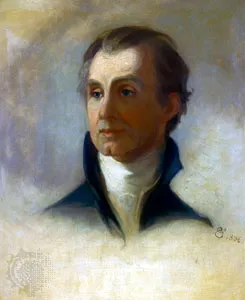
| James Monroe |
Madison was followed by James Monroe as President. There was an Era of Good Feelings as political polarization faded with the decline of the Federalist Party. In 1823 Monroe opposed European colonialism in the western hemisphere. This was later called the Monroe Doctrine.
There was widespread talk of a war over slavery when Missouri wanted to be carved out of the Southern part of the Louisiana Purchase territory and enter the Union as a slave state in 1819. Thomas Jefferson said:

... but this momentous question, like a fire bell in the night, awakened and filled me with terror. I considered it at once as the knell of the Union. it is hushed indeed for the moment. but this is a reprieve only, not a final sentence. - Jefferson to Holmes, April 22, 1820

An attempted Tallmadge Amendment would have phased slavery out of existence in Missouri but was defeated by Southerners. Monroe favored slavery expansion but reluctantly signed the Missouri Compromise of 1820, which allowed Missouri to join the union as a slave state at the same time that Maine joined the union as a free state and banned slavery in Louisiana Purchase territory outside the new state of Missouri.
The word bunk was inspired by a speech by a representative to the sixteenth Congress, Felix Walker. Walker was from Buncombe County, North Carolina. When he was told to stop a speech that people thought was irrelevant, Walker said he had a right to speak for Buncombe.
Monroe believed that the Constitution didn't allow Congress to authorize the construction of internal improvements or infrastructure. In 1824, the Supreme Court ruled in Gibbons v. Ogden that the Constitution's Commerce Clause gave the federal government the authority to regulate interstate commerce.

|
| Louisiana Purchase |
The economic Panic of 1819 was caused by global market adjustments in the aftermath of the Napoleonic Wars. Its severity was compounded by excessive speculation in public lands, fueled by the unrestrained issue of paper money from banks and business concerns.
Andrew Jackson seized control of the Spanish territorial capital of Pensacola. This led to the Adams-Onis Treaty, whereby Spain ceded control of Florida to the United States. Also, the US and the British agreed to make the 49th parallel the border between much of the US and Canada through the Treaty of 1818.
When Monroe was governor of Virginia, Gabriel's slave conspiracy planned to kidnap him and negotiate for their freedom. While dozens of slaves were hanged, both Monroe and Jefferson worked to spare the lives of about 50 slaves. Monroe supported the American Colonization Society, which funded the sending of emancipated slaves to African countries such as Liberia. Monrovia, the capital of Liberia, is named after Monroe.

|
| John Quincy Adams |
In the election of 1824 John Quincy Adams, Henry Clay, John C. Calhoun and William H. Crawford ran for president. Since none of them won a majority of the electoral college, the House was required to hold a contingent election under the terms of the Twelfth Amendment. The top three in terms of votes were Jackson, Adams and Calhoun. Clay supported Adams, who won. Supporters of Jackson accused Adams of making a Corrupt Bargain with Clay, who became Adams' Secretary of State.
Adams was successful in gaining congressional support for building roads, canals and the Baltimore and Ohio railroad. However, Congress refused to create a national university, a naval academy, a national astronomical observatory, a national bankruptcy law and a national system of weights and measures. Along with Clay, Adams believed in the American System for promoting economic growth. However, Southerners feared that a strong federal government could threaten slavery.
Adams signed the Tariff of 1828, which imposed high tariffs on imported materials that were important to New England but favored Western interests. It was called the Tariff of Abominations in the South and led to the nullification controversy. Adams saw a need for a high protective tariff because American manufactured products were overpriced and badly made. It was thought that only a high tariff would allow American manufacturing to get a start.
Adams revised the Treaty of Indian Springs with the Muscogee Indians to let them stay, even though they lost most of their land to Georgia. The governor of Georgia, George Troup, demanded that the Muscogee be removed entirely. Many in the Deep South favored immediate Indian removal.
After his term in office ended, Adams was elected to the House of Representatives.
Adams was against slavery. He was particularly opposed to the annexation of Texas and the Mexican–American War, which he saw as a war to extend slavery and its political grip on Congress. He also led the repeal of the "gag rule," which had prevented the House of Representatives from debating petitions to abolish slavery from 1836 to 1844. As Adams said:
It is among the evils of slavery that it taints the very sources of moral principle. It establishes false estimates of virtue and vice: for what can be more false and heartless than this doctrine which makes the first and holiest rights of humanity to depend on the color of the skin?
A plan to strengthen and unify the nation, the American System was advanced by the Whig Party and a number of leading politicians including Henry Clay and John Quincy Adams. Clay was the first to refer to it as the "American System." Motivated by a growing American economy bolstered with major exports such as cotton, tobacco, native sod and tar, the politicians sought to create a structure for expanding trade. The South and West opposed this plan. This System included such policies as:
- Support for a high tariff to protect American industries and generate revenue for the federal government
- Maintenance of high public land prices to generate federal revenue
- Preservation of the Bank of the United States to stabilize the currency and rein in risky state and local banks
- Development of a system of internal improvements (such as roads and canals) which would knit the nation together and be financed by the tariff and land sales
George Whitefield, Jonathan Edwards, Gilbert Tennent, and the New Lights (those who wanted less ritual and tradition) and the Old Lights (those who wanted more ritual and tradition) highly influenced the First Great Awakening. The First Great Awakening in the American colonies is closely related to the Evangelical Revival in the British Isles. Pulling away from ritual and ceremony, the Great Awakening made religion more personal by fostering a sense of spiritual conviction of personal sin and need for redemption, and by encouraging introspection and a commitment to personal morality. It incited rancor and division between traditionalists, who insisted on the continuing importance of ritual and doctrine, and revivalists who encouraged emotional involvement and personal commitment. It had a major impact in reshaping the Congregational Church, the Presbyterian Church, the Dutch Reformed Church, and the German Reformed denomination, and strengthened the small Baptist and Methodist denominations. It had less impact on Anglicans and Quakers. Unlike the Second Great Awakening, which began about 1800 and reached out to the unchurched, the First Great Awakening focused on those who were already church members. The First Great Awakening happened in the 1730s. The Second Great Awakening happened from the late 1700s to the mid-1800s and led to abolitionism, temperance and women's rights. The Third Great Awakening in the 1850s–1900s was characterized by new denominations, active missionary work, Chautauquas, and the Social Gospel approach to social issues. The YMCA (founded in 1844) played a major role in fostering revivals in the cities in the 1858 Awakening and after. The revival of 1858 produced leaders such as Dwight L. Moody, who carried out religious work in the Civil War armies. The Christian and Sanitary Commissions and numerous Freedmen's Societies were also formed during the war.
|
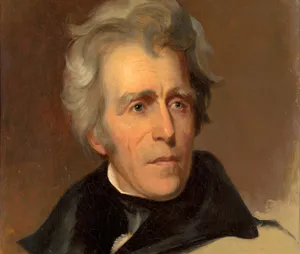
| Andrew Jackson |
Adams was followed by Andrew Jackson as President. Jackson won the Creek War of 1813-1814. The Treaty of Fort Jackson required the Creek to surrender of vast lands in present-day Alabama and Georgia. Jackson's victory at the Battle of New Orleans against the British made him a national hero. The First Seminole War led to the annexation of Florida from Spain. Jackson was born into a poor family but became a lawyer who sued to collect debts and was a slaveowner. Nevertheless, he was seen as a man of the people.
During the campaign, Jackson had charged the Adams bureaucracy with fraud and with working against his election. As President, he initiated sweeping removals among high-ranking government officials-Washington bureau chiefs, land and customs officers, and federal marshals and attorneys. Jackson claimed to be purging the corruption, laxity, and arrogance that came with long tenure, and restoring the opportunity for government service to the citizenry at large through "rotation in office."
Under the guise of reform, many offices were doled out as rewards for political services. Newspaper editors who had championed Jackson's cause, some of them very unsavory characters, came in for special favor. His worst appointee was an old army comrade named Samuel Swartwout. Against all advice, Jackson made him collector of the New York City customhouse, where the government collected nearly half its annual revenue. In 1838, Swartwout absconded with more than $1 million, a staggering sum for that day. Jackson denied that political criteria motivated his appointments, claiming honesty and efficiency as his only goals. Yet he accepted an officeholder's support for Adams as evidence of unfitness, and in choosing replacements, he relied exclusively on recommendations from his partisans. A Jackson senator from New York, William L. Marcy, defended Jackson's removals by proclaiming in 1832 that in politics as in war, "to the victor belong the spoils of the enemy." While Jackson didn't start the spoils system, he enlarged it.
As soon as he became President, Georgia, Alabama and Mississippi passed laws to extend state control over Indians. Chiefs and tribal meetings were not legally recognized, and Indians were subject to militia duty and payment of state taxes even though they weren't allowed to vote, bring suits or testify in court. Whites were encouraged to settle on Indian land. However the Indian Trade and Intercourse Act of 1802 said that there would be no land cessions except by treaty, and that federal law applied to Indians. Jackson ignored the Act and encouraged state action. However, financial aid was given to tribes that gave up their land and went west. While treaties often promised Indians that new land further west would be theirs as long as the grass grows and the sun shines, these treaties were broken when whites wanted more land.
Many Chickasaws sold their land at good prices and moved west, but many Creeks and Choctaws stayed on their plots of land and were defrauded by land companies. Starving Creeks raided white farms and were attacked by state militia, which led to the Second Creek War.
With 17,000 Cherokees surrounded by 900,000 whites in Georgia, Alabama and Tennessee, the Cherokees adapted to white civilization and became farmers, blacksmiths, carpenters, masons and owners of property. According to the Census of 1826, they owned 22,000 cattle, 7,600 horses, 46,000 swine, 726 looms, 2,488 spinning wheels, 172 wagons, 2,943 plows, 10 saw mills, 31 grist mills, 62 blacksmith shops, 8 cotton machines and 18 schools. Their chief Sequoyah invented a written language, and they bought a printing press and published a newspaper. Traditional Cherokee culture did not include laws or courts but relied on custom and stressed individual freedom. As they adapted to Western society, more than 1,000 of them owned slaves, and they welcomed missionaries and Christianity.
In 1829, Georgia extended its jurisdiction to about 9,000,000 acres of land on which gold had been discovered that lay within its boundaries, but was still occupied by the Cherokee Indians. Thousands of whites invaded, destroyed Indian property and staked out claims. At first, Jackson ordered federal troops to remove them and ordered both whites and Indians to stop mining. Then Jackson removed the troops, the whites returned and Jackson said he could not interfere with state authority. As the Cherokees' title to the land had been guaranteed by a treaty with the United States, the Indians appealed to the federal courts. In two separate cases the Supreme Court ruled against Georgia, but Georgia ignored those decisions and continued to enforce its jurisdiction within the territory claimed by the Cherokees.
As president, Jackson signed the Indian Removal Act in 1830. Most Northern Congressmen voted against the Act, and most Southern Congressmen voted for it. The Act forced the removal of the Cherokee, Chickasaw, Choctaw, Creek (Muscogee) and Seminole tribes. They were sent on what Indians called the Trail of Tears, where thousands died of starvation and disease because of all the money that could be made by replacing them with plantations filled with slaves and cotton.
Most of the 20,000 Choctaws in Mississippi didn't want to move, but about 50 Choctaw delegates received bribes of land and money, and the Treaty of Dancing Rabbit Creek was signed. They received financial help for leaving, compensation for property left behind and food for the first year. But food disappeared and hunger came. Many died of cholera and pneumonia. There were 7,000 Choctaws who refused to leave.
In Georgia, Cherokees lost their land and their government. Meetings were banned. Cherokees were not allowed to dig for gold that was on their land or testify in court against whites. Ten white missionaries to the Cherokees and the printer of the Cherokee Phoenix sided with the Indians, and were beaten, chained and forced to march 35 miles a day to the county jail. Nine were released when they swore allegiance to Georgia's laws, but Samuel Worcester and Elizur Butler refused to give such an oath and were sentenced to four years of hard labor. The US Supreme Court, in Worcester v. Georgia, ruled that Georgia had violated the treaty with the Cherokees; however, Georgia ignored the ruling, and Jackson refused to enforce the court order. Georgia sent its militia to force out the Cherokees. Their property was taken, their homes were burned, their schools were closed and their women were mistreated. Cherokees were forced to leave their land, and many died from measles and cholera.
There were 22,000 Creeks and over 300,000 whites in Alabama. Creeks signed the Treaty of Washington, which included promises that were quickly broken. They gave up 5 million acres of land with the provision that 2 million of those acres would be owned by individual Creeks, who could either sell them or own them. However, white looters, land seekers, defrauders, whiskey sellers and thugs invaded Creek land. Creek Indians had been driven to near starvation, and feared that a long journey west would increase hunger. Some desparate Creeks raided farms, which was used as a pretext for forcing them out. Many died from starvation and disease. 800 Creeks helped the government fight Seminoles in return for a promise that they could stay in Alabama, a promise that was broken. They were driven from their homes, robbed and Indian women were raped. Contractors used old ships to save money, sometimes with disastrous results. Some Creeks were taken over the Mississippi by the aging steamer Monmouth, which sank, killing 311 Indians.
While Jackson had a states' rights policy toward Georgia's Indian removal policy, he forced nullificationists in South Carolina to back down during the Nullification Crisis over tariff increases. When Jackson first heard of the Nullification Crisis, he said:
I consider, then, the power to annul a law of the United States, assumed by one State, incompatible with the existence of the Union, contradicted expressly by the letter of the Constitution, unauthorized by its spirit, inconsistent with every principle on which It was founded, and destructive of the great object for which it was formed.
In response to the Tariff of 1828, John Calhoun, a statesman and plantation owner from South Carolina, said that a state could nullify any law it didn't like, especially the Tariff of 1828. The Tariff of 1832 reduced the tariff, but not enough to appease the South. Jackson asked Congress to pass the Force Bill, which would authorize the president to send federal soldiers against South Carolina if it sought to nullify federal law. In March 1833, Congress authorized President Jackson to use military force, if needed, to enforce the tariff laws in South Carolina. Jackson told Lewis Cass that he saw the crisis, in no uncertain terms, as a secession crisis. He wrote: "If I can judge from the signs of the times Nullification, and secession, or in the language of truth, disunion, is gaining strength, we must be prepared to act with promptness, and crush the monster in its cradle before it matures to manhood." Jackson said, "Our Federal Union: It must be preserved."
Both Jackson and Calhoun were slaveowners, and they both said that slavery was the real issue behind the tariff issue. In a letter Jackson wrote to the Rev. A.J. Crawford in May 1833, Jackson wrote:
The tariff was only the pretext, and disunion and southern confederacy the real object. The next object will be the negro, or slavery question.
In a September 11, 1830 letter, Calhoun wrote:
I consider the tariff act as the occasion, rather than the real cause of the present unhappy state of things. The truth can no longer be disguised, that the peculiar institution of the Southern States and the consequent direction which that and her soil have given to her industry, has placed them in regard to taxation and appropriations in opposite relation to the majority of the Union, against the danger of which, if there be no protective power in the reserved rights of the states they must in the end be forced to rebel, or, submit to have their paramount interests sacrificed, their domestic institutions subordinated by Colonization and other schemes, and themselves and children reduced to wretchedness.
Though Henry Clay favored high tariff rates, he sought to avoid a crisis that could end in civil war. He proposed a compromise tariff bill that would lower tariff rates, but do so gradually, thereby giving manufacturing interests time to adapt to less protective rates. Clay's compromise tariff won the backing of both manufacturers, who believed they would not receive a better deal, and Calhoun. Jackson simultaneously signed the tariff bill and the Force bill, and South Carolina leaders accepted the new tariff, ending the crisis. Back then, there was no income tax. The tariff was used to fund the government. So the issue was not whether the tariff should exist, but whether it should be low or high. By the 1850s, the tariff was low, and the issue faded into the background.
The charter of the Bank of the United States was due to expire in 1836. Congress passed a bill to extend the bank's charter, and Jackson vetoed it. Nearly all purchasers of public lands paid with bank notes, many of which had to be discounted because of doubts as to the continuing solvency of the banks that issued them. Partly to protect federal revenues against loss and partly to advance his concept of a sound currency, Jackson issued the Specie Circular in July 1836, requiring payment in gold or silver for all public lands. This measure created a demand for specie that many of the banks could not meet; banks began to fail, and the effect of bank failures in the West spread to the East. By the spring of 1837 the entire country was gripped by a financial panic when President Van Buren took office.
Jackson won 5 million in reparations for the capture of American ships and sailors from France. He paid off the national debt. Jackson and his postmaster general allowed local southern officials to intercept and destroy abolitionist literature. The President also asked Congress to pass a "law as will prohibit, under severe penalties, the circulation in the southern States, through the mail, of incendiary publications intended to instigate the slaves to insurrection." The bill never passed.
In his farewell address, Jackson spoke about sectionalism in blunt terms. "We behold systematic efforts publicly made to sow the seeds of discord between different parts of the United States and to place party divisions directly upon geographical distinctions; to excite the South against the North and the North against the South, and to force into the controversy the most delicate and exciting topics-topics upon which it is impossible that a large portion of the Union can ever speak without strong emotion," Jackson wrote.
But he also repeated the need to keep the Union solvent at the same time, under one constitutional system of laws. "In order to maintain the Union unimpaired it is absolutely necessary that the laws passed by the constituted authorities should be faithfully executed in every part of the country, and that every good citizen should at all times stand ready to put down, with the combined force of the nation, every attempt at unlawful resistance, under whatever pretext it may be made or whatever shape it may assume," Jackson pleaded.
However, Jackson also reinforced the concept of state sovereignty on the slavery issue. "All efforts on the part of people of other States to cast odium upon their institutions, and all measures calculated to disturb their rights of property or to put in jeopardy their peace and internal tranquility, are in direct opposition to the spirit in which the Union was formed, and must endanger its safety," Jackson argued.
A Seminole chief, Osceola, had been imprisoned and chained by the Indian agent Thompson. Osceola's wife had been delivered into slavery. When Thompson ordered Seminoles to leave Florida, they refused. They waged guerrilla warfare on white coastal settlements, murdering white families, capturing slaves and destroying property.
The Dade massacre was an 1835 military defeat for the United States Army. Under the Indian Removal Act of 1830, the US was attempting to force the Seminoles to move away from their land in Florida provided by the Treaty of Moultrie Creek (following the American annexation of Spanish Florida under the Adams-Onis Treaty) and relocate to Indian Territory under the terms of the Treaty of Payne's Landing. Two US Army companies numbering 103 men under the command of Major Francis L. Dade were ambushed by approximately 180 Seminole and black Seminole warriors as they marched from Fort Brooke on Tampa Bay to reinforce Fort King in Ocala. Only three US soldiers and their guide Louis Pacheco survived the attack, and one died of his wounds the following day. The battle sparked the Second Seminole War, which lasted for eight years, cost $20 million 19th century dollars and cost 1,500 American lives.
The Second Seminole War (1835–1842) began as a result of the United States unilaterally voiding the Treaty of Moultrie Creek and demanding that all Seminoles relocate to Indian Territory in present-day Oklahoma under the Indian Removal Act (1830). The United States also wanted to prevent the Seminoles from harboring runaway slaves. Hundreds of black fugitives fought alongside the Seminoles, who protected their freedom. After several ultimatums and the departure of a few Seminole clans per the Treaty of Payne's Landing (1832), hostilities commenced in December 1835 with the Dade battle and continued for the next several years with a series of engagements throughout the peninsula and extending to the Florida Keys. Though the Seminole fighters were at a tactical and numerical disadvantage, Seminole military leaders effectively used guerrilla warfare to frustrate United States military forces, which eventually numbered over 30,000 regulars, militiamen and volunteers. General Thomas Sidney Jesup was sent to Florida to take command of the campaign in 1836. Instead of futilely pursuing parties of Seminole fighters through the territory as previous commanders had done, Jesup changed tactics and engaged in finding, capturing or destroying Seminole homes, livestock, farms, and related supplies, thus starving them out. Jesup also authorized the controversial abduction of Seminole leaders Osceola and Micanopy by luring them under a false flag of truce. General Jesup clearly violated the rules of war and spent 21 years defending himself over it. By the early 1840s, many Seminoles had been killed, and many more were forced by impending starvation to surrender and be removed to Indian Territory.
The Battle of Lake Okeechobee was fought between 1,000 US Army troops of the 1st, 4th, and 6th Infantry Regiments and 132 Missouri Volunteers under the command of Colonel Zachary Taylor, and about 400 Seminole warriors led by chiefs Abiaka, Billy Bowlegs, Halpatter Tustenuggee (Alligator) and Wild Cat on December 25, 1837. The Seminoles defended their large encampment by Lake Okeechobee against an attack by Zachary Taylor's troops. Zachary Taylor's march to Lake Okeechobee was part of a larger offensive into South Florida that was planned by General Thomas Jesup. The battle was a victory for the Seminoles, as they held off the US troops long enough to safely evacuate their encampment. Due to the large number of casualties his troops suffered, Zachary Taylor was forced to end his offensive into South Florida, and he marched his army over 100 miles back to Tampa Bay.
Realizing it was almost impossible to remove the remaining Seminoles from Florida, the Van Buren administration negotiated a compromise allowing them to remain in Southwest Florida.

|
| Martin Van Buren |
Martin Van Buren co-founded the Democratic Party with Andrew Jackson and became Jackson's vice president from 1833 to 1837. Van Buren was unpopular because of his response to the Panic of 1837, which centered on his Independent Treasury system, a plan under which the federal government of the United States would store its funds in vaults rather than in banks; more conservative Democrats and Whigs in Congress ultimately delayed his plan from being implemented until 1840. It was abolished in 1841, but was revived in 1846 and lasted until 1913. His presidency was further marred by the costly Second Seminole War and his refusal to admit Texas to the Union as a slave state.
Federal policy under Jackson had sought to move Indian tribes to lands west of the Mississippi River through the Indian Removal Act of 1830, and the federal government negotiated 19 treaties with Indian tribes during Van Buren's presidency. The 1835 Treaty of New Echota, signed by government officials and representatives of the Cherokee tribe, had established terms under which the Cherokees ceded their territory in the southeast and agreed to move west to Oklahoma. In 1838, Van Buren directed General Winfield Scott to forcibly move all those who had not yet complied with the treaty.
The Cherokees were herded violently into internment camps where they were kept for the summer of 1838. Some 20,000 people were relocated against their will. An estimated 4,000 Cherokee died during the Trail of Tears. Entire Indian nations were relocated, with some losing as much as half their populations.
When Canadians rebelled against the British, Van Buren enforced the Neutrality Act to prosecute American filibusters who tried to invade Canada. The 1842 Webster-Ashburton Treaty settled a border dispute between Maine and Canada.
In 1841, John Quincy Adams successfully argued before the US Supreme Court to free Amistad slaves. The Amistad was a slave ship that attempted to take Mende African slaves from Havana, Cuba to another part of Cuba. One Mende freed himself from his shackles and then freed the rest. The Mendes killed the ship captain and cook, and then demanded that their enslavers take them back to Africa. Instead, they were taken to America. Spain asked President Martin Van Buren to return them as slaves to Cuba. Instead, the US Supreme Court agreed with Adams to free them and allowed them to return to Africa.
President William Harrison died of pneumonia 31 days after taking office. His campaign slogan was "Tippecanoe and Tyler too."
|
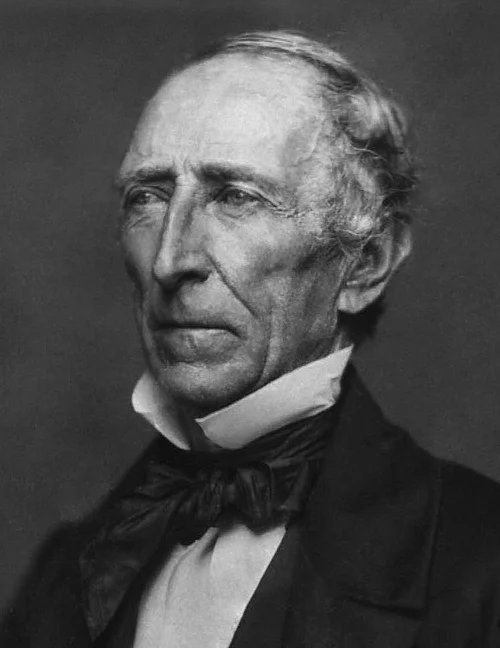
| John Tyler |
Harrison was followed by John Tyler as President. Tyler was the first vice president to become president. Tyler was born into a slave owning Virginia family, and was pro-slavery and pro-states' rights. During the Civil War, he supported the Confederacy. Tyler was the first president to have his veto of legislation overridden by Congress. He faced a stalemate on domestic policy, although he had several foreign-policy achievements, including the Webster–Ashburton Treaty with the United Kingdom (which adjusted the border between the US and Canada) and the Treaty of Wanghia with China. He began the annexation of Texas three days before his last day in office.
Tyler's political career began in the Virginia legislature, where he served from 1811 to 1816, 1823 to 1825, and in 1839. He served as United States representative (1817–21), as state governor (1825–27), and as United States senator (1827–36). His service in Washington was marked by his consistent support of states' rights and his strict constructionist interpretation of the Constitution. While in the Senate, Tyler-who was a slaveholder-sought to prohibit the slave trade in the District of Columbia but opposed its abolition there without the consent of Maryland and Virginia. He voted against the protective tariffs of 1828 and 1832 but also condemned South Carolina's attempted nullification of these measures.
In an unusual show of independence, Tyler resigned from the Senate in 1836 rather than yield to his state legislature's instructions to reverse his vote on Senate resolutions censuring President Jackson for removal of deposits from the Bank of the United States. This anti-Jackson stand endeared Tyler to the opposition Whig Party, which in 1840 nominated him for the vice presidency in an effort to attract Southern support. Harrison and Tyler defeated the Democratic incumbents Martin Van Buren and Richard M. Johnson after a campaign that sedulously avoided the issues and stressed innocuous party insignia and the slogan "Tippecanoe and Tyler too!" (the former referring to the river in Indiana where Harrison defeated the Shawnee Indians in 1811).
President Harrison's sudden death, only one month after his inauguration, created a constitutional crisis. Because the Constitution was silent on the matter, it was unclear whether, upon the death of a president, the vice president would become president or merely "vice president acting as president," as John Quincy Adams maintained at the time. Defying his opponents, who dubbed him "His Accidency," Tyler decided that he was president and moved into the White House, thereby establishing a precedent that was never successfully challenged.
After Tyler vetoed two bills aimed at reestablishing a national bank, all but one member, Secretary of State Daniel Webster, of the cabinet Tyler inherited from Harrison resigned, and two days later he was formally ostracized by congressional Whigs. Tyler was now a president without a party. Nevertheless, his administration managed to accomplish a great deal. It reorganized the navy, established the United States Weather Bureau, brought an end to the Second Seminole War (1835–42) in Florida, and put down the rebellion (1842) led by Thomas Dorr against the state government of Rhode Island.
In Rhode Island, Thomas Dorr led a rebellion because only people with property could vote, allowing 5,000 with property to rule over 12,000 without property. Dorr founded the Rhode Island Suffrage Association and, in 1841, paraded demanding electoral reform. Dorr won a mock election promising a constitution that would eliminate the property requirement for voting. The rebellion was put down, the rebels were arrested and Dorr fled the state. In 1843 Dorr returned and was sentenced to life in prison, but a new governor pardoned him after 20 months.
EDGAR ALLAN POE
Edgar Allan Poe began his literary career in the 1820s. He wrote The Murders in the Rue Morgue, The Tell-Tale Heart, The Fall of the House of Usher, Annabel Lee and The Raven. He invented the detective fiction genre. His entire work is in volume 1 and volume 2 of his collected works. The Raven is his most famous poem.
|
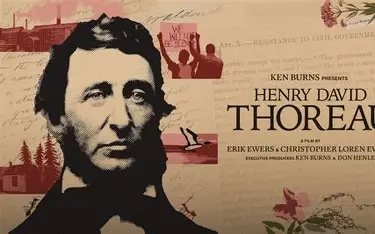
| Henry David Thoreau |
TRANSCENDENTALISM
Transcendentalism is a philosophical, spiritual, and literary movement that developed in the late 1820s and 1830s in the New England region of the United States. A core belief is in the inherent goodness of people and nature, and while society and its institutions have corrupted the purity of the individual, people are at their best when truly "self-reliant" and independent. Transcendentalists saw divine experience inherent in the everyday. Emphasizing subjective intuition over objective empiricism, its adherents believe that individuals are capable of generating completely original insights with little attention and deference to past transcendentalists. Henry David Thoreau and Ralph Waldo Emerson were leaders of transcendentalism. Thoreau's name is pronounced THU-ro, with the accent on the first syllable.
Thoreau wrote Walden and On the Duty of Civil Disobedience. In 1846 the writer Henry David Thoreau refused to pay his Massachusetts poll tax to protest the Mexican War. He spent a night in jail and wrote On the Duty of Civil Disobedience, in which he condemned "undue respect for law" when a law was unjust. His friend Ralph Waldo Emerson visited Thoreau in jail and asked, "What are you doing in there?" Thoreau replied, "What are you doing out there?" The next morning a still-unidentified lady, perhaps his aunt, Maria, paid the tax. Thoreau reluctantly emerged, did an errand, and then went to collect huckleberries. A single night, he decided, was enough to make his point that he could not support a government that endorsed slavery and waged an imperialist war against Mexico. Thoreau defended private, individual conscience against the expediency of the majority. He critiqued the idea that majority rule automatically equates to justice, emphasizing that power often rests with the physically strongest rather than the morally right. Citizens should not resign their conscience to the law; instead, they must act according to what they believe is right, even if it means breaking the law. Later Mahatma Gandhi and Martin Luther King would practice civil disobedience.

|
| Ralph Waldo Emerson |
Thoreau stayed for two years at Walden Pond (1845–47). In the summer of 1847 Emerson invited him to stay with his wife and children again, while Emerson himself went to Europe. Thoreau accepted, and in September 1847 he left his cabin forever. Thoreau published Walden in 1854. In it Thoreau wrote the following:
I went to the woods because I wished to live deliberately, to front only the essential facts of life, and see if I could not learn what it had to teach, and not, when I came to die, discover that I had not lived. I did not wish to live what was not life, living is so dear; nor did I wish to practise resignation, unless it was quite necessary. I wanted to live deep and suck out all the marrow of life, to live so sturdily and Spartan-like as to put to rout all that was not life, to cut a broad swath and shave close, to drive life into a corner, and reduce it to its lowest terms
Elsewhere Thoreau wrote,
Simplify your life. Don't waste the years struggling for things that are unimportant. Don't burden yourself with possessions. Keep your needs and wants simple and enjoy what you have. Don't destroy your peace of mind by looking back, worrying about the past. Live in the present. Simplify!
Thoreau's friend Emerson wrote transcendental essays. He believed in being true to yourself. He said the following about consistency:
A foolish consistency is the hobgoblin of little minds, adored by little statesmen and philosophers and divines. With consistency a great soul has simply nothing to do. He may as well concern himself with his shadow on the wall. Speak what you think now in hard words, and to-morrow speak what to-morrow thinks in hard words again, though it contradict every thing you said to-day. - 'Ah, so you shall be sure to be misunderstood.' - Is it so bad, then, to be misunderstood? Pythagoras was misunderstood, and Socrates, and Jesus, and Luther, and Copernicus, and Galileo, and Newton, and every pure and wise spirit that ever took flesh. To be great is to be misunderstood.
Emerson also said,
- I hate quotations. Tell me what you know.
- To be yourself in a world that is constantly trying to make you something else is the greatest accomplishment.
- The only person you are destined to become is the person you decide to be.
Paper, gunpowder, the ship's rudder and the compass were invented in China. Further progress happened later with the Industrial Revolution.
Beginning in Great Britain around 1760, the Industrial Revolution had spread to continental Europe and the United States by about 1840. This transition included going from hand production methods to machines; new chemical manufacturing and iron production processes; the increasing use of water power and steam power; the development of machine tools; and rise of the mechanised factory system. Output greatly increased, and the result was an unprecedented rise in population and population growth. The textile industry was the first to use modern production methods, and textiles became the dominant industry in terms of employment, value of output, and capital invested. Steam powered ships and trains improved transportation and telegraphs improved communication. The rapid increase in the speed of transportation and communication and the greater use of interchangeable parts led to a division of labor and specialization.
In feudal Europe serfs had more leisure time than during the Industrial Revolution. They were bound to the soil, so they had less freedom, but couldn't be bought or sold individually like slaves, which kept their families together. During the Industrial Revolution most people working in manufacturing had 80-100-hour weeks working between 10 and 16 hours, including children, for six days every week. Unions demanded, and sometimes won, shorter work weeks. In the 1912 Presidential Election, Teddy Roosevelt's Progressive Party included eight-hour work days in their campaign. In 1914 the Ford Motor Company cut shifts from nine to eight hours daily. In 1916 the Adamson Act established an eight-hour working day, with additional overtime pay, for railroad workers. In 1926 Henry Ford introduced 40-hour work weeks with five working days with no cut in wages after discovering that 48-hour work weeks yielded only a small increase in productivity that lasted a short period. This discovery inspired other manufacturing companies to adopt the 40-hour work week. In 1938 Congress passed the Fair Labor Standards Act, which required employers to pay overtime to all employees who worked more than 44 hours a week. This act was only applied to industries whose combined employment represented about 20 percent of the US labor force. In 1940 the Fair Labor Standards Act was amended to reduce the workweek to 40 hours. Since then, the 40-hour work week has been a US law.
French General Jean-Baptiste Vaquette de Gribeauval, Honoré Blanc and London gunsmith Henry Nock used interchangeable parts, which are used in factory assembly lines. In 1785, muskets with interchangeable locks caught the attention of the United States' Ambassador to France, Thomas Jefferson, through the efforts of Honoré Blanc. Jefferson tried unsuccessfully to persuade Blanc to move to America, then wrote to the American Secretary of War with the idea, and when he returned to the US, he worked to fund its development. President George Washington approved of the concept, and in 1798 Eli Whitney signed a contract to mass-produce 12,000 muskets built under the new system. In July 1801, Whitney built ten guns, all containing the same exact parts and mechanisms, then disassembled them before the United States Congress. He placed the parts in a mixed pile and, with help, reassembled all of the firearms in front of Congress, much as Blanc had done some years before. As of 1851 the British were impressed with the way Americans used machines instead of skilled craftsmen to make interchangeable parts, and called this "the American system of manufactures."
The Bessemer process is named after its inventor, the Englishman Henry Bessemer, who took out a patent on the process in 1856. The process was the first inexpensive industrial process for the mass production of steel from molten pig iron before the development of the open hearth furnace. Before its invention, it took a day to convert iron to steel. The Bessemer process allowed it to be done in 10 to 20 minutes.
Compared with the Bessemer process, which it displaced, the open hearth process' main advantages were that it did not embrittle the steel from excessive nitrogen exposure, was easier to control and permitted the melting and refining of large amounts of scrap iron and steel. The open-hearth furnace was first developed by German/British engineer Carl Wilhelm Siemens. In 1865, the French engineer Pierre-Émile Martin took out a licence from Siemens and first applied his regenerative furnace for making steel. Their process was known as the Siemens–Martin process.
Thomas Savery is considered the inventor of the first commercially used steam powered device, a steam pump that used steam pressure operating directly on the water. The first commercially successful engine that could transmit continuous power to a machine was developed in 1712 by Thomas Newcomen. In 1764, James Watt made a critical improvement by removing spent steam to a separate vessel for condensation, greatly improving the amount of work obtained per unit of fuel consumed. By the 19th century, stationary steam engines powered the factories of the Industrial Revolution. Steam engines led to the replacement of sailing ships by paddle steamers, and steam locomotives operated on the railways. Reciprocating piston type steam engines were the dominant source of power until the early 20th century. Steam drove textile mill spindles and sewing machines. It was also used to convert iron into steel. The steam came from coal. In 1860 14 million tons of coal were mined. By 1884 it was 100 million tons.
While returning by ship from Europe in 1832, Morse met Charles Thomas Jackson of Boston, a man who was well schooled in electromagnetism. Witnessing various experiments with Jackson's electromagnet, Morse developed the concept of a single-wire telegraph. The Morse code that he developed would become the primary language of telegraphy in the world.