- CIVIL WAR ERA ECONOMIES
- JAMES K. POLK (1845 - 1849) - MEXICAN WAR
- ZACHARY TAYLOR (1849 - 1850)
- MILLARD FILLMORE (1850 - 1853)
- SLAVE INSURRECTIONS
- THE IRREPRESSIBLE CONFLICT
- ABOLITIONISTS
- SLAVES AND SLAVEOWNERS
- SLAVE CODES
- BLACK CODES
- LETTERS BY SLAVES
- SECESSIONIST DOCUMENTS
- PRE-WAR POLITICAL PARTIES
- VOTING RIGHTS
- THIRD SEMINOLE WAR
- FRANKLIN PIERCE (1853 - 1857) - BLEEDING KANSAS
- JAMES BUCHANAN (1857 - 1861) - BLEEDING KANSAS
- MORMON WAR
- DRED SCOTT
- JOHN BROWN'S RAID
- THE EMERGENCE OF LINCOLN
- ELECTION OF 1860
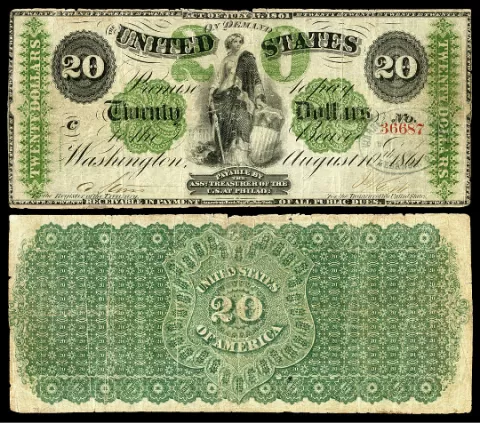
|
| Union Demand Note |
During much of the 19th century steam engines and horses were used for transportation, telegraphs used Morse Code for communication and candles and fireplaces were used for light and heat. Most of the factories were in the North. The North depended on free labor and immigration more than the South. Fewer than one-eighth of immigrants settled in the South. During the middle decades of the 19th century, twice as many Southerners moved North compared to the number of Northerners who moved South. While farms existed in both North and South, the South had more farms and plantations and depended largely on slavery for labor. By 1860, the number of people involved in agriculture dropped to from 70 percent to 40 percent in the North and stayed at 80 percent in the South. About one-tenth of Southerners lived in urban areas, compared with one-fourth of Northerners. Nearly twice the percentage of Northern children attended school. In 1850 only 14 percent of canals went through Southern states. The percentage of railroad miles in the South went from 44 percent in 1840 to 26 percent in 1850. In 1860 about one percent of the North's population were slaves, compared to 39 percent of the South's population. Also in 1850 the South, which had 42 percent of the nation's population, had only 18 percent of the country's manufacturing capacity. The South supplied three-fourths of the world's supply of cotton. By 1860 the North had 70 percent of the population compared to 30 percent for the South. However, the South accounted for two-thirds of America's exports, most of it cotton. Other Southern crops were tobacco, rice, sugar and hemp. The economies of North and South were different, but economically mutually beneficial. Cotton mills in the North and Europe used Southern cotton, and the South bought manufactured items from the North and Europe. However, the South saw the North's economic growth as a threat to slavery.
Samuel Slater introduced industrial spinning machinery in New England in 1789. In 1814, the power loom was introduced in Waltham, Massachusetts. Textile factories multiplied, with 80 to 90 percent of the workers being young women. These women were paid low wages and sometimes went on strike.
Balloon frame housing began around 1830 in Chicago and Rochester and now accounts for at least three-fourths of modern homes. These homes are built with machine sawed boards and factory-produced nails to form the skeleton of a frame house. This "Chicago construction" allowed homes to be built in a fraction of the time compared to homes built by traditional methods and spread throughout the country.
Of the 143 important inventions patented from 1790 to 1860, 93 percent were from the free states. Also, education was more widespread in the US than in most of Europe. Among the free population the literacy rate of 90 percent could only be rivaled by Sweden and Denmark.
The McCormick Reaper and John Deere tractors increased the productivity of farms. However, before the Civil War it took 61 hours of labor to produce an acre of wheat. By 1900 it took 3 hours, 19 minutes. Turnpikes, railroads and canals increased transportation.
There were company towns where workers were paid in scrip that could only be used in company stores. Some workers bought items on credit and were increasingly in debt to the companies they worked for.
Worker safety law didn't exist in the Civil War era. In Lowell, Massachusetts, the Pemberton Mill collapsed in 1860. There were more than 900 workers inside, most of them women, and 88 died. Even though an engineer knew that the weight of the heavy machinery was too much for the structure, a jury found there was "no evidence of criminal intent."
Economic downturns began in 1837, 1857, 1873, 1893, 1907, 1919 and 1929. At first they were called panics, and then depressions. After the Great Depression they were called recessions.
From 1848 to 1856, the number of banks increased by 50 percent, and their notes, loans and deposits doubled. Railroad mileage and capital tripled from 1850 to 1857. The Panic of 1857 was caused by the Crimean War in Europe and domestic issues. Most banks suspended specie payments, factories shut down, business failures multiplied, railroads went bankrupt, construction halted, crop prices plummeted, land speculation collapsed, immigration and imports fell and people lost their jobs. The economy rebounded in 1858. The economic problems of 1857 increased the popularity in the North of Republican economic policies such as a transcontinental railroad, a homestead act, higher tariffs and grants to states for agricultural and mechanical colleges. However, a Mississippian said that it was "better for us that these territories should remain a waste, a howling wilderness," than to allow them to be populated by Yankees. In 1859, President Buchanan, who was pro-South, vetoed a land-grant college act. Buchanan later vetoed a homestead act.
DeBow was a Southern editor who arranged commercial conventions to encourage direct trade with Europe in Southern ships, river and harbor improvements, railroad construction and a southern route for a railroad to the Pacific. "Give us factories, machine shops, work shops," said Southern journalists, and "we shall be able ere long to assert our rights." But even as the South spent more on railroads, manufacturing and textiles, it fell increasingly behind the North economically. Because of the North's more rapid economic and population growth, the South's share of national manufacturing in the 1850s fell from 18 percent to 16 percent. According to the Census of 1860, the average Southern white man had about twice the wealth of the average Northern white man, but most of this wealth was in land and slaves. Studies done by Frederick Law Olmsted indicate that slavery didn't motivate slaves to do more work than enough to avoid a whipping. According to Olmsted, slaves would sometimes break farm implements and had no motive to find more efficient ways of doing things.

|
| Confederate Money |
Southern politicians tried to slow the growth of an increasingly industrial anti-slavery North, so legislation for helping the North's economy to grow had to wait until after secession. As Congressman Nathaniel Macon of North Carolina said, "If Congress can make banks, roads and canals under the Constitution, they can free any slave in the United States." During the war, the Pacific Railway Acts, signed into law by President Abraham Lincoln in 1862 and 1864, funded the creation of the transcontinental railroad. In 1869, a golden spike linked the Central Pacific and the Union Pacific at Promontory, Utah. Other legislation included the Morrill Tariff, land grant colleges created by the Morrill Act of 1862, the Homestead Act and the end of slavery in the District of Columbia. The Homestead Act allowed 160 acres of public land to a homesteader after five years of residence and the addition of improvements. About 40 percent of those who attempted to benefit from the Homestead Act succeeded. The Act accounted for fewer than 25 percent of new farms. The rest were the result of land bought from the government, railroads and speculators. The Union also started the Department of Agriculture and the first national parks.
The Mexican War and railroads led to western expansion. Republicans funded railroads because they believed that infrastructure would help the economy. However, the economic boost from railroads was combined with Robber Barons who controlled the railroads. Chinese immigrants who built the railroads were lynched and massacred after the railroads were built, followed by Chinese Exclusion Acts. Westward expansion led to Indian wars and massacres. The Gold Rush increased western expansion, and Manifest Destiny was used as a justification for it.
Before the war, each bank printed its own paper money. If a bank went bankrupt, all the money it printed was worthless. In the past, people thought that money was worthless unless it was backed by gold or silver, but over time, it was found that the full faith and credit of the United States government and the FDIC guarantees for bank deposits provided a more stable financial system. The very first paper money issued by an American national authority came in 1775, when the Continental Congress authorized "Continental currency" to finance the Revolutionary War. These notes were fiat in nature and had no gold or silver reserve backing them. The next time money was not backed by gold or silver was to fund the Civil War, when the Legal Tender Act of 1862 authorized the minting of $150 million in "greenbacks." By the end of the war, $450 million worth of greenbacks were in circulation. In 1875 the Specie Payment Resumption Act was passed to restore confidence in US currency. It promised that starting January 1, 1879, the government would redeem greenbacks in gold. The gold standard lasted until Nixon ended it in 1971. It was believed at the time that greenbacks that were not backed by gold or silver were inflationary, and that restoring the gold standard would be sound economic policy. However, the Panic of 1873 - 1879 was followed by the Panic of 1893, which was the worst depression before the Great Depression and led to the Panic of 1896.
The National Banking Acts of 1863 and 1864 were two United States federal banking acts that established a system of national banks chartered at the federal level, and created the United States National Banking System. They encouraged development of a national currency backed by bank holdings of US Treasury securities and established the Office of the Comptroller of the Currency as part of the United States Department of the Treasury.
The Revenue Act of 1861 introduced the income tax as a flat tax. Congress also passed the Revenue Act of 1862, which introduced progressive income taxes and established an excise tax affecting nearly every commodity, as well as the first national inheritance tax. To collect these taxes, Congress created the Office of the Commissioner of Internal Revenue. The Revenue Act of 1864 increased the income tax rates established by the Revenue Act of 1862. After the war, courts held that the income tax was unconstitutional. The 1895 US Supreme Court's Pollock v. Farmers' Loan & Trust Co. held that the unapportioned income tax imposed by the Wilson–Gorman Tariff Act of 1894 was in effect a "direct tax" that violated the Constitution's requirement that direct taxes be apportioned among the states. This holding was superseded in 1913 by the Sixteenth Amendment, which explicitly permits Congress to levy income taxes without apportionment.
During the war the Southern share of exports went from two-thirds to almost zero because of the Union blockade of the Confederate coast. The armies of Sherman and Sheridan destroyed much of the South's manufacturing, railroads and infrastructure. Emancipation caused the loss of slaves growing food for the South and added soldiers fighting for the North.
Iron production in the North was 29 percent higher in 1864 than for the entire country in the previous record year of 1856, and coal production was 21 percent higher for the four years of the war than the previous record four year period for the entire country. Merchant ship tonnage was also at a record high in spite of damage done by Confederate raiders. Railroad traffic increased by 50 percent. In spite of the 72 percent reduction in cotton textiles, the Northern manufacturing index in 1864 was 13 percent higher than the total for the entire country in 1860. The North grew more wheat in both 1862 and 1863 than the entire country in the previous record year of 1859. The North doubled exports of wheat, corn, pork and beef because of crop failures in western Europe.
The war stimulated the economies of both the North and the South, but the South was affected much more by the destruction of war, since most of the war was fought in the South. The war killed one-quarter of the South's white men of military age, two-fifths of Southern livestock, and half of farm machinery. Thousands of miles of railroad were wrecked. Two-thirds of Southern assessed wealth was destroyed. Southern agricultural and manufacturing capital declined by 46 percent from 1860 to 1870, while Northern capital increased by 50 percent. The South's share of national wealth went from 30 percent in 1860 to 12 percent in 1870. The average per capita income (including slaves) dropped from two-thirds of the Northern average to two-fifths of the Northern average during the war, and stayed that way for the rest of the 19th century.
When the war began, the South had one-ninth the industrial capacity of the North. The North manufactured 97 percent of the nation's firearms, 94 percent of its cloth, 93 percent of its pig iron and more than 90 percent of its boots and shoes. The North had more than twice the density of railroads per square mile, and several times the number of canals and macadamized roads. As the war continued, the South couldn't replace damaged transportation. Of 470 locomotives built in the United States in 1860, only 19 had been made in the South. The Confederate Quartermaster General Abraham Myers couldn't provide the army with enough tents, uniforms, shoes, blankets, horses and wagons. Confederate transportation problems left food rotting in warehouses while armies went hungry.
During most of the war the Confederate government imposed a 10 percent tax on farm crops even though there was no tax on property in slaves, causing resentment among poor Southern farmers. In February 1864 the Confederate government imposed a 5 percent tax on land and slaves. Also, there was impressment of crops by Confederate armies. Southern farmers were given promissory notes which declined greatly in value, and some Confederate cavalries simply confiscated crops and paid nothing for them.
Near the end of the war the South had bread riots because of hyperinflation. At a store charging $70 for a barrel of flour a woman asked, "How can I pay such prices? I have seven children; what shall I do?" "I don't know," the merchant replied, "unless you eat your children." One Southern woman who was part of a mob taking food from stores in Richmond lifted her sleeve to show a skeletal arm in front of a bystander and said, "This is all that's left of me!" She said, "We are starving." Jefferson Davis, the Confederate President, threw coins at the bread rioters and gave them five minutes to disperse before he would order that they get shot.
According to the historian McPherson, inflation in the South reached 9,000 percent by the war's end. Inflation in the Union during the four years of the war was only 80 percent. In the North, the nation's first income tax and taxes on playing cards, billiard tables, yachts, carriages, newspaper advertisements, jewelry, patent medicines, value added taxes on manufactured goods, taxes on the gross receipts of corporations, banks and insurance companies, an inheritance tax, a tax on dividends and interest paid to investers, and so on soaked up enough excess money to prevent extreme inflation. Many of these taxes were progressive, affecting the rich the most. More women worked during the war, but they got paid much less than men for doing the same work, which kept average wages down. Also, automation in the form of more reapers, mowers, sewing machines and Blake McKay machines for sewing uppers of shoes to soles meant less need to hire more workers. During the war copper increased by 50 percent, and silver quadrupled as new mines were opened especially in Nevada, which became a state in 1864. Confederate dollars were called "shinplasters" because that's about all they could be used for. The South's desertion rate became very high. The North had problems with bounty jumpers, but the South's problems were worse when Confederates saw that defeat was all but certain.

|
| James K. Polk |
The Oregon Treaty of 1846 established the 49th parallel as the boundary between America and the United Kingdom in Oregon Country, even though some wanted more and used the slogan "Fifty-four forty or fight!" The Walker Tariff of 1846 reduced the tariff. Polk implemented Van Buren's Independent Treasury system. In 1845 Polk sent diplomat John Slidell to Mexico in a failed attempt to purchase New Mexico and California for $30 million and to secure the Rio Grande as the border between Mexico and America. Mexico refused to accept Slidell. Polk opposed internal improvements (now known as infrastructure) and signed legislation to create the Department of the Interior.
In California by the Sierra Nevada mountains during the winter of 1846-47, 42 members of the snowbound Donner Party died, and the rest resorted to cannibalism to survive.
In 1821 Mexico won its independence from Spain. Mexico then asked for more American settlers for the then-Mexican state of Texas, hoping the settlers would reduce the risk of Comanche Indian raids. Mexico abolished slavery in 1829 but gave Texas until 1830 to do so. After 1830 Texans called their slaves servants indentured for life. In other words, they refused to abolish slavery. In 1836 Texans fought for their independence from Mexico at the Alamo and were defeated. However, the Texans defeated the Mexican Army at the Battle of San Jacinto on April 21, 1836 and won independence as the Republic of Texas. Texas existed as a separate Lone Star Republic until it joined the US as a slave state in 1845. Polk completed the Texas annexation process that Tyler had begun.

|
| Mexico 1824 |
It was John O'Sullivan, the editor of the Democratic Review, who said in 1845 that it was, "Our manifest destiny to overspread the continent allotted by Providence for the free development of our yearly multiplying millions." Many Americans believed that it was their "Manifest Destiny" for a rapidly expanding population and economy to spread across the West to the Pacific Ocean. This destiny was rooted in the belief in American exceptionalism. After the Mexican War a series of Indian wars pushed Native Americans aside and eventually onto reservations.
In 1845, President James K. Polk sent Congressman John Slidell to Mexico to negotiate the disputed Texas-Mexican border and purchase New Mexico and California, but the Mexican government refused to receive him. Plantation owners hoped that land acquired southward would add slave states to the Union, and Polk was a slave owner. So, he provoked the Mexican War by sending American soldiers, led by Zackary Taylor, into disputed territory. Texas claimed land down to the Rio Grande River and Mexico claimed land up to the Nueces River. Taylor moved his army to Corpus Christi, Texas, which is across from the Nueces River and was claimed by Mexico as well as Texas. Mexicans fired on Taylor's troops because they thought their land was being invaded, killing Taylor's quartertmaster Colonel Cross and then killing 16 more in addition to those captured and wounded. The war lasted from 1846 through 1848 and ended with the Treaty of Guadalupe Hidalgo, signed at gunpoint. Nicholas Trist negotiated the treaty with Mexico. Mexico was paid $15 million for the loss of half of their land, a huge territory stretching down to the Rio Grand and from west of Texas up to and including California. The treaty promised that Mexicans who owned land in the conquered territory could keep their land, but many were later forced to surrender the land they owned. Ulysses S. Grant, in his Memoirs called the Mexican War "one of the most unjust ever waged by a stronger against a weaker nation." He fought well in the war but thought it was wrong. According to Grant, "The Southern rebellion was largely the outgrowth of the Mexican war. Nations, like individuals, are punished for their transgressions."
Articles VIII and IX ensured the safety of existing property rights of Mexican citizens living in the transferred territories. Despite assurances to the contrary, land grants by the Mexican government to its citizens were often not honored by the United States because of unilateral modifications to and interpretations of the Treaty and US legal decisions. Land disputes between the descendants of Mexican land owners and Anglo Americans continued into the 21st century. The United States also agreed to assume $3.25 million (equivalent to $118.1 million today) in debts that Mexico owed to United States citizens.
The residents had one year to choose whether they wanted American or Mexican citizenship; over 90 percent chose American citizenship. The others moved to what remained of Mexico (where they received land) or, in some cases in New Mexico, were allowed to remain in place as Mexican citizens.
During the war a Whig member of congress, Abraham Lincoln, followed the policy of his party. He opposed the war but voted for money to fund the war so that Whigs wouldn't get blamed for an American defeat. Still, Lincoln said that the war was begun on the wrong spot, so Lincoln's opponents called him "spotty Lincoln."
Before the victory against Mexico John C. Frémont assisted an uprising among American settlers in California that formed an independent "bear flag republic" before joining the US as a state. Stephen Watts Kearny led a regiment over the Santa Fe Trail to seize the capital of New Mexico.
Although Polk hoped that the land conquered from Mexico would turn into slave states, those territories had too many mountains and deserts for slavery to be practical there. No one knew that at the time, so there was controversy over a possible war over slavery. Northern members of Congress made many attempts to pass a Wilmot Proviso banning slavery in those territories, but there were enough Southern members of Congress to block those attempts.
Some Mexicans living on land conquered by the US waged guerrilla warfare against Americans until the US military defeated them. Some American soldiers in Mexico used the war as an excuse to commit crimes against Mexican civilians, including murder, robbery and rape. Santa Anna's soldiers had committed similar war crimes when crushing Mexican rebellions. During the siege of Vera Cruz civilians were killed by shells. Many soldiers got sick from bad water and disease.
In 1848 Karl Marx and Friedrich Engels published The Communist Manifesto in London. The pamphlet later led to Lenin's revolution in Russia in 1917.

|
| Zachary Taylor |
Zachary Taylor was a war hero and a member of the Whig Party. He defeated the Democrat Lewis Cass. In 1848 Zachary Taylor followed Polk as President. Even though Taylor, like Polk, was a plantation owner, he had a more national outlook from his years in the military. Taylor opposed expansion of slavery into territories conquered from Mexico. He told a Pennsylvania audience that "The people of the North need have no apprehension of the further extension of slavery." He threatened to send in the military to force secessionists to back down, but he died in office of cholera after eating bad milk and cherries on July 9, 1850. During the Mexican War, he won the battles of Palo Alto, Resaca de la Palma, Monterrey and Buena Vista. Under Taylor, the Clayton-Bulwer Treaty was signed, under which the United States and the United Kingdom agreed that neither nation would establish new Latin American colonies.
The discovery of gold in California led to the California Gold Rush of 1848, when James Marshall found gold at Sutter's Mill in Coloma, California. The Gold Rush lasted from 1848 to 1855 and brought about 300,000 people to California. Disease, malnutrition, firewater and homicide reduced the Indian population of California from an estimated 150,000 in 1845 to 35,000 by 1860. Other Indians were enslaved, raped and kidnapped. Indians fled Sutter's Mill, leaving no one to harvest wheat. Miners plundered his livestock and stole his millstones, and Sutter went bankrupt.

|
| Millard Fillmore |
Fillmore agreed to support compromises to save the Union. Congress attempted to pass a series of compromises in an omnibus bill, but the omnibus failed. However, the politician Stephen Douglas managed to pass the compromises one at a time, and Fillmore agreed to sign them. These compromises were known collectively as the Compromise of 1850.
The compromises allowed California to be admitted as a free state. The slave state of Texas had to sell western land to New Mexico in return for $10 million. The compromises did not include a previous attempt to split Texas into several smaller states, which would have given the South more senators had the plan succeeded. The interstate slave trade, but not slavery itself, was banned in the District of Columbia. Michigan Senator Lewis Cass convinced a majority that Popular Sovereignty should be allowed to settle the slavery issue in the territories of New Mexico and Utah. Popular Sovereignty meant that settlers in those territories could vote slavery up or down at the territorial stage, without having to wait for achieving statehood to resolve the issue. In 1852 Brigham Young allowed both polygamy and slavery in Utah Territory. New Mexico Territory passed a fugitive slave code in 1859. Nevertheless, since those territories had too many mountains and deserts for slavery to be practical, they became free states.
In return, the South got the new, extremely harsh Fugitive Slave Act of 1850. Even free Northern blacks who had never been slaves were sometimes forced into slavery by slave catchers. A slaveowner could bring an affidavit from a slave state court or the testimony of a white witness to a federal commissioner to claim an alleged fugitive slave. The commissioner would receive five dollars if the alleged fugitive was freed, and ten dollars if the commissioner decided in favor of the slaveowner. The law also required US marshals and deputies to assist slave catchers, and fined them $1,000 if they refused. It allowed marshals to deputize citizens to assist slave catchers, and imposed harsh penalties on anyone who harbored a fugitive slave or prevented his capture. The expense of capturing fugitive slaves would be paid by the federal treasury.
When William and Ellen Craft escaped from slavery in Georgia, Ellen was light-skinned enough to pass for white. She dressed as a man going North with "his" servant William for medical treatment. The Crafts joined a church in Boston led by Theodore Parker, who was head of the local vigilance committee. Parker's church included other fugitive slaves. When President Fillmore threatened to reenslave them, Bostonians sent the Crafts on a ship to England. Parker wrote to Fillmore, "You cannot think that I am going to stand by and see my own church carried off to slavery and do nothing."
Shadrach escaped from slavery in Virginia and worked as a waiter in a Boston coffeehouse. Government agents seized him and took him to a courthouse. Blacks rushed into the courthouse, overwhelmed the marshals and sent Shadrach to freedom in Montreal, where he opened a restaurant. Fillmore wanted to convict four blacks and four whites indicted by a grand jury for helping Shadrach escape, but juries refused to convict.
When Thomas Sims escaped from slavery in Georgia and became a waiter in Boston, he was captured, and the court he was taken to was heavily guarded by police and soldiers. Sims was put on a ship that returned him to slavery. During the war, Sims was sold in Charleston, taken to New Orleans and from there to a slaveowner in Vicksburg. Sims found freedom by joining Grant's Union army and returned to Boston.
In the Pennsylvania town of Christiana the Quaker community welcomed fugitive slaves. A slaveowner with family members and three marshals came there to capture two escaped slaves who lived with a Pennsylvania black man. Dozens of blacks guarded the fugitives. Quakers told the slaveowner to leave for his own safety, but the slaveowner said, "I will have my property, or go to hell." Shooting broke out, and the slaveowner and his son died. Two other whites and two blacks were wounded. The blacks fled, and the three leaders went to Canada. Ontario refused to extradite the blacks who fled there, so Fillmore tried to convict those who aided their escape. A grand jury indicted 36 blacks and five whites. A jury aquitted one, and charges against the rest were dropped.
In Syracuse, New York, a black cooper named William Henry, known as "Jerry", had escaped from slavery in Missouri. On October 1, 1851, Henry was arrested under the Fugitive Slave Law of 1850. The anti-slavery Liberty Party was holding its state convention in the city, and when word of the arrest spread, several hundred abolitionists, both black and white, broke into the city jail and freed Jerry. The event came to be widely known as the Jerry Rescue. The crowd rushed Jerry to a carriage that brought him to Lucy Watson's home. She tended to Jerry's wounds and removed his ankle shackles. Lucy proceeded to bury them in the garden. The handcuffs were harder to remove and needed the help of a blacksmith named Peter Lilly. Eventually, he removed the cuffs, and Lucy dressed Jerry in women's clothes as a disguise. Jason Hoyt and James Davis brought Jerry from Watson's house to Caleb Davis' home, where he hid for four days. Davis was a well-known Democrat who had a reputation for being vocally anti-abolitionist. He was one of the last people that anyone assumed would be involved in the Jerry Rescue, and even after the rescue, Davis continued to speak out against abolitionists. One witness reported that Davis was still, "on the street cursing the abolitionists and the whole business." Jerry was then brought to an Underground Railroad station thirty miles away in Mexico, New York. From Mexico, New York, he was then brought westward of Oswego until he was able to cross Lake Ontario into Canada. He settled in Kingston, Ontario, where he worked as a cooper and carpenter. Of the people involved in the Jerry Rescue, Enoch Reed was convicted of resisting a federal officer. Reed died before his appeal could be heard. In the end, twelve men were arrested for helping out with the rescue, but only one was convicted on a minor charge.
Jefferson Davis was a senator from Mississippi who led the Southern fight for slavery in the territories. In his February 13, 1850, Senate speech, he argued that slavery was "a property recognized by the Constitution, and held in a portion of the States," so that "the Federal Government is bound to admit it into all the Territories, and to give it such protection as other private property receives."
In 1712 25 black and two Indian slaves set fire to a building and then killed nine whites. They were captured and tried, and 21 were executed. Some were burned, some were hanged, one was broken on the wheel and one was burned slowly over a low fire for eight to ten hours.
The Stono Rebellion (also known as Cato's Conspiracy or Cato's Rebellion) was a slave revolt that began on September 9, 1739, in the colony of South Carolina. It was the largest slave rebellion in the Southern Colonial era, with 25 colonists and 35 to 50 African slaves killed. The uprising's leaders were likely from the Central African Kingdom of Kongo, as they were Catholic and some spoke Portuguese.
The leader of the rebellion, Jemmy, was a literate enslaved man. In some reports, however, he is referred to as "Cato," and likely was held by the Cato (or Cater) family, who lived near the Ashley River and north of the Stono River. He led 20 other enslaved Kongolese, who may have been former soldiers, in an armed march south from the Stono River. They killed two warehouse guards and stole guns and gunpowder. Killing and burning where they went, they were bound for Spanish Florida, where successive proclamations had promised freedom for fugitive slaves from British North America.
Jemmy and his group recruited nearly 60 other slaves and killed more than 20 whites before being intercepted and defeated by the South Carolina militia near the Edisto River. Survivors traveled another 30 miles before the militia finally defeated them a week later. Most of the captured slaves were executed; the surviving few were sold to markets in the West Indies. In response to the rebellion, the General Assembly passed the Negro Act of 1740, which restricted slaves' freedoms and placed a moratorium on importing new slaves.
In New York City in 1741, mysterious fires broke out. Blacks and whites were accused of conspiring together. After a trial with forced confessions, two white men and two white women were executed, 18 slaves were hanged and 13 slaves were burned alive.
Tens of thousands of slaves joined British forces or escaped to British lines during the American Revolution, sometimes using the disruption of war to gain freedom. For instance, when the British evacuated from Charleston and Savannah, they took 10,000 freed slaves with them. They also evacuated slaves from New York, taking more than 3,000 for resettlement to Nova Scotia, where they were recorded as Black Loyalists and given land grants.
Gabriel was an American bondsman who planned the first major slave rebellion in US history on August 30, 1800. His abortive revolt greatly increased the whites' fear of the slave population throughout the South. The son of an African-born mother, Gabriel grew up as the slave of Thomas H. Prosser. Gabriel became a deeply religious man, strongly influenced by biblical example. In the spring and summer of 1800, he laid plans for a slave insurrection aimed at creating an independent black state in Virginia with himself as king. He planned a three-pronged attack on Richmond, Va., that would seize the arsenal, take the powder house, and kill all whites except Frenchmen, Methodists, and Quakers. Some historians believe that Gabriel's army of 1,000 slaves (estimates range from 2,000 to 50,000), assembled 6 miles outside the city on the appointed night, might have succeeded had it not been for a violent rainstorm that washed out bridges and inundated roads. Before the rebel forces could be reassembled, Governor James Monroe, already informed of the plot, ordered out the state militia. Gabriel and about dozens of his companions were subsequently arrested, tried, and hanged. Information regarding the revolt was leaked before its execution.
Slaves in three North Carolina counties conspired to poison their owners, in some cases successfully, in 1805.
The 1811 German Coast uprising was a slave rebellion that occurred in the Territory of Orleans from January 8–10, 1811. It occurred on the east bank of the Mississippi River in the modern-day Louisiana parishes of St. John the Baptist, St. Charles and Jefferson. The rebellion was the largest of its kind in the history of the United States, but the rebels only killed two white men. Confrontations with US military personnel and local militiamen who were sent to suppress the rebellion, combined with post-trial executions, resulted in the deaths of 95 rebels.
On January 8, between 64 and 125 enslaved people ignited a fight for freedom and marched from plantations in and near present-day LaPlace, Louisiana on the German Coast towards New Orleans. More people escaped slavery and joined them along the way, and some accounts claimed a total of 200 to 500 people escaped and participated in the rebellion. During their two-day, 20 mile long march, the rebels, armed mostly with improvised weapons, burned five plantations along with several sugarhouses and crop fields
White settlers led by US officials formed militia companies, and in a battle on January 10, killed 40 to 45 of the people escaping slavery while suffering no fatalities themselves, then hunted down and killed several other people without trial. Over the next two weeks, white planters and US officials interrogated, tried, executed, and decapitated an additional 44 people escaping slavery who had been captured. Executions were generally by hanging or firing squad. Heads were displayed on pikes to intimidate others.
Denmark Vesey's insurrection, which was to take place on Bastille Day, July 14, 1822, became known to thousands of blacks throughout Charleston, South Carolina, and along the Carolina coast. The plot called for Vesey and his group of enslaved people and free blacks to execute their enslavers and temporarily liberate the city of Charleston. Vesey and his followers planned to sail to Haiti to escape retaliation. Two enslaved men opposed to Vesey's scheme leaked the plot. Charleston authorities charged 131 men with conspiracy. In total, 67 men were convicted and 35 hanged, including Denmark Vesey.
Nat Turner's Rebellion, historically known as the Southampton Insurrection, was a slave rebellion that took place in Southampton County, Virginia, in August 1831. Led by Nat Turner, the rebels, made up of enslaved African Americans, killed between 55 and 65 white people, making it the deadliest slave revolt for the latter racial group in US history. The rebellion was effectively suppressed within a few days, at Belmont Plantation on the morning of August 23, but Turner survived in hiding for more than 30 days afterward.
There was widespread fear among the white population in the rebellion's aftermath. Militias and mobs killed as many as 120 enslaved people and free African Americans in retaliation. After trials, the Commonwealth of Virginia executed 56 enslaved people accused of participating in the rebellion, including Turner himself; many black people who had not participated were also persecuted in the frenzy. Because Turner was educated and a preacher, Southern state legislatures passed new laws prohibiting the education of enslaved people and free blacks, restricting rights of assembly and other civil liberties for free blacks, and requiring white ministers to be present at all worship services.
There were many other slave insurrections before the Thirteenth Amendment was enacted.
The Civil War was called the War of the Rebellion by Northerners and the War Between the States by Southerners. Since other countries have civil wars, it is internationally known as the American Civil War.
The first enslaved Africans were brought to present-day South Carolina in 1526, and European enslavement of Native Americans has been documented as far back as Columbus in 1493–1494. A series of compromises (compromises over slavery in the Constitution, the Missouri Compromise of 1820, the Compromise Tariff of 1833 and the Compromise of 1850) delayed, but did not prevent, secession.
In 1790, one thousand tons of cotton were produced in the South every year. By 1860, it was a million tons. In the same period, 500,000 slaves grew to four million. The American Civil War was looming. Many other countries abolished slavery without war, but in the US, slavery was sectional. America was large enough to have a variety of soil and climate that allowed slavery to grow rapidly in the South, and fade away in the North. The sectional nature of slavery realigned the major political parties. It split the Democratic Party between North and South, and caused the new antislavery Republican Party to replace the Whig and American parties. It split the largest religious denominations (the Methodist, Baptist and Presbyterian churches) between North and South. And then it split the nation. Abraham Lincoln ran for president, promising to ban slavery in the territories to put slavery "in the course of ultimate extinction." Shortly after Lincoln was elected in 1860, seven Southern slave states, led by South Carolina, seceded from the Union. Four more slave states seceded after the Fort Sumter crisis. Secessionists, in their declarations of causes of secession, Alexander Stephens' Cornerstone Speech and other secessionist documents made it clear that a desire to defend slavery was their motive.
As Alexander Stephens, the Confederate Vice President, said in his Cornerstone speech:

The constitution, it is true, secured every essential guarantee to the institution while it should last, and hence no argument can be justly urged against the constitutional guarantees thus secured, because of the common sentiment of the day. Those ideas, however, were fundamentally wrong. They rested on the assumption of the equality of races. This was an error. It was a sandy foundation, and the government built upon it fell when the 'storm came and the wind blew.'
Our whole government is founded upon exactly the opposite idea; its foundations are laid, its corner-stone rests, upon the great truth that the negro is not equal to the white man, that slavery subordination to the superior race is his natural and normal condition.
After leaving the Union, Mississippi issued a declaration stating, "Our position is thoroughly identified with the institution of slavery-the greatest material interest of the world."
President Lincoln and Alexander Stephens, the Confederate Vice President, had the following exchange:
You think slavery is right and should be extended; while we think slavery is wrong and ought to be restricted. That I suppose is the rub. - From Abraham Lincoln's letter to Confederate Vice President Alexander Stephens, Dec 22, 1860
We at the South do think African slavery, as it exists with us, both morally and politically right. This opinion is founded upon the inferiority of the black race. You, however, and perhaps a majority of the North, think it wrong. - From Stephens' reply to Lincoln, Dec 30, 1860
Other secessionists complained about Northern opposition to the fugitive slave clause, the existence of abolitionists and the Underground Railroad, and the fact that Lincoln wanted to ban slavery in the territories to put slavery in the course of ultimate extinction. The Confederate states of Texas, Georgia, Mississippi and South Carolina wrote declarations of causes of secession. Southern publications such as The Charleston Mercury, Debow's Review and others had editorials defending slavery.
The North had more than twice the population of the South. The population of the North was growing because of immigration, which caused Southerners to feel that slavery was no longer safe within the Union. Most immigrants went North because they preferred the North's system of labor to that of the South. The South was used to minority rule over the majority. The three-fifths clause gave the South more than its share of control over the House of Representatives, and rules for the Senate also benefited the South since each state gets two senators regardless of population. The number of electors needed to win the White House depended on a state's combined number of senators and representatives. For years, Southerners threatened to secede from the Union if an antislavery president was elected. As Lincoln said about secession, the South would "rule or ruin." Control over the White House gave slaveowners control over the US Supreme Court, which led to their Dred Scott victory. The South felt that slavery was increasingly threatened by the growth of the North and the election of Lincoln in 1860.
Whigs, including Abraham Lincoln, knew that abolishing slavery in the slave states would guarantee an immediate war over slavery, a war they wished to avoid. They believed that compromises of the Constitution over slavery implied constitutional recognition of slavery in states where it existed, so they sought indirect and gradual plans for attempting to phase out slavery peacefully. One of these was the plan of Henry Clay, a leader of the Whig Party, which was based on compensated emancipation combined with colonization. Lincoln, as a Whig, believed in this plan at first, but by the time he ran for president, he attempted the gradual plan of banning slavery in the territories. He hoped to gradually but peacefully end slavery this way, but the attempt at a peaceful end to slavery was a failure.
Slavery existed since ancient times, but in ancient times slavery wasn't based on race. In the Old South, it was. Also, in places that were ruled by kings and queens the gap between slave and free was not as extreme. In a country where most people were free, no one wanted to be a slave. Also, in America, slavery was sectional, which made it more controversial. In other countries where slavery was not sectional, it could be abolished all at once. Slavery got worse before it was abolished. Under chattel laws for slavery, slaves were said to have no rights. They were legally treated as property. Some Southern slave states gave slaves legal rights in theory, but no legal rights that any Southern court would recognize in fact. Therefore, Jefferson Davis, a Senator from Mississippi, could claim that slave states gave slaves legal rights, even though the testimony of a slave was not allowed to be heard in Southern courts.
The average slave lived about the same average life span as the average poor white. Most slaveowners didn't kill slaves because they were valuable. Still, if an occasional overseer killed a slave for running away from a whipping, there was no judge, no jury. Also, slaveowners could, and often did, rape slave women. Slave families were torn apart. A New Orleans Newspaper ad read, "NEGROES FOR SALE. — A negro woman 24 years of age, and two children, one eight and the other three years. Said negroes will be sold separately or together as desired." Even for slaveowners who tried to keep families together, families might need to be separated to settle an estate after the slaveowner died. One group of slaves called family separation "the crying time." And slaves could be punished for trying to learn to read and write. Slaves were driven either by whipping or the threat of whipping into working from dawn till dusk from six to seven days a week. Some slave women walked for miles to see their children on a nearby plantation and then walked back to avoid a whipping for being late for work. Whether a slave had adequate food and clothing or was hungry and cold in the winter depended on the individual conscience, or lack of a conscience, of whoever had the money to buy the slave.
Slaves did almost all the work on plantations aside from things like bookkeeping. As one Mississippi planter lamented after the war, "I never did a day's work in my life, and don't know how to begin. You see me in these coarse old clothes; well, I never wore coarse clothes in my life before the war."
Some of the more extreme Southerners wanted to reopen the Atlantic Slave Trade. William Lowndes Yancey said, "If it is right to buy slaves in Virginia and carry them to New Orleans, why is it not right to buy them in Africa and carry them there?" A few other Southerners wanted to force free blacks in the South to choose a master or mistress. These plans were never carried out. In 1858, Charles A. L. Lamar used the schooner Wanderer as a slave ship to illegally bring about 500 blacks from Africa to Georgia, where the 400 survivors were sold as slaves. A Southern jury refused to convict Lamar, who rebought his ship and continued his illegal trade in slaves.
James Hammond of South Carolina gave his King Cotton speech in 1858, claiming that cotton grown by slaves saved the economy after the Panic of 1857. George Fitzhugh of Virginia wrote Sociology for the South and Cannibals All in which he called slavery "the oldest, the best, the most common form of Socialism." Fitzhugh claimed that slaves were the "mudsills" of society that supported civilization. A Georgia newspaper read, "Free Society! we sicken at the name. What is it but a conglomeration of greasy mechanics, filthy operatives, small-fisted farmers, and moon-struck theorists." One Republican banner at the Lincoln-Douglas debates read, "SMALL-FISTED FARMERS, MUD SILLS OF SOCIETY, GREASY MECHANICS FOR A. LINCOLN."
Hinton Rowan Helper of North Carolina published The Impending Crisis in which he claimed that slavery was bad for poor whites. According to Helper, "Slavery is hostile to general education" and causes the South to "welter in the cesspool of ignorance and degradation." Several Southern states made it a crime to buy Helper's book. Members of Congress carried guns because of controversy over slavery.
David Walker was born a free black in North Carolina. In 1829 he moved to Boston and published Walker's Appeal. Georgia offered $10,000 to anyone who captured Walker alive, or $1,000 to anyone who brought him dead. The Appeal read,
Let our enemies go on with their butcheries, and at once fill up their cup. Never make an attempt to gain our freedom or natural right from under our cruel oppressors and murderers, until you see your way clear—when that hour arrives and you move, be not afraid or dismayed ... God has been pleased to give us two eyes, two hands, two feet, and some sense in our heads as well as they. They have no more right to hold us in slavery than we have to hold them ... Our sufferings will come to an end, in spite of all the Americans this side of eternity. Then we will want all the learning and talent among ourselves, and perhaps more, to govern ourselves.—"Every dog must have its day," the American's is coming to an end.
In 1830, Walker was found dead near the doorway of his shop in Boston.
Jermain Wesley Loguen was born "Jarm Logue" in Tennessee in 1813. His enslaver, Mannasseth Logue, was also his biological father. He escaped on his master's horse and went to college. Twenty-six years after his Christmas escape, Loguen was a renowned minister in Syracuse, N.Y., his home a hub on the Underground Railroad. He gave the following speech in Syracuse, New York about the Fugitive Slave Act of 1850:
The time has come to change the tones of submission into tones of defiance—and to tell Mr. Fillmore and Mr. Webster, if they propose to execute this measure upon us, to send on their blood-hounds ... I received my freedom from heaven, and with it came the command to defend my title to it ... I don't respect this law—I don't fear it—I won't obey it! It outlaws me, and I outlaw it ... I will not live a slave, and if force is employed to reenslave me, I shall make preparation to meet the crisis as becomes a man ... Your decision tonight in favor of resistance will give vent to the spirit of liberty, and it will break the bands of party, and shout for joy all over the North ... Heaven knows that this act of noble daring will break out somewhere—and may God grant that Syracuse be the honored spot, whence it shall send an earthquake voice through the land!
Most Northerners weren't abolitionists, and two-thirds of Southerners didn't own any slaves. However, many Northerners thought that slavery was wrong but were afraid that abolitionists might start a war over slavery. Many Southerners, including poor whites who owned no slaves, supported slavery. Some poor Southern whites formed slave patrols. Abolitionists and slaveowners represented the polarizing extremes that made America a house divided.
When the war began, both sides downplayed the slavery issue: Lincoln in order to keep the support of the border states and Davis in an attempt to gain support from the United Kingdom and France. The Crittenden-Johnson resolutions were the North's attempt at downplaying the slavery issue. John J. Crittenden of Kentucky and Senator Andrew Johnson of Tennessee were both pro-Union slaveholders, and their resolution claimed that the war goal was to save the Union, and not to free the slaves.
A 2024 article from The Texas Tribune described a "new Texas curriculum" which includes the building of Thomas Jefferson's Monticello without mentioning the fact that the building was built by slaves. Also, The McGraw-Hill World Geography Textbook (2015), used in Texas schools, described slaves as "servants." They were not servants. They were slaves.

|
| Harriet Tubman |
There was an Underground Railroad, but it only reached the border states. Escape from the Deep South was almost impossible. Escape from slavery in the border states was possible but very dangerous. Escaped slaves who were caught were whipped many times. The North included a small but vocal group of abolitionists who believed that slavery should be abolished quickly because it was so evil. Most Northerners, including antislavery Northerners, believed that abolitionists were too radical and extreme. Abolitionists included Harriet Tubman, William Lloyd Garrison, Wendell Philips, Frederick Douglass, John Brown, Harriet Beecher Stowe, Sojourner Truth and Elijah Lovejoy.
Tubman was born into slavery in 1822, her head injured by an overseer when she was 15. She later escaped from Dorchester County, Maryland to Philadelphia where she lived as a freewoman. Once free, Tubman dedicated her life to the abolition of slavery as a conductor on the Underground Railroad. Harriet Tubman made more than a dozen missions to rescue approximately 70 enslaved people. She always carried a pistol on these missions, telling slaves, "You'll be free or die." She said, "There was one of two things I had a right to, liberty or death; if I could not have one, I would have the other; for no man should take me alive ..." The Underground Railroad included conductors who gave escaped slaves places to stay as they made their way North. When the Civil War began, Tubman worked for the Union Army, first as a cook and nurse, and then as an armed scout and spy. Her guidance of the raid at Combahee Ferry led to the liberation of more than 700 enslaved people.
Tubman was one of nine children who was born to enslaved parents in Maryland in 1822. Tubman suffered a head injury as a child when an enslaver trying to catch a runaway hit her in the head with a metal bar. She had visions and sleep disorders the rest of her life. When she was about 27, Tubman left behind her husband and ran away from her enslaver on the Brodas Plantation, finding freedom in neighboring Pennsylvania. At the time, maps were restricted and knowledge of geography limited. Historians say Tubman learned how to navigate Maryland's Eastern Shore from Black sailors with whom she worked harvesting lumber. And she had Polaris, the North Star, which served as a celestial guide to fleeing enslaved people. Unlike other stars that circle across the sky each night, Polaris remains static in the north sky, making it an invaluable navigation tool for people who couldn't read or write or easily access maps. In rural Dorchester County, Maryland, where rivers and swamps complicate the tree-covered flat landscape, being able to look up meant Tubman knew which way to go. "God's time is always near. He set the North Star in the heavens; He gave me the strength in my limbs; He meant I should be free," Tubman told a biographer. Tubman noted that she knew no one, and no one was waiting for her, when she crossed into Pennsylvania. There was no system in place to aid her: "I had crossed the line. I was free; but there was no one to welcome me to the land of freedom. I was a stranger in a strange land; and my home after all, was down in Maryland; because my father, my mother, my brothers, and sisters, and friends were there. But I was free, and they should be free." People who turned in escaped slaves could reap significant financial benefits; Tubman's owner offered a $300 reward during her first escape attempt in 1849, which would be worth more than $12,000 today.
After the US military reclaimed Port Royal Sound, South Carolina, from the Confederacy in 1861, Tubman was sent on a critical mission to gather intelligence from the 8,000 formerly enslaved people who had escaped to Union lines. She was attached to Gen. Isaac Stevens' headquarters and worked for Gens. Rufus Saxton and David Hunter, commanding a ring of black men as spies, scouts and river pilots.
On June 1, 1863 Tubman guided three US Army boats with 300 black soldiers from Colonel James Montgomery's Second South Carolina Volunteers, and a battery of white soldiers from another regiment, up the Combahee River into Confederate-controlled territory. Earlier, Tubman and her men had infiltrated Confederate plantations and identified the enslaved men who were forced to plant mines along the Combahee River to prevent Union access. With their help, Tubman's men and the US Army officers defused the mines. Those soldiers also rooted out Confederate forces, burned seven plantations — including the owners' homes, barns, stockpiles of rice, and stables - and cut Confederate supply lines by destroying a bridge.
From those burned lands, hundreds of enslaved people flocked to the soldiers' rowboats at the river shore. Fearful that the rowboats might capsize, Montgomery asked Tubman to calm the crowds. Using her strong voice, she started singing and was met with a joyful response of clapping and shouting. 756 people were liberated that day; the US Army did not lose a single life. The Combahee Ferry Raid is now considered the largest and most successful slave rebellion in US history.
The Robinson family ancestors had become wealthy in part due to the slave trade, but were abolitionists in later generations. The family helped at least 11 people escape to freedom. While the Robinsons kept meticulous records ‒ the bill of sale for merino sheep imported from Spain in 1810 ‒ historians believe they may have deliberately obfuscated exactly how many escaping slaves passed through the farm. The second generation of Robinsons to live there, Rowland Thomas and Rachel Gilpin Robinson avoided purchasing goods made by enslaved people and routinely preached at area churches on the evils of slavery. They also often hired escapees to work on the farm, paying them for their labor. They were doing something that was illegal and would've carried strict punishments.
William Lloyd Garrison was the leading abolitionist. He believed in rapid emancipation, equal rights for women and pacifism, although he accepted the need for war after the Fort Sumter crisis. He published The Liberator, an abolitionist publication. He called the Constitution a "covenant with death" and "an agreement with Hell" because of compromises of the Constitution over slavery. He said that Lincoln's slowness to emancipation was a policy that was "stumbling, halting, prevaricating, irresolute, weak, besotted."
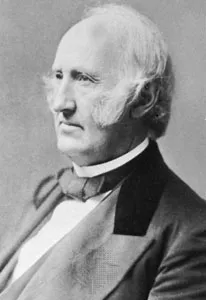
|
| Wendell Phillips |
Wendell Phillips was for the abolition of slavery and equal rights for women. In 1845 Phillips published No Union With Slaveholders. He thought that the South should be allowed to secede to rid the North of the South's pro-slavery influence. Phillips defended John Brown and, after Brown's death, wanted a monument to be built to honor him. Phillips said that without the right to vote, "freedom, so called, is a sham." Of the Fugitive Slave Act of 1850 he said, "We must trample this law under our feet." Near the end of the war Phillips wanted a radical reconstruction policy, and said that Lincoln's ten percent plan didn't go far enough to ensure the rights of newly freed slaves. He said that it "leaves the large landed proprietors of the South still to domineer over its politics, and makes the negro's freedom a mere sham." He said that it "perpetuates slavery under a softer name."
In his memoirs Frederick Douglass described his escape from a Maryland plantation. He said he was cold in the winter and hungry. He described the time a mistress battered a slave woman to death for falling asleep when she was supposed to be minding a child. He was sent by his master to work for Covey, who had a reputation for breaking in rebellious slaves. He said he fought with Covey for hours, and thought he'd won by drawing first blood. After that, Covey treated him with respect. Douglass later borrowed papers from a freedman and escaped to the North. When his train arrived in New York he was told that there were slave-catchers there, so he took another train to Massachusetts. Since he had worked on ships as a slave he tried to get a job working in a shipyard, but other workers said they would quit if forced to work with a n***er, so he got a job working in a factory. He then became an abolitionist and published The North Star, an abolitionist publication. He lived and lectured in the United Kingdom until abolitionists bought his freedom. During the Civil War Lincoln asked Douglass to help recruit emancipated slaves for the Union army. Douglass described a slave whipping as follows:
He would at times seem to take great pleasure in whipping a slave. I have often been awakened at the dawn of day by the most heart-rending shrieks of an own aunt of mine, whom he used to tie up to a joist, and whip upon her naked back till she was literally covered with blood. No words, no tears, no prayers, from his gory victim, seemed to move his iron heart from its bloody purpose. The louder she screamed, the harder he whipped; and where the blood ran fastest, there he whipped longest. He would whip her to make her scream, and whip her to make her hush; and not until overcome by fatigue, would he cease to swing the blood-clotted cowskin.
While Garrison was a pacifist, Douglass believed in the need for violence to oppose slavery. "The only way to make the Fugitive Slave Law a dead letter", Douglass said in 1850, "is to make half a dozen or more dead kidnappers." Douglass was a pacifist before the Fugitive Slave Act of 1850, saying that "moral force" was needed rather than the "shedding of one single drop of blood", but after 1850, he was for "forcible resistance." He said that "Power concedes nothing without a demand. It never did and it never will."

|
| Frederick Douglass |
John Brown was an abolitionist who believed that violence was needed to end slavery. Brown's belief in violence made him controversial.
In 1852, Harriet Beecher Stowe published her antislavery novel Uncle Tom's Cabin. Some modern people mock her novel for making Uncle Tom appear to be overly subservient. However, Stowe envisioned Uncle Tom as a Christ-like figure, to show the un-Christian evils of slavery. The sentimental style in which the book was written was very popular in the 19th century. Her book was a best-seller, second only to the Bible. Stowe's book was fiction, but it was based on what she was told by blacks who escaped from slavery. When Lincoln met Stowe, he said, "So you're the little woman who wrote the book that made this great war." An editorial in the New Orleans Crescent read, "There never before was anything so detestable or so monstrous among women as this."
Sojourner Truth and her daughter escaped from slavery in Swartekill, New York, in 1826. She later won freedom for her son in an 1828 court case. She fought for the abolition of slavery and equal rights for women. During the Civil War, she helped recruit blacks for the Union army. In 1851 she said,
That man over there says that woman needs to be helped into carriages and lifted over ditches ... Nobody ever helps me into carriages, or over mud-puddles or gives me any best place. And a'nt I a woman?
Look at my arm! I have plowed, and planted, and gathered into barns, and no man could head me! And a'nt I a woman?
I would work as much and eat as much as a man, when I could get it, and bear the lash as well. And a'nt I a woman?
I have borne thirteen children and seen em most all sold off to slavery, and when I cried out with my mother's grief, none but Jesus heard me! And a'nt I a woman?
Not all of those who supported equal rights for women were abolitionists. When Sojourner Truth tried to give an 1853 speech in New York City at the Fourth National Women's Rights Convention, a hostile mob was shouting, jeering and threatening. Truth said, "we'll have our rights, see if we don't; and you can't stop us from them; see if you can. You may hiss as much as you like, but it is comin'."
In 1837, a pro-slavery mob murdered the abolitionist Elijah Lovejoy in Alton, Illinois. Lovejoy died defending himself and his press from pro-slavery rioters who set fire to a warehouse storing his press and shot Lovejoy as he stepped outside to tip a ladder being used by the mob.
Sarah Grimké wanted freedom for both slaves and women. She wrote,
We cannot push Abolitionism forward with all our might until we take up the stumbling block out of the road ... If we surrender the right to speak in public this year, we must surrender the right to petition next year, and the right to write the year after, and so on. What then can woman do for the slave, when she herself is under the feet of man and shamed into silence?
Solomon Northup was a free black man who lived in the North. He was drugged by slave catchers, torn away from his wife and children and enslaved in the Red River region of Louisiana from 1841 to 1853. He wrote a book about it, Twelve Years a Slave.
In September 1861 Mary Boykin Chesnut's cousin Betsey Witherspoon was found dead in her bed, murdered by her slaves, smothered with a pillow. Mrs. Chesnut was married to Confederate James Chesnut, who rowed out to Fort Sumter and demanded that Anderson, who commanded the fort, surrender the fort. She was friends with Confederate leaders, including the Wigfalls, Varina and Jefferson Davis and John Bell Hood. She lived on a plantation with hundreds of slaves. Still, she said that she hated slavery. However, she also liked the fact that her slaves knew what she wanted before she did. She wanted her side to win, but said that if anything as terrible as defeat should happen, the one good thing would be Lincoln's Emancipation Proclamation. When Sherman marched through South Carolina, she said that Job was her comforter. She wrote a diary about the war.
Chesnut expressed her private doubts about slavery and about the rape of slave women. She wrote,
I wonder if it be a sin to think slavery a curse to any land. Sumner said not one word of this hated institution which is not true. Men and women are punished when their masters and mistresses are brutes and not when they do wrong — and then we live surrounded by prostitutes. An abandoned woman is sent out of any decent house elsewhere. Who thinks any worse of a negro or mulatto woman for being a thing we can't name? God forgive us, but ours is a monstrous system and wrong and iniquity. Perhaps the rest of the world is as bad—this only I see. Like the patriarchs of old our men live all in one house with their wives and their concubines, and the mulattoes one sees in every family exactly resemble the white children — and every lady tells you who is the father of all the mulatto children in everybody's household, but those in her own she seems to think drop from the clouds.
Chesnut felt that women and slaves were sold. She wrote,
You know how women sell themselves and are sold in marriage, from queens downward, eh?
You know what the Bible says about slavery—and marriage. Poor women. Poor slaves.
Amelia Martin, in her diary, mentioned finding some escaped slaves. Her mother thought the slaves should be returned to their masters. Her father thought they should be sent North to escape. A neighbor got a cash reward for turning in the slaves to their masters.
Celia, a slave woman, told her master after five years of rape to stop. Robert Newsom, the slave owner, came to rape her again. She killed Robert, and as a result of the State of Missouri v. Celia court case she was hanged.
Lucy Mead, born into slavery and sold multiple times after age 9, had been free for 30 years when she took out a newspaper ad with a simple plea: "I would like to find my people," she wrote in 1895 in the Richmond Planet. Her mother, two sisters, two brothers and stepchildren all disappeared into the South's pre-Civil War market for humans. Her husband was killed by a mob in Texas.
Slaves in Georgia needed written permission to travel. It was assumed that only whites knew how to read and write, but a black slave named Susie King Taylor wrote permission to travel for any slave who wanted one. During the war, she helped children and colored soldiers learn to read and write and tended to the wounded as a nurse. When she was eleven and twelve years old, Susie forged passes for her grandmother. "Every person had to have this pass, for at nine o'clock each night a bell was rung, and any colored persons found on the street after this hour were arrested by the watchman, and put in the guard-house until next morning, when their owners would pay their fines and release them." She described what she was told as a slave as follows:
About this time I had been reading so much about the 'Yankees' I was very anxious to see them. The whites would tell their colored people not to go to the Yankees, for they would harness them to carts and make them pull the carts around, in place of horses. I asked grandmother, one day, if this was true. She replied, 'Certainly not!' that the white people did not want slaves to go over to the Yankees, and told them these things to frighten them.
Slave codes varied from state to state. Many slave codes had the following:
Most regions required any slaves away from their plantations or outside of the cities they resided in to have a pass signed by their master. Many cities in the slave-states required slave tags, small copper badges that enslaved people wore, to show that they were allowed to move about.
Most places restricted the marriage rights of enslaved people, ostensibly to prevent them from trying to change masters by marrying into a family on another plantation. All the slave states passed anti-miscegenation laws, banning the marriage of white and black people as did the free states of Indiana, Illinois, and Michigan.
Free blacks were denied the rights of citizens to assemble in groups, bear arms, learn to read and write, exercise free speech, or testify against white people in Court.
After 1810, states made manumissions of slaves more difficult to obtain, in some states requiring an act of the legislature for each case of manumission. This sharply reduced the incidence of planters freeing slaves.
Slave codes made it illegal to teach slaves to read or write.
There were prohibitions on gathering in large groups.
There were slave patrols to enforce slave codes.
Black Codes in free states varied from state to state. Massachusetts didn't have a black code, but blacks were still barred from some restaurants and places of employment. Connecticut, Ohio, Illinois, Indiana, Michigan and New York enacted laws to discourage free blacks from residing in those states. They were denied equal political rights, including the right to vote, the right to attend public schools, and the right to equal treatment under the law. In Oregon, black people were forbidden to settle, marry, or sign contracts. In Ohio black people were required to have a certificate indicating that they were free and a good behavior bond. The Indiana Legislature decreed in 1843 that only white students could attend public schools. Iowa and Indiana in 1851 and Illinois in 1853 enacted legislation barring any blacks, free or slave, from these states. Ohio repealed its negro exclusion law in 1849. Some of the Northern states repealed such laws around the same time that the Civil War ended and slavery was abolished by constitutional amendment.
After the Civil War Southern states had Black Codes. The defining feature of the Black Codes was broad vagrancy law, which allowed local authorities to arrest freed people for minor infractions and commit them to involuntary labor. This period was the start of the convict lease system, also described as "slavery by another name" by Douglas Blackmon in his 2008 book of this title. The Thirteenth Amendment doesn't apply to prisoners, and the convict lease system was designed to exploit this loophole. Some states explicitly curtailed black people's right to bear arms, justifying these laws with claims of imminent insurrection. In Mississippi and Alabama, these laws were enforced by creating special militias. The Black Codes turned what had been misdemeanors into felonies.
The folk song about John Henry was about a very real black man. He was arrested under the Black Codes for theft after the war. The evidence against him was hazy. He was sentenced in 1866 to work cutting tunnels through the Appalachian Mountains with a steam drill for the Chesapeake and Ohio Railroad, and died from it. His death was from a respiratory disease probably caused by inhaling microscopic particles of rock. That same year, Jefferson Davis was accused of the deaths of 500 Union prisoners of war at Anderson Prison Camp. The judge suspended his sentence indefinitely, and he went free.
After 1860, many states passed laws against miscegenation, but the US Supreme Court's 1967 Loving vs. Virginia decision overturned them.
Jourdon Anderson and his family were freed by Union troops during the Civil War and left Tennessee for Ohio. A few months after the war ended, Anderson's former enslaver wrote to him, asking him to return to the plantation, where the harvest was about to come in, and promising a wage and freedom. Anderson dictated his reply to his abolitionist employer, who was so impressed with its wit he had it published in the newspaper.
Dayton, Ohio, August 7, 1865
To my old Master, Colonel P. H. Anderson, Big Spring, Tennessee
Sir:
I got your letter, and was glad to find that you had not forgotten Jourdon, and that you wanted me to come back and live with you again, promising to do better for me than anybody else can. I have often felt uneasy about you. I thought the Yankees would have hung you long before this, for harboring Rebs they found at your house. I suppose they never heard about your going to Colonel Martin's to kill the Union soldier that was left by his company in their stable.
Although you shot at me twice before I left you, I did not want to hear of your being hurt, and am glad you are still living. It would do me good to go back to the dear old home again, and see Miss Mary and Miss Martha and Allen, Esther, Green, and Lee. Give my love to them all, and tell them I hope we will meet in the better world, if not in this. I would have gone back to see you all when I was working in the Nashville Hospital, but one of the neighbors told me that Henry intended to shoot me if he ever got a chance.
I want to know particularly what "the good chance" is you propose to give me. I am doing tolerably well here. I get $25 a month, with victuals and clothing; have a comfortable home for Mandy (the folks call her Mrs. Anderson), and the children, Milly, Jane, and Grundy, go to school and are learning well. The teacher says Grundy has a head for a preacher. They go to Sunday school, and Mandy and me attend church regularly. We are kindly treated. Sometimes we overhear others saying, "Them colored people were slaves" down in Tennessee. The children feel hurt when they hear such remarks; but I tell them it was no disgrace in Tennessee to belong to Colonel Anderson. Many darkeys would have been proud, as I used to be, to call you master.
Now if you will write and say what wages you will give me, I will be better able to decide whether it would be to my advantage to move back again.
As to my freedom, which you say I can have, there is nothing to be gained on that score, as I got my free papers in 1864 from the Provost-Marshal-General of the Department of Nashville. Mandy says she would be afraid to go back without some proof that you were disposed to treat us justly and kindly; and we have concluded to test your sincerity by asking you to send us our wages for the time we served you. This will make us forget and forgive old scores, and rely on your justice and friendship in the future.
I served you faithfully for thirty-two years, and Mandy twenty years. At $25 a month for me, and $2 a week for Mandy, our earnings would amount to $11,680. Add to this the interest for the time our wages have been kept back, and deduct what you paid for our clothing, and three doctor's visits to me, and pulling a tooth for Mandy, and the balance will show what we are in justice entitled to. Please send the money by Adams Express, in care of V. Winters, Esq., Dayton, Ohio.
If you fail to pay us for faithful labors in the past, we can have little faith in your promises in the future. We trust the good Maker has opened your eyes to the wrongs which you and your fathers have done to me and my fathers, in making us toil for you for generations without recompense. Here I draw my wages every Saturday night; but in Tennessee there was never any pay-day for the negroes any more than for the horses and cows. Surely there will be a day of reckoning for those who defraud the laborer of his hire.
In answering this letter, please state if there would be any safety for my Milly and Jane, who are now grown up, and both good-looking girls. You know how it was with poor Matilda and Catherine. I would rather stay here and starve and die, if it come to that, than have my girls brought to shame by the violence and wickedness of their young masters.
You will also please state if there has been any schools opened for the colored children in your neighborhood. The great desire of my life now is to give my children an education, and have them form virtuous habits.
From your old servant, Jourdon Anderson
P.S.- Say howdy to George Carter, and thank him for taking the pistol from you when you were shooting at me.
Anderson's former enslaver was forced to sell his plantation and died a few years later at 44. Anderson lived a long life, had 11 children with his wife and became a sexton in his church.
Other letters by former slaves were written by Annie Davis, Frederick Douglass and Jermain Wesley Loguen.
Secessionist documents are at:
- Alexander Stephens' Cornerstone Speech
- Reflections on the Cornerstone Speech
- Georgia's Declaration of Causes of Secession
- Mississippi's Declaration of Causes of Secession
- South Carolina's Declaration of Causes of Secession
- Texas' Declaration of Causes of Secession
- South Carolina's Address to the Slaveholding States
- First Message of Governor Isham Harris
- Second Message of Governor Isham Harris
Southern political speeches are at:
- Speech of E.S. Dargan
- The Southern Address by John C. Calhoun
- Robert Toomb's Speech at Tremont Temple, Boston
- Yancey's Speech to the Democratic Convention 1860
Southern editorials are at:
- Augusta Chronicle 1864
- Augusta Chronicle 1865
- Charleston Courier - Slavery and State Sovereignty
- Charleston Mercury - Lunacy
- Charleston Mercury - Prospects of Slavery Expansion
- Charleston Mercury - Slaveholders and Non-Slaveholders of the South
- Charleston Mercury - The Course of Submission
- Charleston Mercury - The Present Distractions
- Charleston Mercury - The Terrors of Submission
- Charleston Mercury - What Shall the South Carolina Legislature Do?
- DeBow's Review - Destiny of the Slave States
- DeBow's Review - Reopening the Slave Trade
- DeBow's Review - Views of Non-slaveholders
- Gainesville, Alabama Independent Editorial
- Macon Telegraph and Confederate - The Arming and Emancipation of Slaves
- New Orleans Daily Crescent
- The Richmond Enquirer - The True Issue
- Southern Punch - The New Herasy
- The Staunton Spectator - Danger of Insurrection
- Staunton Vindicator Editorial
- Staunton Vindicator - Submission is Ruin
- Republican Banner - The Crittenden Compromise
- The Daily Constitutionalist - What Should Georgia Do?
- The Mercury Editorial
- Washington (Arkansas) Telegraph Editorial
- Washington (Arkansas) Telegraph - The Slave Soldiers
DEMOCRATIC PARTY
The 19th-century Democratic Party was a national party until it split between Northern and Southern wings in 1860 because of divisions over slavery. Stephen Douglas was a leading Democrat, but divisions over slavery were too great for his efforts at compromise to paper over. Southern Democrats were very proslavery. Northern Democrats tolerated slavery in the South and were willing to allow Popular Sovereignty to decide the slavery issue in the territories. Democrats tended to favor a stronger president, stronger state governments, lower tariffs, hard money, and expansionism.
After the Mexican War an antislavery faction of Democrats from New York, known as the "Barnburners," wanted to nominate Van Buren. They opposed slavery, banks and extension of public debt. Another faction, known as the "Hunkers," were more willing to compromise on the slavery issue and supported banks and internal improvements. The Locofocos were a radical faction of the New York Democratic Party (1835–mid-1840s) advocating for economic equality, hard money, and labor rights while opposing monopolies and chartered banks. The Locofocos opposed Tammany Hall, and were nicknamed "Locofocos" after using locofoco friction matches to continue a meeting after gaslights were extinguished by members of Tammany.
Race baiting was very popular with 19th century Democrats, north and south. At the Lincoln Douglas debate at Alton, Illinois the leading Democrat Stephen Douglas said,
But the Abolition party really think that under the Declaration of Independence the negro is equal to the white man, and that negro equality is an inalienable right conferred by the Almighty, and hence that all human laws in violation of it are null and void. With such men it is no use for me to argue. I hold that the signers of the Declaration of Independence had no reference to negroes at all when they declared all men to be created equal. They did not mean negro, nor the savage Indians, nor the Fejee Islanders, nor any other barbarous race. They were speaking of white men. ("It's so," "it's so," and cheers.) They alluded to men of European birth and European descent-to white men, and to none others, when they declared that doctrine. ("That's the truth.") I hold that this Government was established on the white basis. It was established by white men for the benefit of white men and their posterity forever, and should be administered by white men, and none others.
COPPERHEADS OR PEACE DEMOCRATS
During the war the Copperheads, led by Clement Vallandigham, wanted to end the war immediately and allow what was left of the South, including slavery, to survive. In 1863, Vallandigham was convicted by an Army court-martial for publicly expressing opposition to the war and exiled to the Confederate States of America. He later wrote the party platform for Northern Democrats in the election of 1864.
WAR DEMOCRATS
War Democrats in American politics of the 1860s were members of the Democratic Party who supported the Union and rejected the policies of the Copperheads, or Peace Democrats.
WHIG PARTY
The party was hostile toward manifest destiny, territorial expansion into Texas and the Southwest, and the Mexican–American War. It disliked presidential power, as exhibited by Andrew Jackson and James K. Polk, and preferred congressional dominance in lawmaking. Members advocated modernization, meritocracy, the rule of law, protections against majority rule, and vigilance against executive tyranny. They favored an economic program known as the American System, which called for a protective tariff, federal subsidies for the construction of infrastructure, and support for a national bank, including re-authorization of the Second Bank of the United States. Whigs also favored publicly funded education. The party was active in both the North and the South.
Henry Clay was a leading Whig for many years. He was a slave owner who wanted to find a peaceful, gradual way to end slavery through compensated emancipation and colonization of emancipated slaves. He believed that colonization would reduce racist fears of emancipation among 19th-century whites. Lincoln was a Whig until the Whig Party was replaced by the new, antislavery Republican Party. Lincoln called Clay his "beau ideal" of a statesman and quoted Clay as condemning those proslavery enough to "blow out the moral lights around us" and eradicate the love of liberty.
The Mexican War created a division between "Conscience Whigs" and "Cotton Whigs" over the status of slavery in the territories. Charles Sumner, Senator of Massachusetts, opposed the nomination of Zachary Taylor because he was a slaveowner. Conscience Whigs opposed an alliance of "lords of the loom" and "lords of the lash."
REPUBLICAN PARTY
In 1854, the Republican Party emerged to combat the expansion of slavery into western territories after the passing of the Kansas–Nebraska Act. By 1858 it had enlisted former Whigs and former Free Soil Democrats who were antislavery. It was the Kansas-Nebraska Act of 1854 that led to the forming of the Republican Party. The first anti-Nebraska local meeting where "Republican" was suggested as a name for a new anti-slavery party was held in a Ripon, Wisconsin schoolhouse on March 20, 1854. John C. Frémont ran as the first Republican nominee for President in 1856 behind the slogan "Free soil, free silver, free men, Frémont and victory!" Although Frémont's bid was unsuccessful, the party showed a strong base. It had almost no support in the South. In 1860 Lincoln won the election as a Republican.
LIBERTY PARTY
The Liberty Party was an abolitionist political party in the United States before the American Civil War. The party experienced its greatest activity during the 1840s, while remnants persisted as late as 1860. It supported James G. Birney in the presidential elections of 1840 and 1844. It didn't win many votes.
FREE SOIL PARTY
The Free Soil Party, also called the Free Democratic Party or the Free Democracy, was a political party in the United States from 1848 to 1854, when it merged with the Republican Party. The party was focused on opposing the expansion of slavery into the western territories of the United States. Conscience Whigs, Barn Burners and members of the short-lived abolitionist Liberty Party joined this political party. While they didn't agree over banks and tariffs, they were united in opposition to slavery.
AMERICAN PARTY OR KNOW NOTHING PARTY
Several political parties were called the American Party. Before the Civil War the American Party was made up of Know Nothings, who were anti-immigrant, anti-Catholic and favored temperance. The Know Nothings began when two secret fraternal societies in New York, the Order of United Americans and the Order of the Star Spangled Banner, merged under the leadership of James Barker in 1852. It organized hundreds of lodges all over the country. Members were pledged to vote for only native born Protestants for public office. When asked by outsiders about the Order, members were to respond, "I know nothing."
Lincoln said the following in an August 24, 1855 letter to his friend Joshua Fry Speed:
I am not a Know-Nothing. That is certain. How could I be? How can any one who abhors the oppression of negroes, be in favor of degrading classes of white people? Our progress in degeneracy appears to me to be pretty rapid. As a nation, we begin by declaring that "all men are created equal." We now practically read it "all men are created equal, except negroes." When the Know-Nothings get control, it will read "all men are created equal, except negroes, and foreigners, and catholics." When it comes to this I should prefer emigrating to some country where they make no pretence of loving liberty-to Russia, for instance, where despotism can be taken pure, and without the base alloy of hypocracy.
Rich white men who met property requirements could vote. Rhode Island enshrined black male suffrage (and jury service) in its constitution, making it unique among the free states before the Civil War.
In New York, blacks could vote from 1821. Black men who met the property and residency test were enfranchised along with whites. As their numbers grew after gradual emancipation, the legislature in 1811 added a requirement that would-be black voters obtain an official "certificate of freedom" to prove their status. The 1821 state constitution then extended white male suffrage to all taxpayers, but continued to impose a $250 property-ownership and three-year residency requirement on free black men seeking the ballot. That onerous threshold remained in place right up until the Civil War era. In New Jersey, blacks could vote from 1790 to 1807. In Pennsylvania, blacks could vote until 1838. Blacks in other states were barred from voting either by law or by impossibly high legal requirements. By the end of the Civil War, 19 out of 24 Union states didn't allow blacks to vote at all, although this changed with the ratification of the Fifteenth Amendment. By 1900 Southern states denied blacks the right to vote by means of grandfather clauses, literacy tests and poll taxes.
In New Jersey, women who owned enough property could vote from 1776 to 1807. Women in Kentucky and Kansas who owned property could vote on school issues only.
The Third Seminole War (1855–1858) was precipitated as an increasing number of settlers in central and southern Florida led to increasing tension with Seminoles and Miccosukees living in the area. In December 1855, US Army personnel located and destroyed a large Seminole plantation west of the Everglades, perhaps to deliberately provoke a violent response that would result in the removal of the remaining Seminole citizens from the region. Holata Micco, a Seminole leader known as Billy Bowlegs by whites, responded with a raid near Fort Myers, leading to a series of retaliatory raids and small skirmishes with no large battles fought. Once again, the United States military strategy was to target Seminole civilians by destroying their food supply. By 1858, most of the remaining Seminoles, war weary and facing starvation, acquiesced to being removed to the Indian Territory in exchange for promises of safe passage and cash payments. An estimated 200 to 500 Seminoles in small family bands still refused to leave and retreated deep into the Everglades and the Big Cypress Swamp to live on land considered unsuitable by American settlers.

|
| Franklin Pierce |
Even though Franklin Pierce was from New Hampshire, he was pro-slavery. He supported the Fugitive Slave Act of 1850, the Kansas-Nebraska Act (which led to the Bleeding Kansas controversy over slavery) and the Ostend Manifesto, which was a failed attempt to buy Cuba from Spain and add it to the Union as a slave state.
William Walker led armed men on an expedition that seized La Paz, the capital of Baja California in 1853. His attempted filibustering ended in defeat, but he was acquitted of violating the neutrality law. In 1854, Walker received financial support from Cornelius Vanderbilt for a filibuster expedition in which he took over Nicaragua. In 1856, Walker declared himself the president of Nicaragua. Southerners hoped that Nicaragua could be added to the Union as a slave state, but in 1857 Walker was defeated and overthrown. Again, a jury acquitted Walker of violating the neutrality law. Walker made a third attempt at filibustering, but his ship hit a reef and sank. In 1860 Walker made a fourth attempt at filibustering, and was executed by a Honduran firing squad.
Southern expansionists called for acquiring Cuba as a slave state. At the suggestion of Secretary of State William L. Marcy, American ministers in Europe-Pierre Soulé for Spain, James Buchanan for Britain, and John Y. Mason for France met to discuss strategy related to an acquisition of Cuba. They met secretly at Ostend, Belgium, and drafted a dispatch at Aachen, Prussia. The document was sent to Washington in October 1854, outlining why a purchase of Cuba would be beneficial to each of the nations and declaring that the US would be "justified in wresting" the island from Spanish hands if Spain refused to sell. To Marcy's chagrin, Soulé made no secret of the meetings, causing unwanted publicity in both Europe and the US. The dispatch was published as demanded by the House of Representatives. Dubbed the "Ostend Manifesto," it was immediately denounced in both the Northern states and Europe.
In 1854, the Gadsden Purchase cost a large amount of taxpayer money to buy a small amount of land from Mexico, which was added to the southwest border.
Anthony Burns was an African-American man who escaped from slavery in Virginia in 1854. His capture and trial in Boston and transport back to Virginia generated wide-scale public outrage in the North and increased support for abolition. The proslavery President Franklin Pierce spent a large amount of taxpayer money to reenslave Anthony Burns. Outraged antislavery Northerners protested outside the prison where Burns was held before he was forced back into slavery. The clergyman Thomas Wentworth Higginson led a group of abolitionists who attacked the courthouse with revolvers, axes and a battering ram. The attempt failed, and a deputy died from a gunshot wound. Burns was escorted from the courthouse by Marshal Freeman and his men, along with an additional 140 US Marines and infantrymen. State militia brigades lined the streets to keep the crowd at bay and to prevent any interference with the procession while Burns was escorted to a revenue cutter that returned him to slavery in Virginia.
The Wisconsin state Supreme Court and the Vermont state legislature claimed a right to nullify the Fugitive Slave Act, and Northern courts attempted jury nullification of the law. Some Northern states passed personal liberty laws requiring that captured blacks be given the right to trial by jury and habeas corpus. Some Northern states blocked police from enforcing the Fugitive Slave Act.
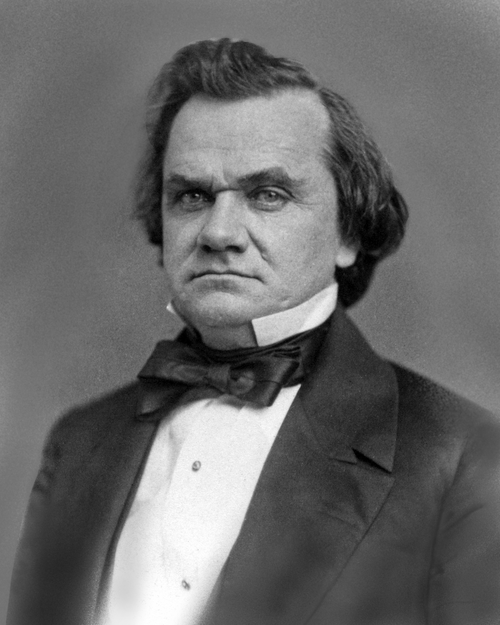
|
| Stephen Douglas |
Senator Stephen Douglas' Kansas-Nebraska Act of 1854 prepared the territories of Kansas and Nebraska, which were from the Louisiana Purchase, for statehood. Southern congressmen told Douglas they wouldn't vote for his territorial legislation unless it repealed the Missouri Compromise ban on slavery in the territories. Douglas said that repealing it would cause "one hell of a storm," but gave in to pressure. Southern congressmen also voted against an attempted Homestead Act that would have given free state settlers an advantage. So Douglas borrowed an idea from the Compromise of 1850 and replaced the Missouri Compromise ban on slavery with Popular Sovereignty, which meant that settlers in Kansas and Nebraska Territories could vote slavery either up or down at the territorial stage without having to wait for statehood to resolve the issue. The new, antislavery Republican Party was founded in opposition to Douglas' Kansas-Nebraska bill.
Most of the settlers who arrived in Kansas were antislavery. In 1854 the New England Emigrant Aid Company provided financial assistance to antislavery emigrants who went to Kansas Territory. Abolitionists such as Henry Ward Beecher sent "Beecher Bibles," which were Sharps rifles disguised as Bibles to protect them from proslavery people. However, proslavery border ruffians led by Missouri Senator David Atchinson and others rode up from Missouri and used massive vote fraud to set up a proslavery government at Lecompton. The antislavery majority set up their government in Topeka. So Kansas had two rival governments, each claiming to be the legitimate government of Kansas Territory.
A proslavery posse of around 800 men poured into Lawrence, Kansas, destroyed its two newspaper offices, burned the hotel and the home of the free-soil governor, and plundered shops and houses.
Senator Charles Sumner gave his Crime Against Kansas speech in which he condemned the Sack of Lawrence and accused Andrew Butler, a cousin of Senator Preston Brooks, of being in league with "the harlot Slavery." Brooks caned Sumner about 30 times until he lost consciousness. It took four years for Sumner to recover. Southerners gave Brooks new canes inscribed with "Hit Him Again" and "Use Knock Down Arguments."
In 1856, John Brown and his followers murdered five proslavery people at Pottawatomie Creek, splitting their skulls with broadswords. Months later, Brown helped 35 antislavery men defend themselves at Osawatomie, Kansas, against an attack by hundreds of proslavery men from Missouri. The murders were part of the violence committed by both proslavery and antislavery factions in Kansas Territory. Estimates of the number of murders in "Bleeding Kansas" range from 56 to 200.
Governor Wilson Shannon resigned in August 1856 when he realized that Pierce was about to fire him. He was replaced by John W. Geary as governor. Geary condemned the "felon legislature" in Lecompton that passed a proslavery constitution over his veto and resigned in March 1857.
The Topeka Constitution would have excluded all blacks, free and slave, from Kansas. It was submitted to the US Congress but opposed by Pierce. It passed the House but failed in the Senate.

|
| James Buchanan |
James Buchanan defeated Frémont (the Pathfinder) in the election of 1856. Democrats in Pittsburgh said the contest was about "the white race or the negro race." Democrats said that Frémont would "elevate the African race in this country to complete equality of political and economic condition with the white man." Senator Robert Toombs of Georgia said that the election of Frémont "would be the end of the Union." James Buchanan was an advocate for states' rights, particularly regarding slavery, and minimized the role of the federal government.
In 1834, Buchanan purchased two enslaved individuals-Daphne Cook and her daughter Ann-from his sister's family in Virginia. Rather than freeing them outright, he indentured them to himself in Pennsylvania, where slavery was technically illegal. Daphne, age 22, was bound to serve him for seven years, and Ann, just five years old, was indentured for 23 years. This arrangement placed them in a legal gray area—not enslaved, but not truly free either, a condition historians call "term slavery" or "statutory slavery." Buchanan's motivations weren't purely humanitarian. He was running for Senate and feared that his sister's slave ownership could damage his political image. Buying and indenturing the Cooks allowed him to appear neutral on slavery while solving his own need for household servants.
After Geary resigned as governor of Kansas, Buchanan replaced him with Robert J. Walker as governor. Even though Walker was from Mississippi, he acknowledged that free state men were in the majority, but the free state residents refused to vote in an election that was designed to allow proslavery vote fraud. Two districts with 130 legitimate voters returned 2,900 ballots, 1,600 of which were copied from an old Cincinnati directory. Walker threw out the fraudulent returns and certified a free state majority in the next territorial legislature.
The Lecompton Constitution was drafted by the proslavery Lecompton government and included provisions to protect slavery in the state and to exclude free blacks from its bill of rights. Slavery was the subject of Article 7, which protected the right to enslaved "property." It prevented the legislature from emancipating enslaved people without their enslavers' consent and full compensation. The Lecompton government asked the proslavery president, James Buchanan, to allow Kansas to join the Union as a slave state. A rigged election approved it in December 1857. Walker called the result "a vile fraud, a bare counterfeit" and left Kansas.
The proslavery side demanded a referendum on parts of the proposed Lecompton Constitution, which they claimed was a choice between a "Constitution with Slavery" and a "Constitution with no Slavery." However, the constitution without slavery said both that "Slavery shall no longer exist" and that "the right of property in slaves in this territory shall in no manner be interfered with." In other words, the constitution without slavery merely prevented the importation of slaves from outside of Kansas in the future, although it would be difficult to know when a slave came to Kansas. Because free-soilers boycotted the election, the Lecompton Constitution went to Congress for ratification. The US Senate voted to allow the admission of Kansas to the Union as a slave state, but the US House of Representatives voted against it.
Stephen Douglas opposed the Lecompton constitution because it was based on massive vote fraud, and his Popular Sovereignty beliefs were based on a majority vote, not vote fraud. Jefferson Davis, a congressman from Mississippi, said that Douglas was "catering to the prejudice of a majority to exclude the property of a minority." Davis thought that slaveowners were an oppressed minority. The Lecompton Constitution was overwhelmingly defeated in a second vote in January 1858 by a majority of voters in the Kansas Territory. Voting for the Constitution allowed Kansas to achieve earlier statehood, while rejecting it delayed statehood by two years. Antislavery Kansas voters saw this condition as a bribe and overwhelmingly rejected it. Kansas joined the Union as a free state in 1861, joining California, Minnesota and Oregon.
Buchanan approved of a Corwin Amendment, which was a failed attempt at protecting slavery in states where it existed to appease the South.
On November 24, 1859, Charles Darwin's On the Origin of Species was published.
The Pony Express was an American express mail service that used relays of horse-mounted riders between Missouri and California. The Central Overland California and Pikes Peak Express Company operated it. The Pony Express went bankrupt in 18 months when a faster telegraph service was established. During its 18 months of operation beginning in 1860, the Pony Express reduced the time for messages to travel between the East and West Coasts to about 10 days.
The Mormons, or Latter Day Saints, were a religious sect founded by Joseph Smith in 1830 and based in Kirtland, Ohio. They were driven out of New York and Ohio into Missouri. During the Mormon War of 1838 mobs in Missouri massacred some Mormons in 1838-39, and the rest sought refuge in Illinois. When a Mormon offshoot disclosed that Smith allowed polygamy, Smith ordered the destruction of the dissenters' printing press, and Smith and his brother were put in jail. In 1844, a mob broke into the jail and killed Smith and his brother. Smith's successor Brigham Young led the Mormons to the basin of the Great Salt Lake in modern Utah, which was then Mexican territory, in 1846-47. However, the Mormons also persecuted others. President Buchanan started the Utah War of 1857-1858 to force Mormons to accept secular rule. The Mountain Meadows Massacre (September 7–11, 1857) was a series of attacks during the Utah War that resulted in the mass murder of at least 120 members of a wagon train that was led by Captains John T. Baker and Alexander Fancher. The massacre occurred in the southern Utah Territory at Mountain Meadows, and was perpetrated by settlers from the Church of Jesus Christ of Latter-day Saints (LDS Church) involved with the Utah Territorial Militia (officially called the Nauvoo Legion), who recruited and were aided by some Southern Paiute Native Americans. The wagon train, made up mostly of immigrant families from Arkansas, was bound for California, traveling on the Old Spanish Trail that passed through the Territory. Mormons told the immigrants under a white flag of truce that they would be escorted to safety if they surrendered their cattle and oxen to the Indians and their weapons to the Mormons. After the immigrants agreed to do so, men, women and children were massacred.
Dred Scott had been the slave of army surgeon John Emerson, who took Scott from Missouri to Illinois and from there to Fort Snelling in Louisiana Purchase Territory in what is now Minnesota over several years in the 1830s. Scott married a slave woman owned by Emerson who gave birth to a daughter. The Missouri Compromise banned slavery in the Louisiana Purchase.
The Supreme Court issued its 1857 Dred Scott v. Sanford decision. The seven-to-two majority opinion, written by Chief Justice Roger Taney, said that blacks "were so far inferior, that they had no rights which a white man was bound to respect," that blacks weren't citizens and that slavery had to be allowed in the territories. Even though Taney had freed his own slaves, he wanted to defend the South. Of his Southern countrymen, he wrote that "the knife of the assassin is at their throats."
Taney freed slaves he inherited from the Maryland plantation owned by his family. In 1819, Taney defended an abolitionist Methodist minister, Jacob Gruber, who had been arrested for his criticism of slavery. Gruber was charged with attempting to stir up "acts of mutiny and rebellion." Taney claimed that the prosecution lacked a case against Gruber and argued that, lacking evidence of criminal intent, Gruber's freedom of conscience and freedom of speech needed to be protected. Taney delivered an impassioned defense of Gruber and, in his opening argument, Taney condemned slavery as "a blot on our national character." After listening to the defense, the jury acquitted Gruber. However, increasing sectionalism caused Taney to defend the slave-owning states. By the time Jackson was president, Taney said that the rights of free blacks were not protected by the Constitution. This belief led to his infamous Dred Scott decision.
At his inauguration in 1860 Lincoln said that if "vital questions affecting the whole people" are to be "irrevocably fixed by decisions of the Supreme Court," then "the people will have ceased to be their own rulers."

|
| John Brown |
In 1859, John Brown and his followers raided an arsenal at Harper's Ferry, Virginia in an attempt to arm slaves and lead slave insurrections. He received funding from the "Secret Six" group of abolitionist supporters, who were Gerrit Smith, Thomas Wentworth Higginson, Theodore Parker, Samuel Gridley Howe, George L. Stearns and Franklin B. Sanborn. The Secret Six supplied Brown's followers with weapons when he attacked the arsenal. Brown's band included five blacks and 17 whites. Frederick Douglass told Brown that he was walking into a "perfect steel-trap." The Bleeding Kansas conflict caused some former pacifists to see the need for violence. However, Brown was captured by US Marines led by Robert E. Lee and hanged. Brown's raid increased Southern fears of slave insurrections. At his trial, Brown prophetically wrote, "I, John Brown, am now quite certain that the crimes of this guilty land will never be purged away, but with blood." When explaining his actions in court Brown said,
I deny everything but what I have all along admitted: of a design on my part to free slaves ... Had I interfered in the manner which I admit ... in behalf of the rich, the powerful, the intelligent, the so-called great ... every man in this Court would have deemed it an act worthy of reward rather than punishment.
This Court acknowledges, too, as I suppose, the validity of the law of God. I see a book kissed, which I suppose to be the Bible, or at least the New Testament, which teaches me that all things whatsoever I would that men should do to me, I should do even so to them. It teaches me, further, to remember them that are in bonds as bound with them. I endeavored to act up to that instruction ... Now, if it is deemed necessary that I should forfeit my life for the furtherance of the ends of justice, and mingle my blood further with the blood of my children and with the blood of millions in this slave country whose rights are disregarded by wicked, cruel, and unjust enactments, I say, let it be done.
After Brown was hanged, Northern church bells tolled, Northern minute guns were fired and some Northerners were run out of Southern towns. A few Northerners were lynched. Horace Greeley described Brown's raid as "the work of a madman" while praising his "grandeur and nobility." Ralph Waldo Emerson said, "He will make the gallows holy as the cross." The following year, the 54th Massachusetts Colored Regiment marched through Boston to the tune of John Brown's Body while the abolitionist William Lloyd Garrison looked on with his hand on a bust of John Brown.

|
| Abraham Lincoln in 1858 |
Lincoln's speeches and letters are in The Speeches and Letters of Abraham Lincoln.
Lincoln was born in a backwoods cabin 3 miles south of Hodgenville, Kentucky, and was taken to a farm in the neighboring valley of Knob Creek when he was two years old. Both his parents were almost completely illiterate, and he himself received little formal education. He once said that, as a boy, he had gone to school "by littles"-a little now and a little then-and his entire schooling amounted to no more than one year's attendance. His neighbors later recalled how he used to trudge for miles to borrow a book. His family later moved to Indiana and then to Illinois.
After his arrival in Illinois, having no desire to be a farmer, Lincoln tried his hand at a variety of occupations. As a rail-splitter, he helped to clear and fence his father's new farm. As a flatboatman, he made a voyage down the Mississippi River to New Orleans, Louisiana. (This was his second visit to that city, his first having been made in 1828, while he still lived in Indiana.) Upon his return to Illinois he settled in New Salem, a village of about 25 families on the Sangamon River. There he worked from time to time as storekeeper, postmaster, and surveyor. With the coming of the Black Hawk War (1832), he enlisted as a volunteer and was elected captain of his company. Afterward he joked that he had seen no "live, fighting Indians" during the war but had had "a good many bloody struggles with the mosquitoes." Meanwhile, aspiring to be a legislator, he was defeated in his first try and then repeatedly reelected to the state assembly. He considered blacksmithing as a trade but finally decided in favor of the law. Already having taught himself grammar and mathematics, he began to study law books. In 1836, having passed the bar examination, he began to practice law.
Lincoln served as a lobbyist for the Illinois Central Railroad, assisting it in getting a charter from the state, and thereafter he was retained as a regular attorney for that railroad. After successfully defending the company against the efforts of McLean county to tax its property, he received the largest single fee of his legal career-$5,000. (He had to sue the Illinois Central in order to collect the fee.) He also handled cases for other railroads and for banks, insurance companies, and mercantile and manufacturing firms. In one of his finest performances before the bar, he saved the Rock Island Bridge, the first to span the Mississippi River, from the threat of the river transportation interests that demanded the bridge's removal. His business included a number of patent suits and criminal trials. One of his most effective and famous pleas had to do with a murder case. A witness claimed that, by the light of the moon, he had seen Duff Armstrong, an acquaintance of Lincoln's, take part in a killing. Referring to an almanac for proof, Lincoln argued that the night had been too dark for the witness to have seen anything clearly, and with a sincere and moving appeal he won an acquittal.
Lincoln shared the sympathies that the Jacksonians professed for the common man, but he disagreed with the Jacksonian view that the government should be divorced from economic enterprise. "The legitimate object of government," he was later to say, "is to do for a community of people whatever they need to have done, but cannot do at all, or cannot do so well, for themselves, in their separate and individual capacities." Among the prominent politicians of his time, he most admired Henry Clay and Daniel Webster. Clay and Webster advocated using the powers of the federal government to encourage business and develop the country's resources by means of a national bank, a protective tariff, and a program of internal improvements for facilitating transportation. In Lincoln's view, Illinois and the West as a whole desperately needed such aid for economic development. From the outset, he associated himself with the party of Clay and Webster, the Whigs.
Lincoln was a Whig member of the Illinois State Legislature, to which he was elected four times from 1834 to 1840. He served for a single term in Congress from 1847 to 1849.
Lincoln believed that the main threat to democracy in America was not from without but from within. In an 1838 Lyceum address Lincoln said:
At what point then is the approach of danger to be expected? I answer, if it ever reach us, it must spring up amongst us. It cannot come from abroad. If destruction be our lot, we must ourselves be its author and finisher. As a nation of freemen, we must live through all time, or die by suicide.
Lincoln struggled with depression. In January 1841, Abraham Lincoln seems to have at least vaguely thought of suicide. His friend Joshua Speed found him one day thrashing about in his room. "Lincoln went Crazy," Speed wrote. "I had to remove razors from his room - take away all Knives and other such dangerous things — it was terrible." "Lincoln could not eat or sleep," Daniel Mark Epstein writes in his book, The Lincolns. In Lincoln's time depression was called "the hypo," which Lincoln admitted he was afflicted with at times. After the Union defeat at the Battle of Fredericksburg Lincoln said that if there was a worse place than Hell, he was in it. At one point he said that, in spite of economic measures to fund the war, the bottom was out of the tub. However, he later realized that the Confederacy's economic problems were much worse.
Lincoln gained national fame for his House Divided Speech, Speech at New Haven and especially his Cooper Union Address. In a letter Lincoln wrote to Joshua Fry Speed he explained his opposition to slavery and the Know Nothings. Even though Speed owned slaves, he was friend of Lincoln's.
Lincoln argued that the fathers of our Constitution set the policy of banning slavery in the territories, as Lincoln pointed out in his Cooper Union Address. The Northwest Ordinance and the Missouri Compromise were among the examples mentioned by Lincoln. In his House Divided speech Lincoln said that Kansas-Nebraska and Dred Scott were part of a plan, and that the next step would be to legalize slavery in the free states. With the exceptions of New Jersey and Illinois most of the free states had laws that freed slaves brought into their states. If the Lemmon v. the People lawsuit had reached the US Supreme Court, these state laws may well have been overturned.
In June 16, 1858 Lincoln, in his House Divided speech, described controversy over slavery as follows:
In my opinion, it will not cease, until a crisis shall have been reached and passed.
'A house divided against itself cannot stand.'
I believe this government cannot endure, permanently half slave and half free.
I do not expect the Union to be dissolved — I do not expect the house to fall — but I do expect it will cease to be divided.
At the Lincoln-Douglas Debate in Chicago on July 9, 1858 Lincoln's opponent, Stephen Douglas, said, "In my opinion, this government is founded on the white basis. It was made by the white man, for the benefit of the white man, to be administered by white men ..." Lincoln said that this was "the same old serpent that says you work and I eat, you toil and I will enjoy the fruits of it. Turn in whatever way you will—whether it come from the mouth of a King, an excuse for enslaving the people of his country, or from the mouth of men of one race as a reason for enslaving the men of another race, it is all the same old serpent."
During the August 27, 1858 Lincoln-Douglas debate at Freeport, Illinois, Lincoln asked Douglas how he could reconcile Popular Sovereignty with the Dred Scott decision. Douglas said that the antislavery majority in Kansas could keep slavery out simply by refusing to pass laws requiring police protection of property in slaves. Southerners saw Douglas as a false friend of the South after this.
At the Lincoln-Douglas debate in Alton on October 15, 1858, Lincoln said:
That is the real issue. That is the issue that will continue in this country when these poor tongues of Judge Douglas and myself shall be silent. It is the eternal struggle between these two principles-right and wrong-throughout the world. They are the two principles that have stood face to face from the beginning of time; and will ever continue to struggle. The one is the common right of humanity and the other the divine right of kings. It is the same principle in whatever shape it develops itself. It is the same spirit that says, "You work and toil and earn bread, and I'll eat it." No matter in what shape it comes, whether from the mouth of a king who seeks to bestride the people of his own nation and live by the fruit of their labor, or from one race of men as an apology for enslaving another race, it is the same tyrannical principle.
At the Lincoln-Douglas devate at Peoria on October 16, 1858, Lincoln said:
This declared indifference, but as I must think, covert real zeal for the spread of slavery, I can not but hate. I hate it because of the monstrous injustice of slavery itself. I hate it because it deprives our republican example of its just influence in the world-enables the enemies of free institutions, with plausibility, to taunt us as hypocrites-causes the real friends of freedom to doubt our sincerity, and especially because it forces so many really good men amongst ourselves into an open war with the very fundamental principles of civil liberty-criticising the Declaration of Independence, and insisting that there is no right principle of action but self-interest.
Lincoln realized that it would be difficult to convince many Northerners to believe in complete equality. As he said, "a universal feeling, whether well or ill-founded, cannot be safely disregarded." However, he tried to move public opinion in the direction of unalienable equal rights. When describing the importance of public opinion he said, "Public sentiment is everything. With public sentiment, nothing can fail; without it, nothing can succeed. Consequently he who molds public sentiment goes deeper than he who enacts statutes or pronounces decisions. He makes statutes and decisions possible or impossible to be executed."
Lincoln defended equality many times, but flip-flopped on the equality issue in his September 18, 1858 debate with Stephen Douglas at Charleston, Illinois. According to the historian David Herbert Donald, some members of the audience held up a banner of a black man, a white woman and a mulatto child, showing their fears of racial equality. In the 19th century, Democrats were against racial equality, but Lincoln felt a need to win some of their votes. So he downplayed the equality issue while condemning Douglas' Kansas-Nebraska Act, which would allow the residents of the Kansas and Nebraska territories to vote for or against slavery. Lincoln argued that the national policy should be to ban slavery in the territories.
In his letter to H.L. Pierce, April 6, 1859, Lincoln said, "Those who deny freedom to others deserve it not for themselves, and, under a just God, cannot long retain it."
In a February 27, 1860, speech at Cooper Union in New York City, Lincoln responded to Southern threats of secession by saying,
We hear that you will not abide the election of a Republican president! In that event, you say you will destroy the Union; and then, you say, the great crime of having destroyed it will be upon us!
That is cool. A highwayman holds a pistol to my ear, and mutters through his teeth, 'Stand and deliver, or I shall kill you and then you will be a murderer!'
What the robber demands of me — my money — is my own; and I have a clear right to keep it; but my vote is also my own; and the threat of death to me to extort my money and the threat to destroy the Union to extort my vote can scarcely be distinguished.
What will convince slaveholders that we do not threaten their property? This and this only: cease to call slavery wrong and join them in calling it right. Silence alone will not be tolerated-we must place ourselves avowedly with them. We must suppress all declarations that slavery is wrong, whether made in politics, in presses, in pulpits, or in private. We must arrest and return their fugitive slaves with greedy pleasure. The whole atmosphere must be disinfected from all taint of opposition to slavery before they will cease to believe that all their troubles proceed from us.
All they ask, we can grant, if we think slavery right. All we ask, they can grant if they think it wrong.
Right and wrong is the precise fact upon which depends the whole controversy.
Thinking it wrong, as we do, can we yield? Can we cast our votes with their view and against our own? In view of our moral, social, and political responsibilities, can we do this?
Let us not grope for some middle ground between right and wrong. Let us not search in vain for a policy of don't care on a question about which we do care. Nor let us be frightened by threats of destruction to the government.
In his March 6, 1860 speech at New Haven, Connecticut, Lincoln said,
What we want, and all we want, is to have with us the men who think slavery wrong. But those who say they hate slavery, and are opposed to it, but yet act with the Democratic party-where are they? Let us apply a few tests. You say that you think slavery is wrong, but you denounce all attempts to restrain it. Is there anything else that you think wrong, that you are not willing to deal with as a wrong? Why are you so careful, so tender of this one wrong and no other? [Laughter.] You will not let us do a single thing as if it was wrong; there is no place where you will allow it to be even called wrong! We must not call it wrong in the Free States, because it is not there, and we must not call it wrong in the Slave States because it is there; we must not call it wrong in politics because that is bringing morality into politics, and we must not call it wrong in the pulpit because that is bringing politics into religion; we must not bring it into the Tract Society or the other societies, because those are such unsuitable places, and there is no single place, according to you, where this wrong thing can properly be called wrong! [Continued laughter and applause.]
Lincoln described his belief in opportunity for all as follows,
One of the reasons why I am opposed to Slavery is just here. What is the true condition of the laborer? I take it that it is best for all to leave each man free to acquire property as fast as he can. Some will get wealthy. I don't believe in a law to prevent a man from getting rich; it would do more harm than good. So while we do not propose any war upon capital, we do wish to allow the humblest man an equal chance to get rich with everybody else. [Applause.] When one starts poor, as most do in the race of life, free society is such that he knows he can better his condition; he knows that there is no fixed condition of labor, for his whole life. I am not ashamed to confess that twenty five years ago I was a hired laborer, mauling rails, at work on a flat-boat - just what might happen to any poor man's son! [Applause.] I want every man to have the chance — and I believe a black man is entitled to it — in which he can better his condition — when he may look forward and hope to be a hired laborer this year and the next, work for himself afterward, and finally to hire men to work for him! That is the true system.
Lincoln made it clear that, while he would compromise on some issues, even the hated fugitive slave clause of the Constitution, he would not compromise on preventing extension of slavery into the territories. In his December 10, 1860 letter to Lymon Trumbull Lincoln said, "Let there be no compromise on the question of extending slavery. If there be, all our labor is lost, and, ere long, must be done again. The dangerous ground-that into which some of our friends have a hankering to run-is Pop. Sov. Have none of it. Stand firm. The tug has to come, & better now, than any time hereafter."
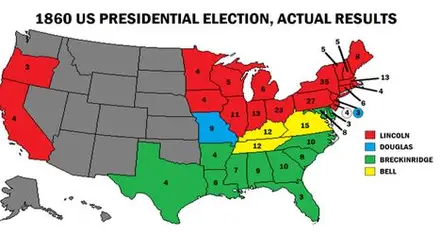
|
| 1860 Election |
1860 was an election year. At the Democratic Convention in Charleston, South Carolina, William Lowndes Yancey used his demand for a slave code for the territories as a wedge issue to split the Democratic Party between North and South. On the platform committee, California and Oregon joined the slave states in providing a 17 to 16 majority vote for the slave code requirement, as Stephen Douglas' Freeport Doctrine convinced the South that the Dred Scott decision wasn't enough to secure slavery in the territories. Then Douglas men won a 165 to 138 vote for their platform based on Popular Sovereignty. Around 50 Southern delegates walked out, and the convention reconvened in Baltimore. Anti-Douglas Southern delegates left the Baltimore convention and formed their own convention, which nominated John C. Breckinridge of Kentucky on a slave code platform. Northern Democrats nominated Douglas.
Yancey succeeded in splitting the Democratic Party between North and South. He hoped that doing so would result in the election of Lincoln, which would lead to secession, which Yancey hoped would preserve slavery. The first part of Yancey's plan worked as intended. Yancey succeeded in splitting the Democratic Party between the two sections, which made it more likely that Lincoln would win the election. Lincoln's election led to secession. However, the result was not the salvation of slavery. In his 1860 speech, Yancey called whites the "master race."
The Republican convention in 1860 chose between William Seward, the well-known candidate for president, and Abraham Lincoln, the dark horse candidate. Seward was thought of as radical because of his 1850 speech in which he said that a "higher law" than the Constitution condemned slavery, and because of an 1858 speech in which Seward said that "It is an irrepressible conflict between opposing and enduring forces, and it means that the United States must and will, sooner or later, become either entirely a slaveholding nation, or entirely a free-labor nation." However, when Seward lost the nomination and became Lincoln's Secretary of State, he was much more conciliatory. Still, at the convention, Honest Abe Lincoln was seen as less radical than Seward and more honest than Seward's campaign manager, Thurlow Weed. One of Lincoln's campaign managers brought some split rails to the Republican Convention to highlight Lincoln's background as a symbol of hard work and opportunity for all. As vote after vote showed a declining lead for Seward and growing support for Lincoln, there was what one witness described as "thousands cheering with the energy of insanity." Lincoln won the nomination.
President Buchanan and Secretary of War Floyd had a record of corruption which harmed the popularity of Democrats in the North. This corruption included paying bribes to congressmen who voted for the Lecompton Constitution.
Northern and Southern Democrats used the race issue to win votes. For example, a writer for the Texas Methodist weekly said that abolitionists would use "poison", "fire", "blood and flame" to "force their fair daughters into the embrace of buck negroes for wives." A secessionist from Alabama said that Republicans wanted them to "submit to having our wives and daughters choose between death and gratifying the hellish lust of the negro!!" Northern Democrats also resorted to race-baiting.
Lincoln ran as the leader of the new, antislavery Republican Party. Stephen Douglas ran as the leader of the Northern Democrats. John C. Breckinridge ran as leader of the Southern Democrats. John Bell ran as the leader of the Constitutional Union Party. Bell had owned slaves, but the Constitutional Union Party's platform said nothing about the issue. Even though Lincoln won almost no votes in the South, he won 40 percent of the total vote, a plurality. Democrats won 44 percent of the vote in the free states. Lincoln campaigned promising to ban slavery in the territories if elected, in opposition to the Dred Scott decision. Even though Lincoln won the election on November 6, 1860, he didn't take office until March 4, 1861.
Shortly after Lincoln won the election, seven Southern slave states, led by South Carolina, seceded from the Union and set up the Confederate government at Montgomery, Alabama. Confederates chose Jefferson Davis as President and Alexander Stephens as Vice President. Buchanan said that secession was unconstitutional. Otherwise, the Constitution was a mere "rope of sand." However, he also said that nothing could be done about it. He wanted Republicans to revoke personal liberty laws and obey the Fugitive Slave Act to appease the South.
One attempt at avoiding war was a proposed Thirteenth Amendment that would have been unamendable and would have protected slavery. This attempt failed to win enough votes. Another attempt was the Crittenden Compromise, which would have extended the Mason-Dixon line from sea to sea and allowed everything South of it to be open to slavery. President-elect Lincoln's January 11, 1861 letter to J. T. Hale, a Republican in Congress, read,
We have just carried an election on principles fairly stated to the people. Now we are told in advance, the government shall be broken up, unless we surrender to those we have beaten, before we take the offices. In this they are either attempting to play upon us, or they are in dead earnest. Either way, if we surrender, it is the end of us, and of the government. They will repeat the experiment upon us ad libitum. A year will not pass, till we shall have to take Cuba as a condition upon which they will stay in the Union. They now have the Constitution, under which we have lived over seventy years, and acts of Congress of their own framing, with no prospect of their being changed; and they can never have a more shallow pretext for breaking up the government, or extorting a compromise, than now. There is, in my judgment, but one compromise which would really settle the slavery question, and that would be a prohibition against acquiring any more territory.