- WORLD WAR II
- ADOLF EICHMANN
- KLAUS BARBIE
- INDIAN RULER SAVES POLISH CHILDREN
- EDITH EGER, HOLOCAUST SURVIVOR
- STELLA REPPER, HOLOCAUST SURVIVOR
- WERNHER VON BRAUN
- GI BILL
- 1984
- BRACERO PROGRAM
- HARRY S. TRUMAN (1945 - 1953)
- THE KOREAN WAR
- HYDROGEN BOMB
- DWIGHT D. EISENHOWER (1953 - 1961)
- ROCK AND ROLL
- OVERTHROW OF MOSSADEGH IN IRAN
- OPERATION WETBACK
- HOLLYWOOD BLACKLIST
- MCCARTHYISM
- JULIUS AND ETHEL ROSENBERG
- OVERTHROW OF ÁRBENZ IN GUATEMALA
- LITTLE ROCK NINE
- CIVIL RIGHTS MOVEMENT
Fascism became popular under Hitler in Germany, Mussolini in Italy, Tojo in Japan and Francisco Franco in Spain. During the Depression many people wanted a strong leader to bring order out of chaos.
Ben Urwand's book The Collaboration: Hollywood's Pact with Hitler documents how studio executives in the 1930s, trying to protect access to the German market, allowed Nazi officials to review scripts and even removed Jews from credits. During the Red Scare, studios created a blacklist that banned suspected Communists from show business. Each time, studios claimed they had no choice.
Klemens von Metternich was an Austrian conservative at the center of the European balance of power known as the Concert of Europe for three decades as Austrian foreign minister from 1809 and chancellor from 1821 until the liberal Revolutions of 1848 forced his resignation. The revolutions of 1848-1849 opposed conservative systems, such as absolute monarchy and feudalism, and sought to establish nation states, founded on constitutionalism and popular sovereignty. Giuseppe Maria Garibaldi was an Italian general and revolutionary who waged a series of wars to unite Italian city states by 1861. Otto von Bismarck was the German chancellor who used wars to unite German city-states under Prussia by Blut und Eisen (blood and iron) in 1871. The newly united German state was called the Deutsches Reich, or German Empire. The autocratic leader was the Kaiser, and the German parliament was the Reichstag.
Antisemitism existed throughout much of European history. The music composer Richard Wagner was an antisemite, as was Houston Stewart Chamberlain, who published The Foundations of the 19th Century in 1899. The book combined antisemitism and Social Darwinism. In 1900 Ludwig Woltmann argued that the Aryan or German race was superior to other races. Other antisemites believed in the need for Lebensraum (living space) taken by war from inferior races such as Slavs and Jews. Wilhelm Schallmayer promoted a eugenics based policy that would weed out the sick while improving and multiplying the strong. The Austrian antisemite Georg Ritter von Schönerer coined the word Heil! (Hail!). His followers called him the Führer (Leader). He defined Jews as a race, not a religeon and like Woltmann he claimed that the German or Aryan race was superior to Jews and Slavs.
Even though the philosopher Friedrich Nietzsche wrote about an overman who would be free of moral constraints, he opposed antisemitism. However, after his death, Nazis claimed Nietzche as a Nazi philosopher.
Benito Mussolini was an Italian politician and journalist who, upon assuming office as Prime Minister, became the dictator of Italy from the March on Rome in 1922 until his overthrow in 1943. He was also Duce of Italian fascism upon the establishment of the Italian Fasces of Combat in 1919, and held the title until his summary execution in 1945. He founded and led the National Fascist Party (PNF). As a dictator and founder of fascism, Mussolini inspired the international spread of fascism during the interwar period.
In the 1920s, he ordered the Pacification of Libya and the bombing of Corfu over an incident with Greece, and his government annexed Fiume after a treaty with Yugoslavia. In 1936, Ethiopia was conquered following the Second Italo-Ethiopian War and merged into Italian East Africa (AOI) with Eritrea and Somalia. In 1939, Italian forces annexed Albania. Between 1936 and 1939, Mussolini ordered an intervention in Spain in favor of Francisco Franco, during the Spanish Civil War. Mussolini took part in the Treaty of Lausanne, Four-Power Pact and Stresa Front. However, he alienated the democratic powers as tensions grew in the League of Nations, which he left in 1937. Now hostile to France and Britain, Italy formed the Axis alliance with Nazi Germany and Imperial Japan.
Mussolini initially declared Italy's non-belligerence. However, in June 1940, believing Allied defeat imminent, he joined the war on Germany's side, to share the spoils. After the tide turned, and the Allied invasion of Sicily, King Victor Emmanuel III dismissed Mussolini as head of government and placed him in custody in July 1943. After the king agreed to an armistice with the Allies in September 1943, Mussolini was rescued by Germany in the Gran Sasso raid. Adolf Hitler made Mussolini the figurehead of a puppet state in German-occupied north Italy, the Italian Social Republic, which served as a collaborationist regime of the Germans. With Allied victory imminent, Mussolini and mistress Clara Petacci attempted to flee to Switzerland, but were captured by communist partisans and executed on April 28, 1945.
Hitler was born in Braunau am Inn in Austria-Hungary and moved to Germany in 1913. He was decorated during his service in the German Army in the First World War, receiving the Iron Cross. In 1919 he joined the German Workers' Party (DAP), the precursor of the Nazi Party, and in 1921 was appointed the leader of the Nazi Party. Hitler started out as a failed art student. Some of the people who bought his attempts at art were Jewish.
Hitler's childhood family doctor was Dr. Eduard Bloch, an Austrian physician based in Linz who treated the Hitler family until 1907. Dr. Bloch provided medical care for young Adolf during childhood ailments and oversaw Klara Hitler's treatment for breast cancer, often charging reduced or no fees due to the family's financial hardship. After the 1938 Anschluss, Hitler referred to Bloch as an "Edeljude" (noble Jew) and arranged Gestapo protection to help him emigrate to the United States.
Hitler was officially presented the Iron Cross on August 4, 1918 by his regimental commander, Major von Tubeuf, following a recommendation from Lieutenant Hugo Gutmann. Hitler was a message runner. Even though message running required courage, few message runners received awards for it. Gutmann was Jewish, and Hitler hated Jews but kept his Iron Cross.
The only experience Germany had with democracy was from the Weimer Republic, which was forced on Germany by the victors of World War I. The Weimer Republic lasted from November 9, 1918 to March 23, 1933, during which Germany was a constitutional republic. Hindenburg, Ludendorff, Kaiser Wilhelm II and Hitler spread the stab-in-the-back myth, which was an antisemitic and anti-communist conspiracy theory that was widely believed and promulgated in Germany after 1918. It maintained that the Imperial German Army did not lose World War I on the battlefield, but was instead betrayed by certain citizens on the home front – especially Jews, revolutionary socialists who fomented strikes and labor unrest, and republican politicians who had overthrown the House of Hohenzollern in the German Revolution of 1918–1919. Advocates of the myth denounced the German government leaders who had signed the Armistice of November 11, 1918 as the "November criminals."
In 1923 Adolf Hitler and Erich Ludendorff led the Beer Hall Putsch, which was a failed attempt to overthrow the Weimer Republic. Around 2,000 Nazis marched on the center of Munich, but were stopped by police. Hitler was wounded and later served nine months in Landsberg prison, where he wrote Mein Kampf. In his book Hitler opposed Jews, Communists, Social Democrats and the Weimer Republic. He wanted Lebensraum or living space in the east by taking over other countries, especially Russia. He favored killing the weak and the sick. In his book he described the Big Lie, and accused Jews of being guilty of it, although Hitler himself told very big lies. According to Hitler, people are used to small lies, but can be fooled by big lies.
From 1930 to 1933 Stalin diverted wheat from kulaks (wealthy peasants) and others to Russia, causing mass starvation. Ukrainians called this starvation the Holodomor. Five million starved to death, including four million in Ukraine. Soviet agents raided the homes of Ukrainians to seize food, and the borders of Ukraine were sealed to prevent escape.
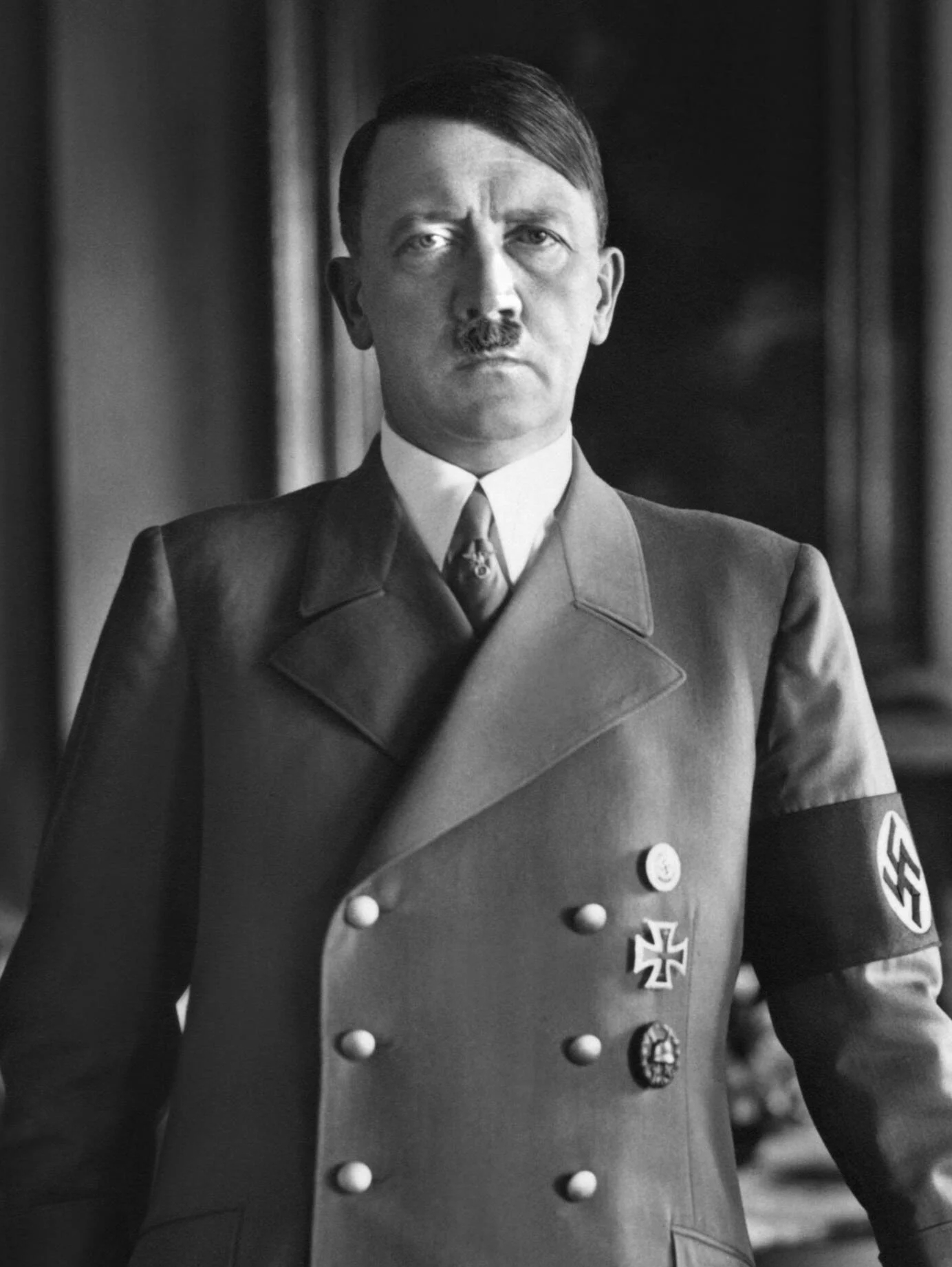
|
| Adolph Hitler |
As the Great Depression spread, the Nazi and Communist parties in Germany gained votes. The Nazis outvoted the Communists, and Hindenburg became the leader of Germany. Hindenburg didn't like Hitler, but finally allowed him to become the German leader in 1933. In 1933 the Reichstag fire was lit by Marinus van der Lubbe. Hitler blamed it on Communists and asked President Hindenburg to issue the Reichstag Fire Decree, which suspended civil liberties. Hitler made it clear that he wanted to be a dictator, although a few elections were held. Hitler's military spending ended the Great Depression in Germany, even though it persisted elsewhere. After World War I there was hyperinflation. Germans needed wheelbarrows full of marks to buy food. With Hitler Germans had jobs and a better economy. Hitler built autobahns (major highways with no speed limits) and weapons. All the money borrowed to fund the war effort depended upon not paying war reparations demanded by the Treaty of Versailles, and upon waging war to exploit other countries. Also, Jews were not counted as among the unemployed. A Nazi slogan was Ein Volk, Ein Reich, Ein Führer (One People, One Empire, One Leader).
Hitler didn't invent eugenics or antisemitism, but borrowed and amplified the worst ideas in Western society. He didn't invent the use of a backward swastika as a racist symbol. He didn't invent the use of Blut und Boden (blood and soil) as a racist slogan. He wasn't the first to use the phrase "master race." Southern proslavery propagandist William L. Yancey used the phrase in 1860. However, he did invent the idea of using the swastika at an angle in a white circle with a red background for use with Nazi flags and arm bands.
The idea for Volkswagen emerged in the early 1930s when Adolf Hitler envisioned a car that would be affordable and practical for the average German family. He wanted a vehicle that could comfortably transport two adults and three children, suitable for the newly constructed autobahns. To bring this vision to life, Hitler collaborated with renowned automotive engineer Ferdinand Porsche, who was tasked with designing the car. This collaboration led to the creation of the KdF-Wagen (Kraft durch Freude Wagen), which would later become known as the Volkswagen Beetle. While Hitler did draw a couple of sketches of what he thought a Volkswagen should look like, those drawings do not look like the final Beetle. Ferdinand Porsche designed the car with the help of Erwin Komenda for the body design, with the familiar final design completed by 1938. The government initiated a savings plan to allow citizens to afford the car, which was priced at 999 Reichsmarks. However, during the war, much of the money was diverted to war production. Volkswagen's history is also marked by its use of forced labor during the Nazi era. The company operated several forced labor camps and employed both Jewish and non-Jewish workers from occupied territories.
On November 27, 1933, Kraft durch Freude (Strength through Joy) was announced by Robert Ley as a subset of the German Labor Front whose goal was to provide Germans with access to once-privileged leisure activities such as cruises and the ownership of motorcars. The government feared that increasing wages would dampen the rearmament process and decided to raise living standards differently to influence the opinion of Nazism, and paid for the program by taking deductions from workers' wages. Through its structure of organized events and promotion of propaganda, it was also intended to prevent dissident and anti-state behavior. By 1939, it became the world's largest tourism operator. KdF organized activities such as sporting events on factory floors, art exhibitions, discounted concerts and subsidized holidays and cruise trips.
Charles Lindbergh made the first transatlantic flight from New York City to Paris in 1927. In 1932 the Lindbergh baby was kidnapped and murdered. Like many Americans at the time, Lindbergh was for neutrality as Hitler was taking over European countries, and expressed antisemitic opinions. He was part of the America First movement which opposed war with Hitler, although he didn't support Hitler. In 1940 Goring, the head of the German Air Force, gave Lindbergh a Commander Cross of the Order of the German Eagle.
A man was killed so that Nazis could steal his life insurance money. A communist was beaten to death by the Nazis after they lied and falsely accused him of hiding a machine gun in his garden. The garden was dug up, and no gun was ever found. Nazis ripped out the fingernails of a person in a concentration camp. They said that atrocity stories were lies, and would be punished. Newspapers were censored. The Nazi Julius Streicher published the extremely antisemetic paper Der Stürmer. Der Stürmer was known for its virulently anti-Semitic caricatures, which depicted Jews as ugly characters with exaggerated facial features and misshapen bodies. In his propaganda work, Streicher furthered medieval stereotypes accusing Jews of killing children, sacrificing their bodies, and drinking their blood.
Ernst Röhm's Brownshirts (the SA) cracked skulls and otherwise attacked opponents of Hitler when communists and others heckled Hitler during his speeches. However, during the Night of the Long Knives or Röhm Purge the leadership of the SA were murdered, including Röhm. Heinrich Himmler's SS committed the murders between June 30 and July 2, 1934. Hitler saw the SA as a threat to his power. The purge demonstrated the Nazi regime's willingness to go outside of the law to commit murder as an act of state. Himmler's SS was smaller and more disciplined than the SA.

|
| Hindenburg |
When Hitler came to power, the US refused to sell helium to Germany, so Germany used hydrogen instead for the Hindenburg zeppelin. Helium is inert because it has a full shell of electrons, but hydrogen is not inert, which causes it to react with oxygen, making it combustible. Electron shells are full with two electrons for the first shell, six electrons for the second shell, ten electrons for the third shell and so on. Hydrogen only has one electron, whereas helium has two. The zeppelin burst into flames in Lakehurst, New Jersey in 1937, killing 35 of the people aboard.
Herschel Grynszpan was a Polish-Jewish expatriate born and raised in Weimar Germany who shot and killed the Nazi German diplomat Ernst vom Rath on November 7, 1938 in Paris. The Nazis used this assassination as a pretext to launch Kristallnacht, "The Night of Broken Glass", the pogrom of November 9-10, 1938. On the night of the Kristallnacht, many Jewish shops had broken glass. The Kristallnacht was a pogrom carried out by the Nazi SA and German civilians. Over 7,000 Jewish businesses were damaged or destroyed. 267 synagogues were destroyed. Jewish homes, schools and hospitals were attacked, and hundreds of Jewish people were killed.
Anti-Semitism fueled by demagogues like the radio priest Charles Coughlin influenced immigration policy. In 1939 pollsters found that 53 percent of those interviewed agreed with the statement "Jews are different and should be restricted." Between 1933 and 1945 the United States took in only 132,000 Jewish refugees, ten percent of the quota allowed by law.
Congress in 1939 refused to raise immigration quotas to admit 20,000 Jewish children fleeing Nazi oppression. Instead of relaxing immigration quotas, American officials worked in vain to persuade Latin American countries and the United Kingdom to admit Jewish refugees. In January 1944, Secretary of the Treasury Henry Morgenthau, as the only Jew in the Cabinet, presented the President with a "Report to the Secretary on the Acquiescence of this Government in the Murder of the Jews." Shamed into action, Roosevelt created the War Refugee Board, which, in turn, set up refugee camps in Italy, North Africa, and the United States.
On May 13, 1939, the German transatlantic liner St. Louis sailed from Hamburg, Germany, for Havana, Cuba. On the voyage were 937 passengers. Almost all were Jews fleeing from the Third Reich. Most Jewish passengers had applied for US visas and planned to stay in Cuba only until they could enter the United States. Cuba was only willing to admit 22 Jewish passengers and six others. Quotas established by the Immigration Act of 1924 (the Johnson-Reed Act) strictly limited the number of immigrants admitted to the United States each year. A Fortune Magazine poll at the time indicated that 83 percent of Americans opposed relaxing restrictions on immigration. President Roosevelt could have issued an executive order to admit the St. Louis refugees. However, public hostility towards immigrants and other political considerations made him reluctant to take this step. The United Kingdom, the Netherlands, Belgium and France admitted most of the refugees. 254 died during the war.
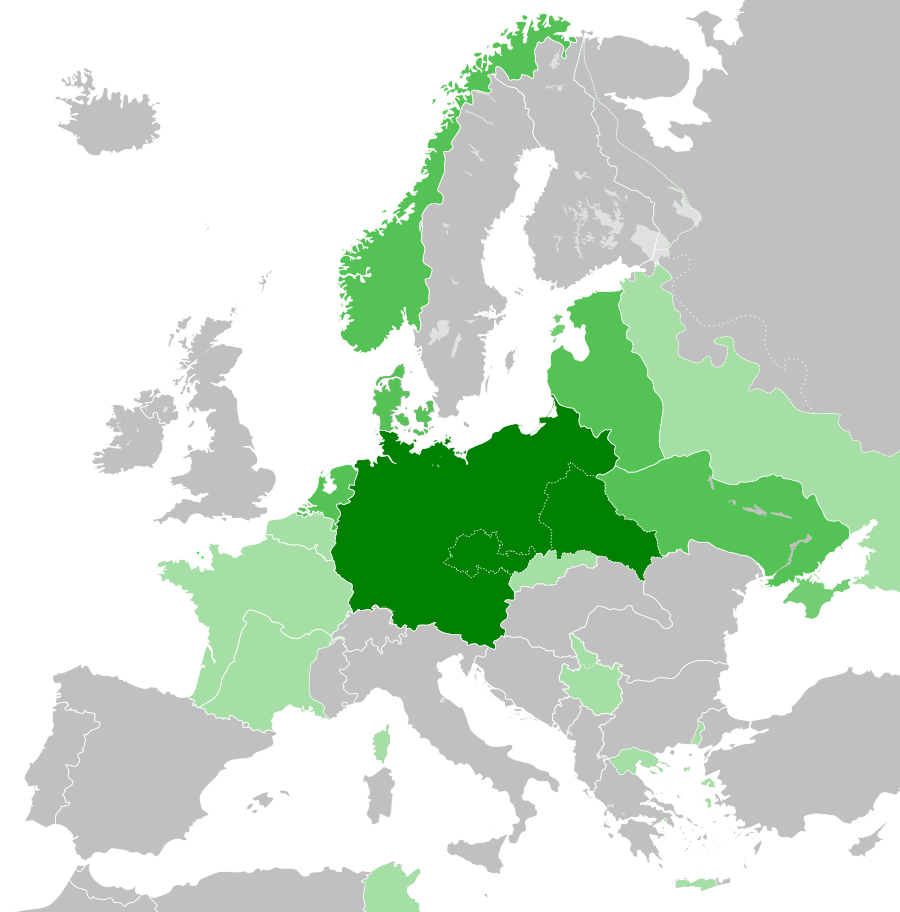
|
| World War II Map of Europe |
Isolationism was popular in America and appeasement was popular in the United Kingdom. After World War I no one wanted another war. At first, Hitler wanted to reunite Germanic parts of Europe, and many felt the Treaty of Versailles was too harsh. Neville Chamberlain, the Prime Minister of the United Kingdom, followed a policy of appeasement. This policy was an attempt to avoid war by giving Hitler everything he wanted. Every time Hitler invaded a country he promised that peace would follow, and Chamberlain believed him. So when Hitler violated the Treaty of Versailles by invading the Rhineland, Austria and the Sudetenland, (the Germanic part of Czechoslovakia) nothing was done to stop him. After Hitler's invasion of the Sudetenland Chamberlain signed a treaty with Hitler at Munich on September 29, 1938. Hitler promised that the Sudetenland would be his last territorial demand in Europe. Chamberlain said there would be "peace with honor ... peace for our time." When Hitler invaded the non-Germanic part of Czechoslovakia Chamberlain realized after it was too late that he had been lied to, and that appeasement was a failure. Winston Churchill replaced Neville Chamberlain as Prime Minister of the United Kingdom.
World War II began on September 1, 1939, when Nazi Germany, under Adolf Hitler, invaded Poland, after which the United Kingdom and France declared war on Germany. Poland was divided between Germany and the Soviet Union under the Molotov–Ribbentrop Pact. In 1940, the Soviet Union annexed the Baltic states (Lithuania, Latvia and Estonia) and parts of Finland and Romania. Germany conquered Norway, Denmark, Luxemburg, Belgium and the Netherlands in 1940. The fascist Quisling was installed by the Nazis to rule over Norway. After the fall of France in June 1940, the war continued mainly between Germany and the British Empire, with fighting in the Balkans, Mediterranean, and Middle East, the aerial Battle of Britain and the Blitz, and the naval Battle of the Atlantic. The Nazis signed a pact that included Italy, Hungary, Romania, Bulgaria and Japan. Germans then invaded Yugoslavia, Greece, Libya and Iraq. Through campaigns and treaties, Germany gained control of much of continental Europe and formed the Axis alliance with Italy, Japan, and other countries. In June 1941, Germany invaded the Soviet Union, opening the Eastern Front and initially making large territorial gains.
The Maginot Line was a line of concrete fortifications, obstacles and weapon installations built by France in the 1930s to deter invasion by Nazi Germany and force them to move around the fortifications. It was impervious to most forms of attack; consequently, the Germans invaded through the Low Countries in 1940, passing it to the north. The line, which was supposed to be fully extended further towards the west to avoid such an occurrence, was finally scaled back in response to demands from Belgium. Indeed, Belgium feared it would be sacrificed in the event of another German invasion. The line has since become a metaphor for expensive efforts that offer a false sense of security.
Constructed on the French side of its borders with Italy, Switzerland, Germany, Luxembourg and Belgium, the line did not extend to the English Channel. French strategy, therefore, envisioned a move into Belgium to counter a German assault. Based on France's experience with trench warfare during World War I, the massive Maginot Line was built in the run-up to World War II, after the Locarno Conference in 1925 gave rise to a fanciful and optimistic "Locarno spirit." French military experts believed the line would deter German aggression because it would slow an invasion force long enough for French forces to mobilise and counterattack.
The Maginot Line was invulnerable to aerial bombings and tank fire; it used underground railways as a backup. It also had state-of-the-art living conditions for garrisoned troops, supplying air conditioning and eating areas for their comfort. French and British officers had anticipated the geographical limits of the Maginot Line; when Germany invaded the Netherlands and Belgium, they carried out plans to form an aggressive front that cut across Belgium and connected to the Maginot Line.
The French line was weak near the Ardennes. General Maurice Gamelin, when drafting the Dyle Plan, believed this region, with its rough terrain, would be an unlikely invasion route of German forces; if it were traversed, it would be done at a slow rate that would allow the French time to bring up reserves and counterattacks. The German Army, having altered their planned offensive against Sedan when it became known to the Allies redirected the effort against this weak point in the French defensive front. A rapid advance through the forest and across the River Meuse encircled much of the Allied forces, resulting in a sizeable force having to be evacuated at Dunkirk and leaving the troops to the south unable to mount an effective resistance to the German invasion of France.
After capitulation, France was governed as Vichy France headed by Marshal Philippe Pétain. From 1940 to 1942, while the Vichy regime was the nominal government of all of France except for Alsace-Lorraine, the Germans and Italians militarily occupied northern and south-eastern France. France was not liberated until 1944, when the allied invasion restored the French Government.
Sweden had been neutral state since 1814 and was governed by a coalition of all the major parties. After the outbreak of World War II in 1939, it attempted to cultivate economic relations with both Nazi Germany and the United Kingdom with the particular aim of securing its own food supplies. German forces invaded and occupied Norway and Denmark in April 1940 while Finland entered into a de facto alliance with Nazi Germany from 1941. During the war, Sweden exported iron ore used in the German war industries and maintained a trade policy which primarily favored Nazi Germany and German-occupied Europe. Controversially, the Swedish government also allowed German soldiers on leave to travel through its territory from German-occupied Norway before the practice was finally stopped in August 1943. It was only in November 1944 that Sweden, under significant pressure from the Allies, ceased trading with Nazi Germany.
In a meeting held with Fascist Italy's leader, Benito Mussolini, and Foreign Minister Galeazzo Ciano, in June 1941, Hitler stated his opinion on Switzerland quite plainly: "Switzerland possesses the most disgusting and miserable people and political system. The Swiss are the mortal enemies of the new Germany." In August 1942, Hitler further described Switzerland as "a pimple on the face of Europe" and as a state that no longer had a right to exist, denouncing the Swiss people as "a misbegotten branch of our Volk." From a Nazi viewpoint, Switzerland, as a small, multilingual, decentralized democracy where German-speakers felt more of an affinity with their French-speaking fellow Swiss citizens than towards the German speaking people living across the border, was the antithesis of the racially homogeneous and collectivised "Führer State". Hitler also believed that the independent Swiss state had come into existence at a time of temporary weakness of the Holy Roman Empire, and now that German power had been re-established after the National Socialist takeover, the independent country of Switzerland had become obsolete. However, For reasons that are still uncertain, Hitler never ordered the invasion. One theory is that neutral Switzerland was useful to hide Nazi gold and to serve as a refuge for war criminals in case of defeat. This may also be the reason for Germany's continued recognition of Switzerland's neutrality.
Due to Switzerland's declared military neutrality in World War II, Swiss banks had been a safe haven for Jewish assets before and during the war. The Holocaust saw the genocide of approximately six million Jews, which included individuals who had deposited their funds into Swiss banks. Since the end of World War II, some individual heirs to depositors who were murdered reported difficulties in retrieving the funds because Swiss banks had asked for death certificates of the original depositors. However, the Nazis did not issue death certificates to those they murdered. Furthermore, some heirs to victims alleged that Swiss banks stonewalled them and deliberately misled them about the existence of an account. Swiss banking secrecy laws prevented bankers from answering questions about account holders to individuals they deemed had no evidence that they were connected to the original depositor. Any revealing of information could have led to a fine or imprisonment of the respective banker under the 1934 Swiss Federal Act on Banks.
Roosevelt started the Lend-Lease program, which included sending bombers and other weapons to countries fighting Hitler, such as the United Kingdom and the Soviet Union. He used the analogy of lending a neighbor a garden hose while his house was on fire because your house might be next. Roosevelt mentioned his Four Freedoms that were at stake: the freedom of speech, the freedom of worship, the freedom from want, and the freedom from fear. The January 6, 1941 speech is as follows,

In the future days, which we seek to make secure, we look forward to a world founded upon four essential human freedoms.
The first is freedom of speech, and expression-everywhere in the world.
The second is freedom of every person to worship God in his own way-everywhere in the world.
The third is freedom from want-which, translated into world terms, means economic understandings which will secure to every nation a healthy peacetime life for its inhabitants-everywhere in the world.
The fourth is freedom from fear-which, translated into world terms, means a world-wide reduction of armaments to such a point and in such a thorough fashion that no nation will be in a position to commit an act of physical aggression against any neighbor-anywhere in the world.
That is no vision of a distant millennium.
It is a definite basis for a kind of world attainable in our own time and generation.
That kind of world is the very antithesis of the so-called new order of tyranny which the dictators seek to create with the crash of a bomb.

In 1941 A. Philip Randolph, who led the Brotherhood of Sleeping Car Porters, used the threat of a march on Washington and support from the NAACP, Fiorello La Guardia and Eleanor Roosevelt to force the administration to ban discrimination by defense contractors and establish the Fair Employment Practices Committee to enforce that order. Milton Webster, the BSCP's First Vice-president, worked to make the FEPC an effective tool in combatting employment discrimination.
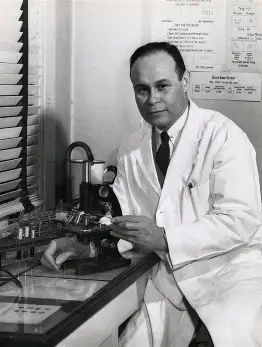
|
| Charles Richard Drew |
Charles Richard Drew was an American surgeon who developed improved techniques for blood storage, and applied his expert knowledge to developing large-scale blood banks early in World War II. Drew realized blood plasma was able to be preserved two months longer through de-liquification, or the separation of liquid blood from the cells. When ready for use the plasma would then be able to return to its original state via reconstitution. This thesis earned him his Doctor of Science in Medicine degree in 1940, becoming the first African American to do so. The District of Columbia chapter of the American Medical Association allowed only white doctors to join, consequently Drew died without ever being accepted for membership in the AMA. Drew's research allowed medics to save thousands of Allied forces' lives during the war. As the most prominent African American in the field, Drew protested against the practice of racial segregation in the donation of blood, and resigned his position with the American Red Cross in 1942. The Red Cross maintained the policy until 1950.
Spanning from the early 1930s to 1945, Japan employed expansionist policies and aggressive military actions, including the invasion of the Republic of China, and the annexation of French Indochina. During the war, the Imperial Japanese Army (IJA) and the Imperial Japanese Navy (IJN) committed war crimes, including attacking neutral countries without a prior declaration of war, massacres of millions of civilians, rapes of "comfort women," unethical human experimentation, torture, starvation, forced labor and biological and chemical warfare and experimentation. In addition, prisoners of war were tortured, executed, and experimented on. For example, Mongolian prisoners were injected with deadly diseases so that Japanese doctors could study the effects. The Nanjing Massacre or the Rape of Nanjing was the mass murder of Chinese civilians by the Imperial Japanese Army in Nanjing, the capital of the Republic of China, immediately after the Battle of Nanking and retreat of the National Revolutionary Army during the Second Sino-Japanese War. Estimates of the death toll vary from a low of 40,000 to a high of over 300,000, and estimates of rapes range from 20,000 to over 80,000.
Manchu Detachment 731 was a covert biological and chemical warfare research and development unit of the Imperial Japanese Army that engaged in lethal human experimentation and biological weapons manufacturing during the Second Sino-Japanese War (1937–1945) and World War II. Estimates vary as to how many were killed. Between 1936 and 1945, roughly 14,000 victims were murdered in Unit 731. It is estimated that at least 200,000 individuals have died due to infectious illnesses caused by the activities of Unit 731 and its affiliated research facilities. It was based in the Pingfang district of Harbin, the largest city in the Japanese puppet state of Manchukuo (now Northeast China) and had active branch offices throughout China and Southeast Asia.
Established in 1936, Unit 731 routinely conducted tests on people who were dehumanized and internally referred to as "logs." Victims were further dehumanized by being confined in facilities referred to as "log cabins." Experiments included disease injections, controlled dehydration, biological weapons testing, hypobaric pressure chamber testing, vivisection, organ harvesting, amputation, and standard weapons testing. Victims included not only kidnapped men, women (including pregnant women), and children but also babies born from the systemic rape perpetrated by the staff inside the compound. The victims also came from different nationalities, with the majority being Chinese and a significant minority being Russian. Additionally, Unit 731 produced biological weapons that were used in areas of China not occupied by Japanese forces, which included Chinese cities and towns, water sources, and fields. All prisoners within the compound were killed to conceal evidence, and there were no documented survivors.
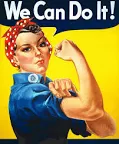
|
| Rosie the Riveter |
The attack on Pearl Harbor was a surprise military strike by the Empire of Japan on the United States Pacific Fleet at its naval base at Pearl Harbor on Oahu, Hawaii, on December 7, 1941. At the time, the US was a neutral country in World War II. The air raid on Pearl Harbor, which was launched from aircraft carriers, resulted in the US entering the war on the side of the Allies on the day following the attack. Hitler privately said that there would have to be an eventual racial reckoning with Japan but for the time they were allies.
While men were drafted to fight the war, women were encouraged by the government to work in factories producing weapons and other goods. Rosie the Riveter was an iconic poster that was part of this effort.
Kamikaze Japanese Special Attack Units of military aviators flew suicide attacks for the Empire of Japan against Allied naval vessels in the closing stages of the Pacific campaign of World War II. About 3,800 kamikaze pilots died during the war in attacks that killed more than 7,000 Allied naval personnel, sank several dozen warships, and damaged scores more.
During World War II, the United States forcibly relocated and incarcerated about 120,000 people of Japanese descent in ten concentration camps operated by the War Relocation Authority (WRA), mostly in the western interior of the country. About two-thirds were US citizens. These actions were initiated by Executive Order 9066, issued by President Franklin D. Roosevelt on February 19, 1942, following the outbreak of war with the Empire of Japan in December 1941. About 127,000 Japanese Americans then lived in the continental US, of which about 112,000 lived on the West Coast. Internees were prohibited from taking more than they could carry into the camps, and many were forced to sell some or all of their property, including their homes and businesses. In its 1944 decision Korematsu v. United States, the US Supreme Court upheld the constitutionality of the removals under the Due Process Clause of the Fifth Amendment to the United States Constitution.
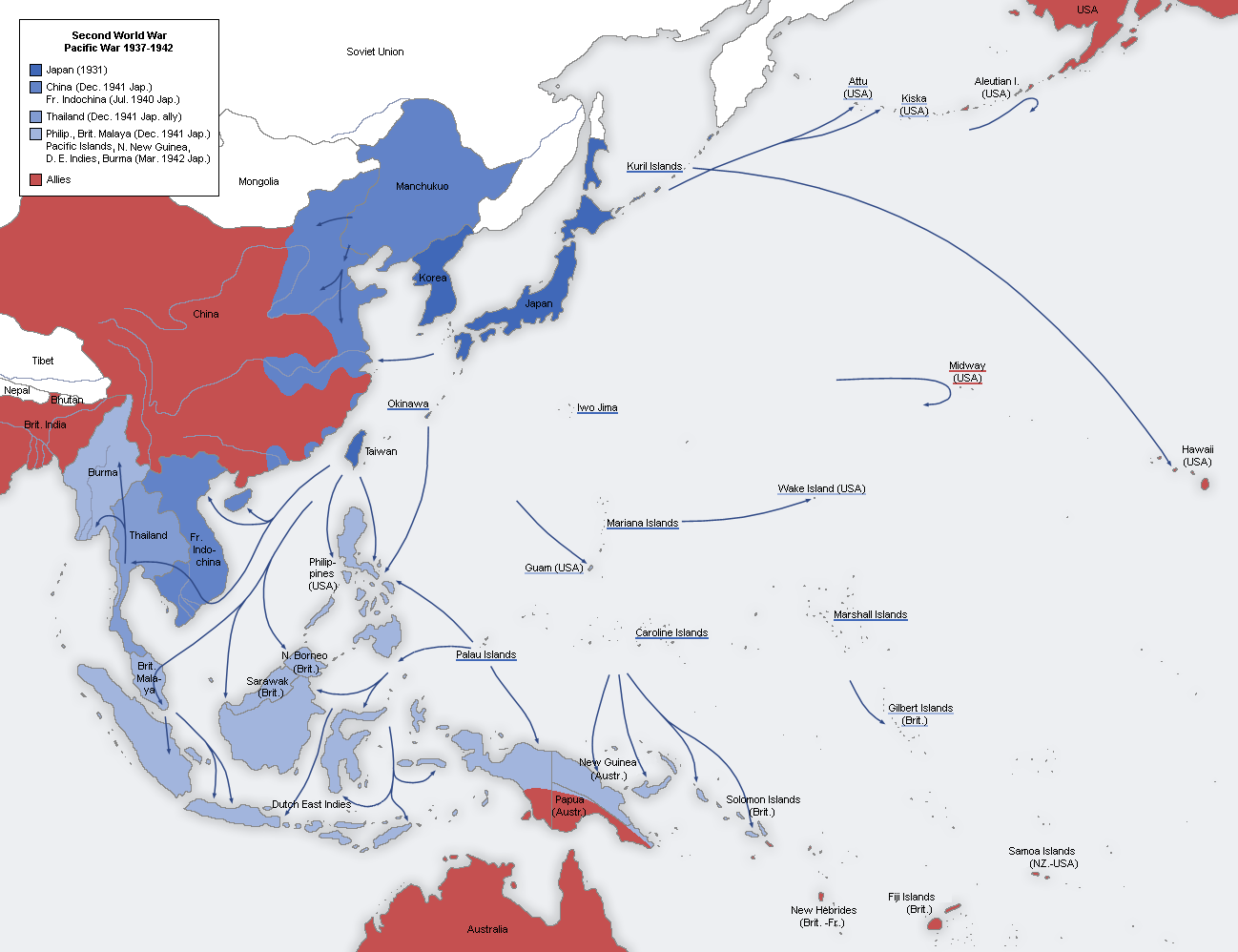 |
| World War II Map of Asia |
The Bataan Death March was the forcible transfer by the Imperial Japanese Army of around 72,000 to 78,000 American and Filipino prisoners of war (POWs) from the municipalities of Bagac and Mariveles on the Bataan Peninsula to Camp O'Donnell via San Fernando. The transfer began on April 9, 1942, after the three-month Battle of Bataan in the Philippines during World War II. The total distance marched from Mariveles to San Fernando and from the Capas Train Station to various camps was 65 miles. Prisoner of war casualties prior to reaching Camp O'Donnell included thousands of Filipino deaths and 500 to 650 American deaths during the march.
In 1941 a number of other countries had larger militaries than America. America at that time was known not for having a large military, but for its vast potential. However, it would take years to realize that potential. So while Stalin kept asking for us to open a second front fighting Hitler, America spent years island-hopping in the Pacific, fighting Japan. It would take years before the US could make enough Sherman tanks, machine guns, ration kits and so forth to launch Operation Overlord.
The Alien Registration Act, popularly known as the Smith Act, is a United States federal statute that was enacted on June 28, 1940. It set criminal penalties for advocating the overthrow of the US government by force or violence, and required all foreigners over the age of 14 to register with the federal government. Approximately 215 people were indicted under the legislation, including alleged communists and socialists. Prosecutions under the Smith Act continued until a series of US Supreme Court decisions in 1957 reversed a number of convictions under the Act as being unconstitutional.
During the war, the Nazi T-4 Euthanasia Program killed many disabled children by poison, disease, gas or starvation. Hitler ordered the program in 1939. It lasted from 1940 to 1945. Hitler officially ended the program in 1941 after criticism, but the program was continued in secret after that. At first, Hitler ordered that disabled children be slowly poisoned to death so that their deaths would seem to be from natural causes. These deaths were painful. Then a Nazi invented a fake shower that would use poison gas to kill. Even Nazified churches condemned such things, so Hitler was more careful to try to hide the Final Solution.
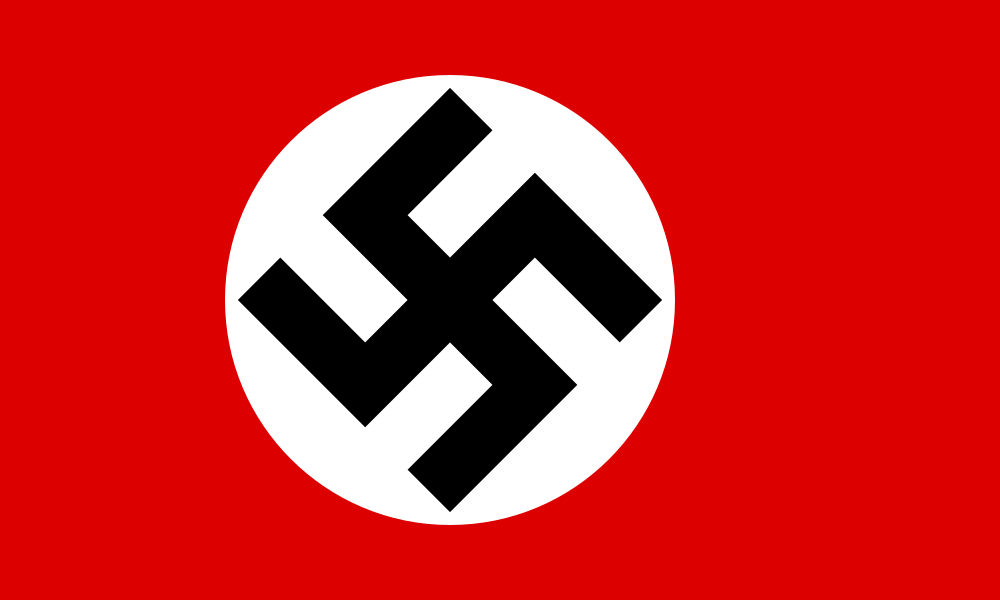
|
| Nazi Flag |
Jews were forced to sell their businesses at low prices to Germans. They were forced out of their homes into Jewish houses. They weren't allowed to own pets, typewriters, cars, radios or phones. They had to be in by a curfew. They were put on short rations. They weren't allowed to go to the cinema, parks, libraries or swimming pools. They weren't allowed to buy tobacco or flowers. At first, they were allowed to emigrate after being robbed of much of their money. Later they were not allowed to leave Germany. Nazis shipped Jews out, telling them they were to be relocated. Some Germans were relocated, but Jews never came back. They were exterminated. During the Holocaust six million Jews were murdered in death camps and elsewhere. Some were killed by deliberately engineered epidemics of typhus. Others were killed by bullets, starvation or Zyklon-B poison gas. Millions of Slavs, Roma (Gypsies), gays and partisans were also killed in the Holocaust.
In Poland, four Jews were hanged at one time by the Nazis for trading goods without coupons. A Polish child had a finger cut off by a Nazi for "stealing potatoes." Nazis diverted food from Poland to the "master race" in Germany. Germans profited from the homes, cars and businesses taken away from Jews. Vladek Spiegelman, a Holocaust survivor, described the following: "the Germans took from Srodula to Auschwitz over 1,000 people. Most they took were kids - some only 2 or 3 years. Some kids were screaming and screaming. They couldn't stop. So the Germans swinged them by the legs against a wall. And they never anymore screamed."
The "Final Solution to the Jewish question" was the official code name for the murder of all Jews within reach, which was not restricted to the European continent. This policy of deliberate and systematic genocide starting across German-occupied Europe was formulated by Nazi leadership in January 1942 at the Wannsee Conference held near Berlin, and culminated in the Holocaust, which saw the murder of 90 percent of Polish Jews, and two-thirds of the Jewish population of Europe.
Nazi Germany used six extermination camps in Central Europe, primarily in occupied Poland, during World War II. These were Chełmno, Belzec, Sobibor, Treblinka, Majdanek and Auschwitz-Birkenau. In addition to those killed at concentration camps, many were also murdered in the Aktion T4, or directly on site. At concentration camps like Dachau, Buchenwald, Bergen-Belsen and Flossenbürg, inmates were forced to work as slave labor. Many of them were worked and starved to death or died from deliberately engineered epidemics of typhus. Nazis removed gold fillings from the dead.
Kupferberg Holocaust Center estimates of the total number
of civilian victims killed by Nazis are as follows:
| Group | Estimated Number of Victims |
|---|---|
| Jews | 6,000,000 |
| Soviet civilians and POWs | 5,500,000 |
| Polish civilians | 1,800,000 |
| Greeks | 350,000 |
| Yugoslav civilians | 300,000 |
| Forced laborers (Mostly Polish and Soviet) | 300,000 |
| Roma (Gypsies) | 250,000 |
| People with disabilities | 250,000 |
| Non-Jewish French civilians | 170,000 |
| German "asocials" | 80,000 |
| Italians | 75,000 |
| Netherlanders | 75,000 |
| German political opponents | 50,000 |
| Belgians | 50,000 |
| Austrians | 34,000 |
| Czechs | 32,000 |
| Romanian prisoners | 15,000 |
| Homosexuals | 6,000 |
| Spanish "Republicans" | 3,500 |
| Muslims | 2,000 |
| Norwegians | 1,800 |
| Danes | 1,600 |
| Jehova's Witnesses | 1,500 |
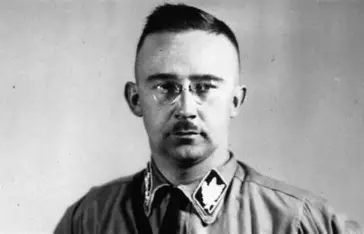
|
| Heinrich Himmler |
Himmler acquired a reputation for good organizational skills and for selecting highly competent subordinates, such as Reinhard Heydrich. From 1943 onwards, he was both Chief of the Kriminalpolizei (Criminal Police) and Minister of the Interior, which gave him oversight of all police and security forces (including the Gestapo). He also controlled the Waffen-SS, a branch of the SS that served in combat alongside the Wehrmacht (Germany's armed forces) in World War II. As the principal enforcer of the Nazis' racial policies, Himmler was responsible for operating concentration and extermination camps as well as forming the Einsatzgruppen death squads in German-occupied Europe. A day before the launch of Operation Barbarossa in June 1941, Himmler commissioned the drafting of Generalplan Ost, which was approved by Hitler in May 1942 and implemented by the Nazi regime, resulting in the deaths of approximately 14 million people in Eastern Europe. Near the end of the war Himmler attempted to open peace talks with the Allies, which caused Hitler to dismiss him from all his posts. Himmler was captured by British forces and committed suicide.
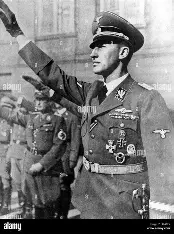
|
| Reinhard Heydrich |
Heydrich was the founding head of the Sicherheitsdienst (Security Service, SD), an intelligence organisation charged with seeking out and neutralising resistance to the Nazi Party via arrests, deportations, and murders. He helped organise Kristallnacht, a series of coordinated attacks against Jews throughout Nazi Germany and parts of Austria on November 9-10, 1938. The attacks were carried out by SA stormtroopers and civilians and presaged the Holocaust. Upon his arrival in Prague, Heydrich sought to eliminate opposition to the Nazi occupation by suppressing Czech culture and deporting and executing members of the Czech resistance. He was directly responsible for the Einsatzgruppen, the special task forces that travelled in the wake of the German armies and murdered more than two million people by mass shooting and gassing including 1.3 million Jews.
Heydrich was mortally wounded in Prague on 27 May 1942 as a result of Operation Anthropoid. He was ambushed by a team of Czech and Slovak soldiers who had been sent by the Czechoslovak government-in-exile to kill him; the team was trained by the British Special Operations Executive. Heydrich died from sepsis caused by his injuries on June 4, 1942. Nazi intelligence falsely linked the Czech and Slovak soldiers and resistance partisans to the villages of Lidice and Ležáky. Both villages were razed; the men and boys aged 14 and above were shot and most of the women and children were deported and murdered in Nazi concentration camps.
Soldiers who rescued Holocaust survivors saw people who looked like walking skeletons from starvation. Elie Wiesel, a Holocaust survivor, said he saw children burned alive when a death camp ran out of poison gas. Wiesal wrote a book about the Holocaust, Night.
Anne Frank's family was hidden behind a bookcase in Amsterdam until a person who lived with the family told the Nazis that Jews were hidden there. Anne and her sister Margot died in Bergen-Belsen concentration camp, probably from typhus.

|
| Auschwitz |
At the Auschwitz death camp the weak, the sick and the disabled were executed immediately, and healthy prisoners were used as slave labor before they were killed. Josef Mengele was one of the Nazi doctors who decided who lived and who died. He also conducted medical experiments on prisoners, especially on twins. He would perform unnecessary amputations of limbs or inject them with deadly diseases. He also removed hearts, stomachs and kidneys without anesthesia. There are those who thought it was strange that he would give Jewish children candy and smile, and then order their deaths. In the gas chambers bodies were piled up at the door as people tried to get out. Some had broken fingers from trying to climb the walls. Some had arms pulled from their sockets, trying to escape.
Near the end of the war, Russian soldiers approached Auschwitz, and Germans marched prisoners to a train leading to Dachau, a concentration camp in Germany, to keep Russians from freeing the prisoners. Before they left, prisoners who worked as tinmen were made to dismantle the gas chamber machinery to hide what happened there. The sick or weak prisoners were then burned alive, and the rest were marched to a train. Those too weak to march were shot. More died on the train from overcrowding and lack of food. At Dachau, prisoners slept on straw with lice that spread typhus. Americans rescued the survivors.
One surviver was 16, six feet tall but barely 80 pounds when the Soviet army liberated the Polish ghetto he lived in. As Orli Peters, his son, described it, "He and a group of other survivors walked free through the gates into the city for the first time in five years. He thought their skeletal bodies might stir sympathy among the townspeople. Instead, as he passed a group of women, he heard one shout, 'The vermin are multiplying again.'" Orli's father later became an aerospace engineer in the United States, married and raised five children. In 1970, he helped NASA bring the Apollo 13 astronauts safely back to Earth.
Ilse Koch was known as the Bitch of Buchenwald, a Nazi extermination camp. She was known for having prisoners killed for their tattoos.
Martin Niemöller was a German Lutheran pastor who at first supported the Nazis but then condemned them and was sent to a concentration camp. He said,
First they came for the Communists
And I did not speak out
Because I was not a Communist
Then they came for the Socialists
And I did not speak out
Because I was not a Socialist
Then they came for the trade unionists
And I did not speak out
Because I was not a trade unionist
Then they came for the Jews
And I did not speak out
Because I was not a Jew
Then they came for me
And there was no one left
To speak out for me
In May 1940 the Soviet secret police or NKVD killed almost 22,000 Polish military officers and intelligentsia in the Katyn Woods massacre.
On June 22, 1941, Germany launched Operation Barbarossa, the invasion of Russia. Once World War II had already started, Hitler declared that "racial war has broken out and this war shall determine who shall govern Europe, and with it, the world". The racial policy of Nazi Germany portrayed the Soviet Union (and all of Eastern Europe) as populated by non-Aryan Untermenschen ('sub-humans'), ruled by Jewish Bolshevik conspirators. Hitler claimed in Mein Kampf that Germany's destiny was to follow the Drang nach Osten ('drive to the East') as it did "600 years ago." Accordingly, it was a partially secret but well-documented Nazi policy to kill, deport, or enslave the majority of Russian and other Slavic populations and repopulate the land west of the Urals with Germanic peoples, under Generalplan Ost (General Plan for the East). The Nazis' belief in their ethnic superiority pervades official records and pseudoscientific articles in German periodicals, on topics such as "how to deal with alien populations."
Germans were defeated at the battles at Moscow, Stalingrad and Leningrad. At Stalingrad Russia's Operation Uranus attacked Nazis with a pincer movement. Months later, Paulus' 6th army was forced to surrender, enraging Hitler. More than a million Russians were killed or wounded defending Stalingrad, but the Russians won. The siege of Leningrad lasted from 1941 to 1944 and resulted in mass starvation and more than a million Russian soldiers killed, captured or missing, but the Russians won. Nazis were defeated at the Battle of Moscow. Germans blitzed through the Russian countryside, burning schools filled with Russian schoolchildren and using Russian hospitals for target practice. The SS followed the German army, killing Jews. Between 24 million and 27 million Russian soldiers and civilians were killed by the Nazis.
On September 1941 Nazis killed about 33,771 Jews at Babi Yar, which is a ravine in Kyiv, Ukraine. A total of more than 100,000 Jews, Soviet prisoners of war, Roma, communists and Ukrainian nationalists were killed there. More than 50,000 Jews were killed in the Odessa massacre in October 1941, and 42,000-43,000 Jews were killed in the 1943 Aktion Erntefest massacre in occupied Poland.
Stalin moved his war production east to keep it away from the Germans. The largest tank battle in history happened in the Kursk peninsula. Russians and Germans made the best tanks, but Germany rushed the production of Tiger and Panther tanks, leading to mechanical failures. Also, Russians laid booby traps for the Germans. Russia won the tank battle and spent the rest of the war pushing Germans back to Germany.
As early as 1938 members of the German military plotted to kill Hitler because they thought he was a danger to Germany. The 20 July plot was a failed attempt to assassinate Adolf Hitler and overthrow the Nazi regime on 20 July 1944. The plotters were part of the German resistance, mainly composed of Wehrmacht officers. The leader of the conspiracy, Claus von Stauffenberg, tried to kill Hitler by detonating an explosive hidden in a briefcase. However, due to the location of the bomb at the time of detonation, the blast only singed Hitler. Hitler was enraged and had anyone suspected to have been connected with the plotters strung up on piano wire. Hitler tried to get Nazis to watch videos of his enemies strung up on piano wire, but they refused to watch. One of the plotters, Erwin Rommel, was allowed to poison himself with cyanide instead of being strung up on piano wire because of his military fame.
By June 6, 1944, America's war-making potential was fully realized, and America, the United Kingdom and Canada launched Operation Overlord or D-Day when invading Normandy. At the Battle of the Bulge Germany sent its young, its old, everything it had in a last-ditch attempt to avoid defeat. Anthony McAuliffe's soldiers guarded a vital position at Bastogne, which was in southern Belgium. The port of Antwerp was northwest of Bastogne. If Bastogne fell to the Germans, American supplies that went through Antwerp would be in jeopardy. The Germans demanded that McAuliffe surrender his position. His one-word reply was "NUTS." This was his way of saying no. McAuliffe was reinforced and held his position.
Details of Operation Overlord were among the military secrets kept by the Allied militaries during the war. As Churchill said, "In wartime, truth is so precious that she should always be attended by a bodyguard of lies." In the US code talkers used their knowledge of Native American languages as a basis to transmit coded messages. There were approximately 400 to 500 Native Americans in the United States Marine Corps whose primary job was to transmit secret tactical messages. Code talkers are credited with some decisive victories. Their code was never broken. Codes were developed based on the languages of the Comanche, Hopi, Meskwaki, and Navajo peoples. When there was no Native American word for a thing, other words were substituted. For example, a submarine was called an "iron fish."
Ultra was the designation adopted by British military intelligence in June 1941 for wartime signals intelligence obtained by breaking high-level encrypted enemy radio and teleprinter communications at the Government Code and Cypher School (GC&CS) at Bletchley Park. The code name "Boniface" was used as a cover name for Ultra. In order to ensure that the successful code-breaking did not become apparent to the Germans, British intelligence created a fictional MI6 master spy, Boniface, who controlled a fictional series of agents throughout Germany. Information obtained through code-breaking was often attributed to the human intelligence from the Boniface network. The US used the codename Magic for its decrypts from Japanese sources, including the "Purple" cipher.
Much of the German cipher traffic was encrypted on the Enigma machine. Used properly, the German military Enigma would have been virtually unbreakable; in practice, shortcomings in operation allowed it to be broken. The term "Ultra" has often been used almost synonymously with "Enigma decrypts." However, Ultra also encompassed decrypts of the German Lorenz SZ 40/42 machines that were used by the German High Command, and the Hagelin machine.
Winston Churchill was reported to have told King George VI, when presenting to him Stewart Menzies (head of the Secret Intelligence Service and the person who controlled distribution of Ultra decrypts to the government): "It is thanks to the secret weapon of General Menzies, put into use on all the fronts, that we won the war!" F. W. Winterbotham quoted the western Supreme Allied Commander, Dwight D. Eisenhower, at war's end describing Ultra as having been "decisive" to Allied victory.
Hitler was in his underground bunker. At first, Hitler hoped that a Steiner offensive would save him. When Hitler realized he was about to lose, he said that he didn't want to be treated like a "monster in a cage." Hitler and Eva Braun then had a quick wedding using a ring from a murdered Jewess and then killed themselves. German propaganda minister Joseph Goebbels and his family were also in the bunker. Goebbels and his wife poisoned their large number of children, saying that life without their Fuhrer would not be worth living. Then they killed themselves.
Many Nazi leaders were captured as they tried to escape and were later tried by a court at Nuremberg in 1945. John Woods was the hangman at Nuremberg, and hanged the Nazi war criminals too low, which probably caused painful executions. Twelve of the defendants were sentenced to death (Göring, Ribbentrop, Keitel, Kaltenbrunner, Rosenberg, Frank, Frick, Streicher, Sauckel, Jodl, Seyss-Inquart, and Bormann). On 16 October, ten were hanged. Hermann Göring, commander-in-chief of the Luftwaffe (air force), killed himself with cyanide in his prison cell before he could be hanged. Seven defendants (Hess, Funk, Raeder, Dönitz, Schirach, Speer, and Neurath) were sent to Spandau Prison to serve their sentences. All three acquittals (Papen, Schacht, and Fritzsche) were based on a deadlock between the judges; these acquittals surprised observers. Despite being accused of the same crimes, Sauckel was sentenced to death, while Speer was given a prison sentence because the judges considered that he could reform. Nikichenko released a dissent approved by Moscow that rejected all the acquittals, called for a death sentence for Hess, and convicted all the organizations. Adolf Eichmann, who played a major role in organizing the Holocaust, escaped at first and was later captured, tried and executed by the Israelis. The book Eichmann Interrogated describes his interrogation by the Israelis.
Albert Speer, who was spared a hanging at Nuremberg and sentenced to prison instead, was Hitler's architect. However, near the end of the war he was Minister of Armaments and War Production. He moved German equipment for manufacturing weapons around to avoid allied bombs, and used slave labor from Sauckel to do this. The slaves were driven to work by whips until they were worked and starved to death and replaced by more slave labor. However, at Nuremberg Speer acted like the nice Nazi, and his life was spared. Speer denied knowing about the Holocaust, although there is evidence that he did know about it.

|
| Iron Curtain Countries |
As soon as the war in Europe ended the Cold War began. Millions of Russians died fighting Hitler, and Stalin used the opportunity to seize Eastern Europe. The Soviets controlled Eastern Europe from the 1940s through the 1980s. Lithuania, Latvia and Estonia were wiped off the map for decades by Stalin. Poland, Czechoslovakia, Hungary, Bulgaria, Romania, East Germany, Albania and Yugoslavia were countries controlled by Moscow. Churchill said, "from Stettin in the Baltic to Trieste in the Adriatic, an Iron Curtain has descended."
In 1923 Robert Millikan, Nobel Prize-winning physicist, said, "There is no likelihood man can ever tap the power of the atom." Einstein was a pacifist when the war began, but the holocaust and the influence of his friends persuaded him to send a letter to Roosevelt outlining the possibility of creating a more powerful bomb than the world had ever seen based on his E=mc² formula. The result was the Manhattan Project, which led to the creation of a uranium-235 isotope bomb and a plutonium bomb. Uranium-235 isotope was separated from the more plentiful uranium-238 isotope and bombarded with fast neutrons to create a nuclear bomb. Plutonium is man-made. From 1942 to 1946, the project was directed by Major General Leslie Groves of the US Army Corps of Engineers. Nuclear physicist J. Robert Oppenheimer was the director of the Los Alamos Laboratory that designed the bombs.
America was the only country where the economic stimulus of war outweighed the destruction of war. Europe and Japan were destroyed. The worst harm to American territory from the war was at Pearl Harbor. Aside from that, a Fu-Go balloon bomb from Japan killed six children at a Sunday school picnic in Bly, Oregon in 1945. In America, the war was followed by postwar prosperity and the baby boom from 1946 to 1964.
Within weeks of the invasion of Poland on September 1, 1939, Nazi policy toward the Jews changed from voluntary emigration to forced deportation. After discussions with Hitler in the preceding weeks, on September 21 SS-Obergruppenführer Reinhard Heydrich, head of the SD, advised his staff that Jews were to be collected into cities in Poland with good rail links to facilitate their expulsion from territories controlled by Germany, starting with areas that had been incorporated into the Reich. He announced plans to create a reservation in the General Government (the portion of Poland not incorporated into the Reich), where Jews and others deemed undesirable would await further deportation. On September 27, 1939, the SD and the Sicherheitspolizei (SiPo, "Security Police") – the latter comprising the Geheime Staatspolizei (Gestapo) and Kriminalpolizei (Kripo) police agencies – were combined into the new Reichssicherheitshauptamt (RSHA, "Reich Security Main Office"), which was placed under Heydrich's control.
After a posting in Prague to assist in setting up an emigration office there, Eichmann was transferred to Berlin in October 1939 to command the Reichszentrale für jüdische Auswanderung ("Reich Central Office for Jewish Emigration") for the entire Reich under Heydrich and Heinrich Müller, head of the Gestapo. He was immediately assigned to organise the deportation of 70,000 to 80,000 Jews from Ostrava district in Moravia and Katowice district in the recently annexed portion of Poland. On his own initiative, Eichmann also laid plans to deport Jews from Vienna. Under the Nisko Plan, Eichmann chose Nisko as the location for a new transit camp where Jews would be temporarily housed before being deported elsewhere. In the last week of October 1939, 4,700 Jews were sent to the area by train and were essentially left to fend for themselves in an open meadow with no water and little food. Barracks were planned but never completed. Many of the deportees were driven by the SS into Soviet-occupied territory and others were eventually placed in a nearby labour camp. The operation soon was called off, partly because Hitler decided the required trains were better used for military purposes for the time being. Meanwhile, as part of Hitler's long-range resettlement plans, hundreds of thousands of ethnic Germans were being transported into the annexed territories, and ethnic Poles and Jews were being moved further east, particularly into the General Government.
On December 19, 1939, Eichmann was assigned to head RSHA Referat IV B4 (RSHA Sub-Department IV-B4), tasked with overseeing Jewish affairs and evacuation. Heydrich announced Eichmann to be his "special expert", in charge of arranging for all deportations into occupied Poland. The job entailed co-ordinating with police agencies for the physical removal of the Jews, dealing with their confiscated property, and arranging financing and transport. Within a few days of his appointment, Eichmann formulated a plan to deport 600,000 Jews into the General Government. The plan was stymied by Hans Frank, governor-general of the occupied territories, who was disinclined to accept the deportees as to do so would have a negative impact on economic development and his ultimate goal of Germanisation of the region. In his role as minister responsible for the Four Year Plan, on March 24, 1940 Hermann Göring forbade any further transports into the General Government unless cleared first by himself or Frank. Transports continued, but at a much slower pace than originally envisioned. From the start of the war until April 1941, around 63,000 Jews were transported into the General Government. On many of the trains in this period, up to a third of the deportees died in transit. While Eichmann claimed at his trial to be upset by the appalling conditions on the trains and in the transit camps, his correspondence and documents of the period show that his primary concern was to achieve the deportations economically and with minimal disruption to Germany's ongoing military operations.
Jews were concentrated into ghettos in major cities with the expectation that at some point they would be transported farther east or even overseas. Horrendous conditions in the ghettos – severe overcrowding, poor sanitation, and a lack of food – resulted in a high death rate.
While hiding in Argentina after the war Eichmann was extensively interviewed for four months beginning in late 1956 by Nazi expatriate journalist Willem Sassen. Eichmann confessed that he knew that millions of Jews and others were being killed: "I didn't care about the Jews deported to Auschwitz, whether they lived or died. It was the Führer's order: Jews who were fit to work would work and those who weren't would be sent to the Final Solution." Sassen asked him: "When you say Final Solution, do you mean they should be eradicated?", to which Eichmann replied: "Yes."
Eichmann was later captured and tried by the Israelis and sentenced to death by hanging.
After the German conquest and occupation of the Netherlands, Barbie was assigned to Amsterdam. He had been pre-assigned to Adolf Eichmann's Amt (Department) IV/B-4. This department was responsible for the identification, roundup, and deportation of Dutch Communists, Jews and Freemasons. On 11 October 1940, Barbie arrested Hermannus van Tongeren, Grand Master of the Grand Orient of the Netherlands. In March 1941, van Tongeren was transported to Sachsenhausen concentration camp where, in freezing conditions, he died two weeks later. On 1 April, Barbie summoned van Tongeren's daughter, Charlotte, to SD headquarters and informed her that her father had died of an infection in both ears and had been cremated.
In 1942, he was sent to Dijon, in the Occupied Zone of France. In November of the same year, at the age of 29, he was assigned to Lyon as the head of the local Gestapo. He established his headquarters at the Hôtel Terminus in Lyon, where he personally tortured adult and child prisoners. He became known as the "Butcher of Lyon."
The daughter of a French Resistance leader based in Lyon said her father was beaten and his skin torn, and that his head was immersed in buckets of ammonia and cold water; he could not sit or stand and died three days later from burns to his skin. Other tortures included training German shepherd dogs to bite and using them to rape naked women.
It has been estimated that Barbie was directly responsible for the deportation of up to 14,000 Jews and resistance fighters, personally participating in roundups such as the Rue Sainte-Catherine Roundup, which saw 84 people arrested in a single day. He arrested Jean Moulin, a high-ranking member of the French Resistance and his most prominent captive. In 1943, he was awarded the Iron Cross (First Class) by Adolf Hitler for his campaign against the French Resistance and the capture of Moulin.
In April 1944, Barbie ordered the deportation to Auschwitz of a group of 44 Jewish children from an orphanage at Izieu. He then rejoined the SiPo-SD of Lyon in its retreat to Bruyères, where he led an anti-partisan attack in Rehaupal in September 1944.
In 1947, Barbie was recruited as an agent for the 66th Detachment of the US Army Counterintelligence Corps (CIC) along with a Serbian agent of the Belgrade special police and SD, Radislav Grujičić. The US used Barbie and other Nazi Party members to further anti-communist efforts in Europe. Years later he was sentenced to life in prison.
Eleven-year-old Wiesław Stypuła held on tight to the bench in the back of a military truck, one of several carrying him and other Polish children through the Indian countryside. Only a sudden bump in the road shattered the monotony of the journey on that autumn day in 1942. The trucks passed through the gates of a coastal settlement in Gujarat State and came to a halt.
Polish children—some as young as 2—emerged from the vehicles, blinking and shielding their eyes from the sun. They were thin and looked sick; many were shoeless and dressed in rags. The children had been detained in labor camps in Siberia, victims of the Soviet push to deport the Polish intelligentsia and their families in the early years of World War II. Now, the Soviets had agreed to allow the youths, many of whom had lost their parents en route to Siberia, to seek refuge in other countries. Traveling via Turkmenistan and Iran, Stypuła and his peers endured weeks of transport to India, the first state to offer them shelter.
Standing at the gates to meet the children was a man in his late 40s. Maharaja Digvijaysinhji Ranjitsinhji Jadeja, ruler of the princely state of Nawanagar, would ultimately welcome an estimated 600 to 1,000 young Polish refugees seeking safety amid the chaos of war. That day, his daughter, Princess Harshad Kumari, stood nearby to greet the new arrivals. The youths "looked so miserable, and their clothes hung about their frames," she later recalled. "And this was their state, we were told, after they had been fed and cared for" at transit camps along the way.
The maharaja's booming voice broke the silence. "Do not consider yourselves orphans,C he said. "You are now Nawanagaris, and I am Bapu, the father of all the people of Nawanagar, so also yours."
Years later, survivor Karolina Rybka recounted the profound impact of the maharaja's hospitality. "Nobody wanted us," she told CBC News in 2019. "I have no idea what would have happened to us, a thousand kids. The war was everywhere. … He saved our lives."
In February 1940, the Soviets initiated mass deportations of Polish civilians, sending an estimated 320,000 to 500,000 members of the intelligentsia—entire families of military officers, civil servants, landowners, teachers and anyone else deemed "socially dangerous"—to labor camps in Siberia and Kazakhstan. Many died along the way, traveling in unheated cattle cars in the middle of winter. Others succumbed to harsh conditions at the labor camps.
The situation changed suddenly in June 1941, when Adolf Hitler broke his nonaggression pact with Joseph Stalin and invaded the Soviet Union, transforming Moscow from one of Poland's captors into an uneasy ally. The following month, the Sikorski-Mayski Agreement between the Soviet Union and the Polish government-in-exile freed Polish prisoners detained in Soviet camps and authorized the formation of a Polish army in Soviet territory.
Digvijaysinhji, who was then serving as India's representative in Britain's Imperial War Cabinet, heard about the Polish orphans' plight and decided to step in. The maharaja announced that he would personally invite the children to stay in Nawanagar as his guests while politicians worked out a more comprehensive Polish refugee policy.
The British were very upset that he didn't ask for their permission, but he told them, "It's my money. Where I spend it is my affair, and I don't have to ask anybody."
The camp that Digvijaysinhji built for the children near his summer palace on the Kathiawar Peninsula, in the small village of Balachadi, was designed to provide young Poles not only with shelter but also with community. It featured a school, a library, kitchens and a Catholic church. Planned out by Nawanagar's chief engineer and supervised by the maharaja's personal secretary, the camp held a few dozen elongated barracks that could each accommodate about 30 children.
To the young refugees, Balachadi soon felt like a home or a summer camp rather than simply a functional settlement. In total, nearly 1,000 children between the ages of 2 and 15 would pass through its gates over the course of the war. (Twelve young Polish Jews briefly stayed at the camp before traveling on to Haifa, in what was then British-controlled Palestine, in 1943.) Those 16 and older were eventually moved to a larger camp in Valivade, the main installation for Polish refugees in India. It was financed in full by the Polish government-in-exile, with the blessing of the British and Indian governments.
Polish teachers evacuated alongside the children ran the Balachadi camp's school. No suitable building for these classes existed, so the maharaja donated his personal guesthouse as a makeshift school. Initially lacking sufficient Polish textbooks, the upper classes launched a self-help drive. "We would copy the textbooks by hand so that [younger] children could use" them, too, Stypuła recalled in A Little Poland in India.
For years, Edith Eger kept quiet, refusing to speak about the cattle cars or the death camps or the Nazi guard who broke her back. She never told her children how, at 16, she had been forced to dance for Josef Mengele, the "Angel of Death," who had sent her mother to die earlier that day. Nor did she talk about the death march she endured near the end of the war, and the fact that she resorted to eating grass to survive at a time when others turned to cannibalism.
When she felt hungry, she imagined that she was preparing her mother's recipes for chicken paprikash and Székely goulash. When she worried she wouldn't be able to make it another day, she dreamed of her future wedding.
"I created my own world," she told the Times of London. "They couldn't touch my spirit."
Dr. Eger trained as a ballerina and gymnast in prewar Hungary. The photo was taken by Erich Friedman, her boyfriend, who later died in Auschwitz. She gained confidence while attending ballet school, and by the early 1940s, she had turned to gymnastics. She trained with the Hungarian national team, dreaming of an Olympic medal. But, in what she described as one of the most devastating moments of her life, she was abruptly cut from the team, told that she no longer qualified because she was Jewish. "I thought I could be really great. And then Hitler destroyed all that," Dr. Eger told Ireland's Sunday Independent.
By March 1944, when German troops marched through Kosice, Klara was studying at a music conservatory in Budapest, where she managed to hide out during the war. The rest of the family were forced from their home and sent to live at a brick factory, where thousands of Jews from the city were interned before being taken away. Told that they would be sent to work in the fields, they boarded a train that took them across the border to Auschwitz, in occupied Poland. An orchestra was playing as they arrived.
"You see," Dr. Eger's father said, "it can't be a terrible place." He was guided into a men's line as families were separated by gender. She never saw him again. In another line, she had her first encounter with Mengele, a notorious SS physician who conducted medical experiments on prisoners. He pointed her mother to the right, toward the gas chambers, while sending Edie and Magda to the left. "You're going to see your mother very soon," Dr. Eger recalled him saying. "She's just going to take a shower."
When Mengele came to her barracks that night looking for entertainment, friends pushed her forward, saying that she was a dancer. Ordered to perform, she closed her eyes, imagined that she was onstage at the Budapest opera house, and danced to Tchaikovsky's "Romeo and Juliet." Outside, she could hear an orchestra playing "The Blue Danube." Her reward was a piece of bread, which she shared with the other prisoners.
An estimated 1.1 million people perished at Auschwitz, the majority of them Jews. Edie saw guards shooting a child in a tree for target practice. Once, she was beaten with a dog leash when she sneaked out from the barracks to go to the bathroom.
As the war neared its end, the sisters were shuffled between concentration camps. Allied troops were closing in when the sisters and other prisoners were forced to march to Gunskirchen, in Austria. Those who fell behind were killed. When Edie stumbled, she said, she was rescued by friends who "formed a chair with their arms," carrying her along and enabling her to survive.
By the time US soldiers liberated Gunskirchen in May 1945, she was sick and starving. She was nearly left for dead before a GI spotted her in a pile of bodies. The following year, at age 19, she married Béla Eger, a Jewish underground fighter whom she met while recovering at a tuberculosis hospital in the Tatra Mountains. "We were like shipwrecked, lonely people," she recalled.
The Nazis forced Stella Repper and her family to relocate to Theresienstadt, known in Czech as Terezin, when she was 13 years old. More than 73,000 Jews in German-occupied Czechoslovakia were forced to do the same between 1941 and 1945. During her three-year imprisonment, when thousands of European Jews were pushed east to extermination sites, she evaded transport to Auschwitz, a Nazi death camp in occupied Poland. Theresienstadt was the final Holocaust ghetto that was liberated. "The wagons - open wagons - with horses every day, and the dead people were just thrown on top of each other," Repper said. "Their legs were hanging down. The arms were hanging down. I saw them every day bringing them to the crematorium." The first Czech Jews were deported to Theresienstadt - a military garrison in Northern Czechoslovakia - by winter 1941. Six months later Repper's family, and the rest of the Jews of Prostějov, were ordered to go. The year Repper arrived, more than 54,000 Jews were deported by cattle cars from Bohemia and Moravia, where Prostějov was located. Just 7,000 of the total who were imprisoned in Theresienstadt survived when it was liberated. Once Repper's family got to Theresienstadt, they were registered and sorted. "You ceased to have a name. You became a number," she said. "My number was 779." Families were separated. Repper couldn't find her mother for a week after they were split up. The captives of Theresienstadt faced malnutrition and diseases like typhoid. More than 30,000 Jews died there as a result. The Germans deported about 90,000 Jews eastward through Theresienstadt to killing centers like Auschwitz and Treblinka. The transports in the fall of 1944 - when momentum in the war looked like it was turning against the Germans - were different from before, and directly affected Repper. The SS began liquidating the camp using transports, leaving a gaping hole in the population. Males from their teens to their 50s were deported to Auschwitz. Repper's father, Felix, and twin, Jiří, were among them. At this point, Hájková said, "the SS is running through the street and snapping people up." After Repper heard about an art department, she begged a ghetto administrator to let her be an assistant and help clean the studio, which was housed in an old shack. She was granted her wish and worked under Dutch illustrator Jo Spier. Repper received a notice that she and her mother would be taken away on a round of transports. She said Spier used his influence and the Bamberg Horseman project to convince the Germans to keep his teenage plaster-mixer off the list. "He said, 'I can't finish when you're sending my people away,'" she recalled Spier telling an SS officer. On the day of the transport, Repper and her mother arrived at the processing point, but they never boarded the train. On May 9, 1945, the Russians liberated Theresienstadt. Repper and her mother discovered her father and brother had survived. Within weeks, she and her family were in a new home in Prostějov, piecing their lives back together.
Wernher von Braun (1912–1977) was a German-American aerospace engineer and space architect who played a central role in the development of modern rocketry and space exploration. He began his career in Germany, working on liquid-fueled rockets and co-developing the V-2 rocket at the Peenemünde Army Research Center during World War II, which became the first human-made object to reach space. His early fascination with space was inspired by Hermann Oberth's work, and he joined the German Society for Space Travel while still a student.
After World War II, von Braun and about 1,600 other German scientists were brought to the United States under Operation Paperclip to advance American missile and space programs. In the US, he worked on intermediate-range ballistic missiles and later became a key figure at NASA, serving as director of the Marshall Space Flight Center. He was the chief architect of the Saturn V rocket, which powered the Apollo spacecraft to the Moon in 1969.
Von Braun's career was marked by both technical brilliance and controversy due to his involvement with the Nazi Party and the use of forced labor in V-2 production. Despite this, he is widely regarded as the father of modern rocket science and the American lunar program, receiving numerous honors including induction into the National Academy of Engineering and the National Medal of Science.
The GI Bill, formally the Servicemen's Readjustment Act of 1944, was a law that provided a range of benefits for some of the returning World War II veterans. The original GI Bill expired in 1956, but the term "gi bill" is still used to refer to programs created to assist American military veterans. The final bill provided immediate financial rewards for practically all World War II veterans, thereby avoiding the highly disputed postponed life insurance policy payout for World War I veterans that had caused political turmoil in the 1920s and 1930s. Benefits included low-cost mortgages, low-interest loans to start a business or farm, one year of unemployment compensation, and dedicated payments of tuition and living expenses to attend high school, college, or vocational school. These benefits were available to all veterans who had been on active duty during the war years for at least 90 days and had not been dishonorably discharged. President Roosevelt signs the GI Bill into law on June 22, 1944. By 1956, 7.8 million veterans had used the GI Bill education benefits, some 2.2 million to attend colleges or universities and an additional 5.6 million for some kind of training program. Historians and economists judge the GI Bill a major political and economic success-especially in contrast to the treatments of World War I veterans-and a major contribution to US stock of human capital that encouraged long-term economic growth. The original GI Bill ended in 1956. The Post-9/11 Veterans Educational Assistance Act of 2008 provided veterans with funding for the full cost of any public college in their state. The GI Bill was also modified through the passage of the Forever GI Bill in 2017.
On June 8, 1949 Secker & Warburg published George Orwell's 1984. In the novel, Winston Smith worked for the Ministry of Truth. One slogan used by the totalitarian government ruled by Big Brother is, "Who controls the past controls the future: who controls the present controls the past." Winston's job was to rewrite the history books to fit the changing party line. Another slogan was, "The party told you to reject the evidence of your eyes and ears. It was their final, most essential command." Big Brother said that "War is peace. Freedom is slavery. Ignorance is strength." In the past Orwell's book was banned by communist countries. Now some American schools ban the book. The following dialogue is between Winston, in Big Brother's torture chamber, and O'Brien, an agent of Big Brother:
"You are a slow learner, Winston," said O'Brien gently.
"How can I help it?" Winston blubbered. "How can I help seeing what is in front of my eyes? Two and two are four."
"Sometimes, Winston. Sometimes they are five. Sometimes they are three. Sometimes they are all of them at once. You must try harder. It is not easy to become sane."
The Bracero Program was a temporary labor initiative between the United States and Mexico that allowed Mexican workers to be employed in the US agricultural and railroad industries from 1942 to 1964. The Spanish word "bracero" means farm worker. The word is related to "brazo," the Spanish word for arm, as braceros work with their arms. The program, which was designed to fill agriculture shortages during World War II, offered employment contracts to 4.6 million braceros in 24 US states. It was the largest guest worker program in US history.
The program was the result of a series of laws and diplomatic agreements, initiated on August 4, 1942, when the United States signed the Mexican Farm Labor Agreement with Mexico. The program was jointly managed by the US State Department, Department of Labor, and the Immigration and Naturalization Service (INS). Under the agreement, braceros were promised fair treatment, including:
- Adequate living conditions (shelter, food and sanitation).
- A minimum wage of 30 cents per hour.
- Protection from being drafted into military service.
- A requirement that a portion of their wages be saved in accounts in Mexico.
- Workers were also legally protected against discrimination, including being excluded from whites-only areas.
The program also allowed the importation of contract laborers from Guam as a temporary measure during the early phases of World War II. The program was temporarily suspended in the mid-1940s because of lynchings and other maltreatment.
The agreement was extended with the Migrant Labor Agreement of 1951, enacted as an amendment to the Agricultural Act of 1949 by the United States Congress, which set the official parameters for the Bracero Program until its termination in 1964.
In studies published in 2018 and 2023, it was found that the Bracero Program did not harm the wages or employment for American-born farm workers, and that termination of the program had an adverse impact on American-born farmers and resulted in increased farm mechanization. After the program ended in 1964, the government tried to advertise for US citizens to take the place of Bracero workers, without success. Since the abolition of the Bracero Program, temporary agricultural workers have been admitted with H-2 and H-2A visas.
 |
| Harry S. Truman |
In 1945 Roosevelt died in office, and Harry Truman became president. As the president who said, "the buck stops here" Truman made the fateful decision to drop a uranium 235 isotope bomb on Hiroshima and to drop a plutonium bomb on Nagasaki. The "Fat Man" atomic bomb, a plutonium implosion-type weapon, was dropped on Nagasaki by the B-29 bomber "Bockscar" on August 9, 1945, three days after the "Little Boy" bomb was dropped on Hiroshima by the B-29 "Enola Gay." Estimates indicated that the number of American soldier lives saved would exceed the estimated loss of Japanese civilian lives. The result was many immediate deaths, and more damage done through radiation in spreading cancer and birth defects. Japan surrendered, and the war ended.
Black soldiers thought they had earned the right to equality by helping to defeat Hitler. The Old South's response was an increase in lynchings. In 1947 black navy veteran Joe Roberts was shot to death for refusing to call a white man "sir." Truman overcame prejudices he'd learned as a child and said he was "sickened" by the lynchings, and desegregated the military. On July 26, 1948, Truman signed Executive Order 9981, which abolished discrimination "on the basis of race, color, religion or national origin" in the United States Armed Forces. On September 8, 1948, black veteran Isaiah Nixon was shot dead in front of his wife and six children after he defied threats and voted. Strom Thurmond, a Southern segregationist, launched his Dixiecrat revolt against Democrats. When his Dixiecrat revolt failed, he led Southerners in joining the Republican Party. Truman recognized the State of Israel on May 14, 1948, eleven minutes after it declared itself a nation.
During the Cold War Truman oversaw the Berlin airlift. He authorized the Marshall Plan, which allowed money to rebuild Western Europe as a protection against soviet expansion. He also gained United Nations approval for the Korean War (1950-1953), which ended with an American victory in South Korea but a defeat in North Korea. South Korea evolved into a capitalist democracy, and North Korea evolved into an impoverished communist state.

|
| Truman Defeats Dewey |
Truman signed United States Executive Order 9835, sometimes known as the "Loyalty Order", on March 21, 1947. The order established the first general loyalty program in the United States, designed to root out communist influence in the US federal government. Truman aimed to rally public opinion behind his Cold War policies with investigations conducted under its authority. He also hoped to quiet right-wing critics who accused Democrats of being soft on communism. At the same time, he advised the Loyalty Review Board to limit the role of the Federal Bureau of Investigation (FBI) to avoid a witch hunt. The program investigated over 3 million government employees, just over 300 of whom were dismissed as security risks. In addition to the Communist Party and the Ku Klux Klan the hundreds of groups suspected of disloyalty included the Chopin Cultural Center, the Cervantes Fraternal Society, the Committee for the Negro in the Arts, the Committee for the Protection of the Bill of Rights, the League of American Writers, the Native Friends of America, People's Drama, the Washington Bookshop Association and the Yugoslav Seaman's Club.
Truman won a surprise victory when he narrowly defeated Dewey in 1948.
The Berlin Blockade (June 24, 1948 – May 12, 1949) was one of the first major international crises of the Cold War. During the multinational occupation of post–World War II Germany, the Soviet Union blocked the Western Allies' railway, road, and canal access to the sectors of Berlin under Western control. The Western Allies organized the Berlin Airlift to carry supplies to the people of West Berlin. American and British air forces flew over Berlin more than 250,000 times, dropping necessities such as fuel and food. On May 12, 1949, the USSR lifted the blockade of West Berlin, due to economic issues in East Berlin, although for a time the Americans and British continued to supply the city by air as they were worried that the Soviets would resume the blockade and were only trying to disrupt western supply lines. The Berlin Airlift officially ended on September 30, 1949 after fifteen months. The US Air Force had delivered 1,783,573 tons (76.4 percent of total) and the RAF 541,937 tons (23.3 percent of total), totaling 2,334,374 tons, nearly two-thirds of which was coal, on 278,228 flights to Berlin. In addition Canadian, Australian, New Zealand and South African air crews assisted the RAF during the blockade.
The Marshall Plan was an American initiative enacted in 1948 to provide foreign aid to Western Europe. The United States transferred $13.3 billion in economic recovery programs to Western European economies after the end of World War II in Europe. Replacing an earlier proposal for a Morgenthau Plan, it operated for four years beginning on April 3, 1948, though in 1951, the Marshall Plan was largely replaced by the Mutual Security Act. The goals of the United States were to rebuild war-torn regions, remove trade barriers, modernize industry, improve European prosperity and prevent the spread of communism. The Marshall Plan proposed the reduction of interstate barriers and the economic integration of the European Continent while also encouraging an increase in productivity as well as the adoption of modern business procedures.
The North Atlantic Treaty Organization (NATO), also called the North Atlantic Alliance, is an intergovernmental transnational military alliance of 32 member states-30 European and 2 North American. Established in the aftermath of World War II, the organization implements the North Atlantic Treaty, signed in Washington, D.C., on 4 April 1949. NATO is a collective security system: its independent member states agree to defend each other against attacks by third parties. During the Cold War, NATO operated as a check on the threat posed by the Soviet Union. The alliance remained in place after the dissolution of the Soviet Union and the Warsaw Pact, and has been involved in military operations in the Balkans, the Middle East, South Asia, and Africa.
Amidst the Cold War, the McCarran Internal Security Act of 1950 required communist organizations to register with the US government and established measures for the detention of subversives. The act faced significant opposition for undermining civil liberties, yet it passed over President Truman's veto.
During the Korean War Truman tried wage and price controls as inflation increased. The attempt at wage controls led to the 1952 steel strike, which was a strike by the United Steelworkers of America (USWA) against US Steel (USS) and nine other steelmakers. The strike was scheduled to begin on April 9, 1952, but Truman nationalized the American steel industry hours before the workers walked out. The steel companies sued to regain control of their facilities. On June 2, 1952, in a landmark decision, the US Supreme Court ruled in Youngstown Sheet & Tube Co. v. Sawyer that the President lacked the authority to seize the steel mills. The strike involved 560,000 workers.
The Korean War (June 25, 1950 – July 27, 1953) was an armed conflict on the Korean Peninsula fought between North Korea (Democratic People's Republic of Korea; DPRK) and South Korea (Republic of Korea; ROK) and their allies. North Korea was supported by China and the Soviet Union, while South Korea was supported by the United Nations Command (UNC) led by the United States. The conflict was one of the first major proxy wars of the Cold War. Fighting ended in 1953 with an armistice but no peace treaty, leading to the ongoing Korean conflict.
After the end of World War II in 1945, Korea, which had been a Japanese colony for 35 years, was divided by the Soviet Union and the United States into two occupation zones at the 38th parallel, with plans for a future independent state. Due to political disagreements and influence from their backers, the zones formed their governments in 1948. North Korea was led by Kim Il Sung in Pyongyang, and South Korea by Syngman Rhee in Seoul; both claimed to be the sole legitimate government of all of Korea and engaged in border clashes as internal unrest was fomented by communist groups in the south. On June 25, 1950, the Korean People's Army (KPA), equipped and trained by the Soviets, launched an invasion of the south. In the absence of the Soviet Union's representative, the UN Security Council denounced the attack and recommended member states to repel the invasion. UN forces comprised 21 countries, with the United States providing around 90 percent of military personnel.
Seoul was captured by the KPA on June 28, and by early August, the Republic of Korea Army (ROKA) and its allies were nearly defeated, holding onto only the Pusan Perimeter in the peninsula's southeast. On 15 September, UN forces landed at Inchon near Seoul, cutting off KPA troops and supply lines. UN forces broke out from the perimeter on 18 September, re-captured Seoul, and invaded North Korea in October, capturing Pyongyang and advancing towards the Yalu River-the border with China. On October 19,, the Chinese People's Volunteer Army (PVA) crossed the Yalu and entered the war on the side of the North. UN forces retreated from North Korea in December, following the PVA's first and second offensive. Communist forces captured Seoul again in January 1951 before losing it to a UN counter-offensive two months later. After an abortive Chinese spring offensive, UN forces retook territory roughly up to the 38th parallel. Armistice negotiations began in July 1951, but dragged on as the fighting became a war of attrition and the North suffered heavy damage from US bombing.
Combat ended on July 27, 1953 with the signing of the Korean Armistice Agreement, which allowed the exchange of prisoners and created a four-kilometre-wide (2+1⁄2-mile) Demilitarized Zone (DMZ) along the frontline, with a Joint Security Area at Panmunjom. The conflict caused more than one million military deaths and an estimated two to three million civilian deaths. Alleged war crimes include the mass killing of suspected communists by Seoul and the mass killing of alleged reactionaries by Pyongyang. North Korea became one of the most heavily bombed countries in history, and virtually all of Korea's major cities were destroyed. No peace treaty has been signed, making the war a frozen conflict.
A hydrogen or thermonuclear bomb has two stages.
- Primary (fission) - Uses uranium or plutonium to create an initial explosion.
- Secondary (fusion) - Contains fusion fuel (deuterium/tritium or lithium deuteride).
Compression and heat from the primary trigger the fusion reaction.
When the White House publicly announced that the Soviet Union had indeed exploded their own atomic weapon (known as JOE-1) on September 23, 1949, discussions surrounding the proposal to build the superbomb immediately intensified. The Soviet nuclear test shocked the world.
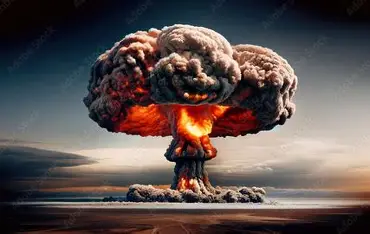
|
| Atomic bomb |
In the fall of 1951, it was decided that there should be two separate test operations. The first operation, IVY, was to be held as soon as possible and would include a number of tests to verify the Teller-Ulam design in a strictly experimental situation. The second operation, CASTLE, would come as soon as possible after IVY and would test the Teller-Ulam configuration in forms suitable for military use (i.e. weaponized devices).
The first series of thermonuclear tests conducted by the United States took place in November 1952 during Operation IVY. The first test took place on November 1, 1952 on the small Pacific island of Elugelab at Enewetak Atoll in the Marshall Islands. The explosion, nicknamed the "Mike Shot," was very successful. It yielded an energy equivalent of 10 megatons of TNT, an amount roughly 1000 times as large as that released by the Hiroshima bomb (some 13 kilotons) that was dropped on Japan in August 1945. Though the test proved successful, the Mike device was very far from being a practical deliverable weapon. Its thermonuclear fuel consisted of liquid deuterium, a substance which must be cooled to temperatures colder than -250 C in order to liquefy it. As a result, the bomb required a complex refrigerating device (the size of a small laboratory) in order to maintain the fuel in that condition prior to its being exploded.
One of the major reasons physicists decided to test the first thermonuclear device with liquid deuterium as its fuel was because it would be much easier for physicists to make theoretical calculations from the simple "burning" of deuterium compared to the complex multi-step process involved in the explosion of solid lithium deuteride (LiD). In addition, the United States did not at the time have a production plant capable of producing the high quantities of enriched lithium necessary for use in a thermonuclear device.
The second device tested on November 16, 1952 during Operation IVY was known as the "King Shot." This device was dropped from an aircraft and exploded at an altitude of 1480 feet above its target. The explosion, which derived its energy entirely from fission, was extremely large and probably yielded somewhere around 500 kilotons (the actual yield was never officially released). According to President Dwight D. Eisenhower in a speech made a year after the IVY tests, the United States possessed an atomic bomb "25 times" the size of the ones used in Japan, meaning 500 kilotons.
The King Shot was important because it demonstrated that developing thermonuclear weapons was not the only way to build extremely massive bombs. Ever since JOE-1, many politicians and physicists claimed that the only possible way for America to ensure its security was to produce a much bigger bomb than the Soviets had, and that the only way to do that was through a crash development program of the hydrogen bomb. Hans Bethe, in opposing the crash program for the super, suggested that a bigger bomb could readily be produced by a straightforward extrapolation of the current fission technology.
In addition to the work being done on thermonuclear weapons, much of the research done at Los Alamos during the late 1940s investigated new methods to make more efficient, more powerful fission bombs. Some physicists explored ways to improve implosion techniques through experimental laboratory work. Others focused on using mathematical calculations to explore the possibilities of new configurations. By the early 1950s, scientists had determined that very efficient fission bombs in the megaton class could be developed by adopting the latest implosion techniques. The King Shot confirmed these ideas by producing an explosion yielding nearly half a megaton of TNT.
Operation CASTLE was the second thermonuclear test series planned by the Atomic Energy Commission and took place in the spring of 1954. During CASTLE, six variants of the superbomb were tested. The first test in that series, the Bravo test, took place on March 1, 1954. Bravo was a device using Lithium Deuteride as its fuel and the explosion yielded 15 megatons, the largest bomb ever exploded by the United States. The bomb was in a form readily adaptable for delivery by an aircraft and was thus America's first weaponized hydrogen bomb.
The Bravo test explosion yielded more than two and a half times what scientists had expected. The huge explosion released large quantities of radioactive debris into the atmosphere. This resulted in the exposure and contamination of the inhabitants of nearby atolls, as well as some servicemen and the crew of a Japanese fishing trawler ("The Lucky Dragon") which had gone unnoticed in the security zone around the blast. This incident pushed the danger of radioactive fallout from nuclear weapons clearly into the public mind.
Nuclear Tests at Operation CASTLE
- Bravo – 14.8 Megatons
- Romeo – 11.0 Megatons
- Koon – 0.10 Megatons
- Union – 6.90 Megatons
- Yankee – 13.5 Megatons
- Nectar – 1.69 Megatons
The Mark 17 and Mark 24 were the first mass-produced hydrogen bombs deployed by the United States. The two differed in their "primary" stages. They entered service in 1954, and were phased out by 1957. Design and development originated when Los Alamos National Laboratory proposed that a bomb design using lithium deuteride with non-enriched lithium was possible. The new design was designated TX-17 on February 24, 1953. The TX-17 and 24 were tested as the "Runt" (Castle Romeo shot) device during Operation Castle in 1954. After the successful tests, basic versions of the Mk 17 and 24 were deployed as part of the "Emergency Capability" program.
The thermonuclear bomb or hydrogen bomb is a weapon whose enormous explosive power results from an uncontrolled self-sustaining chain reaction in which isotopes of hydrogen combine under extremely high temperatures to form helium in a process known as nuclear fusion. The high temperatures that are required for the reaction are produced by the detonation of an atomic bomb.
A thermonuclear bomb differs fundamentally from an atomic bomb in that it utilizes the energy released when two light atomic nuclei combine, or fuse, to form a heavier nucleus. An atomic bomb, by contrast, uses the energy released when a heavy atomic nucleus splits, or fissions, into two lighter nuclei. Under ordinary circumstances atomic nuclei carry positive electrical charges that act to strongly repel other nuclei and prevent them from getting close to one another. Only under temperatures of millions of degrees can the positively charged nuclei gain sufficient kinetic energy, or speed, to overcome their mutual electric repulsion and approach close enough to each other to combine under the attraction of the short-range nuclear force. The very light nuclei of hydrogen atoms are ideal candidates for this fusion process because they carry weak positive charges and thus have less resistance to overcome.
The hydrogen nuclei that combine to form heavier helium nuclei must lose a small portion of their mass (about 0.63 percent) in order to "fit together" in a single larger atom. They lose this mass by converting it completely into energy, according to Albert Einstein's famous formula: E = MC squared. According to this formula, the amount of energy created is equal to the amount of mass that is converted multiplied by the speed of light squared. The energy thus produced forms the explosive power of a hydrogen bomb.
In a thermonuclear bomb, the explosive process begins with the detonation of what is called the primary stage. This consists of a relatively small quantity of conventional explosives, the detonation of which brings together enough fissionable uranium to create a fission chain reaction, which in turn produces another explosion and a temperature of several million degrees. The force and heat of this explosion are reflected back by a surrounding container of uranium and are channeled toward the secondary stage, containing the lithium-6 deuteride. The tremendous heat initiates fusion, and the resulting explosion of the secondary stage blows the uranium container apart. The neutrons released by the fusion reaction cause the uranium container to fission, which often accounts for most of the energy released by the explosion and which also produces fallout (the deposition of radioactive materials from the atmosphere) in the process. (A neutron bomb is a thermonuclear device in which the uranium container is absent, thus producing much less blast but a lethal "enhanced radiation" of neutrons.) The entire series of explosions in a thermonuclear bomb takes a fraction of a second to occur.
A thermonuclear explosion produces blast, light, heat, and varying amounts of fallout. The concussive force of the blast itself takes the form of a shock wave that radiates from the point of the explosion at supersonic speeds and that can completely destroy any building within a radius of several miles. The intense white light of the explosion can cause permanent blindness to people gazing at it from a distance of dozens of miles. The explosion's intense light and heat set wood and other combustible materials afire at a range of many miles, creating huge fires that may coalesce into a firestorm. The radioactive fallout contaminates air, water, and soil and may continue years after the explosion; its distribution is virtually worldwide.
Thermonuclear bombs can be hundreds or even thousands of times more powerful than atomic bombs. The explosive yield of atomic bombs is measured in kilotons, each unit of which equals the explosive force of 1,000 tons of TNT. The explosive power of hydrogen bombs, by contrast, is frequently expressed in megatons, each unit of which equals the explosive force of 1,000,000 tons of TNT. Hydrogen bombs of more than 50 megatons have been detonated, but the explosive power of the weapons mounted on strategic missiles usually ranges from 100 kilotons to 1.5 megatons. Thermonuclear bombs can be made small enough (a few feet long) to fit in the warheads of intercontinental ballistic missiles; these missiles can travel almost halfway across the globe in 20 or 25 minutes and have computerized guidance systems so accurate that they can land within a few hundred yards of a designated target.
The USSR first tested a hydrogen bomb on August 12, 1953, followed by the United Kingdom in May 1957, China (1967), and France (1968). In 1998 India tested a "thermonuclear device," which was believed to be a hydrogen bomb. During the late 1980s there were some 40,000 thermonuclear devices stored in the arsenals of the world's nuclear-armed nations. This number declined during the 1990s.
Between 1945 and 1980, the United States, the USS.R., the United Kingdom, France and China exploded 504 nuclear devices in atmospheric tests at thirteen primary sites yielding the explosive equivalent of 440 megatons of TNT. Of these atmospheric tests, 330 were conducted by the United States. Accounting for all types of nuclear tests, official counts show that the United States has conducted 1,054 nuclear weapons tests to date, involving at least 1,151 nuclear devices, most of which occurred at Nevada Test Site and the Pacific Proving Grounds in the Marshall Islands, with ten other tests taking place at various locations in the United States, including Alaska, Colorado, Mississippi, and New Mexico. There have been an estimated 2,000 nuclear tests conducted worldwide; the number of nuclear tests conducted by the United States alone is currently more than the sum of nuclear testing done by all other known nuclear states (the USSR, United Kingdom, France, China, India, Pakistan, and North Korea) combined. These nuclear tests infused vast quantities of radioactive material into the world's atmosphere, resulting in widely dispersed radiation and its subsequent deposition as global fallout. There was a significant increase in thyroid cancer, leukemia and certain solid tumors that have developed within a decade or more after exposure.
Political scientist Howard Ball said, "Days sometimes began with bright white early-morning atomic explosions, followed by brownish-purple mushroom clouds ... and children played in the grey radioactive dust as they would in snow." High levels of strontium 90, a radioactive isotope from the fallout, began showing up across the United States. According to Tomas Clark of the Seattle Times the Nevada test site released 148 times as much radiation as the Chernobyl disaster in the Soviet Union.

|
| Dwight D. Eisenhower |
In 1952 war hero Dwight Eisenhower became president. He gave strong financial support to South Vietnam. After the Soviet Union launched Sputnik he authorized the creation of NASA. His administration planned the Bay of Pigs invasion, which President Kennedy carried out. He signed the Civil Rights Acts of 1957 and 1960. He established the Dwight D. Eisenhower Interstate Highway system. He also completed racial integration of the military that was begun under Truman. He sent Army troops to enforce federal court orders that integrated schools in Little Rock, Arkansas. In 1959 Alaska and Hawaii became states.
The Soviet Union's Sputnik was the first artificial Earth satellite. It was launched into an elliptical low Earth orbit by the Soviet Union on October 4, 1957 as part of the Soviet space program. It sent a radio signal back to Earth for three weeks before its three silver-zinc batteries became depleted. The launch of Sputnik led to the space race, the result of which was America's moon landing when Nixon was president.
Eisenhower signed the Civil Rights Act of 1957 to provide federal protection for African American voting rights; most African Americans in the Southern United States had been disenfranchised by state and local laws. Though the bill passed Congress, opponents of the act were able, in the Senate, to remove stringent voting protection clauses via the Anderson–Aiken amendment and the O'Mahoney jury trial amendment, significantly watering down its immediate impact. During the debate over the law, Senator Strom Thurmond conducted the longest one-person filibuster in Senate history at the time.
The Civil Rights Act of 1960 established federal inspection of local voter registration polls and introduced penalties for anyone who obstructed someone's attempt to register to vote. This law served to more effectively enforce what was set forth in the 1957 act through eliminating certain loopholes in it. Aside from addressing voting rights, the Civil Rights Act of 1960 also imposed criminal penalties for obstruction of court orders to limit resistance to the Supreme Court's school desegregation decisions, arranged for free education for military members' children and banned the act of fleeing to avoid prosecution for property damage.
During the 1950s Gary Powers was one of 170 men who were aboard 31 flights over the USSR. When Powers plane was downed, Eisenhower denied knowledge of the flight until Powers was shown on Soviet television and confessed to the flight. He served 21 months of his sentence before being released in a prisoner swap in 1962.
In Eisenhower's Farewell Address he said that "balance" and "good judgment" are needed with regard to government-funded scientific research and the military-industrial complex. He called for disarmament, and warned,
we must guard against the acquisition of unwarranted influence, whether sought or unsought, by the military-industrial complex. The potential for the disastrous rise of misplaced power exists and will persist.
We must never let the weight of this combination endanger our liberties or democratic processes. We should take nothing for granted. Only an alert and knowledgeable citizenry can compel the proper meshing of the huge industrial and military machinery of defense with our peaceful methods and goals, so that security and liberty may prosper together.
Rock and roll is a genre of popular music that evolved in the United States during the late 1940s and early 1950s. It originated from African American music such as jazz, rhythm and blues, boogie-woogie, electric blues, gospel, and jump blues, as well as from country music. For example, Elvis Presley popularized Willie Mae "Big Mama" Thornton's blues tune Hound Dog. While rock and roll's formative elements can be heard in blues records from the 1920s and in country records of the 1930s, the genre did not acquire its name until 1954.
1953 coup in Iran, coup d'état in Iran that occurred in August 1953. Funded by the United States and the United Kingdom, it removed Mohammad Mosaddegh from power and restored Mohammad Reza Shah Pahlavi as Iran's leader. Some 300 people died during fighting in Tehrān.
With its strategic location and vast oil reserves, Iran was of special interest to the United States, the United Kingdom, and other powers. Britain had established a presence in the country during World War II to protect a vital supply route to its ally the Soviet Union and to prevent the oil from falling into German hands. After the war, the United Kingdom effectively retained control over Iran's oil through the establishment of the Anglo-Iranian Oil Company.
This arrangement changed abruptly in 1951 when the Iranian parliament, led by Mosaddegh's nationalist and democratically elected government, voted to nationalize the country's oil industry. Seeing its interests thus threatened, the UK embarked on a secret campaign to weaken and destabilize Mosaddegh. At first the British government tried to convince the shah to remove Mossadegh from office by engineering a parliamentary decree, a ploy that both failed and enhanced Mosaddegh's reputation while diminishing the shah's. When the push to remove Mosaddegh evolved into the idea of a coup to overthrow the government, Britain, reluctant to shoulder the responsibility alone, persuaded the US to join forces by playing on Cold War fears that Mosaddegh, an avowed anticommunist, was aligning himself with Tudeh, the Iranian Communist Party.
The United States took the leading role in a covert operation, called Operation Ajax, whereby CIA-funded agents were used to foment unrest inside Iran by way of the harassment of religious and political leaders and a media disinformation campaign. These efforts, formally approved by President Dwight D. Eisenhower, came to a head in August 1953 when Mosaddegh and his government were overthrown and Mohammad Reza, a pro-Western monarch, was returned to power. The coup nearly failed, however, because the shah, fearful for his throne, vacillated over signing the royal decrees the CIA had prepared to sanction the change of government. Fighting between supporters of both sides resulted in hundreds of deaths.
Mosaddegh was imprisoned for three years and then lived the rest of his life under house arrest. It is generally agreed today that the 1953 coup sowed the seeds for the Islamic Revolution of 1979, in which the shah was overthrown and went into exile. In 2013 the CIA formally disclosed its role in the coup.
Operation Wetback was an immigration law enforcement initiative created by Joseph Swing, a retired United States Army Lieutenant General and head of the United States Immigration and Naturalization Service (INS). The program was implemented in June 1954 by US Attorney General Herbert Brownell. The short-lived operation used military-style tactics to remove Mexican immigrants-some of them American citizens-from the United States. Though millions of Mexicans had legally entered the country through joint immigration programs in the first half of the 20th century, with some being naturalized citizens and some once native, Operation Wetback was designed to send them to Mexico. The program became a contentious issue in Mexico–United States relations, even though it originated from a request by the Mexican government to stop the illegal entry of Mexican laborers into the United States. Legal entry of Mexican workers for employment was at the time controlled by the Bracero Program, established during World War II by an agreement between the US and Mexican governments. Operation Wetback was primarily a response to pressure from a broad coalition of farmers and business interests concerned with the effects of illegal immigration from Mexico. Upon implementation, Operation Wetback gave rise to arrests and deportations by the US Border Patrol.
Mexico began discouraging emigration to the United States in the early 1900s, beginning with President Porfirio Díaz. Diaz, like many other Mexican government officials, realized that the laborers leaving for the United States would be needed to industrialize and expand the Mexican economy. While Mexico did not have extensive capital, its largest asset was abundant, cheap labor, the primary resource needed to modernize the country's economy and develop industrial agribusiness. The large and growing agricultural industry in the United States created a demand for labor. From the 1920s onward, with the exception of the depression era, Mexicans served as the primary labor source for much of the agricultural industry in the United States, especially in the Southwest. Every year during the 1920s, some 62,000 workers entered the United States legally, and over 100,000 illegally. Pressure from Mexican agribusiness owners to return laborers from the United States to Mexico prompted increased action by the Mexican government. The labor problems caused crops to rot in Mexican fields because so many laborers had crossed into the US Meanwhile, American agriculture, which was also transitioning to large-scale farms and agribusinesses, continued to recruit illegal Mexican laborers to fulfill its expanding labor requirements.
The first systematic Hollywood blacklist was instituted on November 25, 1947, the day after ten left-wing screenwriters and directors were cited for contempt of Congress for refusing to answer questions before the House Un-American Activities Committee (HUAC). The ten men – Alvah Bessie, Herbert Biberman, Lester Cole, Edward Dmytryk, Ring Lardner Jr., John Howard Lawson, Albert Maltz, Samuel Ornitz, Adrian Scott and Dalton Trumbo – had been subpoenaed by the committee in late September to testify about their Communist affiliations and associates. The contempt citation included a criminal charge that led to a highly publicized trial and conviction, with a maximum of one year in jail in addition to a $1,000 fine ($13,100 today).
The Congressional action prompted a group of studio executives, acting under the aegis of the Association of Motion Picture Producers, to suspend without pay these ten film artists – initially labeled "The Unfriendly Ten" but soon changed to "The Hollywood Ten" – and to pledge that "thereafter no Communists or other subversives would 'knowingly' be employed in Hollywood." The blacklist eventually expanded beyond ten into the hundreds. On June 22, 1950, a pamphlet-style book entitled Red Channels was published. Focused on the field of broadcasting, it identified 151 entertainment industry professionals as "Red Fascists and their sympathizers" who had infiltrated radio and television. It was not long before those named, along with a host of other artists, were barred from employment in the entertainment field.

|
| Joe McCarthy |
From 1950 through 1954, Senator Joe McCarthy of Wisconsin falsely accused many Americans of being members of the Communist Party. Many actors in Hollywood were blacklisted. Communists could be lurking anywhere, using their positions as school teachers, college professors, labor organizers, artists, or journalists to aid the program of world Communist domination. McCarthy, a right-wing Republican, launched a series of highly publicized probes into alleged Communist penetration of the State Department, the White House, the Treasury, the Central Intelligence Agency and the US Army. The Army hearings finally destroyed McCarthy's career. Many people lost their jobs and some were falsely imprisoned because of blacklists that later fell into disrepute and laws that were later struck down.
McCarthy was elected to the Senate in 1946 and rose to prominence in 1950 when he claimed in a speech in Wheeling, West Virginia, that communists had infiltrated the State Department. At a Women's Republican Club he said, "I have here in my hand a list of 205-a list of names that were made known to the Secretary of State as being members of the Communist Party and who nevertheless are still working and shaping policy in the State Department." He added, "One thing to remember in discussing the Communists in our government is that we are not dealing with spies who get thirty pieces of silver to steal the blueprints of a new weapon. We are dealing with a far more sinister type of activity because it permits the enemy to guide and shape our policy." The next day he gave a speech in Salt Lake City and claimed that 57 Communists (the number kept changing) were in the State Department. McCarthy then appeared on the floor of the Senate reading from out-of-date dossiers and changing the wording as he went along. For example, he changed "liberal" to "communistically inclined" and "active fellow traveler" to "active Communist." He claimed that 40 books in State Department libraries across the world were communistic, including The Selected Works of Thomas Jefferson and The Children's Hour. Some books were burned. Magazines published articles like "How Communists Get That Way" and "Communists Are After Your Child."
McCarthy was eventually undermined significantly by the skillful criticism of journalist Edward R. Murrow. Closing a half-hour television report on McCarthy in March 1954, American journalist Edward R Murrow delivered an editorial on the show See It Now about McCarthy's tactics and their impact. Murrow's editorial about McCarthy harmed McCarthy's popularity. As Murrow said:
We must not confuse dissent with disloyalty. We must remember always that accusation is not proof and that conviction depends upon evidence and due process of law. We will not walk in fear, one of another. We will not be driven by fear into an age of unreason, if we dig deep in our history and our doctrine, and remember that we are not descended from fearful men – not from men who feared to write, to speak, to associate and to defend causes that were, for the moment, unpopular.
President Eisenhower refrained from speaking out in public about the Red Scare because he didn't want to increase publicity about McCarthy. In a letter he wrote to his brother Milton he explained, "As for McCarthy. Only a short-sighted or completely inexperienced individual would urge the use of the office of the presidency to give an opponent the publicity he so avidly desires."

|
| Red Scare |
There had been real spies who penetrated into the State Department, notably Alger Hiss. And Communist agents had stolen classified secrets from the wartime Manhattan Project that built the atomic bomb.
After McCarthy's reelection in 1952, he obtained the chairmanship of the Committee on Government Operations of the Senate and of its Permanent Subcommittee on Investigations. For the next two years, he was constantly in the spotlight, investigating various government departments and questioning innumerable witnesses about their suspected communist affiliations. Although he failed to make a plausible case against anyone, his colorful and cleverly presented accusations drove some people out of their jobs and brought popular condemnation to others.
McCarthyism both reached its peak and began its decline during the McCarthy hearings: 36 days of televised investigative hearings led by McCarthy in 1954. After first calling hearings to investigate possible espionage at the Army Signal Corps Engineering Laboratories in Fort Monmouth, New Jersey, the junior senator turned his communist-chasing committee's attention to an altogether different matter, the question of whether the Army had promoted a dentist who had refused to answer questions for the Loyalty Security Screening Board. The hearings reached their climax when McCarthy suggested that the Army's lawyer, Joseph Welch, had employed a man who at one time had belonged to a communist front group. Welch's rebuke to the senator-"Have you no sense of decency, sir, at long last? Have you left no sense of decency?"-discredited McCarthy and helped to turn the tide of public opinion against him.
In May 1954, Ike said that administration officials and all executive branch employees would ignore any call from McCarthy to testify. The first move the White House made was to try to discredit the men around McCarthy, notably the lawyer Roy Cohn, who was leading the investigation, and Cohn's assistant David Schine, who had recently been drafted into the Army. The Army compiled a damaging dossier of dirt on Cohn, showing that he used threats and intimidation to demand that Schine be given plum assignments and easy duty. The White House leaked this dossier to the press and Congress. McCarthy and Cohn now stood accused of abuse of power. In early December 1954, the Senate passed a motion of condemnation, in a vote of 67 to 22. McCarthy was ruined-and within three years he was dead from alcohol abuse. The era of McCarthyism was over.
Julius and Ethel Rosenberg were an American married couple who were convicted of spying for the Soviet Union, including providing top-secret information about American radar, sonar, jet propulsion engines, and nuclear weapon designs. They were executed by the federal government of the United States on June 19, 1953 using New York's state execution chamber in Sing Sing in Ossining, New York, becoming the first American civilians to be executed for such charges. Other convicted co-conspirators were sentenced to prison, including Ethel's brother, David Greenglass (who had made a plea agreement), Harry Gold, and Morton Sobell. Klaus Fuchs, a German scientist working at the Los Alamos Laboratory, was convicted in the United Kingdom. Among records the US government declassified after the fall of the Soviet Union are many related to the Rosenbergs, including a trove of decoded Soviet cables (code-name Venona), which detailed Julius' role as a courier and recruiter for the Soviets.
Roy Cohn was McCarthy's right-hand man. As the assistant prosecutor, the twenty-four-year-old Cohn pushed aggressively for the death penalty, particularly for Ethel, despite substantial questions about the extent of her involvement in her husband's espionage. As Cohn would later boast in his autobiography, he had privately lobbied the judge for the death sentence, an extraordinary ethical breach for a prosecutor. In his pursuit of the death penalty for Ethel Rosenberg-a mother of two young boys-Cohn manipulated evidence, pressured witnesses, and engaged in ex parte communications with the judge. Years later, declassified Soviet cables would show that while Julius Rosenberg was indeed a spy, the evidence against Ethel was much weaker. David Greenglass, Ethel's brother and the key witness against her, would eventually admit that he had lied in his testimony at Cohn's urging.
Harry Gold, a spy serving a 30-year sentence for another espionage case, testified against the Rosenbergs. In a later trial Gold lied about his fictional wife and children. When testifying against the Rosenbergs Gold had been coached for 400 hours by the FBI.
The 1954 Guatemalan coup d'état deposed the democratically elected Guatemalan President Jacobo Árbenz and marked the end of the Guatemalan Revolution. The coup installed the military dictatorship of Carlos Castillo Armas, the first in a series of US-backed authoritarian rulers in Guatemala. The coup was precipitated by a CIA covert operation code-named PBSuccess.
The Guatemalan Revolution began in 1944, after a popular uprising toppled the military dictatorship of Jorge Ubico. Juan José Arévalo was elected president in Guatemala's first democratic election. He introduced a minimum wage and near-universal suffrage. Arévalo was succeeded in 1951 by Árbenz, who instituted land reforms which granted property to landless peasants. The Guatemalan Revolution was disliked by the US federal government, which was predisposed during the Cold War to see it as communist. This perception grew after Árbenz had been elected and formally legalized the communist Guatemalan Party of Labor. The US government feared that Guatemala's example could inspire nationalists wanting social reform throughout Latin America. The United Fruit Company (UFC, now called Chiquita Brands International), whose highly profitable business had been affected by the softening of exploitative labor practices in Guatemala, engaged in an influential lobbying campaign to persuade the US to overthrow the Guatemalan government. US President Harry Truman authorized Operation PBFortune to topple Árbenz in 1952, which was a precursor to PBSuccess.
Dwight D. Eisenhower was elected US president in 1952, promising to take a harder line against communism, and his staff members John Foster Dulles and Allen Dulles had significant links to the United Fruit Company. The US federal government drew exaggerated conclusions about the extent of communist influence among Árbenz's advisers, and Eisenhower authorized the CIA to carry out Operation PBSuccess in August 1953. The CIA armed, funded, and trained a force of 480 men led by Carlos Castillo Armas. After US efforts to criticize and isolate Guatemala internationally, Armas' force invaded Guatemala on June 18, 1954, backed by a heavy campaign of psychological warfare, as well as air bombings of Guatemala City and a naval blockade.
The invasion force fared poorly militarily, and most of its offensives were defeated. However, psychological warfare and the fear of a US invasion intimidated the Guatemalan Army, which eventually refused to fight. Árbenz unsuccessfully attempted to arm civilians to resist the invasion, before resigning on June 27, 1954. Castillo Armas became president ten days later, following negotiations in San Salvador. Described as the definitive deathblow to democracy in Guatemala, the coup was widely criticized internationally, and strengthened the long-lasting anti-US sentiment in Latin America. Attempting to justify the coup, the CIA launched Operation PBHistory, which sought evidence of Soviet influence in Guatemala among documents from the Árbenz era, but found none. Castillo Armas quickly assumed dictatorial powers, banning opposition parties, executing, imprisoning and torturing political opponents, and reversing the social reforms of the revolution. In the first few months of his government, Castillo Armas rounded up and executed between three thousand and five thousand supporters of Árbenz. Nearly four decades of civil war followed, as leftist guerrillas fought the series of US-backed authoritarian regimes whose brutalities include a genocide of the Maya peoples.
Árbenz had expropriated 234,000 acres of land owned by United Fruit. Armas gave the land back to United Fruit, abolished the tax on interest and dividends to foreign investors, eliminated the secret ballot and jailed thousands of political critics.

|
| Little Rock Nine |
The US Supreme Court issued its Brown v. Board of Education, May 17, 1954. Tied to the Fourteenth Amendment to the US Constitution, the decision declared all laws establishing segregated schools to be unconstitutional, and it called for the desegregation of all schools throughout the nation. After the decision, the National Association for the Advancement of Colored People (NAACP) attempted to register black students in previously all-white schools in cities throughout the South. The Brown decision ordered that schools be desegregated "with all deliberate speed." Since no specific deadline was set, many Southern schools ignored the order. However, in Little Rock, Arkansas, the school board agreed to comply with the high court's ruling. Virgil Blossom, the Superintendent of Schools, submitted a plan of gradual integration to the school board.
By 1957, the NAACP had registered nine black students to attend the previously all-white Little Rock Central High, selected on the criteria of excellent grades and attendance. They were called the "Little Rock Nine." When integration began on September 4, 1957, the Arkansas National Guard was called in to "preserve the peace." Originally at orders of the governor, they were meant to prevent the black students from entering due to claims that there was "imminent danger of tumult, riot and breach of peace" at the integration.
Woodrow Wilson Mann, the mayor of Little Rock, asked President Eisenhower to send federal troops to enforce integration and protect the nine students. On September 24, Eisenhower invoked the Insurrection Act of 1807 to enable troops to perform domestic law enforcement. The president ordered the 101st Airborne Division of the United States Army to Little Rock-initially without its black soldiers at the request of the Department of Justice. He issued Executive Order 10730, which federalized the Arkansas National Guard and ordered them to support the integration on September 23 of that year-and federalized the entire 10,000 member Arkansas National Guard, taking it out of Faubus' control.
By the end of September 1957, the nine were admitted to Little Rock Central High under the protection of the 101st Airborne Division (and later the Arkansas National Guard), but they were still subjected to a year of physical and verbal abuse by many of the white students. Melba Pattillo had acid thrown into her eyes and also recalled in her book, Warriors Don't Cry, an incident in which a group of white girls trapped her in a stall in the girls' washroom and attempted to burn her by dropping pieces of flaming paper on her from above. Black students faced physical and emotional abuse from mobs of angry white people.
Claiming that Little Rock had to assert their rights and freedom against the federal decision, in September 1958, Faubus signed acts that enabled him and the Little Rock School District to close all public schools. Thus, with this bill signed, on Monday September 15, Faubus ordered the closure of all four public high schools, preventing both black and white students from attending school. Despite Faubus' decree, the city's population had the chance of refuting the bill since the school-closing law necessitated a referendum. The referendum, which would either condone or condemn Faubus' law, was to take place within thirty days. A week before the referendum, which was scheduled to take place on September 27, Faubus addressed the citizens of Little Rock in an attempt to secure their votes. Faubus urged the population to vote against integration since he was planning on leasing the public school buildings to private schools, and, in doing so, would educate the white and black students separately. Faubus was successful in his appeal and won the referendum. This year came to be known as the "Lost Year."
Faubus' victory led to a series of consequences that affected Little Rock society. Faubus and the school board's intention to open private schools was blocked by an injunction by the 8th US Circuit Court of Appeals, which caused some citizens of Little Rock to turn on the black community. The black community became a target for hate crimes since people blamed them for the closing of the schools. Daisy Bates, head of the NAACP chapter in Little Rock, was a primary victim of these crimes, in addition to the black students enrolled at Little Rock Central High School and their families.

|
| Martin Luther King |
Maya Lin's Civil Rights Memorial lists "Forty Lives for Freedom" - civil rights martyrs killed by white supremacists.
Southerners protested against desegregation with signs that read, "WE WANT white TENANTS IN OUR white COMMUNITY," "We wont [sic] go to school with negroes" and "we don't want to integrate."
In 1955 Autherine Lucy desegregated the University of Alabama. She wasn't allowed in the dining hall or dorms. An angry mob of 1,000 whites rioted and threw bricks and eggs. The University suspended Lucy. When she sued the University accused her of defamation and made her suspension permanent.
Rosa Parks was not the first black woman to protest sitting on the back of a bus. In 1944 Viola White refused to give up her seat on a Montgomery bus, resulting in her arrest. When she was first arrested, the police officers beat her in a classic attempt to 'teach her her place.' She worked alongside Civil Rights leader E. D. Nixon to try to appeal her case, but multiple public officials retaliated against her. They kept the appeal from being heard in court, and a man named A. A. Enger kidnapped and sexually assaulted her daughter. After extensive effort to punish Enger, a warrant was finally signed for his arrest. When he left town, however, he managed to evade all justice.
In 1950 Hilliard Brooks was a young World War II veteran who refused to exit the bus and re-enter in the back. When the driver blocked him from entering, he demanded his money back. The driver refused and called the police, who reportedly shoved Brooks to the ground and beat him repeatedly with a club. The young man attempted to get away, at which point Officer M. E. Mills began shooting. Along with dealing fatal injuries to Brooks, the officer shot two bystanders. After Hilliard Brooks passed away, Mills was absolved by the police board of investigations and the Montgomery mayor, supposedly because he had been acting in self-defense against a dangerous aggressor.
Claudette Colvin, whose refusal in 1955 to give up her seat to a white woman on a segregated bus in Montgomery, Ala., came months before it was overshadowed by a similar act of resistance in the same city by Rosa Parks, a historic moment that helped galvanize the civil rights movement. As a teenager in Alabama, Ms. Colvin went on to become a star witness in a landmark anti-segregation lawsuit whose successful outcome was affirmed by the United States Supreme Court. She was just 15 when she boarded a Montgomery city bus on March 2, 1955. The seating was segregated, with black riders forced to the back, and if the white section filled up, the driver could order black riders to give up their seats if they were in the rows known as "no man's land," between the two sections. To add to the indignity, black riders were not allowed to occupy the same row as white riders, which meant that they had to move back even if there were empty seats next to those passengers. That's exactly what happened when a white woman boarded Ms. Colvin's bus. The driver ordered Ms. Colvin and the three other black people in her row to move. Two of them did. Ms. Colvin and another woman remained seated.

|
|
Norman Rockwell's The Problem We All Live With |
Martin Luther King Jr. was an American Baptist minister and civil rights activist who was one of the most prominent leaders of the civil rights movement from 1955 until his assassination in 1968. He advanced civil rights for people of color in the United States through the use of nonviolent resistance and nonviolent civil disobedience against Jim Crow laws and other forms of legalized discrimination. King was nonviolent even when physically attacked by a white supremacist while giving a speech. He won the 1964 Nobel Peace Prize.
On December 1, 1955, a black woman named Rosa Parks was arrested for refusing to give up her seat to a white man. In 1943 bus driver James F. Blake took Park's money, ordered her to enter from the back and then left without her. He was the same man who called the police on Parks when she refused to give up her seat. Martin Luther King was chosen to lead a bus boycott as head of the Montgomery Improvement Association. The boycott lasted for 381 days and was a success. Montgomery buses stopped forcing blacks to move to the back of buses. After the boycott, Rosa and Raymond Parks lost their jobs. They received death threats on a regular basis. During the boycott, King said:
If we are wrong, the Supreme Court of this nation is wrong. If we are wrong, the Constitution of the United States is wrong. If we are wrong, God almighty is wrong. If we are wrong, Jesus of Nazareth was merely a utopian dreamer who never came down to earth. If we are wrong, justice is a lie, love has no meaning. And we are determined here in Montgomery to work and fight until justice runs down like water and righteousness like a mighty stream.
King also said,
If we are arrested every day, if we are exploited every day, if we are trampled over every day, don't let anyone pull you so low as to hate them. We must use the weapon of love. We must have compassion and understanding for those who hate us. We must realize so many people are taught to hate us that they are not totally responsible for their hate. But we stand in life at midnight, we are always on the threshold of a new dawn.
On January 30, 1956, King's home was bombed. White supremacists bombed the homes of about 21 blacks in Birmingham, including the homes of civil rights leaders. These bombings didn't kill anyone.
In 1960 Ruby Bridges Hall was the first black child to attend William Frantz Elementary School in Louisiana. White children withdrew from the school, and only one teacher, Barbara Henry, was willing to teach her. Federal marshals escorted her to school. A white person threatened to poison her, and another white person held up a black baby doll in a coffin. Some white children came back to school, but not to the class that Ruby was in. As a result of Ruby desegregating a school, her father lost his job working at a gas station, and the local grocery store refused to allow her family to shop there.
In 1960 civil rights sit-ins began, starting in Greensboro, North Carolina. A sit-in at a Woolworths spread throughout the country to protest segregated restaurants.