- RECONSTRUCTION (1865 - 1877)
- ANDREW JOHNSON (1865 - 1869)
- FREEDMEN'S BUREAU
- SOUTHERN HOMESTEAD ACT OF 1866
- CONFLICTS OVER MILITARY RECONSTRUCTION
- RADICAL RECONSTRUCTION
- REDEEMERS
- CONVICT LEASING
- RACE MASSACRES
- OTHER RACIAL VIOLENCE
- THE DUNNING SCHOOL
- THE LOST CAUSE MYTH
- ROBERT E. LEE AND THE LOST CAUSE
- JAMES LONGSTREET AND THE LOST CAUSE
- SPOILS SYSTEM
- POST CIVIL WAR ECONOMICS
- TRANSCONTINENTAL RAILROADS
- CORRUPTION AND THE GILDED AGE
- LABOR MOVEMENT
- ROBBER BARONS
- ULYSSES S. GRANT (1869 - 1877)
- 1870 LYNCHING OF WYATT OUTLAW AND OTHERS
- BATTLE OF CANAL STREET
- HENRY ADAMS
- COLFAX MASSACRE
- THE SLAUGHTERHOUSE CASES
- CRUIKSHANK AND REESE DECISIONS
- PANIC OF 1873
- GRANT'S "PEACE POLICY" WITH INDIAN TRIBES
- WESTERN LAND LEGISLATION
- RUTHERFORD HAYES (1877 - 1881)
|
| Reconstruction |
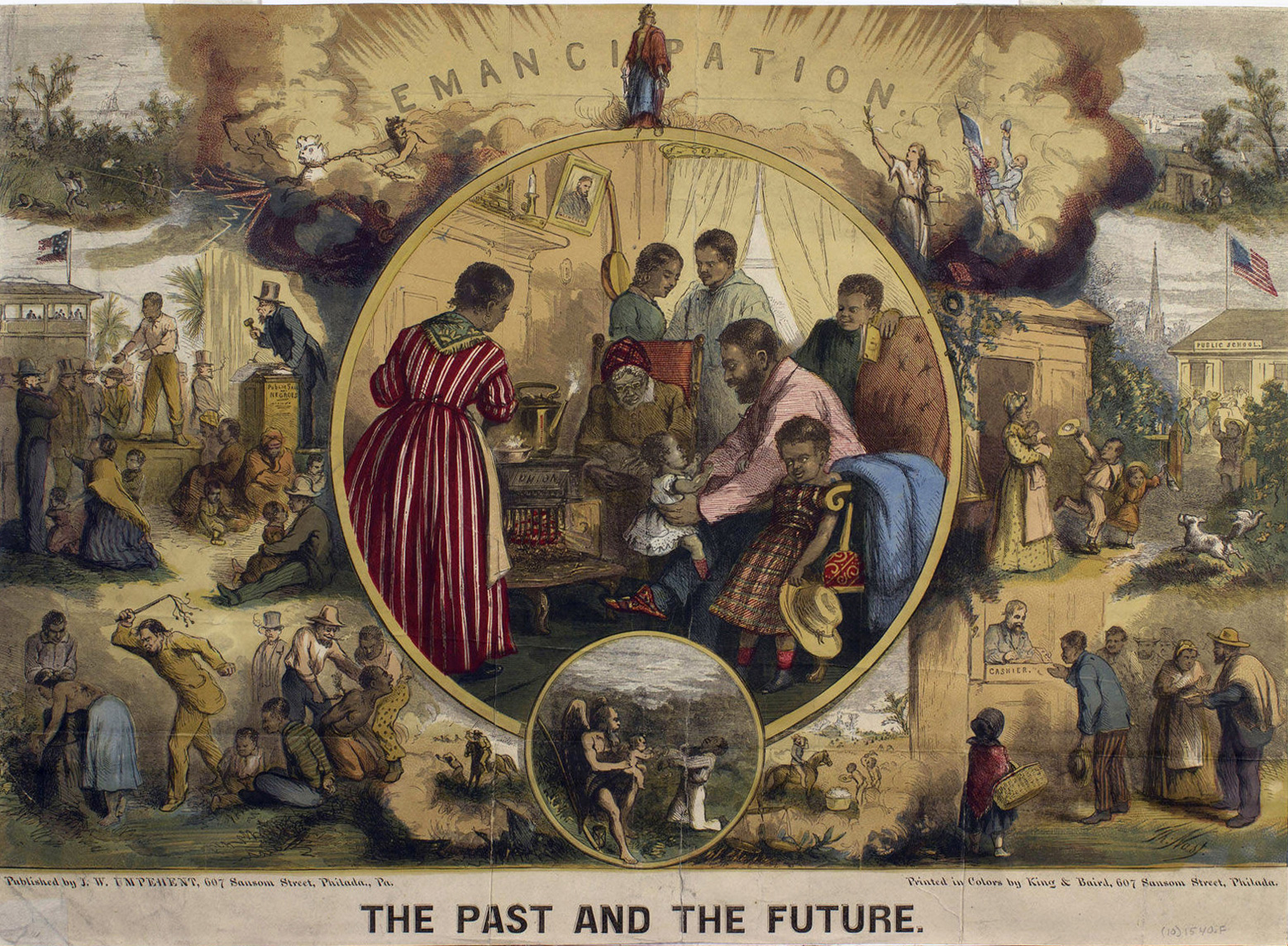
Reconstruction lasted from 1865 to 1877. During Reconstruction the Fourteenth and Fifteenth Amendments were added to the Constitution, the Freedman's Bureau tried to provide land and education for emancipated slaves, and there was extreme conflict between Radical Republicans and President Andrew Johnson, who was pro-Union but racist. During Reconstruction many blacks tried to reunite their families. Southern whites said that such blacks were "acting white", and couldn't believe that blacks really cared about their families. At first blacks won the right to vote, but the revolution of freedom was followed by the counterrevolution of massacres, lynchings, denial of voting rights and segregation for a century after the war. Reconstruction ended because of a bargain made to resolve the result of an 1876 election dispute when Republican Rutherford Hayes defeated Democrat Samuel Tilden in an election marred by massive vote fraud.
For many years the Reconstruction era was described by Dunning School and Lost Cause Myth (pro-South) versions of events, which claimed that "carpetbaggers" (Northerners who went south to help newly freed slaves) and "scalawags" (pro-equality Southerners) were corrupt. Research done by modern historians indicates that, while corruption was everywhere, there was no connection between corruption and a belief in equality. While some Southerners feared that former slaves would seek violent revenge, there were no "horrors of St. Domingo." The Southern diarist Mary Boykins Chesnut wrote that "both parties, white and black, talked beautifully" and that when former slaves "see an opening to better themselves they will move on." The historian Richard White wrote, "Black people were victims, not perpetrators. Their collective restraint was remarkable." While blacks committed crimes that are often committed by the poor, such as stealing, most of the violence was done by whites against blacks. The Ku Klux Klan, the White League, the Knights of the White Camelia, the Red Shirts and others used violence to prevent blacks from voting, to enforce segregation and to spread terror through death and threats.
In 1865 attempts to allow blacks the right to vote were defeated in Minnesota, Wisconsin and Connecticut.
In 1865 the federal government spent much more on the North than on the South. Out of $103,294,501 spent on public works, only $9,469,363 went to the South. While $83 million was spent to subsidize the Union Pacific and Central Pacific railroads, there was no such subsidy for the South. The South wanted federal aid for the Texas and Pacific Railroad.
Das Kapital, written by Karl Marx, is divided into three volumes, of which only the first was published during Marx's lifetime, in 1867; the others were completed from his manuscripts and published by his collaborator Friedrich Engels in 1885 and 1894. Marx claimed that class conflict will lead to a "dictatorship of the proletariat." Lenin, who was inspired by Marx, led the Russian Communist Revolution in 1917.

|
| Andrew Johnson |
On April 14, 1865, Booth assassinated Lincoln, and Andrew Johnson became president. Johnson, as military governor of Tennessee, freed his own slaves. On October 24, 1864 Johnson proclaimed freedom to all slaves in that state, saying to them, "humble and unworthy as I am, if no other better shall be found, I will indeed be your Moses, and lead you through the Red Sea of war and bondage, to a fairer future of liberty and peace." At first Johnson said that treason "must be made odious and traitors must be punished and impoverished. Their great plantations must be seized and divided into small farms ..." Johnson was pro-Union but didn't respect the rights of newly freed slaves. He did nothing to stop Southern whites from killing thousands of blacks and intimidating others into giving up their right to vote. Some blacks were fired from their jobs or were murdered to punish them for voting. Johnson pursued a very lenient policy toward white Southerners.
Secretary of State William Seward encouraged Johnson's lenient policy toward the South. When Comte de Gasparin, a French author and reformer, said that America should allow blacks the right to vote, Seward said that he opposed "a policy of centralization, consolidation and imperialism ... repugnant to the spirit of individual liberty."
On May 29, 1865, Johnson issued the first of two Reconstruction proclamations. The first granted amnesty to most ex-Confederates who took an oath of loyalty to the United States and accepted the end of slavery. The second created the reconstructed government of North Carolina, allowing former Confederates pardoned by Johnson to vote. This formulation denied the right to vote for blacks. Johnson appointed William W. Holden as governor.
Johnson believed that, since secession was against the Constitution, Southern states had never left the Union and had the same powers as other states. Leland Stanford, the governor of California, said that it was also illegal to murder, but that this didn't mean that murders didn't happen or that they shouldn't be punished. However, Johnson thought that Southern states were allowed to decide who should be allowed to vote, and to exclude blacks from voting. No Southern state wanted to allow blacks to vote. At first, an iron-clad oath that a Southern elected official had always been loyal to the Union was required, but Johnson chose to ignore this requirement.
The provost marshalls who accompanied most Northern armies determined Southerners' freedom to travel, controlled their access to supplies and governed their towns and cities. Under the Confiscation Act of 1862 they could seize the property of disloyal Southern citizens, and they often undertook the organization and supervision of labor by freedmen. During Reconstruction the army controlled the South under martial law during 1865 and much of 1866. The military worked as a relief agency, a police force, a court, a public works bureau and a school system. There were clashes between military courts, courts run by the Freedmen's Bureau and civil courts.
A year before he became president, Johnson said, "I am for the white man's government, and in favor of free white qualified voters controlling this country, without regard to negroes." Johnson pardoned former Confederate Harry T. Hayes, who later led the killing of more than 40 blacks during the New Orleans massacre. Johnson also pardoned many other former Confederates, including Jefferson Davis.
Radical Republicans added the Fourteenth Amendment and the Fifteenth Amendment to the Constitution. The Fourteenth Amendment has been called the anti-Dred Scott amendment. It requires equal protection of the laws and allows citizenship to anyone born in the US. It specifies that the debt of the United States is not to be questioned, but does not recognize Confederate debt. Its Due Process clause has been interpreted to apply the First Amendment and other amendments to state governments. The Fifteenth Amendment guarantees blacks the right to vote.
During 1865-1866, Southerners adopted Black Codes to keep blacks in a state as close to slavery as possible. The Freedmen's Bureau and federal courts suspended these codes. Republican state governments repealed the Black Codes. Redeemer (pro-South) governments created landlord liens, vagrancy laws and contract labor laws that amounted to peonage, anti-enticement laws to limit labor mobility, criminal statutes rigged against blacks and a pattern of law enforcement that favored white over black and landlord over sharecropper. During Reconstruction, South Carolina set up a land commission that sold land to 14,000 blacks on easy terms. Later, a Redeemer government foreclosed on the properties of most of these families and transferred the land to white families. As a white Mississippian said, "Our negroes have ... a tall fall ahead of them. They will learn that freedom and independence are two different things."
Johnson sent Carl Schurz to inquire "into the existing condition of things." "Treason," Schurz wrote, "does, under existing circumstances, not appear odious in the south." Southerners resented the loss of their slaves, and wanted to be compensated for their loss. They didn't want any federal exise taxes to go toward the war debt. "I've heard," Schurz wrote, "a Georgia planter argue most seriously that one of his negroes had shown himself certainly unfit for freedom, because he impudently refused to submit to a whipping." The provost marshal in Selma, Alabama, Maj. J. P. Houston, said,

twelve cases, in which I am morally certain the trials have not been had yet, that negroes were killed by whites. In a majority of cases the provocation consisted in the negroes' trying to come to town or to return to the plantation after having been sent away. The cases above enumerated, I am convinced, are but a small part of those that have actually been perpetrated.
According to Schurz, after the freedpeople were no longer seen as valuable property,
the maiming and killing of colored men seems to be looked upon by many as one of those venial offenses which must be forgiven to the outraged feelings of a wronged and robbed people. Besides, the services rendered by the negro to the national cause during the war, which make him an object of special interest to the loyal people, make him an object of particular vindictiveness to those whos hearts were set upon the success of the rebellion. Southerners seem irrevocably committed to the idea that "the elevation of the blacks will be the degradation of the whites."
Schurz said that murders, whipping and physical compulsion would "continue to be so until the southern people will have learned, so as never to forget it, that a black man has rights which a white man is bound to respect."
Henry Adams, a former slave, came to Caddo Parish, Louisiana in a wagon transporting produce to Shreveport when he was robbed and almost killed by a white mob. The next year he went to De Soto Parish and saw the body of a black man hung from an oak tree and the wagon of a black man that was burned. Even the mules were burned. He saw the head of a black man on the road. He was attacked by another mob of whites, and his horse saved his life. He later became a quartermaster sergeant in the army.
Johnson ordered the removal of black troops from the South because Southern whites felt humiliated by them and because their presence was a threat to plantation discipline. Therefore, black soldiers were assigned to garrison duty along the coast.
Mississippi enacted the first Black Code in the fall of 1865, and other Southern states soon followed. Blacks still had contract rights to marry, hold property and sue and be sued. However, the most extreme Black Codes in South Carolina, Mississippi and Texas defined blacks as agricultural and domestic workers, and referred to their employers as "masters." Employers had near total control over their black employees during the day and retained the right of physically punishing workers and docking their pay. In Florida blacks could be whipped for "impudence and disrespect." Also, Southern legislatures could say they were only doing what Northern states did by passing vagrancy laws. The poverty of most blacks meant that few of them could escape vagrancy laws. Mississippi required blacks to have labor certificates, and failure to have them or failure to pay for labor violations and petty criminal infractions could result in forced labor. Apprenticeship laws split families apart by assigning black children to work for white employers. In North Carolina, Mississippi and Kentucky courts sent black children to their former masters. Southern employers agreed not to compete with each other for black workers in order to keep wages down, not to sell or rent land to black people, and went to local courts with contracts to avoid interference by the Freedmen's Bureau. Beatings, whippings, mutilations, rapes and murders went with the Black Codes.
Historian James M. McPherson described the destruction caused to the South's economy during the war:
Union invasion of the Confederacy and the destruction of southern war industries and transportation facilities, the abolition of slavery, the wastage of southern livestock, and the killing of one-quarter of the South's white male population of military age made an economic desert of large areas of the South. While the total value of northern wealth increased by 50 percent during the 1860s, southern wealth decreased by at least 60 percent. In 1860 the South's share of national wealth was 30 percent; in 1870 it was only 12 percent.
According to historians Ransom and Sutch, during Reconstruction blacks got a larger percent of a shrunken Southern economy. The share of the economy they received went from 22 percent in shelter, food and clothing as slaves to 56 percent when they could bargain over wages as free laborers. The average per capita income of blacks increased by 46 percent in seven lower South states from 1857 to 1879, while the per capita income of whites in these states declined by 35 percent.
During the Congressional elections of 1866 Johnson made a "swing around the circle" series of speeches during which he argued with hecklers, compared himself to Christ and was criticized in the press. Republicans gained seats in Congress, which reduced Johnson's effectiveness in attacking Radical Republicans and the Fourteenth Amendment. Republicans required universal manhood suffrage for the organization of Western territories and required that former Confederate states ratify the Fourteenth Amendment to be readmitted to the Union. At first only Tennessee agreed to meet this requirement, and rejoined the Union in 1866.
Republicans impeached Andrew Johnson but failed to remove him from office. The technical reason was that Johnson violated the Tenure of Office Act when he fired Lincoln's Secretary of War, Edwin Stanton. Stanton supported the Fourteenth Amendment, and Johnson opposed it. Also, Republicans opposed the way Johnson dealt with Reconstruction.
Secretary of State William Seward bought Alaska from Russia in 1867. The cost for Alaska in 1867 was $7.2 million, which is about $119 million in current dollars. At the time the purchase was called "Seward's icebox" and "Seward's folly," but resources found there were much more than enough to justify the purchase. The Alaska Purchase gave the United States a land mass of 586,412 square miles, an area about twice the size of Texas. Also in 1867 Karl Marx published Das Kapital, which would later inspire the Communist Revolution in Russia.
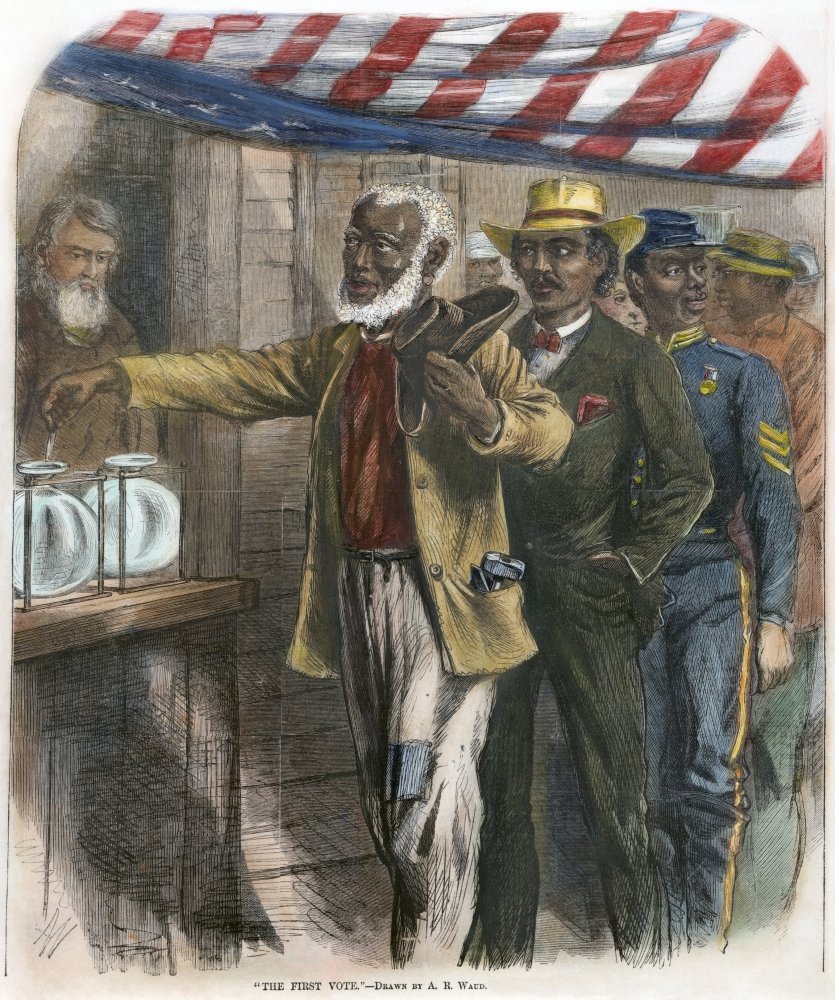
At first, emancipated slaves were able to vote, and some blacks were even elected to the US Congress from Southern states. However, the Fourteenth and Fifteenth Amendments were largely nullified by massive opposition, especially in the South. Segregation and voting restrictions such as the poll tax and literacy tests limited the rights of blacks for a century after the war.
|
| Freedmen Voting in 1867 |
On March 3, 1865, Congress passed "An Act to establish a Bureau for the Relief of Freedmen and Refugees" to provide food, housing and medical aid, establish schools and offer legal assistance. It also attempted to settle former slaves on land confiscated or abandoned during the war. The Freedmen's Bureau was to operate "during the present war of rebellion, and for one year thereafter." The battle to establish the Freedmen's Bureau, and then to extend the legislation one year later, was a major factor in the struggle between President Andrew Johnson and Radical Republicans in Congress over Reconstruction and the role of the federal government in integrating four million newly emancipated African Americans into the political life of the nation. President Abraham Lincoln signed the bill that same day. A little more than a month later, President Lincoln was assassinated, and Vice President Andrew Johnson, who would repeatedly clash with Radical Republicans in the House and Senate, assumed the presidency. The Freedmen's Bureau was under the jurisdiction of Edwin Stanton and the War Department. At its head was Maj. Gen. Oliver Otis Howard, the "Christian General." The bureau had four divisions, Land, Educational, Legal and Medical. Many former slaves needed assistance with education and health. The Legal Division supervised contracts signed by blacks as part of contract labor.
Former slaves wanted abandoned and confiscated land owned by the federal government. A Virginia freedman, Bayley Wyatt, said, "[D]idn't we clear the land and raise de crops ... and didn't dem large cities in the North grow up on de cotton and de sugars and de rice dat we made?" Rufus Saxton of the Freedmen's Bureau said the land would be payment for "two hundred years of unrequited toil." Sherman had made Saxton the inspector of settlements and plantations. O. O. Howard made Saxton the assistant commissioner of the Freedmen's Bureau for the state of Georgia. Sherman's Field Order No. 15 gave blacks land along the Sea Islands off the South Carolina and Georgia coast and along coastal rivers as far south as St. John's River in Florida. Here 40,000 blacks obtained plots of land covering 400,000 acres. However, there was only enough confiscated land for a small percentage of freedmen.
There was extreme opposition to giving former slaves abandoned or confiscated land from Southerners and from Johnson. On July 28, 1865 Howard issued Circular 13 ordering the distribution of 40 acre plots of land to the freedmen, who were to be allowed to lease the land for three years followed by the option to purchase the land at its 1860 value. Johnson overturned the order and stripped the Freedmen's Bureau of its right to allocate land. Howard and Radical Republican Thaddeus Stevens made failed attempts to renew the Bureau's authority to allocate land to the freedmen. Johnson also fired Bureau agents that Southerners accused of being too sympathetic to the plight of emancipated blacks. Many of these agents were replaced with Southerners who were hostile to blacks. However, the military was also part of the Freedmen's Bureau since agents were recruited from the Veterans Reserve Corps, and Northern soldiers wanted to see that their sacrifices of the war would not be in vain. Some of them were murdered.
President Andrew Johnson vetoed two attempts to extend the Freedmen's Bureau. After the second veto, the Senate and the House mustered the two-thirds majorities necessary to override the veto. The Freedmen's Bureau Act of 1866 became law on July 16, extending the agency's work for two more years. The legislation restored South Sea Island Sherman Reservation land to white Southerners. Blacks didn't get their 40 acres and a mule, so the Freedmen's Bureau encouraged blacks to accept contract labor. Although the Bureau wanted to supervise all contracts, some whites had contracts executed before a local magistrate. The illiteracy of former slaves and violence and coercion by white employers magnified the possibility of abuse.
Some of the contracts were enforced under harsh conditions. In South Carolina Charles C. Soule, a white officer in the black Fifty Fourth Massachusetts Infantry, explained to whites "the necessity of making equitable contracts with their workmen, of discontinuing corporal punishment and of referring all cases of disorder and idleness to the military authorities." However, he told black workers, "Every man must work under orders ... and on a plantation the head man who gives all the orders is the owner of the place. Whatever he tells you to do you must do at once, and cheerfully. Remember that all your working time belongs to the man who hires you." Soule told the freedpeople, "you will have to work hard, and get very little to eat, and very few clothes to wear" and husbands and wives on separate plantations could not live together.
In South Carolina William Tunro asked his former slaves to sign contracts for life. Robert Perry, his wife and two others were expelled from the plantation for refusing to sign. They were pursued and murdered by Tunro's neighbors. However, Southerners resented any interference with contracts from the Freedmen's Bureau.
Many of the contracts lasted for a year "for their rations and clothing in the usual way" under conditions not much different from slavery. Northern workers could quite their jobs at any time. Over time some blacks became sharecroppers who received between one-fourth and one-third of the crops they grew. Others became renters of land for farms. There was exploitation. Richard Crump, a former slave, said, "We made crops on shares for three years after freedom, and then we commenced to rent. They didn't pay everything they promised. They taken a lot of it away from us. They said figures didn't lie. You know how that was. You dassent dispute a man's word then."
About one-third of rations from the Freedmen's Bureau went to Southern whites. In some areas such as Alabama during 1865-1866, most of the rations went to Southern whites.
The Southern Homestead Act of 1866 was a United States federal law intended to offer land to prospective farmers, white and black, in the South following the Civil War. It was repealed in 1876 after mostly benefiting white recipients. The law was enacted to break a cycle of debt during the Reconstruction following the American Civil War. Prior to this act, black Americans and whites alike were having trouble buying land. Sharecropping and tenant farming had become ways of life. This act attempted to solve this by selling land at low prices so Southerners could buy it.
A "Second Freedmen's Bureau bill" was introduced December 5, 1865, but was vetoed and weakened before eventually overriding a second veto by president Andrew Johnson. Championed by General Oliver O. Howard, chief of the Freedmen's Bureau, and with support from Thaddeus Stevens and William Fessenden, the Southern Homestead Act was proposed to Congress, and eventually passed, and signed into law by President Andrew Johnson on June 21, 1866, going into effect immediately. The Southern Homestead Act opened up 46,398,544.87 acres of public land for sale in the Southern states of Alabama, Arkansas, Florida, Louisiana, and Mississippi. The land was initially in 80-acre parcels until June 1868, and thereafter in 160-acre parcels, and homesteaders were required to occupy and improve the land for five years before acquiring full ownership.
Until January 1, 1867, the bill specified, only free Blacks and White Unionists would be allowed access to these lands. Accordingly, the primary beneficiaries the first six months were freedmen who were in desperate need of land to till. However, the law encountered many obstacles, notably: Southern bureaucrats often did not comply with the law or with the orders of the Freedmen's Bureau, notably not informing blacks of their opportunity to acquire land; violence from competing whites; poor quality of the land; and poverty of the farmers who were often unable to effectively use the land without further money to invest. Many people also could not participate because the land prices themselves were still too high.
Ultimately, before too much land was distributed, the law was repealed in June 1876. Nevertheless, free blacks entered about 6,500 claims to homesteads, and about 1,000 of these eventually resulted in property certificates. This paled in comparison to the 28,000 white Americans who entered claims.
Indiana Republican Oliver P. Morton, in what would later be called "waving the bloody shirt," called on the nation to remember the sacrifices of Northern soldiers and the Democrats' taint of treason. "Every unregenerate rebel lately in arms against his government," Morton said, "calls himself a Democrat," as were every man who "murdered Union prisoners by cruelty and starvation" and who "shoots down negroes in the streets, burns up negro school-houses and meeting houses, and murders women and children by the light of their own flaming dwellings." Speaking of Democrats, Morton said,
And this party ... proclaims to an astonished world that the only effect of vanquishing armed rebels in the field is to return them to seats in Congress, and to restore them to political power. Having failed to destroy the constitution by force, they seek to do it by construction, with ... the remarkable discovery that the rebels who fought to destroy the constitution were its true friends, and that the men who shed their blood and gave their substance to preserve it were its only enemies.
Grant issued General Orders No. 3 in January 1866 to protect soldiers in the South from lawsuits and to protect freedpeople from Black Codes.
In 1866 the US Supreme Court issued its ex Parte Milligan and Garland decisions, which limited military rule. In 1867 the Court's Cummings decision held that the iron-clad oath was unconstitutional. As the size of the military shrank and cavalries were disbanded the harm done to blacks increased. As a Freedmen's commissioner in Texas said, "The wrongs increase just in proportion to their distance from the United States authorities." New laws to protect the rights of freedmen were passed when there were fewer soldiers to enforce them outside of cities and towns. Without adequate force, Hugo Hillebrandt, a Freedmen's Bureau agent in North Carolina, was powerless when whites stole horses and mules from blacks, and could do nothing when told of the murder of a Union soldier. As the army demobilized, white guerrillas and outlaws became more aggressive. Southerners burned churches, shot soldiers and killed hundreds of freedpeople. Black dockworkers in St. Augustine, Florida armed themselves for protection. Elsewhere in Jackson Country, freedmen armed to protect a school. According to a Freedmen's Bureau official, blacks in Texas were "frequently beaten unmercifully, and shot down like wild beasts, without any provocation." Former Confederates said they were provoked by "sassiness", "putting on airs", "impudence", "insolence" and "disrespect."

|
|
Military Districts Black: First Green: Second Red: Third Yellow: Fourth Blue: Fifth |
Radical Reconstruction Acts were legislation enacted in 1867–68 that outlined the conditions under which the Southern states would be readmitted to the Union following the American Civil War. Congress' passage of the Reconstruction Acts marked the beginning of the Radical Reconstruction period, which would last for the next decade. That legislation divided the South into five military districts. The states were also required to craft new constitutions, which had to include universal male suffrage and needed approval by the US Congress. Former Confederate leaders who had lost the right to hold office were not allowed to vote. The percentage of black men who were allowed to vote rose from 0.5 percent in December 1866 to 80.5 percent in December 1867. In addition, Southern states had to ratify the Fourteenth Amendment, which granted citizenship and equal civil and legal rights to African Americans and former slaves. After completing the requirements, the states would be readmitted to the Union. The new state legislatures formed in 1867-69 reflected the revolutionary changes brought about by the Civil War and emancipation: For the first time, blacks and whites stood together in political life. In general, the Southern state governments formed during this period of Reconstruction represented a coalition of African Americans, recently arrived Northern whites ("carpetbaggers") and Southern white Republicans ("scalawags"). Military rule of the South ended in all but Virginia, Mississippi and Texas in 1868.
The first Reconstruction Act, authored by Oregon Sen. George Henry Williams, a Radical Republican, placed 10 of the former Confederate states-all but Tennessee-under military control, grouping them into five military districts:
First Military District: Virginia, under General John Schofield
Second Military District: North Carolina and South Carolina, under General Daniel Sickles
Third Military District: Georgia, Alabama, and Florida, under Generals John Pope and George Meade
Fourth Military District: Arkansas and Mississippi, under General Edward Ord
Fifth Military District: Texas and Louisiana, under Generals Philip Sheridan and Winfield Scott Hancock
20,000 US troops were deployed to enforce the act.
Congress approved the bill in February 1867, and then on March 2 it overrode Johnson's veto. Three more acts were later enacted (two in 1867 and one in 1868), which concerned how the constitutions would be created and passed at the state level. A legal case (Ex Parte McCardle) arose over the constitutionality of military occupation in the South-thereby bringing into question the legality of the Reconstruction measures. The suit was brought under the Habeas Corpus Act of 1867, and the Radical Republicans responded by stripping the Supreme Court of its power to hear appeals involving that act. Congress again overrode Johnson's veto, and in 1869 the court dismissed the case, stating that it lacked jurisdiction.
The five border states that had not joined the Confederacy were not subject to military Reconstruction. West Virginia, which had seceded from Virginia in 1863, and Tennessee, which had already been readmitted in 1866, were not included in the military districts. Federal troops, however, were kept in West Virginia through 1868 in order to control civil unrest in several areas throughout the state. Federal troops were removed from Kentucky and Missouri in 1866.
The 10 Southern state governments were reconstituted under the direct control of the United States Army. One major purpose was to recognize and protect the right of African Americans to vote. There was little to no combat, but rather a state of martial law in which the military closely supervised local government, supervised elections, and tried to protect office holders and freedmen from violence. Blacks were enrolled as voters; former Confederate leaders were excluded for a limited period.
The former Confederate states began rejoining the Union in 1868, with Georgia being the last state to be readmitted, on July 15, 1870; it had rejoined the Union two years earlier but had been expelled in 1869 after removing African Americans from the state legislature.
Redeemers were the Southern wing of the Democratic Party. They sought to regain their political power and enforce white supremacy. Their policy of Redemption was intended to oust the Radical Republicans, a coalition of freedmen, "carpetbaggers," and "scalawags." They were in from the 1870s to 1910. They dominated Southern politics from the 1870s to 1910. White Democratic Southerners saw themselves as redeeming the South by regaining power.
In a second wave of violence following the suppression of the Ku Klux Klan, violence began to increase in the Deep South. In 1868 white terrorists tried to prevent Republicans from winning the fall election in Louisiana. Over a few days, they killed some two hundred freedmen in St. Landry Parish in the Opelousas massacre. From April to October, there were 1,081 political murders in Louisiana, in which most of the victims were freedmen. Violence was part of campaigns prior to the election of 1872 in several states. In 1874 and 1875, more formal paramilitary groups affiliated with the Democratic Party conducted intimidation, terrorism and violence against black voters and their allies to reduce Republican voting and turn officeholders out. These included the White League and Red Shirts. They worked openly for specific political ends and often solicited coverage of their activities by the press. Every Southern election year from 1868 on was surrounded by intimidation and violence; they were usually marked by fraud as well.
Convict leasing was a system of forced penal labor that was practiced historically in the Southern United States before it was formally abolished during the 20th century. Under this system, private individuals and corporations could lease labor from the state in the form of prisoners, nearly all of whom were Black.
The state of Louisiana leased out convicts as early as 1844. The system expanded throughout most of the South with the emancipation of enslaved people at the end of the American Civil War in 1865. The practice peaked about 1880 and persisted in various forms until it was abolished by President Franklin D. Roosevelt via Francis Biddle's "Circular 3591" of December 12, 1941.
According to Fortune, "the penitentiary system of the South, with its infamous chain-gang ... the object being to terrorize the blacks and furnish victims for contractors, who purchase the labor of these wretches from the State for a song ... The white man who shoots a negro always goes free, while the negro who steals a hog is sent to the chaingang for ten years."
Since the Thirteenth Amendment didn't apply to prisoners, Reconstruction-era Southern states used harsh enforcement of vagrancy laws to create what has been called "slavery by another name." The system was highly lucrative for both the lessees and state governments. For example, in 1898, 73 percent of Alabama's annual state revenue came from convict leasing. Corruption, lack of accountability, and violence resulted in "one of the harshest and most exploitative labor systems known in American history," according to historian Matthew J. Mancini. African Americans, mostly adult males, due to "vigorous and selective enforcement of laws and discriminatory sentencing," comprised the vast majority — though not all — of the convicts leased, according to historian Leon F. Litwack.
While states of the Northern United States sometimes contracted for prison labor, the historian Alex Lichtenstein notes that "only in the South did the state entirely give up its control to the contractor; and only in the South did the physical "penitentiary" become virtually synonymous with the various private enterprises in which convicts labored."
In Hinds County, Mississippi, an average of one black person was killed per day from 1865 to 1867.
The Memphis massacre of 1866 was a rebellion with a series of violent events that occurred from May 1 to 3, 1866, in Memphis, Tennessee. After a shooting altercation between white policemen and black veterans recently mustered out of the Union Army, mobs of white residents and policemen rampaged through black neighborhoods and the houses of freedmen, attacking and killing black soldiers and civilians and committing many acts of robbery and arson. A total of 48 people died, including two whites.
Federal troops were sent to quell the violence and peace was restored on the third day. A subsequent report by a joint Congressional Committee detailed the carnage, with blacks suffering most of the injuries and deaths by far: 46 black and 2 white people were killed, 75 black people injured, over 100 black persons robbed, 5 black women raped, and 91 homes, 4 churches and 8 schools (every black church and school) burned in the black community.
The New Orleans massacre of 1866 occurred on July 30, when a peaceful demonstration of mostly black freedmen was set upon by a mob of police and white rioters, many of whom had been soldiers of the recently defeated Confederate States of America, leading to a full-scale massacre. The massacre began over the results of an election in which blacks were not allowed to vote. Louisiana Radicals met in a convention to enfranchise blacks and disenfranchise rebels. The violence erupted outside the Mechanics Institute, site of a reconvened Louisiana Constitutional Convention. White handkerchiefs used as white flags of surrender were ignored. One black man in a wagon of corpses got up and was shot. According to the official report, a total of 38 were killed and 146 wounded, of whom 34 dead and 119 wounded were black freedmen. Unofficial estimates were higher. Johnson blamed the Radicals for the massacre.
In October 1866, 42 blacks were killed in Caddo Parish, Louisiana. In Bossier Parish 162 blacks were killed. In Louisiana during the summer and fall of 1868, 1,081 blacks and white Republicans were massacred. In one judicial district in North Carolina, a Republican judge counted 700 beatings and 12 murders.
Black schools and churches used for schools were burned, and those who taught blacks were beaten and sometimes killed. General O. O. Howard, the head of the Freedmen's Bureau, said, "The opposition to Negro education made itself felt everywhere in a combination not to allow the freedmen any room or building in which a school might be taught."
Edmonia Highgate, a black woman who went South to teach school, describes her life in Lafayette Parish, Louisiana:
The majority of my pupils come from plantations, three, four, even eight miles distant. So anxious are they to learn that they walk these distances so early in the morning as never to be tardy.
There has been much opposition to the School. Twice I have been shot at in my room. My night school scholars have been shot but none killed. A week ago an aged freedman just across the way was shot so badly as to break his arm and leg. The rebels here threatened to burn down the school and house in which I board yet they have not materially harmed us. The nearest military protection is 200 miles distant at New Orleans.
Julie Hayden was an American seventeen-year-old black school teacher murdered by members of the White Man's League within days of starting a teaching position at a school for black children in Tennessee. Hayden moved from Nashville to Hartsville in Trousdale County, Tennessee, to "educate black people." At the time, teaching black people to read was "interpreted as a challenge to white control." At the time of the murder, Hayden was staying with Emery Lowe and his wife, Pink, as a boarder. Three days after her arrival in Hartsville, on August 21 at 2:00 am, the Lowe home was invaded by members of the White Man's League, who chased her through the house and shot and killed her. According to Harper's Weekly, "Her murderers escaped, nor is it likely that the death of Julia Hayden will ever be avenged, unless the nation insists upon the extermination of the White Man's League."
A blacksmith named Charles Caldwell, a former slave who was elected to the Mississippi Senate, was shot by the son of a white Mississippi judge in 1868. Caldwell fired back and killed the man. He was acquitted by an all white jury, but in 1875, he was shot to death by a white gang.
The school was named after Columbia University professor William Archibald Dunning (1857–1922), whose writings and those of his PhD students comprised the main elements of the school. He supported the idea that the South had been hurt by Reconstruction and that American values had been trampled by the use of the US Army to control state politics. He contended that freedmen had proved incapable of self-government and thus had made segregation necessary. Dunning believed that allowing blacks to vote and hold office had been "a serious error." As a professor, he taught generations of scholars, many of whom expanded his views of the evils of Reconstruction. The Dunning School and similar historians dominated the version of Reconstruction-era history in textbooks into the 1960s.

|
| The Lost Cause |
The Lost Cause Myth version of history claims that the South's cause was heroic and had nothing to do with slavery, even though Southern declarations of reasons for secession and editorials made the opposite claim when secession began. After the war, there was no slavery to defend. Slavery was reviled throughout the world and made the Southern cause look bad. The Lost Cause Myth claims that the South fought for states' rights reasons that are separate from the slavery issue and that the South fought bravely and well, and was defeated by overwhelming numbers. Part of the Myth is that slaves fought for the Confederacy. Some slaveowners took slaves with them into battle as servants, but the Confederate attempt to use slaves as soldiers was from after the last minute desperation, and the idea never got off the ground. Another part of the Myth is that the South seceded over the tariff issue, even though the Confederate government had a tariff.
The phrase "lost cause" was included in the title of an 1866 book by the Virginian journalist Edward A. Pollard, The Lost Cause: A New Southern History of the War of the Confederates. Pollard promoted the claim that states' rights was the cause of the war and that Southerners were forced to defend themselves against Northern aggression. He dismissed the role of slavery in starting the war and understated the cruelty of American slavery, even promoting it as a way of improving the lives of Africans.
In the 1930s Margaret Mitchell published Gone With the Wind, a popular novel that romanticizes the Old South. In it, Mitchell wrote the following description of Reconstruction:
The former field hands found themselves suddenly elevated to the seats of the mighty. There they conducted themselves as creatures of small intelligence might naturally be expected to do. Like monkeys or small children turned loose among treasured objects whose value is beyond their comprehension, they ran wild-either from perverse pleasure in destruction or simply because of their ignorance.
The novel also calls the Ku Klux Klan "a tragic necessity." The film version sanitizes the scene from the book where Scarlett, while riding alone through a shantytown, is nearly raped by a black man, which prompts a retaliatory raid by the Klan.
Proslavery propaganda included the story of happy slaves and kindly slaveowners even before the war. At the same time slaveowners were afraid of slave insurrections. The story of happy slaves continued long after the war. Lincoln, before he was elected, noted that no slaveowner wanted to enjoy for themselves what Southern proslavery propagandists said were the advantages of being a slave. In 1865 a South Carolina planter wrote in the New York Tribune that plantation owners were "laboring under a delusion." He said of slaves, "If they were content, happy and attached to their masters, why did they desert him in the moment of his need and flock to an enemy, whom they did not know; and thus left their perhaps really good masters whom they did know from infancy?"
John Little, a former slave, wrote,
They say slaves are happy, because they laugh, and are merry. I myself and three or four others, have received two hundred lashes in the day, and had our feet in fetters; yet, at night, we would sing and dance, and make others laugh at the rattling of our chains. Happy men we must have been! We did it to keep down trouble, and to keep our from being completely broken: that is as true as the gospel! Just look at it,-must not we have been very happy? Yet I have done it myself-I have cut capers in chains.
Confederate President Jefferson Davis wrote about the place of the South's enslaved African Americans in his The Rise and Fall of the Confederate Government (1881):
[The negro soldiers'] servile instincts rendered them contented with their lot, and their patient toil blessed the land of their abode with unmeasured riches. Their strong local and personal attachment secured faithful service ... Never was there happier dependence of labor and capital on each other. The tempter came, like the serpent of Eden, and decoyed them with the magic word of "freedom" ... He put arms in their hands, and trained their humble but emotional natures to deeds of violence and bloodshed, and sent them out to devastate their benefactors.
Davis discussed the history of slavery and defended its fundamental morality: in his view, slavery enlightened blacks with the "arts of peace, order and civilization" and slaves were happy and "contented" in their servitude. Davis detailed his belief in the hypocrisy of Northern states with regard to slavery considering that most Northern states had once allowed slavery and that all derived income from trade goods produced by slaves, and the unfairness that he saw in the numerous acts and policies that benefited Northern industrialists to the detriment of Southern planters.
A 1950 textbook by Samuel Eliot Morison and Henry Steele Commager read, "As for Sambo, whose wrongs moved the abolitionists to wrath and tears, there is some reason to believe that he suffered less than any other class in the South from its 'peculiar institution.'" United Daughters of the Confederacy used to gift schools with history books describing happy slaves and kindly slaveowners.
The Lost Cause myth version of the war claims that the South fought not for slavery but for states' rights. However, while Southerners did use states' rights arguments to defend slavery, they also strongly opposed attempts by Northern states to nullify the Fugitive Slave Act of 1850. Also, the Confederate Constitution protected slavery at the federal level, not the state level. So while Southerners were inconsistent on the states' rights issue, they were very consistent in defending slavery.
Alexander Stephens was the Confederate Vice President who said that slavery was the Cornerstone of the Confederacy. After the Confederacy was defeated and slavery was abolished, he became a leading apologist for the lost cause, and particularly for the idea that the Civil War was not waged by the Confederacy to defend slavery, but instead was a conflict in which the Confederates fought for states' rights reasons to defend freedom against a tyrannical federal government. In 1868 and 1870 he published two volumes entitled A Constitutional View of the Late War Between the States; Its Causes, Character, Conduct and Results, presented as a series of colloquies at Liberty Hall defending the actions of the Confederates. The book includes long dialogues between himself and men arguing the Union point of view. The dialogues and even the "Unionists" themselves are fake.
The following description of Stephens' book is from the September 12, 1870 New York Times page 2:
The struggle was between the advocates of Federation on one side, and of Consolidation on the other. Slavery, so called, was but the question on which these antagonistic principles, which had been in conflict from the beginning on divers other questions, were finally brought into actual and active collision with each other on the field of battle.
As Alexander Stephens wrote:
The great vital question now is, shall the Federal Government be arrested in its progress, and be brought back to its original principles, or shall it be permitted to go on in its present tendencies and rapid strides until it reaches complete Consolidation! Depend on it, there is no difference between Consolidation and Empire; no difference between Centralism and Imperialism. The consummation of either must necessarily end in the overthrow of Liberty and the establishment of Despotism. To speak of any Rights as belonging to the States, without the innate and unalienable sovereign power to maintain them, is but to deal in the shadow of language without the substance. Nominal Rights without Securities are but Mockeries!
James Loewen, the award-winning author of Lies My Teacher Told Me, said that when he asked modern audiences what the cause of the Civil War was, 60 to 70 percent said that states' rights was the cause. Apparently, Alexander Stephen's flip-flop about causes of the war was very successful.
Confederate Colonel John S. Mosby, the "Gray Ghost" of the Confederacy, said in 1907 that "The South went to war on account of slavery." Mosby mentioned South Carolina's declaration of causes for secession and said, "South Carolina ought to know what was the cause for her seceding."
According to Lonnie Bunch, the founding director of the Smithsonian's National Museum of African American History and Culture, the memoirs of the president and vice President of the Confederate States of America, Jefferson Davis and Alexander H. Stephens, argued that Lincoln wanted war and maneuvered the Confederacy into a position where it had no choice but to attack Fort Sumter. "The aggressor in a war," Alexander Stephens explained, "is not he who strikes the first blow ... but the first who renders force necessary." According to Bunch, the charge "accepts Confederate Vice President Alexander H. Stephens's absurd argument that an act of aggression can be considered defensive ... But was Sumter part of his master plan to make the Union seem the aggrieved party? All the evidence we have, as convincingly interpreted by scholars from Richard Current to Craig Symonds, suggests otherwise. Jefferson Davis fired the shot that started the Civil War, not Abraham Lincoln." Historians who agree with Bunch include John Marszalek, Giles distinguished professor emeritus of history at Mississippi State University and Craig Symonds, Professor emeritus at the US Naval Academy. It is groups affiliated with the Sons of Confederate Veterans, including Brag Bowling, who agree with the Lost Cause interpretation.
Thomas Nelson Page's postbellum fiction featured a nostalgic view of the South in step with what is termed Lost Cause ideology. Emphasizing the element of noblesse oblige within the historical reality of slavery, enslaved people are depicted as faithful, happy and simple, slotted into a paternalistic society. For example, the formerly enslaved person in "Marse Chan" is uneducated, speaks phonetically, and has unrelenting admiration for his former master. The gentry are noble and principled, with fealty to country and to chivalry — they seem like knights of a different age. In his novel The Red Rock he referred to a black character as "a species of worm", "a hyena in a cage", "a reptile" and "a wild beast." Joel Chandler Harris had his Uncle Remus character, a black slave, say that allowing a slave to learn to read and write meant losing a plowhand.
History books used by modern private schools still teach Lost Cause Myth versions of history. Instead of focusing on the horrors of slavery, the Accelerated Christian Education book sympathizes with the southern landowners who had to learn a new way of life after the war:
Under radical reconstruction, the south suffered. Great southern leaders and much of the old aristocracy were unable to vote or hold office. The result was that state legislatures were filled with illiterate or incompetent men. Northerners who were eager to make money or gain power during the crisis rushed to the south … For all these reasons, reconstruction led to graft and corruption and reckless spending. In retaliation, many southerners formed secret organizations to protect themselves and their society from anarchy. Among these groups was the Ku Klux Klan, a clandestine group of white men who went forth at night dressed in white sheets and pointed white hoods.
Another part of the Lost Cause Myth is that the South seceded over the Morrill Tariff Act, which went into effect on March 2, 1861. However, the Morrill Tariff was enacted after secession had already begun. Also, the Confederate Congress approved a Tariff Act on May 21, 1861, to take effect August 31, 1861, which superseded all previous tariff acts and set out duties arranged in schedules. So the government did levy import duties — they just had to be for revenue purposes only, not to shield Southern industries from competition. Robert Barnwell Rhett, a tariff warrior, pushed for the restriction on protective tariffs.
Those who believe in the Lost Cause myth want to believe that Robert E. Lee was the near-perfect military hero. He was among the South's best generals, but according to the myth, he fought for the state of Virginia, not slavery. Facts about Lee are more complicated. Lee inherited 197 slaves from George Washington Parke Custis, who died in 1857 and left a will promising freedom to his slaves no more than five years after his death. Some of Custis' slaves said that Custis told them that they would be freed immediately. Lee had them imprisoned and let out to work as slaves for other slaveowners until the end of the five years specified in the will.
Three of the enslaved people he held at his plantation - Wesley Norris, his sister Mary, and their cousin George Parks - escaped and were captured in nearby Maryland. The report in the March 26, 1866 edition of The New York Daily Tribune, quoting Wesley Norris at length, tells us all about Lee's proclivities:
He then ordered us to the barn, where, in his presence, we were tied firmly to posts by a Mr. Gwin, our overseer, who was ordered by Gen. Lee to strip us to the waist and give us fifty lashes each, excepting my sister, who received but twenty; ...
Gen. Lee, in the meantime, stood by, and frequently enjoined Williams to 'lay it on well,' an injunction which he did not fail to heed; not satisfied with simply lacerating our naked flesh, Gen. Lee then ordered the overseer to thoroughly wash our backs with [excruciatingly painful saltwater] brine, which was done.
Lee separated many slave families on the Custis plantation. Lee tried to convince a Virginia court to allow him to keep some of the slaves as slaves for longer than five years, without success.
Before the July 1863 battle at Gettysburg, Pennsylvania, the Confederate government ordered the enslavement of Pennsylvania blacks. Black men, women, and children were all rounded up by Lee's army and sent South as slaves. Diarist Rachel Cormany said that Confederates were:
hunting up the contrabands and driving them off by droves. O! How it grated on our hearts to have to sit quietly and look at such brutal deeds - I saw no men among the contrabands - all women and children. Some of the colored people who were raised here were taken along - I sat on the front step as they were driven by just like we would drive cattle...One woman was pleading wonderfully with her driver for her children.
In an 1856 letter to his wife, Lee said:
In this enlightened age, there are few I believe, but what will acknowledge, that slavery as an institution, is a moral & political evil in any Country. It is useless to expatiate on its disadvantages. I think it however a greater evil to the white man than to the black race, & while my feelings are strongly enlisted in behalf of the latter, my sympathies are more strong for the former. The blacks are immeasurably better off here than in Africa, morally, socially & physically. The painful discipline they are undergoing, is necessary for their instruction as a race, & I hope will prepare & lead them to better things. How long their subjugation may be necessary is known & ordered by a wise Merciful Providence.
Lee assisted several formerly enslaved people to emigrate to Liberia. According to historian Richard B. McCaslin, Lee was a gradual emancipationist, denouncing extremist proposals for the immediate abolition of slavery. After the war Lee said, "I have always been in favor of emancipation." However, in January 1865 he described slavery "as the best [relation] that can exist between the white and black races while intermingled as at present in this country."
Lee testified before the Joint Congressional Committee on Reconstruction. When he was asked, "General, you are very competent to judge of the capacity of black men for acquiring knowledge: I want your opinion on that capacity, as compared with the capacity of white men?" Lee replied, "I do not think that he is as capable of acquiring knowledge as the white man is." Lee forthrightly opposed allowing blacks to vote: "My own opinion is that, at this time, they [black Southerners] cannot vote intelligently, and that giving them the [vote] would lead to a great deal of demagogism, and lead to embarrassments in various ways."

|
| James Longstreet |
After Confederate defeat, Longstreet was a friend of Grant's and supported Republicans and racial equality. Former Confederates viewed Longstreet, who was one of Robert E. Lee's best Generals during the war, as a traitor to their cause. On January 8, 1872, Longstreet was commissioned a major general in the state militia and assigned to the command of all militia and police forces in New Orleans. Shortly after, he resigned from his posts as a collector of customs and as railroad president, followed by his position as adjutant general in the militia in April. In April 1873, Longstreet dispatched a police force under Colonel Theodore W. DeKlyne to Colfax, Louisiana, to help the local government and its majority-black supporters defend themselves against an insurrection by white supremacists. DeKlyne did not arrive until April 14, one day after the Colfax massacre. His men's task consisted mainly of burying blacks who had been killed and attempting to arrest the culprits. During protests of election irregularities in 1874, referred to as the Battle of Liberty Place, an armed force of 8,400 members of the anti-Reconstructionist White League advanced on the State House in New Orleans, which was the capital of Louisiana at the time, after Republican William Pitt Kellogg was declared the winner of a close and heavily disputed gubernatorial election. Longstreet commanded a force of 3,600 Metropolitan Police, city policemen, and African-American militia troops, armed with two Gatling guns and a battery of artillery. He rode to meet the protesters but was pulled from his horse, shot by a spent ball, and taken prisoner. The White League charged, causing many of Longstreet's men to flee or surrender. Total casualties amounted to 38 killed and 79 wounded. Federal troops sent by President Grant were required to restore order. Longstreet's use of armed black troops during the disturbances increased the denunciations by anti-Reconstructionists.
|
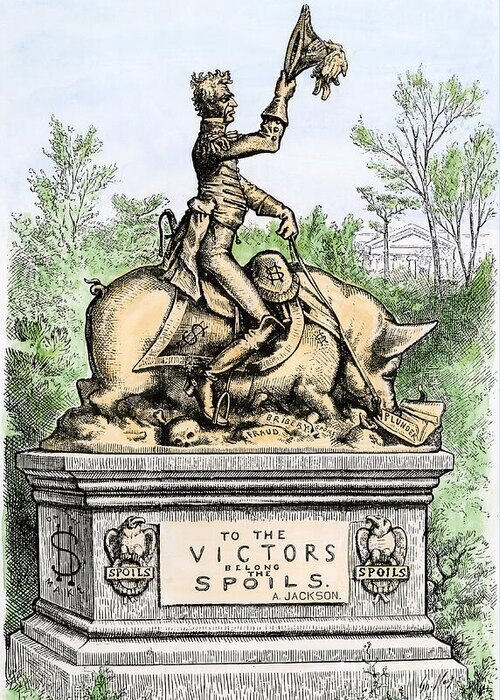
| Andrew Jackson over "fraud," "bribery" and "spoils," eating "plunder." |
A spoils system is a practice in which a political party, after winning an election, gives government jobs to its supporters, friends (cronyism), and relatives (nepotism) as a reward for loyalty to a political party. Loyalty is not always the same as competence. It contrasts with a merit system, where offices are awarded based on competence, independent of political activity. The Spoils System dates back to the colonial era, but intensified under President Andrew Jackson.
By the late 1860s, citizens began demanding civil service reform, but it was only after the 1881 assassination of James A. Garfield by Charles J. Guiteau as revenge for the latter being denied a consulship that the calls for civil service reform intensified. Moderation of the spoils system at the federal level with the passage of the Pendleton Act in 1883, which created a bipartisan Civil Service Commission to evaluate job candidates on a nonpartisan merit basis. While few jobs were covered under the law initially, the law allowed the President to transfer jobs and their current holders into the system, thus giving the holder a permanent job. The Pendleton Act's reach was expanded as the two main political parties alternated control of the White House every election between 1884 and 1896. Following each election, the outgoing President applied the Pendleton Act to some of the positions for which he had appointed political supporters. By 1900, most federal jobs were handled through civil service, and the spoils system was limited to fewer and fewer positions. The number of federal government employees covered by the Act gradually rose from 10 percent at the beginning to 90 percent in 1980.
The separation between political activity and the civil service was made stronger with the Hatch Act of 1939 which prohibited federal employees from engaging in many political activities.
After the Civil War America had greenbacks, banknotes and specie for currency. The Specie Payment Resumption Act restored specie payment of gold for greenbacks as of January 1, 1879. Before this greenbacks were fiat money that was not backed by gold or silver. National banks created during the war were the start of our first national currency. National banks were required to keep a certain amount of capital reserves in the form of federal bonds, and could issue standardized banknotes as currency that was proportional to their reserves in federal bonds. The government also issued a prohibitive tax on banknotes issued by state chartered banks, driving them from circulation. Banks used greenbacks to buy bonds, collected interest paid in gold on the bonds, and then used those bonds to issue banknotes which they loaned to collect additional interest. In 1875, US bond issues formed 63 percent of the investments of New York City national banks. Gold remained essential to financing international trade and paying the interest on government bonds.
The gold standard would restrict the money supply to the amount of gold available to back it. However, restricting the money supply for a different reason caused a recession in 1866 when Congress authorized Andrew Johnson's secretary of the treasury Hugh McCulloch to reduce the number of greenbacks.
Creditors wanted the gold standard because inflation reduced the value of greenbacks. For the same reason debtors were against the gold standard.
With the gold standard merchants could avoid the transaction costs of resorting to the Gold Room for international trade. The Gold Room was the New York exchange for buying gold with currency. The gold standard would also eliminate the higher interest rates that American buyers and bond sellers had to pay for foreign capital. By increasing the confidence of foreign investors in American securities, the gold standard would lower the interest rates on American bonds. Bank notes would increase in value if redeemable in gold. In 1869 the government passed the Public Credit Act, which required that war bonds be repaid in gold. The following year the government refinanced funding of the national debt. Investors could exchange government bonds for new 10 to 15 year bonds at lower interest rates. All could be repaid in gold, and all were tax exempt. Grant's secretary of the treasury, George Boutwell, kept a balance between gold needed for foreign trade, the bank notes issued by national banks and greenbacks.
In spite of occasional recessions the US economy grew faster than that of Europe between 1870 and 1913, with the most rapid growth coming after 1897. America's population went from 31.4 million to 64.9 million from 1860 to 1890.
Members of Congress were given stocks in railroads. The value of these stocks would go up if these members of Congress voted for legislation that benefitted railroads. As the historian Richard White said:
Between 1862 and 1872 Congress gave individual railroads gifts the size of small and medium states. The federal grant to the Union Pacific roughly equaled the acreage of New Hampshire and New Jersey combined. The main line of the Central Pacific got slightly more land than there was in Maryland. The Kansas Pacific, one of the branches connecting with the Union Pacific trunk, had to settle for the equivalent of Vermont and Rhode Island. The Northern Pacific received the equivalent of New England. In all, the land grant railroads east and west of the Mississippi received 131,230,358 acres from the United States. If all these federal land grants had been concentrated into a single state, think of it as "Railroadiana," it would have ranked third, behind Alaska and Texas, in size. The railroads also received state land grants totaling 44,224,175 acres, or an area roughly the size of Missouri, with 33 million acres alone coming from Texas, whose lands were not part of the federal public domain. Finally, cities and towns gave the railroads valuable lands for depots and yards as well as other subsidies. Railroads were required to sell the land, and used revenue from land sales to pay interest on their bonds.
Only the Pacific Railway reached the Pacific by the 1870s. This is because the US government loaned the Pacific Railway US bonds whose interest the government would pay until the bonds came due and whose principal the government guaranteed. The legislation was so badly written that the railroad had to pay only simple, not compound, interest, and they had 30 years to pay back either the principal or the interest.
By 1872 Congress stopped giving new federal subsidies to railroads, although state and local governments continued to subsidize them. Congress also attempted to take back land grants to railroads that had not fulfilled the terms of their grants, and to ensure the repayment of bonds to the Pacific Railway. Antimonopolists tried to prevent railroad monopolies.
|
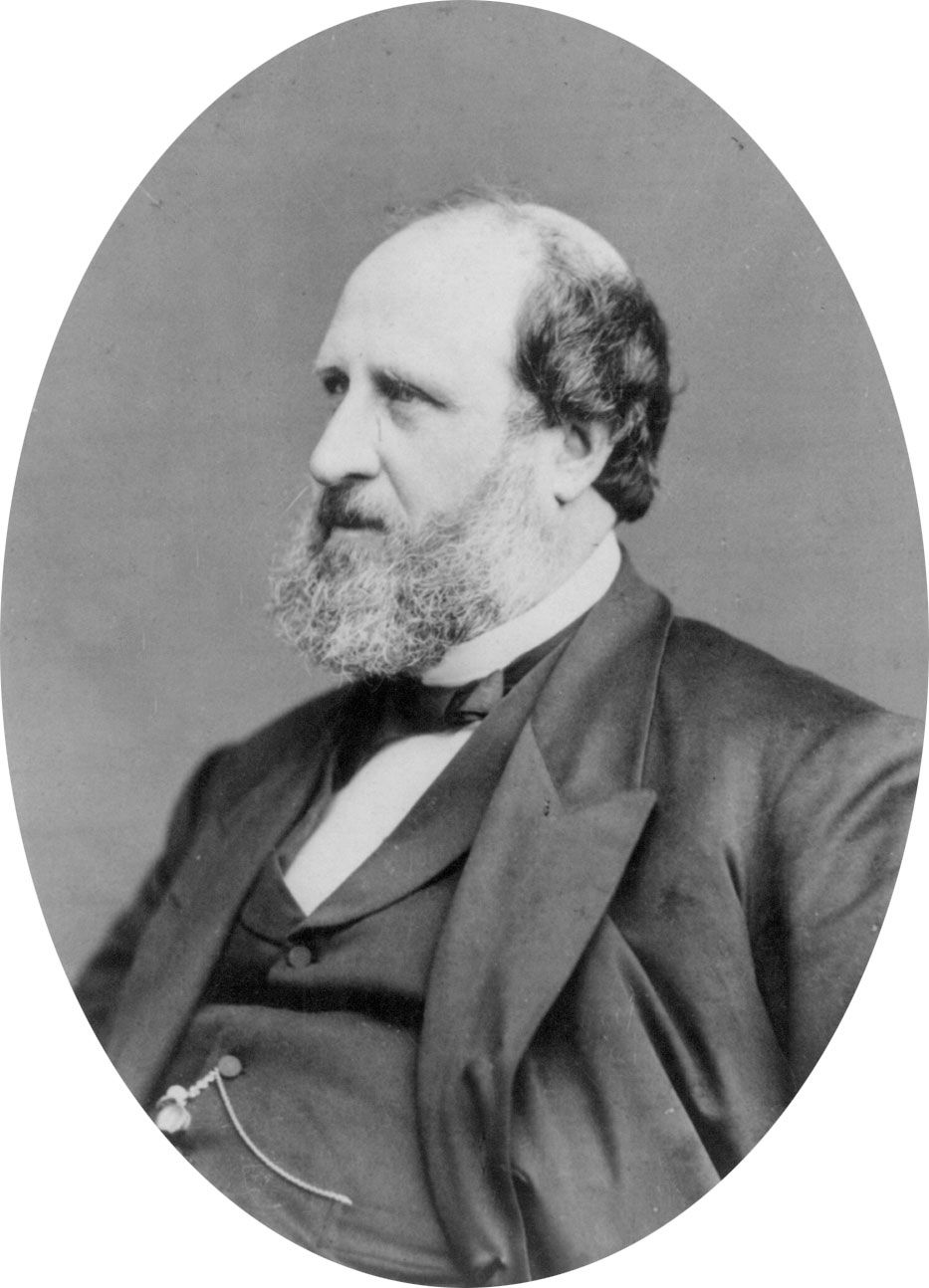
| William Magear "Boss" Tweed |
William Magear "Boss" Tweed was the boss of Tammany Hall, the Democratic Party's corrupt political machine in 19th-century New York City and state. Tweed was elected to the United States House of Representatives in 1852 and the New York County Board of Supervisors in 1858, the year that he became the head of the Tammany Hall political machine. He was also elected to the New York State Senate in 1867. However, Tweed's greatest influence came from being an appointed member of several boards and commissions, his control over political patronage in New York City through Tammany, and his ability to ensure voters' loyalty through jobs he could create and dispense on city-related projects. Charters and contracts for public works rewarded Tweed's allies among businessmen and bankers. All was financed through city bonds negotiated by the city's bankers. Tweed became rich through bribery, patronage and other corruption.
The new County Courthouse was budgeted at $250,000. By 1871 $13 million had been spent on it, and the building still wasn't finished. The Tweed Ring received 65 percent of every padded bill spent on it. The remaining 35 percent went to the contractor. Similar corruption affected everything from street projects to the building of the Brooklyn Bridge.
In January 1871, James Watson, the county auditor who managed the finances of the Tweed ring, was killed when a hoof of the horse from another sleigh hit his head, killing him. The new auditor was bitter over money he felt the ring owed him and released inside information to the New York Times. The resulting headline was Gigantic Frauds of the Ring Exposed. European bankers stopped underwriting city bonds, and the city faced bankruptcy. The New York financial community organized a tax strike and obtained an injunction prohibiting the ring from borrowing or selling bonds.
Boss Tweed was convicted for stealing an amount estimated by an aldermen's committee in 1877 at between $25 million and $45 million from New York City taxpayers from political corruption, but later estimates ranged as high as $200 million (equivalent to $5 billion in 2023). Unable to make bail, he escaped from jail once but was returned to custody. He died in the Ludlow Street Jail.

|
|
Boss Tweed as drawn by Thomas Nast |
The Gilded Age saw rapid economic growth from the late 1870s through 1900. Many immigrants helped grow the economy, although there was a wide gap between the rich and the rest. From 1860 to 1900, the wealthiest 2 percent of American households owned more than a third of the nation's wealth, while the top 10 percent owned roughly three-quarters of it. The bottom 40 percent had no wealth at all. In terms of property, the wealthiest 1 percent owned 51 percent, while the bottom 44 percent claimed 1.1 percent. The rapid expansion of industrialization led to real wage growth of 40 percent from 1860 to 1890. The economy grew especially in the northeast and west.
Overall, the US economy was rapidly expanding during this period (the United States became the biggest economy in the world around 1890), but, as economist Douglas A. Irwin makes clear in "Clashing Over Commerce," tariffs did not have much to do with it. As Irwin points out, the US population more than doubled between 1870 and 1913, growing from less than 40 million to more than 97 million, and "nearly one-third of the population increase from 1870 to 1900 was due to immigration from abroad." It was all these immigrants - particularly unskilled laborers working for low wages in factories - who made the American economy great. "It is difficult to make the case that high import tariffs were an important factor driving late nineteenth-century US economic growth," Irwin concludes.
The Gilded Age was among the most corrupt eras in American history primarily because of the rise of corporations and the growth of modern means of communication that intensified the way corruption can work. Corporate titans could buy anything they wanted-including politicians.

|
| Tweed counts the votes |
"This is a government of the people, by the people and for the people no longer," former president Rutherford B. Hayes wrote in his diary in 1886. "It is a government by the corporations, of the corporations and for the corporations." Politicians took spectacularly handsome bribes from corporations and demanded kickbacks as the helping hand they extended often came with an open palm.
Railroads need monopoly franchises and subsidies, and to get them, they are more than willing to bribe public officials. The Central Pacific Railroad, for example, spent $500,000 annually in thinly disguised bribes between 1875 and 1885. Daniel Drew and Jay Gould spent $1 million to bribe the New York state legislature to legalize their issue of $8 million of "watered stock" (stock not representing the real value) on the Erie Railroad. The Central Pacific spent $200,000 on bribes to get over 9 million acres of free land and $24 million in bonds, and paid $79 million (an overpayment of $36 million) to a construction company which was really one of its own.
Both the Union Pacific and the Central Pacific were built along twisted lines to get subsidies from towns they went through. In 1869 they joined in Utah. By the 1890s most of the country's railway mileage was concentrated in six huge systems. Four of them were completely or partially controlled by the House of Morgan. The other two were controlled by bankers Kuhn, Loeb and Co.
In 1873 Jay Gould of the Union Pacific complained that competition from steamships forced railroads to lower rates. The Union Pacific, Central Pacific and other railroads paid the Pacific Mail Steamship Company to raise its rates and shrink its fleet to reduce competition for railroads.
In the most notorious instance of corruption connected to the railroads, Union Pacific Railroad executives formed a sham construction company, Crédit Mobilier, that submitted bills for double the construction cost of the eastern portion of the Transcontinental Railroad and pocketed the overcharges. These executives paid the Crédit Mobilier $94 million for construction when the actual cost was $44 million. Railroad officials bribed approximately one dozen influential congressmen with Crédit Mobilier shares at below-market prices to avert any investigation and ensure votes to benefit the company. Swept up in the Crédit Mobilier scandal was not just Ulysses S. Grant's first vice president Schuyler Colfax, but his second one Henry Wilson as well. Also implicated in the scandal were Congressmen Oakes Ames, James A. Garfield, James G. Blaine (the Speaker of the House) and others.
Private investment banks and brokerage houses included the House of Cooke, Fisk and Hatch, J. S. Morgan & Co., J. & W. Seligman & Co., Lehman Brothers and Kuhn, Loeb & Co. If stock and bond prices fell when banks called in their loans, panic ensued.
There was insider trading that enriched those with inside knowledge at the expense of those who did not. First railroads and then other corporations had stock traded on the New York Stock Exchange. Outsiders thought that rising stock prices indicated a successful corporation even if it really indicated the diversion of borrowed money to dividends. Those with inside knowledge knew when to buy low and sell high. Outsiders lost money from such market manipulation.
The graft grew even closer to Grant. The Whiskey Ring scandal in which federal agents and whiskey distillers underreported sales to cheat the government out of excise tax revenue and pocket the cash ensnared Grant's personal secretary, Orville Babcock.
In 1886 the American Federation of Labor (AFL) was formed. When the craft unions stymied the ALF's organizing efforts, John L. Lewis of the United Mine Workers and his followers broke away in 1935 and formed the Committee for Industrial Organization (CIO), which crucially aided the emerging unions in auto, rubber, steel and other basic industries. In 1938 the CIO was formally established as the Congress of Industrial Organizations. By the end of World War II, more than 12 million workers belonged to unions and collective bargaining had taken hold throughout the industrial economy. In 1955 the AFL and CIO merged to form the AFL-CIO. Membership in labor unions declined during the 1970s and 1980s.
Organized labor unions fought for better wages, reasonable hours and safer working conditions. The labor movement led efforts to stop child labor, give health benefits and provide aid to workers who were injured or retired.
The first labor union that was more than regional was the Knights of Labor, which began in 1869. In 1885, the Knights of Labor led railroad workers to victory against Jay Gould and his entire Southwestern railway system, consisting of the Missouri Pacific Railroad and the Denver and Rio Grande Railway.
The Great Railroad Strike of 1877, began on July 14 in Martinsburg, West Virginia, after the Baltimore and Ohio Railroad (B&O) cut wages for the third time in a year. The Great Railroad Strike of 1877 was the first strike that spread across multiple states in the US The strike finally ended 52 days later, after it was put down by unofficial militias, the National Guard, and federal troops.
Thomas A. Scott was the president of the Pennsylvania Railroad and a Robber Baron. Because of competition from Rockefeller he tried to keep dividends up by cutting wages, laying off employees and increasing the workweek to 60 hours without an increase in pay. Even though the Pennsylvania cut wages by 20 percent, dividends also had to be cut from 10 percent to 6 percent. Competitition with Rockefeller forced the Pennsylvania and other railroads to form the Eastern Trunk Line Association controlled by Albert Fink. Multiple wage cuts amounted to from 20 percent to 29 percent from 1873 to 1877. Also, there were less predictable schedules, deadheading (waiting without pay for a new assignment), longer hours and less job security. Workers on the Baltimore and Ohio walked out when the owner, John W. Garrett, cut wages by 10 percent and increased dividends by 10 percent. Strikers shut down freight but not passenger trains. State militias were sympathetic to the strikers, so Garrett and Scott controlled state officials who in turn convinced President Hayes to send troops to end the strike. Three federal judges ruled that strikers against bankrupt railroads were in contempt of court. Bankruptcies thus became the way to get federal aid in ending strikes.
In the 1880s there were socialists and anarchists, many of them Germans, who advocated for better conditions for labor. Working conditions were dangerous, wages were low and strikes were common. The Haymarket Riot occurred on May 4, 1886, when a labor protest rally near Chicago's Haymarket Square turned into a riot after someone threw a bomb at police. At least seven policemen died as a result of the violence. Despite a lack of evidence against them, eight radical labor activists were convicted in connection with the bombing. On November 11, 1887, four of the men were hanged. The riot was organized by labor radicals to protest the killing and wounding of several workers by the Chicago police during a strike the day before at the McCormick Reaper Works. The Haymarket Riot was viewed as a setback for the organized labor movement in America.
James McParlan, an Irish Pinkerton agent, Franklin Gowen, head of the Philadelphia and Reading Railroad, and Benjamin Bannan, who published the Miner's Journal for independent mine owners, made greatly exaggerated claims that labor unions were joined by the Molly Maguires, who they described as a secretive group of violent workers. Mining anthracite coal was dangerous work, and miners got black lung disease and were injured and killed in mine disasters. Labor union members were prosecuted and convicted through private courts. As the historian Harold Aurand said, "A private corporation initiated the investigation through a private detective agency; a private police force arrested the offenders; and coal company attorneys prosecuted them. The state provided only the courtroom and the hangman."
The Federation of Organized Trades and Labor Unions began in 1881 under the leadership of Samuel Gompers. Its goals were to encourage the formation of trade unions and to obtain legislation, such as prohibition of child labor, a national eight-hour workday, and exclusion of Chinese and other foreign contract workers.
In July 1892, a dispute between Carnegie Steel and the Amalgamated Association of Iron and Steel Workers exploded into violence at a steel plant owned by Andrew Carnegie in Homestead, Pennsylvania. In what would be one of the deadliest labor-management conflicts in the nation's history, 12 people were killed when striking workers attacked 300 Pinkerton detectives hired by the plant's management as security guards. The violence happened after Henry Clay Frick, chairman and chief executive of Carnegie Steel, wanted to cut workers' wages. At Frick's request, the governor of Pennsylvania sent 8,500 National Guard forces to Homestead, who quickly secured the steel mill and placed the plant and the surrounding town under martial law. Carnegie slashed wages across the board, implemented a 12-hour workday and cut hundreds of jobs in the years to come.
The American Railway Union (ARU) was formed in June 1893 in Chicago, with membership open to all white railroad employees of any profession. While other unions, such as the Brotherhood of Locomotive Firemen, focused on specific professions, the ARU embraced all related professions, even coal miners, longshoremen, and car builders, if they were in the employ of a railroad. Pullman Company employees were eligible since the company owned and operated a few miles of railroad to access its factories. Under the leadership of President Eugene V. Debs, the union won some early victories, and ranks swelled to 150,000 members. A strike broke out at the Pullman factories on May 11, 1894. The timing was unfortunate, since the company could afford to withstand a work stoppage financially by relying on existing leases. Against the might of the Pullman Company, the cause of the workers seemed hopeless. The Pullman Company continued to resist any concessions in negotiations with the strikers, trying to wait them out. So the ARU decided to take a truly injurious action against the Pullman Company on a national scale: a boycott of the handling of Pullman cars by all ARU workers. It was through disruption of the United States mail that the federal government was given an opening for intervention into the boycott and strike. An injunction against the boycott was secured on the grounds of the violent nature of the strike and the threat to interstate commerce, citing the Sherman Antitrust Law of 1890, which ironically had been adopted to combat monopoly by big business. Thousands of US Marshals and US Army troops were deployed in what seemed an outsized response to the disturbance. Fighting between the military and workers at rail yards in the Chicago area left dozens dead and more wounded. The injunction led to the jailing of key leaders, weakening the ARU and the strike. The boycott dissolved in mid-July, and the ARU was defeated. For refusal to obey the injunction, Debs and others in the ARU were indicted for contempt. In late July, President Grover Cleveland appointed a commission to investigate the strike and boycott.
By the early 1900s, there were two million members of labor unions, or about one in fourteen workers. Eighty percent were part of the American Federation of Labor (AFL), which included mostly skilled white men. Blacks earned about one-third as much as whites.
In 1905, the Industrial Workers of the World (IWW or Wobblies) was formed in Chicago. Unlike the AFL, the IWW was not divided into craft unions. Its ideal was One Big Union that would not be divided by race, sex or skill. Instead of contracts it wanted direct action. In Missoula, Montana, Fresno and San Diego, California and Spokane and Aberdeen, Washington they defied laws against speaking in public and clogged local jails to win the right to free speech. In 1916, in Everett, Washington, a boatload of Wobblies was fired upon by 200 armed vigilantes rounded up by a sheriff. Five Wobblies died and 31 were injured by the bullets. Two of the vigilantes were killed, and 19 were wounded. In Montana, Wobbly organizer Frank Little was tortured and hanged.
In 1912 the Wobblies went on strike at the Lawrence, Massachusetts American Woolen Company, which owned four mills there. The work force were immigrants: Portuguese, French-Canadian, English, Irish, Russian, Italian, Syrian, Lithuanian, German, Polish, Belgian. A woman physician named Elizabeth Shapleigh wrote, "thirty-six out of every 100 of all the men and women who work in the mill die before or by the time they are twenty-five years of age." The Wobblies set up soup kitchens to feed 50,000 people. The local militia and state police attacked the strikers. One striker, Anna LoPizzo, was shot and killed. Witnesses saw a policeman shoot the woman, but the authorities arrested the strike leader Joseph Etter and the poet Arturo Giovanitti, who were accused of inciting the murder. "Big Bill" Haywood replaced Etter as the strike leader. Thirty-six strikers were arrested, and a Syrian striker, John Ramy, was bayoneted to death. The hungry children of strikers were sent to be taken care of by supporters. Forty children were about to be put on a train to Philadelphia when policemen beat mothers and children. The strikers won raises of 5 to 11 percent and time and a quarter for overtime. Etter and Giovanitti were acquitted.
On September 23, 1913, the United Mine Workers of America declared a strike against the Rockefeller-owned Colorado Fuel and Iron Corporation, in what is better known as the Colorado Coalfield War. The strike was over low pay and dangerous work conditions. Strikers were driven out of their shacks and lived in tents during the strike. The Rockefellers hired the Baldwin-Felts Detective Agency to use Gatling guns and rifles to break up the strike. The Colorado governor called the National Guard. Back-and-forth murders culminated in the April 20, 1914, Ludlow Massacre that killed dozens of men, women and children when the Colorado National Guard opened fire on the striker encampment at Ludlow. The tents were burned, and the charred remains of 11 children and two women were found in a pit. The strike is considered the deadliest labor unrest in American history.
The Clayton Act of 1914 presumably exempted unions from the antitrust prohibition and established for the first time the Congressional principle that "the labor of a human being is not a commodity or article of commerce." However, judicial interpretation so weakened it that prosecutions of labor under the antitrust acts continued until the enactment of the Norris-La Guardia Act in 1932.
In 1916 the Adamson Act, a federal law, established an 8-hour work day and overtime pay for interstate railroad workers.
The Labor Management Relations Act, 1947, better known as the Taft–Hartley Act, is a United States federal law that restricts the activities and power of labor unions. It was enacted by the 80th United States Congress over the veto of President Harry S. Truman, becoming law on June 23, 1947. Taft–Hartley was introduced in the aftermath of a major strike wave in 1945 and 1946. The Taft–Hartley Act amended the 1935 National Labor Relations Act (NLRA), adding new restrictions on union actions and designating new union-specific unfair labor practices. Among the practices prohibited by the Taft–Hartley act are jurisdictional strikes, wildcat strikes, solidarity or political strikes, secondary boycotts, secondary and mass picketing, closed shops, and monetary donations by unions to federal political campaigns. The amendments also allowed states to enact right-to-work laws banning union shops. Enacted during the early stages of the Cold War, the law required union officers to sign non-communist affidavits with the government.
Robber baron is a term for one of the powerful 19th-century American industrialists and financiers who made fortunes by monopolizing huge industries through the formation of trusts, engaging in unethical business practices, exploiting workers and paying little heed to their customers and stifling competition. Through high prices, low wages and getting government subsidies sometimes through fraudulent means, they built business empires. Alternatively, those who credit the explosive growth of American capitalism during this period to the pursuit material wealth are likely to celebrate these "captains of industry." Among the sectors in which they compiled their great wealth were the oil, steel, liquor, cotton, textile and tobacco industries, railroads, and banks.
John Jacob Astor was a fur magnate who amassed his fortune through the monopoly held by his American Fur Company over the trade in the central and western United States during the first 30 years of the 19th century. This monopoly was achieved in part by crushing rivals and systematically cheating Native Americans of fur pelts. When his competitors complained to the government, Astor's agents resorted to violence. With his riches, Astor routinely paid off politicians to protect his business interests. At the time of his death, Astor was considered the wealthiest person in the country.
James "Diamond Jim" Fisk, one Wall Street's first great financiers, accumulated much of his fortune by fraudulent stock market practices. Fisk took much of the considerable money he made from smuggling Southern cotton to Northern mills during the American Civil War and invested it in Confederate bonds. He then swindled European investors by selling short when the defeat of the Confederate army was imminent but before Europe learned that the Confederate currency had collapsed. In 1866, he formed the brokerage firm Fisk and Belden, and later he and his colleagues protected their control over the Erie Railroad Company by issuing fraudulent stock.

|
| Jason "Jay" Gould |
In April 1869, railroad tycoons Jay Gould and Jim Fisk conspired to corner the gold market in New York. They controlled the Erie Railroad, and a high gold price would allow foreign agriculture buyers to purchase exported crops, shipped east over the Erie's routes. Boutwell's policy of selling gold from the Treasury biweekly, however, kept gold artificially low. Unable to corrupt Boutwell, the schemers built a relationship with others.
At the time America still had greenbacks that were not backed by gold or silver, and Europe was on the gold standard, which made exchanging greenbacks for gold essential to foreign commerce. The exchange took place in the Gold Room in New York City. James Fisk and Jay Gould cornered the market on gold so that they could sell it at a large premium, inflating the price. To prevent the US government from selling gold and thwarting their plan they recruited Grant's brother-in-law and private secretary Orville Babcock into their scheme. Jay Gould bribed Abel Rathbone Corbin, who had married Grant's sister, to use his influence to steer the president toward policies that would favor the robber baron's plan. Gould bribed Assistant Treasurer Daniel Butterfield to gain inside information into the Treasury. It's possible, but unproven, that Grant's wife Julia was given a share of the speculation. At first Gould convinced Grant that inflating the price of gold would help American agricultural exports. When Grant found out what the actual intent of the scheme was, he ordered the Treasury to break the corner and sell gold. Gould found out about this and chose to sell gold rather than buy it.
In July, Grant reduced the sale of Treasury gold to $2,000,000 per month. Fisk told Grant his gold selling policy would destroy the nation. For most of September the sale of gold was not decreased. On September 23, when the gold price reached 143+1⁄8, Boutwell rushed to the White House and talked with Grant. On September 24, known as Black Friday, Grant ordered Boutwell to sell, whereupon Boutwell wired Butterfield to sell $4,000,000 in gold. The bull market at Gould's Gold Room collapsed, the price plummeted from 160 to 133+1⁄3, a bear market panic ensued beginning on September 24, 1869, a day that was long remembered as Black Friday. Gould and Fisk fled, and economic damages lasted months. By January 1870, the economy resumed its post-war recovery.
According to Richard White, professor emeritus of history at Stanford University, "Grant is not a corrupt man as far as I can tell but he combines an incredible lack of attention to detail—astonishing given his army record—and a blind loyalty to friends."
Leland Stanford was elected governor of California in 1861. While governor, Stanford approved millions of dollars in state grants for the construction of a transcontinental railroad line during a period when he was also president of the Central Pacific Railroad. With three colleagues, he formed the Pacific Association and used their combined assets to bribe congressmen and others with political influence in the country's capital. In return, the association was provided 9 million acres and a $24 million loan financed by federal bonds.
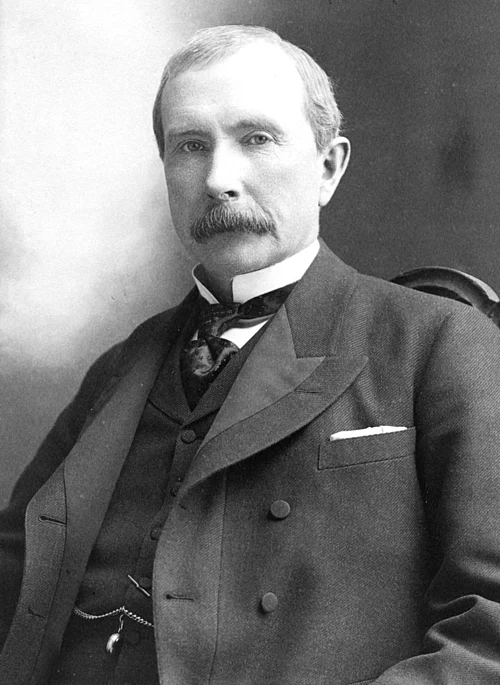
|
| John Davison Rockefeller |
In addition, Stanford and his associates intimidated local governments into providing millions of dollars in subsidies by threatening to have the rail line bypass their communities. In 1885, Stanford was elected to the US Senate by the legislature and re-elected in 1891. In 1885 also, he established what would later become Stanford University. Stanford died in 1893 worth more than $18 billion in 2004 dollars.
John D. Rockefeller made his immense riches from monopolizing America's oil industry. Conspiring with refinery owners, he helped found what became known as the Standard Oil monopoly. The consortium colluded with the railroads to monopolize oil delivery, prompting competitors to allow themselves to be bought by Standard Oil or be forced to pay outrageous shipping costs that would drive them out of business. These who stubbornly resisted were confronted with price wars. In 1868 Standard Oil got rebates, or refunds, on part of the cost of shipping freight by Jay Gould's Erie Railroad and Vanderbilt's New York Central. In return the railroads gained efficiencies of scale and guaranteed traffic by granting Standard Oil special privileges. Rockefeller's rival refiners in Cleveland could either face financial ruin or be bought by Standard Oil. Rockefeller bought his rivals in Pittsburgh, Philadelphia and Oil City. By 1875 he controlled all the major refining centers. Rockefeller gave shipping priority to his own refineries. Even when there was a surplus of oil, his competitor's refineries ran dry. Rockefeller diverted Standard Oil shipments away from the Pennsylvania Railroad and demanded rebates from its rivals. He shut down his Pittsburgh refineries and raised the output of his Cleveland refineries to starve the Pennsylvania of revenue. By 1890, the Rockefeller trust controlled approximately 90 percent of the petroleum production in the United States, a situation that led to the passage of the Sherman Antitrust Act that same year.
By 1899 the Standard Oil Company was a holding company which controlled the stock of many other companies. The capital was $110 million, the profit was $45 million a year, and Rockefeller's fortune was about $200 million. Rockefeller then moved in to iron, copper, coal, shipping and banking (Chase Manhattan Bank). Profits rose to $81 million a year, and Rockefeller's fortune totalled $2 billion.
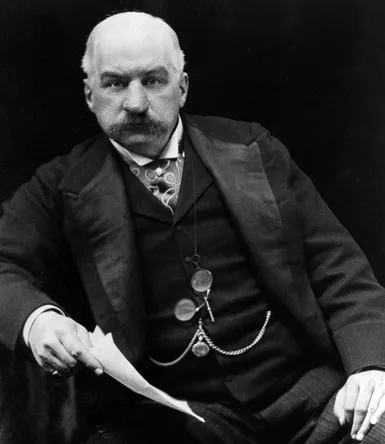
|
| John Pierpont Morgan |
Financier J. P. Morgan organized a number of major railroads and consolidated the United States Steel, International Harvester, and General Electric corporations. He started as a bookkeeper in Cleveland, became a merchant, accumulated money and bought his first oil refinery in 1862. In 1870, he set up the Standard Oil Company in Ohio. He made secret agreements with railroads to ship his oil exclusively. If they refused to ship oil for competitors he gave them discounts on their prices, and thus drove competitors out of business. One independent refiner said, "If we did not sell out ... we would be crushed out ... There was only one buyer on the market and we had to sell at their terms." A memo passed among Standard Oil officials read, "Wilkerson & Co. received car of oil Monday 13th ... Please turn another screw." A rival refinery in Buffalo exploded because of an agreement between the Standard Oil Company and the refinery's chief mechanic, who caused the explosion. The historian Gustavus Myers wrote,
a circular marked "Private and Confidential" was issued by the three banking houses of Drexel, Morgan & Company, Brown Brothers & Company, and Kidder, Peabody & Company. The most painstaking care was exercised that this document should not find its way into the press or otherwise become public. ... Why this fear? Because the circular was an invitation ... to the great railroad magnates to assemble at Morgan's house, No. 219 Madison Avenue, there to form, in the phrase of the day, an iron-clad combination. ... a compact which would efface competition among certain railroads, and unite those interests in an agreement by which the people of the United States would be bled even more effectively than before.
However, robber barons brought rationality and organization to the economy. Morgan linked railroads to each other and to banks, and linked banks to insurance companies. By 1900 he controlled 100,000 miles of railroad, half the country's total mileage. Three insurance companies dominated by Morgan had a billion in assets, and $50 million a year to invest, all money from customers who paid for insurance policies.
Andrew Carnegie led the enormous expansion of the American steel industry in the late 19th century. He was a telegraph clerk at 17, then secretary to the head of the Pennsylvania Railroad, then a broker on Wall Street selling railroad bonds for large commissions, and became a millionaire. He went to London in 1872 and brought the Bessemer method of steel production to the US with a million dollar steel plant. Tariffs protected American steel production, so Carnegie produced 10,000 tons of steel a month, making one and a half million dollars a year in profit. By 1900 he was making $40 million a year. That year Carnegie sold his steel company to J. P. Morgan for $492,000,000.
Morgan then formed the US Steel Corporation, combining Carnegie's corporation with others. He sold stocks and bonds for $1,300,000,000 (about $400 million more than the combined worth of all the companies) and took a fee of $150 million for arranging the consolidation. He did this with the help of a protective tariff, by preventing competition, by keeping the price of steel at $28 a ton and by paying low wages to 2,000 employees who worked 12 hours a day.
Among the others who are often counted among the robber barons are shipping and railroad magnate Cornelius Vanderbilt; industrialist George Pullman, the inventor of the Pullman sleeping car; and Henry Clay Frick, who helped build the world's largest coke and steel operations.
Monopolies and oligopolies (near monopolies) grew. By the early 20th century American Telephone and Telegraph had become a monopoly, and International Harvester made 85 percent of farm machinery. These corporations had interlocking powerful boards of directors, members of which sat on the boards of other corporations. Morgan sat on the board of as many as 48 corporations, and Rockefeller on 37.

|
| Ulysses S. Grant |
The election of 1868 was one of the most violent in American history. Southern employers threatened to dismiss anyone who voted Republican. Southerners seized crops from tenants who attended Republican Union League rallies. Merchants denied credit to freedmen who voted Republican. In Albany, Georgia the Young Men's Democratic Club received five cases of repeating rifles. When poorly armed blacks came to town for a Republican rally, several days of shootings and whippings resulted in the deaths of between 10 and 50 blacks. Armed whites killed hundreds of blacks in St Landry Parish, Louisiana. General Meade and General Thomas used the army to protect voters outside of Georgia and Louisiana, and Grant won the election. By then only Virginia, Mississippi and Texas had not been readmitted to the Union. Georgia would later be expelled from the Union for purging black legislators.
The proposed annexation of Santo Domingo was an attempted treaty during the later Reconstruction era, with precedents under earlier administrations, but re-initiated by United States President Ulysses S. Grant in 1869, to annex Santo Domingo (as the Dominican Republic was commonly known) as a United States territory, with the promise of eventual statehood. However, the proposed annexation bill didn't receive the required two-thirds majority required for it to pass.
The Fifteenth Amendment, which allows blacks the right to vote, was sent to the states for ratification. In 1870 it was ratified.
Grant sent Philip Sheridan to lead US soldiers patrolling the Mexican border. The US supported Benito Juarez against emperor Maximilian, who was installed by the French in 1864. The size of the army was greatly reduced after the war, and the army sold horses. As historian Richard White said, "Away from the railroads, infantry could not chase down mounted nightriders who terrorized freedpeople."
Beginning in 1870 "White Men's Clubs" in Mississippi refused to hire blacks who voted Republican and murdered those who did so. Because of its large black population Republicans would have won in Mississippi if fair elections were held, but white supremacists used violence to control the government. They created "dead books" of blacks who voted and that they wanted to kill. White militia occupied the towns and kept blacks away from the polls. A well armed white militia threatened to wipe a black militia "from the face of the earth." When governor Adelbert Ames asked for federal troops, Grant's attorney general said he was "tired of the[se] autumnal outbursts in the South." In the Revolution of 1875 whites in Mississippi used terror to win an election. The Republican governor Ames fled the state.
Hundreds of armed whites led by Confederate General Matthew C. Butler attacked the mostly black town of Hamburg, South Carolina. Two local white farmers had a quarrel with a black militia. When the black militia refused Butler's demand to disarm, the white mob, armed with a cannon, murdered the sheriff and besieged the armory. The mob killed five freedmen near a railroad trestle. According to historian Richard White,
According to testimony before the US Senate, when a member of the crowd asked, "Well, now, what will we do with the rest?" the answer was "By God, let's pile them up like frogs and shoot them off." The mob did not execute the remaining militiamen, but the whites, many of them now drunk, broke into houses and stores, calling out the names of the executed men, and then telling their companions "he don't answer." This brought gales of laughter. So too did a corpse in the road. "By God, he is looking at the moon and don't wink his eyes," a member of the mob chortled. Alfred Minyard was still living when someone "cut off a big piece of meat from off his rump."
There was corruption, including a Whiskey Ring, an Indian Ring and a Gold Ring. While there is no evidence that Grant was corrupt, he did trust his friends too much. Gen. Orville E. Babcock was indicted as one of the "Whiskey Ring" co-conspirators and charged with conspiracy to defraud the Treasury of the United States. Grant testified that his friend Babcock was innocent, even though evidence proved his guilt. The Indian ring involved fraudulent contracts on Indian reservations. In the War Department, William Belknap's wife arranged with her husband's knowledge for Caleb Marsh to receive the appointment as Indian Trader at Fort Sill in Indian Territory in return for half the profits being returned to her. The existing trader agreed to pay Marsh $12,000 a year to leave the post to him. Marsh paid half the amount to Belknap's wife. When she died Belknap married his wife's sister, and Marsh continued to pay Belknap's new wife. Jay Gould attempted to corner the market for gold. The spoils system was also corrupt. About 53,000 federal jobs were filled with unqualified political appointees with each new administration. Under the spoils system, loyalty was more important than competence. John D. Sanborn, a protégé of Benjamin Butler, secured a contract to collect taxes from delinquent taxpayers. Government investigators had already collected evidence of the taxes to be collected. Sanborn merely collected the taxes, taking more than half as his "fee", and forwarded the rest to the treasury.
Grant enforced Force Acts to stop Klan violence and protect the lives of newly freed slaves, and started the Civil Service Commission to reduce corruption. Grant also negotiated the Alabama Claims against the United Kingdom, which required the United Kingdom to pay for the damage done by British warships renamed the Alabama and Florida and commanded by Confederates during the war.
The Enforcement Act of 1870 prohibited discrimination by state officials in voter registration on the basis of race, color, or previous condition of servitude. It established penalties for interfering with a person's right to vote and gave federal courts the power to enforce the act. The act also authorized the President to employ the use of the army to uphold the act and the use of federal marshals to bring charges against offenders for election fraud, the bribery or intimidation of voters, and conspiracies to prevent citizens from exercising their constitutional rights. The act banned the use of terror, force or bribery to prevent people from voting because of their race. Other laws banned the KKK entirely. Hundreds of KKK members were arrested and tried as common criminals and terrorists. The first Klan was all but eradicated within a year of federal prosecution.
The Second Enforcement Act of 1871 permitted federal oversight of local and state elections if any two citizens in a town with more than twenty thousand inhabitants desired it. The Enforcement Act of 1871 (second act) and the Civil Rights Act of 1875 are very similar to the original act, as they all have the same goal, but revised the first act to make it more effective. The Act of 1871 has more severe punishments with larger fines for disregarding the regulations.
The Third Enforcement Act of 1871, also known as the Ku Klux Klan Act, is an Act of the United States Congress that was intended to combat the paramilitary vigilantism of the Ku Klux Klan. The act made certain acts committed by private persons federal offenses, including conspiring to deprive citizens of their rights to hold office, serve on juries, or enjoy the equal protection of law. The Act authorized the President to deploy federal troops to counter the Klan and to suspend the writ of habeas corpus to make arrests without charge. The act was the last of three Enforcement Acts passed by Congress from 1870 to 1871 during the Reconstruction era to combat attacks upon the suffrage rights of African Americans.
The Civil Rights Act of 1875, sometimes called the Force Act, was designed to "protect all citizens in their civil and legal rights," providing for equal treatment in public accommodations and public transportation and prohibiting exclusion from jury service. The law was not effectively enforced, partly because President Grant had favored different measures to help him suppress election-related violence against blacks and Republicans in the Southern United States.
The acts ended the Klan for decades, although violence against blacks, including deadly violence, continued. While Attorney General Amos T. Akerman was effective in stopping the Klan, Secretary of State Hamilton Fish wanted a lenient policy toward the Klan and the South. Akerman had refused to approve contested land grants to companies controlled by Jay Gould and Collis P. Huntington, one of the Associates of the Central Pacific and the Southern Pacific. Secretary of Interior Delano changed his position and agreed with Fish, Gould and Huntington in having Akerman removed. Grant agreed to remove him. Grant, under pressure from other Republicans, then pardoned some klansmen.
In the 19th century, Republicans who opposed a strong government were called "liberals," even though the term liberal now has a different meaning. Such 19th century liberal Republicans passed the Amnesty Act to allow amnesty for Southerners disqualified from holding office under the Fourteenth Amendment. These small government Republicans included senators Carl Schurz, Lymon Trumbull and Edwin Godkin of the Nation. Schurz called the Ku Klux Klan Act "insane." While these small government Republicans accepted the Thirteenth, Fourteenth and Fifteenth Amendments, they thought that Radical Republicans went too far, and sometimes voted with Democrats and against Radical Republicans. They thought that carpetbaggers, scalawags and immigrants were corrupt. They favored civil service reform, free trade and a return to the gold standard. They opposed the tariff and allowing women the right to vote.
A white mob in Los Angeles lynched 17 Chinese men and boys in a raid on Chinatown. The Chinese Massacre of 1871 was one of the largest mass lynchings in American history.
Even though Samuel Langhorne Clemens (Mark Twain) was from a slave state, he was a friend of Grant's after the war. Twain served for a few weeks in the Confederate army before he "skedaddled" to California. When Grant was dying of throat cancer after smoking too many cigars, he wrote his memoirs so that his wife, Julia Dent Grant, would be provided for. Twain didn't want his friend to get taken advantage of by a bad publisher, so he used his publishing house to publish The Complete Personal Memoirs of General Ulysses S. Grant.
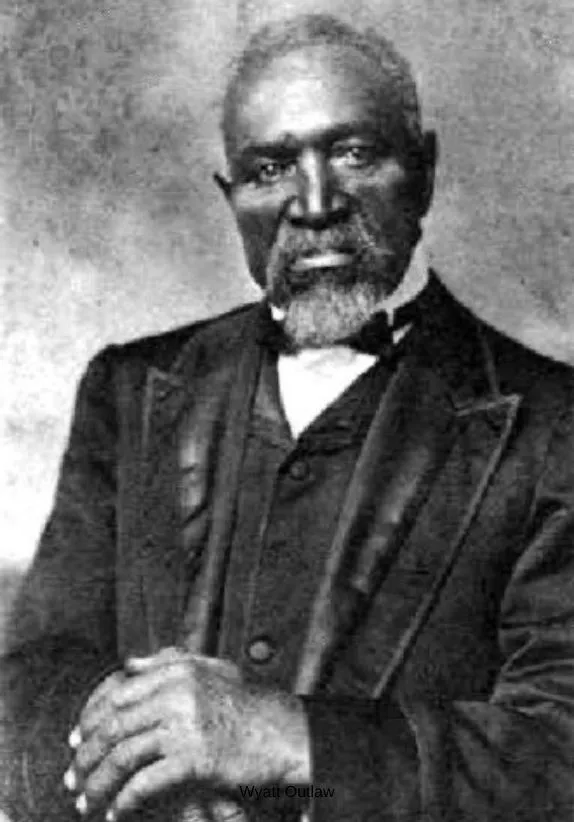
|
| Wyatt Outlaw |
In 1870 white supremacists attacked and killed Republicans, leading to election losses in Alabama, Tennessee, Texas, North Carolina and Georgia. Wyatt Outlaw was a half-black carpenter in Alamance County, North Carolina. He also operated a bar that catered to both white and black railroad workers. He helped found the local African Methodist Church. Outlaw served as president of the Alamance County Union League of America, which opposed the White Brotherhood and had advocated establishing a school for black students - something that Klansmen had vowed to burn down. In 1868 the Republicans won Alamance County.
Outlaw's activism eventually led to his appointment by Governor William Woods Holden to the Graham Town Council, making him one of three African Americans to serve as constables in the town. His involvement in politics and his leadership within the community made him a target for white supremacist groups, particularly the White Brotherhood and the Constitutional Union Guard, both local affiliates of the Ku Klux Klan.
In 1869, this tension erupted when a group of white residents organized a nighttime Klan-style ride through the streets of Graham, seeking to intimidate the African American constables. Outlaw and his fellow constables confronted the riders, opening fire in self-defense; fortunately, no injuries were reported. This act of resistance likely fueled the rage of local Klan sympathizers, setting the stage for the violent retribution that would follow.
On the night of February 26, 1870, a group of masked men, believed to be part of the White Brotherhood, descended on Graham's home with torches, swords, and pistols. They beat down Outlaw's door with axes. When his 73-year-old mother confronted them, they knocked her down and kicked and stomped her. As the mob dragged Outlaw away, his 6-year-old son screamed, "Oh, Daddy! Oh, Daddy!" They lynched Outlaw from an elm tree in the Alamance County Courthouse square-now Sesquicentennial Park. A note was left on Outlaw's body, warning, "Beware, ye guilty, both Black and white." One witness to the crime, a black man, was later found dead in a pond near the town. This local man had claimed to know who was responsible for the lynching.
In nearby Caswell County Robin Jacobs, a freedman, was murdered. The next day another freedman was tied to a tree while fifteen Klansmen took turns raping his wife. Another group of white men raped a black woman and "stuck their knives in various parts of her body." White conservatives murdered white Republican state senator and former Freedmen's Bureau agent John W. Stephens.
Following Outlaw's death, along with the assassination of Stephens for his political views and for assisting freed slaves, Governor Holden declared martial law in Alamance and Caswell Counties. This led to the Kirk-Holden War of 1870, a confrontation between the state government and the Ku Klux Klan that resulted in the detention and indictment of 49 men for Klan-related activity; however, all were ultimately acquitted and released by late August.
Holden's campaign against the Klan was poorly received across the state, and the General Assembly subsequently filed articles of impeachment against him in December, ultimately removing him from office in March 1871. Holden was the first governor in US history to be removed in this manner.
In 1873, Guilford County Superior Court Judge Albion Tourgee pushed to reopen the investigation into Wyatt Outlaw's murder. That year, the Grand Jury of Alamance County issued felony indictments against 63 Klansmen, including 18 murder charges related to Outlaw's lynching. However, the Democratic-controlled state legislature repealed the laws under which most of these indictments were filed, resulting in the charges being dropped. No one was ever prosecuted for Outlaw's murder.
In New Orleans over 8,000 armed men invaded the city to overthrow the Republican government headed by William Pitt Kellogg. At the Battle of Canal Street they seized the city hall, statehouse and arsenal and forced Kellogg to retreat to the Custom House. Kellogg was saved by six regiments of federal troops. Soldiers threw out votes from violent parishes, leading to another disputed election. When Democrats seized control over the state assembly soldiers escorted five Democrats claiming to have won seats out of the chamber. Philip Sheridan investigated the violence. The black ex-Union soldier Henry Adams became a scout and a spy for the Seventh Cavalry in 1875. A congressional delegation negotiated the Wheeler Settlement, which allowed Kellogg to remain as governor and allowed Democrats to control the lower chamber of the state legislature.
The black former Union soldier Henry Adams was part of a committee that kept a record of murders and beatings in Caddo Parish, Louisiana. A sample of it is as follows:
Donahoue, colored, was killed by a white man on Nick Marchu's place, in the year 1873. Miss Delia Young, beat and severely whipped by James Robinson (white) on Hayne's place. ... and also all her crop taken from her in the year 1872. Margaret Bates, badly whipped by John Brown, a white man on Levee Bend plantation, in the year 1873. Henry Hard (colored) killed by a white man, in the year 1874. Dick, a colored man, was killed by a white man in the year 1874. Fred, a colored man, killed by being burnt up at the stake, on Joe Bealey's place, in the year 1872.
Adams said, "Democrats would say to us that 'you all is trying to follow these carpet-baggers, scalawags, and negro leaders, and just as long as you to follow them we are going just to kill you as we did them.' They told us to our teeth. They told me so many a time."

|
|
Thomas Nast cartoon depicting the Klan and the White League |
Colfax, the parish seat of Grant Parish, was named after Schuyler Colfax, Grant's vice president. It was located on the plantation of William Calhoun and consisted of a steamboat landing, a courthouse, a school, a store and some warehouses. Nearby were the cabins of an old slave quarters. Calhoun was a scalawag and Republican officeholder who lived with a mixed race woman, Olivia Williams. They had children. Calhoun had sold land to freedmen and helped them establish a school.
An armed group of white supremacists attacked a courthouse guarded by a mostly black militia in the town of Colfax, Louisiana on April 13, 1873. A bloodbath ensued, as the militia surrendered and the white supremacists carried out a day-long campaign of terror that came to be known as the Colfax Massacre.
In the years following the US Civil War, several freedmen and white candidates sympathetic to the cause of racial equality were elected to office across the South. This progress stirred up deep resentments among other white Southerners, bitter over the loss of the Civil War and eager to once again enshrine white supremacy into law. During this period, federal troops were stationed throughout the South to pacify the region and protect elections. The Enforcement Acts of 1870 and 1871 prohibited people from congregating to disrupt an election and gave the federal government the authority to use its troops in defense of African Americans and their recently granted constitutional rights.
The 1872 Louisiana gubernatorial election resulted in both sides claiming victory. The segregationist and Reconstructionist sides fought a legal battle as well as physical battles, sending armed men to occupy various government buildings. In March of 1873, pro-Reconstruction forces occupied the Grant Parish courthouse in Colfax. The occupation lasted several weeks, until a group of nearly 300 whites marched on the courthouse on Easter Sunday, April 13th. The two sides exchanged fire, but the roughly 60 defenders of the courthouse surrendered after the white supremacists aimed a cannon at the building. The battle turned out to be only a prelude to a day of bloodshed.
Reportedly in response to the accidental shooting of their leader by one of their own, the white supremacist force began to execute captured and wounded members of the militia. They then spread out into town, indiscriminately murdering black residents of Colfax. By the time Louisiana state militia arrived on April 14, an estimated 150 people had been killed-an exact count was made difficult by the fact that many bodies were thrown into the Red River or removed for burial, possibly at mass graves. Whites shot some of the black defenders, slit the throats of others and hanged a few. Nearly all the dead were African American, while only three were white. Grant declared parts of Louisiana to be in a state of insurrection and declared martial law. The state made no arrests, but federal troops arrived a few days later and arrested 97 white men in connection with the massacre. Several of them were convicted of crimes under the Enforcement Acts, but were released when the Supreme Court declared the laws unconstitutional.
Historian Eric Foner described the massacre as the worst instance of racial violence during Reconstruction. In Louisiana, it had the most fatalities of any of the numerous violent events occurring after the disputed gubernatorial contest in 1872 between Republicans and Democrats. Foner wrote, "...every election [in Louisiana] between 1868 and 1876 was marked by rampant violence and pervasive fraud." Although the Fusionist-dominated state "returning board," which ruled on vote validity, initially declared John McEnery and his Democratic slate the winners, the board eventually divided, with a faction declaring Republican William P. Kellogg the victor. A Republican federal judge in New Orleans ruled that the Republican-majority legislature be seated.
The Slaughter-House Cases (1873) was a landmark US Supreme Court decision which ruled that the Privileges or Immunities Clause of the Fourteenth Amendment to the US Constitution only protects the legal rights that are associated with federal US citizenship, not those that pertain to state citizenship. Though the decision in the Slaughter-House Cases minimized the impact of the Privileges or Immunities Clause on state law, the Supreme Court would later incorporate the Bill of Rights to strike down state laws on the basis of other clauses. In 2010, the Court rejected arguments in McDonald v. Chicago to overrule the established precedent of Slaughterhouse and decided instead to incorporate the Second Amendment via the Due Process Clause of the Fourteenth Amendment.
Ostensibly seeking to improve sanitary conditions, the Louisiana legislature and the city of New Orleans had established a corporation charged with regulating the slaughterhouse industry. Members of the Butchers' Benevolent Association challenged the constitutionality of the corporation's monopoly, claiming that it violated the Fourteenth Amendment. The amendment had been ratified in the aftermath of the American Civil War with the primary intention of protecting civil rights of millions of newly emancipated freedmen in the Southern United States, but the butchers argued that the amendment protected their right to "sustain their lives through labor."
In the majority opinion written by Associate Justice Samuel Freeman Miller, the Court held to a narrower interpretation of the Fourteenth Amendment than the plaintiffs urged, ruling that it did not restrict the police powers exercised by Louisiana because the Privileges or Immunities Clause protected only those rights guaranteed by the United States, not individual states. In effect, the clause was interpreted to convey limited protection pertinent to a small minority of rights, such as the right to seek federal office.
In a dissenting opinion, Associate Justice Stephen J. Field wrote that Miller's opinion effectively rendered the Fourteenth Amendment a "vain and idle enactment."
United States v. Cruikshank (1876) was a landmark decision of the United States Supreme Court ruling that the US Bill of Rights did not limit the power of private actors or state governments despite the adoption of the Fourteenth Amendment. It reversed the federal criminal convictions for the civil rights violations committed in aid of anti-Reconstruction murders. Decided during the Reconstruction Era, the case represented a major defeat for federal efforts to protect the civil rights of African Americans.
The case developed from the strongly contested 1872 Louisiana gubernatorial election and the subsequent Colfax massacre, in which dozens of black people and three white people were killed. Federal charges were brought against several whites using the Enforcement Act of 1870, which prohibited two or more people from conspiring to deprive anyone of his constitutional rights. Charges included hindering the freedmen's First Amendment right to freely assemble and their Second Amendment right to keep and bear arms.
In his majority opinion, Chief Justice Morrison Waite reversed the convictions of the defendants, judging that the plaintiffs had to rely on Louisiana state courts for protection. Waite ruled that neither the First Amendment nor the Second Amendment limited the powers of state governments or individuals. He further ruled that the Due Process Clause and the Equal Protection Clause of the Fourteenth Amendment limited the lawful actions of state governments, but not of individuals. The decision left African Americans in the South at the mercy of increasingly hostile state governments dominated by white Democratic legislatures, and allowed groups such as the Ku Klux Klan to continue to use paramilitary force to suppress black voting. Therefore the federal government could no longer use the Enforcement Act of 1870 to prosecute actions by paramilitary groups such as the White League, which had chapters forming across Louisiana beginning in 1874. Intimidation, murders, and black voter suppression by such paramilitary groups were instrumental to the Democratic Party regaining political control of the state legislature by the late 1870s.
Cruikshank was the first case to come before the Supreme Court that involved a possible violation of the Second Amendment. Decades after Cruikshank, the Supreme Court began incorporating the Bill of Rights to apply to state governments. The Court incorporated the First Amendment's freedom of assembly in De Jonge v. Oregon (1937), while the Second Amendment was incorporated in McDonald v. City of Chicago (2010).
The US Supreme Court held in its US v. Reese decision that attempts by county officials in Kentucky to prevent blacks from voting could not be prosecuted under the Enforcement Acts. It held that sections 3 and 4 of the Enforcement Act of 1870 were unconstitutional since they didn't mention race and were therefore overly broad. These sections prohibited election officials from intimidating or obstructing voters.
During the economic Panic of 1873, unemployment reached 14 percent. The Panic ended in 1877. The Panic began when the stock exchange in Vienna crashed on May 9, 1873. The economic harm spread to Germany, Britain and the US The Bank of England raised its discount rate on loans from 4 percent in May to 9 percent in November, which led to higher interest rates across Europe and North America. The bonded debt of American railroads had risen from $416 million in 1867 to $2.23 billion in 1874. Many bonds were sold at discount, leaving railroads to repay a debt much larger than the money they received. Railroad promoters manipulated numbers to make it appear to investors that they were more secure and profitable than they were. The weakness of railroad finances was a threat to bankers that financed them, especially Jay Cooke & Co, which financed the Northern Pacific Railroad. Cooke had promised to limit his bank's advances to the railroad to $500,000, but by 1873 the total was $7 million. Collis Potter Huntington's Central Pacific had similar problems. In January 1873 Congress voted to demonetize silver except for the China dollar for trade with China. Since Europe went to the gold standard, their treasuries no longer needed silver, and the value of silver fell. William Ralston of the Bank of California saw that declining silver prices would cause a run on Comstock mining stocks, which would destroy the bank. Ralston funded the political campaign of Senator William Stewart of Nevada, and conspired with Stewart and others to pass the Coinage Act. The fact that it ended the use of silver for most coinage prevented silver from Europe from flooding the American market. The fact that the Act allowed silver for trade with China gave the San Francisco Mint and Comstock silver a price advantage over silver that had to be shipped from Europe. The Act also eliminated the coinage fee that had to be paid to turn silver into coins. Ralston paid Henry Linderman, the head of the Philadelphia Mint, to write the Coinage Act. The Act did Ralston no good. The economic Panic ruined him, and he drowned in the San Francisco Bay in 1875, possibly from suicide. Tightening credit damaged the finances of the Northern Pacific and other railroads. The Crédit Mobilier scandal made further subsidies to railroads unlikely.
The Freedman's Bank was not a government institution, but was a congressionally chartered savings bank. Freedpeople were encouraged to use the bank. Henry Cooke, the brother of Jay Cooke, was on the board of the bank. Henry changed the bank's charter to turn the savings bank into an investment bank that could make riskier loans. Henry moved funds into transcontinental railroad bonds and made dubious loans to political insiders. As Jay Cooke & Co. ran into trouble, Henry purchased some of its worst assets. Then Henry transferred Freedman's Bank deposits to Jay Cooke & Co., which had lower interest rates. Henry loaned money to his brother Jay, and took the Northern Pacific bonds that his brother couldn't sell as collateral. On September 18, 1873 the New York branch of Jay Cooke & Co. shut its doors, and other branches followed. Depositors rushed to withdraw savings, banks called in loans, businesses collapsed, and the economic Panic began. In 1873 25 railroads defaulted on their debts, followed by 71 in 1874 and another 25 in 1875. By 1876 about half of the railroads had gone into receivership. Railroad stocks lost 60 percent of their value between 1873 and 1878. By 1876 receivers appointed by courts controlled half the railroad mileage in the country. Half the iron foundries closed within a little more than a year after the crash. Scott's Texas Pacific and Huntington's Chesapeake and Ohio went into receivership. Jay Gould saved the Union Pacific from bankruptcy. The number of bankruptcies went from 5,183 in 1873 to 10,478 in 1878. The 65 month long contraction was the longest in American history.
Farmers responded to falling prices with increased production, which further deflated prices. This meant that they had to repay cheap dollars they had borrowed with more expensive dollars. Other industries had similar problems.
Cotton prices fell by 50 percent between 1872 and 1877. Taxes seemed harsher during the Panic, and reduced support for Republicans. The white supremacist wing of the Democratic wing gained in popularity.
Grant was wrestling with major questions about westward expansion. A growing number of settlers were making their way to new states and territories in the West. A vast railroad infrastructure-including the nearly completed Transcontinental Railroad-was expanding by the day. Indigenous leaders of various Tribal nations demanded that previous treaties with the US government be upheld and that their lands be protected from this onslaught of settlers. Grant tried to juggle multiple desires. On the one hand, he called for reform in the Bureau of Indian Affairs (BIA) and peaceful relations with Native Americans. On the other hand, he supported continual population growth and economic development in the West through settler migration and territorial expansion.
Grant had limited interactions with Native Americans during his time in the US Army prior to the Civil War. He noted during the Mexican-American War that many Mexican residents were of Indian ancestry. While stationed at Columbia Barracks in Washington Territory in 1853, Grant wrote to his wife Julia that "[Indians] about here are the most harmless people you ever saw. It is really my [opinion] that the whole race would be harmless and peaceable if they were not put upon by the whites." Grant also befriended Ely S. Parker (whose tribal name was Hasanoanda, later Donehogawa), a leader of the Seneca Tribe who was working as an engineer for the US Treasury in Galena, Illinois, while the Grant family lived there in 1860. During the Civil War, Parker served on Grant's staff and assisted with drafting the surrender documents Confederate General Robert E. Lee signed at Appomattox Court House. In fact, the surrender documents are written in Parker's handwriting.
Towards the end of the Civil War, Congress established the Doolittle Commission to investigate "the present condition of the Indian tribes, especially into the manner in which they are treated by the civil and military authorities of the United States… and examine fully the conduct of Indian agents and superintendents." The Commission found that there was rampant fraud and corruption in the BIA. In the Plains, a group of Lakota, Arapahoe, and Northern Cheyenne under Red Cloud regularly attacked wagon trains and settlers making their way through lands in present-day Montana and Wyoming. The Bozeman Trail was a particularly noteworthy target since that trail ran through land that was guaranteed to these tribes through the 1851 Treaty of Fort Laramie. Seeking peace and reform, Congress established the United States Indian Peace Commission in 1867.
Ely Parker (Donehogawa) served as a member of the Peace Commission and created a four-point plan for establishing long-term peace with these Plains Tribal nations. Grant fully endorsed Parker's recommendations. In his plan, Parker sought to transfer Indian affairs from the BIA to the War Department, establish a permanent land guarantee to the various Tribal nations, provide more oversite of all Indian agencies managed by the federal government, and create a permanent commission composed of both Native Americans and whites to assist the president with formulating fair policies for both groups. As Grant stated to William T. Sherman, he wished that these policies would help "to deal farely [sic] with the Indians and protect them from encroachments by the Whites." A revised Treaty of Fort Laramie in 1868 ended the Red Cloud War by promising to close forts along the Bozeman Trail and to grant hunting rights outside the boundaries of the Great Sioux reservation.
Historian Philip Weeks argues that popular thinking about Indians among white Americans in the nineteenth century split into two distinct camps. "Assimilationists" believed that Indians could be "civilized" as they learned the ways of mainstream white society, including farming, Christianization, the English language, concepts such as democracy and private property, and eventually US citizenship. "Kill the Indian, Save the Man" was a common refrain heard among assimilationists. Conversely, "exterminationists" believed that Indians could not assimilate and that efforts to "civilize" them were futile. As such, they supported the idea of removing Indians to distant reservations far removed from white settlers, even at the expense of their lands and in some cases their lives. Assimilationists also supported the reservation system, arguing that reservations were the best solution temporarily protecting Indians from settlers until they were prepared for US citizenship.
President Grant embraced assimilationist views for the most part. He announced in his First Inaugural Address that "the proper treatment of the original occupants of the land, the Indian, is one deserving of careful study. I will favor any course towards them which tends to their civilization, Christianization and ultimate citizenship." Later in 1869 he announced that "from the foundation of the Government to the present the management of the original inhabitants of this Continent, the Indian, has been one of embarrassment, and expense, and has been attended with continuous robberies, murders, and wars." To address these issues, Grant appointed Parker as head of the Bureau of Indian Affairs and helped establish a Board of Indian Commissioners to oversee the BIA. Some Tribes supported Grant's efforts at peace. For example, a delegation of Cherokee, Choctaw, Creek, and Chickasaw leaders praised Grant at the beginning of his presidency. The Quaker Society of Friends expressed their desire to assist President Grant and offered to send missionaries to help manage reservations and Christianize Indians. All seemed to be going according to plan.
Political reforms often create unintended consequences, both negative and positive. Grant soon learned this lesson the hard way. He believed that transferring Indian Affairs to the War Department would cut out greedy officials who were often appointed to government positions because of their connections and not because of their talents. Military officials would not be tempted by bribes or government patronage. Moreover, "if the men who have to do the fighting could have the management in time of peace [they] would be most likely of any people to preserve peace, for their own comfort if for no other reason," Grant argued. Congress, however, resented this effort to cut into their patronage and passed a law in 1870 banning military officers from serving at trading posts or Indian reservations. This law inspired President Grant's "Peace Policy" of distributing the management of Indian reservations to various Christian denominations, including Catholics, Methodists, Baptists, and Quakers. Additionally, the Board of Indian Commissioners resented Ely Parker's authority in the BIA and undertook a campaign to remove him from office. Feeling that his authority had been undermined, Parker resigned from office in 1871.
Grant also discovered that not every Tribe was ready to embrace the changes his administration proposed. Some Native Americans had no interest in moving to reservations, farming, Christianity, or becoming US citizens. For Tribes who refused to abide by the "Peace Policy," a different plan that might be described as "Peace by Force" was developed. As violence between Indians and settlers increased, Grant described this plan in an 1872 letter to General John Schofield: "Indians who will not put themselves under the restraints required will have to be forced, even to the extent of making war upon them, to submit to measures that will insure [sic] security to the white settlers of the Territories," he argued. However, in his final State of the Union address, Grant blamed the "avarice of the white man" for troubles with Lakotas in the Black Hills.
Some of the worst cases of violence and bloodshed between the US military and Indians took place during Grant's presidency. For example, The Camp Grant and Marias Massacres were two incidents in which mostly women and children were killed by US Army troops. A historic rivalry between the Modoc and Klamath in the Pacific Northwest was further exacerbated when the Modoc were moved to the Klamath reservation in Oregon. When the Modoc tried to return to their traditional lands at Tule Lake, a bloody conflict called the Modoc War broke out. The Ponca tribe maintained a reservation in northeastern Nebraska along the Missouri River. After a years-long dispute with neighboring tribes in Dakota territory, the Ponca endured their own Trail of Tears as they were forced to relocate to Oklahoma in 1877.
Western fertile prairies, arid plains and scorching deserts were treated the same. The Timber Culture Act (1873) and Desert Land Act (1877) made things worse. The government granted two million acres under the Timber Culture Act in Kansas, Nebraska and South Dakota. The Act promise 160 acres to anyone who planted 40 acres of trees. In 1878 the requirement was reduced to ten acres of trees. However, trees planted in arid areas died, and many of the claims made were fictitious. Kansas, Iowa and Missouri had the most immigrants, although Iowa had slightly more emigrants than immigrants.
The Mining Act of 1872 granted open access for exploration on public lands and the exclusive right to mine a discovery. Claims were cheap, $2.50 to $5.00 an acre, and limited in size, and claimants could only retain their claims as long as they worked them. In California hydraulic mining dumped large amounts of debris into rivers and fields until 1884, when courts banned the dumping of debris.
The Homestead Act was another government subsidy to encourage the settlement of the West.

|
| Rutherford Hayes |
Before the war Hayes defended fugitive slaves as a lawyer. During the war he served in the Union army. He opposed the corruption that was widespread at the time. Hayes's administration was influenced by his belief in meritocratic government and equal treatment without regard to wealth, social standing, or race. One of the defining events of his presidency was the Great Railroad Strike of 1877, which he resolved by calling in the US Army against the railroad workers. It remains the deadliest conflict between workers and strikebreakers in American history. He appointed John Marshall Harlan to the US Supreme Court. Hayes's demand for the resignation of two top officials in the New York customhouse (including Chester Arthur, the future president) provoked a bitter struggle with New York senator Roscoe Conkling. In 1879 Hayes signed an act permitting women lawyers to practice before the Supreme Court.
Robert Ingersoll called James G. Blaine "the plumed knight." However, Blaine was entangled with railroad corruption and Thomas A. Scott, the president of the Pennsylvania Railroad and a robber baron. Grant signed the Species Payment Resumption Act of 1875, restoring the gold standard. The Act was unpopular, so Republicans used attacks on Catholics during the election of 1876 and opposed public funding of Catholic schools. Democrats nominated Samuel Tilden for president. Tilden had worked with the railroads as a lawyer. Tilden was for hard money (the gold standard). Although Tilden worked with Tweed he helped sideline Tammany by appointing the Tilden Commission.
Rutherford B. Hayes became the Republican candidate for president. Hayes wanted to protect the rights of newly freed slaves and the Thirteenth, Fourteenth and Fifteenth Amendments to the Constitution. Democrats accused Republicans of "waving the bloody shirt" by mentioning the war and opposed Reconstruction. Democrats used violence to keep blacks from voting. However, the voter participation rate for whites was high. Hayes won South Carolina in a corrupt and violent election in which more votes were cast than the number of eligible male voters. In an election marked by fraud, the result was a tie in the Electoral College. Scott offered to deliver Southern Democrats for Blaine in return for subsidies for the Texas and Pacific Railroad. Scott never got these subsidies. Lobbyists offered to help Hayes if he agreed not to use federal troops or marshals to enforce civil and voting rights for blacks. A Federal Election Commission agreed on a bargain that Hayes could be president in return for ending Reconstruction.
The 1876 election was marred by massive vote fraud when Republican Rutherford Hayes was allowed to win against Democrat Samuel Tilden if he agreed to end Reconstruction. He withdrew federal troops from states still under military occupation and agreed not to interfere with elections in the former Confederacy. As a result, Reconstruction ended in 1877. Withdrawal of federal troops began in South Carolina and Louisiana. A South Carolina freedman wrote, "I am an unprotected freedman ... O God Save the Colored People." Amos Akerman, Grant's old attorney general, said that Hayes rewarded "lawlessness by letting the lawless have their way." Henry Adams' commission in Shreveport sent a petition that said, "the colored people of the South have been debarred from ... the right to vote hold office and the privilege of an education without molestation." It said they had been "oppressed, murdered, and disenfranchised on account of our race and color."
As president, Hayes implemented modest civil-service reforms that laid the groundwork for further reform in the 1880s and 1890s. He supported the gold standard for currency. Coinage of silver was outlawed in 1873. He vetoed the Bland–Allison Act of 1878, which put silver money into circulation and raised nominal prices, but Congress overrode his veto. He also arbitrated a territorial dispute between Argentina and Paraguay after the Paraguayan War. His policy toward western Native Americans anticipated the assimilationist program of the Dawes Act of 1887.