- ABRAHAM LINCOLN (1861 - 1865)
- FORT SUMTER CRISIS
- STATISTICS ON SECESSION
- THE UPPER SOUTH
- THE BORDER STATES
- PREPARATION FOR WAR
- BRITAIN AND FRANCE
- CIVIL WAR AT SEA
- EASTERN THEATER
- EMANCIPATION
- WESTERN THEATER
- GRANT MOVES EAST
- GRANT'S OVERLAND CAMPAIGN
- SHERMAN'S MARCH TO THE SEA
- SHERIDAN'S VALLEY CAMPAIGN
- END OF THE WAR

|
| Abraham Lincoln |
Allan Pinkerton, the founder of Pinkerton's National Detective Agency, claimed that a mob in Baltimore would attempt to assassinate Lincoln on his way to Washington, D.C. before his inauguration. It was determined that Lincoln should be brought from Harrisburg to Philadelphia by special train, and then travel to Washington by a Philadelphia, Wilmington, and Baltimore night line sleeping car. The telegraph lines in all directions were cut to prevent news of Lincoln's movements. The train arrived in Baltimore, and continued on its course arriving at dawn on February 23, 1861. On March 4, 1861, Abraham Lincoln was inaugurated as the 16th President of the United States of America.
For 60 out of the 72 years before Lincoln was elected, presidents were either slaveowners or pro-South Northerners. Some of the slaveowning presidents were more pro-Union than the pro-South presidents who didn't own slaves. Southerners used threats of secession to allow the Southern minority to control the government. Frederick Douglass said that "Lincoln's election has vitiated their authority, and broken their power."
Lincoln, in a message to Congress on July 4, 1861, wrote that the leading object of government was "to elevate the condition of men — to lift artificial weights from all shoulders — to clear the paths of laudable pursuit for all — to afford all, an unfettered start, and a fair chance, in the race of life."
In 1861, Lincoln said, "the right of revolution is never a legal right ... At most, it is but a moral right, when exercised for a morally justifiable cause. When exercised without such a cause revolution is no right, but simply a wicked exercise of physical power."
Lincoln's first inaugural address was an attempt to placate the South in a failed attempt to avoid war. Lincoln promised not to harm slavery in states where it existed, and urged Southerners to heed the "better angels of our nature."
|
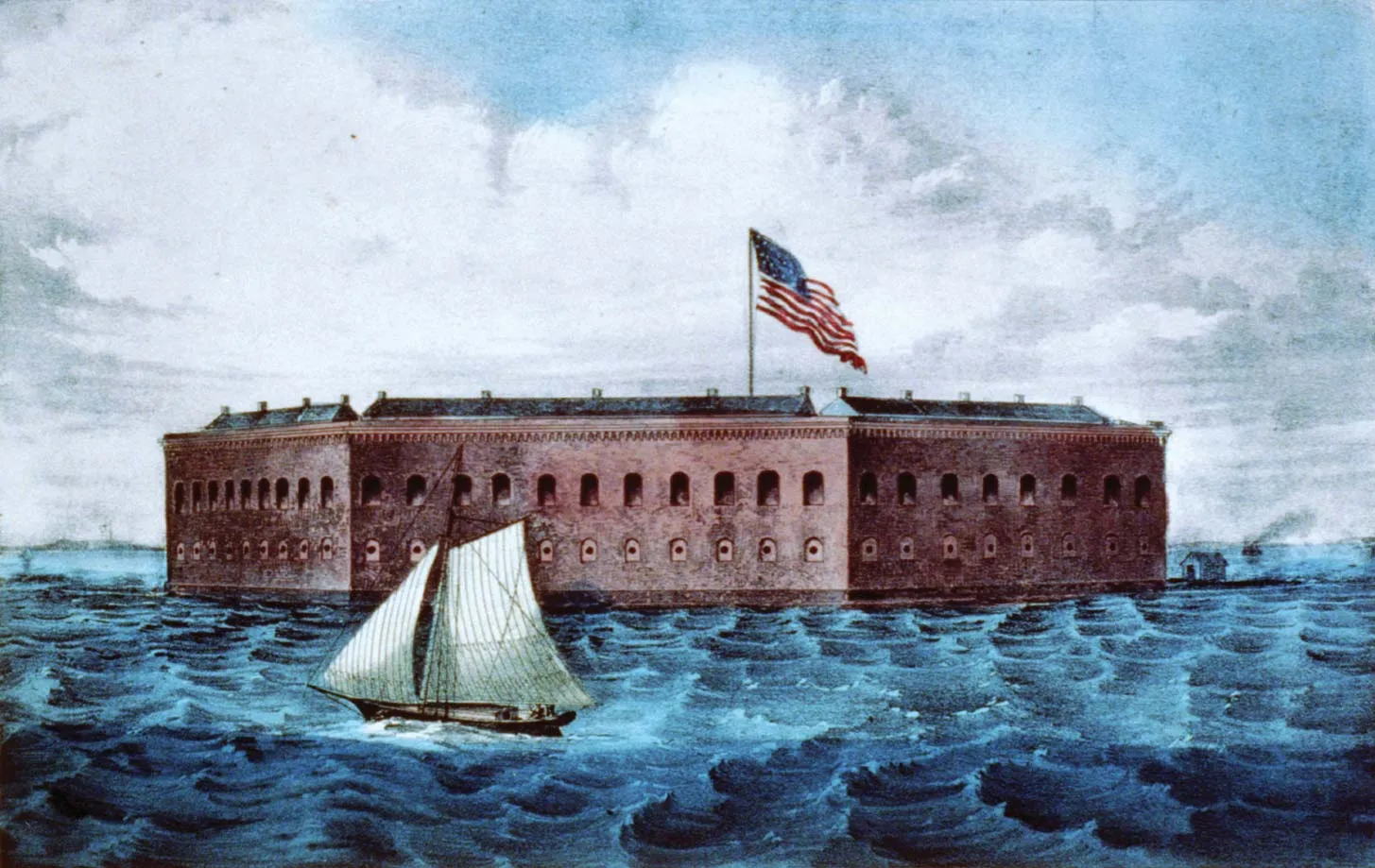
| Fort Sumter |
Buchanan's Secretary of War, John Floyd, was a Southern sympathizer who allowed secessionists to seize Union forts and arsenals throughout the South. Buchanan sent the ship Star of the West to send supplies to Fort Sumter, but Citadel cadets fired upon the ship, and supplies were never delivered. By the time Lincoln took office, Fort Monroe in Virginia, Fort Pickens, Fort Jefferson and Fort Taylor in Florida and Fort Sumter in South Carolina were still held by the Union. Anderson moved his troops from Fort Moultrie, which was difficult to defend, to the more easily defended Fort Sumter, South Carolina. Confederate troops then occupied Fort Moultrie. When Lincoln took office he inherited the Fort Sumter crisis from the Buchanan administration.
Lincoln ordered members of his cabinet to have no communications with Confederate agents because he didn't want to imply recognition of the Confederacy as a legitimate government. Despite this, his Secretary of State, William Seward, thought that he was the real President and that he would pull strings from behind the scenes. So he had unauthorized conversations with Confederate agents and told them that Fort Sumter, South Carolina, would be surrendered and that the Union would defend Fort Pickens, Florida, instead. Lincoln made it clear that he intended to hold both Fort Sumter and Fort Pickens. Lincoln ordered a ship to supply Fort Sumter with food and supplies. Lincoln sent a letter to Governor Pickens of South Carolina saying that no weapons were being sent, and that that there would be no conflict unless the ship was attacked.
Because of confusion, two orders were sent to the captain of the ship Powhatan. One ordered the ship to send supplies to Fort Pickens, the other ordered the ship to Fort Sumter instead. The second order was ignored. Seward told Lincoln to start a patriotic war with Spain or France over their interventionist policies in Santo Domingo and Mexico, claiming that doing so would unite the people. Lincoln chose to fight one war at a time.

|
| William Seward |
James Chesnut, an aide to General P. G. T. Beauregard, rowed out to Fort Sumter and demanded that Anderson, who commanded the fort, surrender the fort. Anderson replied that the fort would probably be starved out soon, but Confederates knew that Lincoln intended to send a ship with food to the fort. So, Chesnut gave orders to the nearby Fort Johnson to open fire on Fort Sumter on April 12, 1861. Beauregard's 19 coastal batteries unleashed a barrage on Fort Sumter, eventually firing an estimated 3,000 shots at the citadel in 34 hours. By Saturday, April 13, cannon fire had broken through the fortress' five-foot-thick brick walls, causing fires inside the post. With his stores of ammunition depleted, Anderson and his Union forces had to surrender the fort shortly after 2 pm. Lincoln called for 75,000 soldiers to serve for 90 days. Four Upper South slave states joined their sister slave states, bringing the total number of Confederate states to eleven. Confederates moved their government from Montgomery, Alabama, to Richmond, Virginia. Confederate troops then occupied Fort Sumter for nearly four years, resisting several bombardments by Union forces before abandoning the garrison before William T. Sherman's capture of Charleston in February 1865.
In his July 4, 1861 address to Congress Lincoln wanted to make it clear that the Fort Sumter crisis was about more than an attack on a fort. He believed that the Confederacy was attacking democracy itself. Kings and queens in Europe wanted to believe that democracies were too weak to survive, and Lincoln wanted to prove them wrong. He responded to the Fort Sumter crisis as follows:
And this issue embraces more than the fate of these United States. It presents to the whole family of man the question whether a constitutional republic, or democracy — a government of the people by the same people — can or can not maintain its territorial integrity against its own domestic foes. It presents the question whether discontented individuals, too few in numbers to control administration according to organic law in any case, can always, upon the pretenses made in this case, or on any other pretenses, or arbitrarily without any pretense, break up their government, and thus practically put an end to free government upon the earth. It forces us to ask, Is there in all republics this inherent and fatal weakness? Must a government of necessity be too strong for the liberties of its own people, or too weak to maintain its own existence?
The following statistics are selected from the Census of 1860. West Virginia is included with the rest of Virginia in the 1860 census since West Virginia didn't exist until 1863, when it seceded from the rest of Virginia and joined the border states. According to historian James McPherson, about 4 percent of West Virginians were slaves. Kentucky had more slavery than the other border states, and many Kentuckians fought for the Confederacy, even though the state was controlled by the North. 90,000 Kentuckians fought for the Union and 35,000 Kentuckians fought for the Confederacy. Mountainous parts of the South such as eastern Tennessee, western North Carolina, northern Arkansas and western Virginia had few slaves and more support for the Union. Confederates seized about 159,000 muskets in addition to other arms from federal arsenals in Southern states when secession began.
| State | Date of Secession | Free Population | Enslaved Population | Total Population | Percent Enslaved |
|---|---|---|---|---|---|
| Lower South Slave States that Seceded Before the Fort Sumter Crisis | |||||
| South Carolina | 12/20/1860 | 301,302 | 402,406 | 703,708 | 57.2 |
| Mississippi | 01/09/1861 | 354,674 | 436,631 | 791,305 | 55.2 |
| Florida | 01/10/1861 | 78,679 | 61,745 | 140,424 | 44.0 |
| Alabama | 01/11/1861 | 529,121 | 435,080 | 964,201 | 45.1 |
| Georgia | 01/19/1861 | 595,088 | 462,198 | 1,057,286 | 43.7 |
| Louisiana | 01/26/1861 | 376,276 | 331,726 | 708,002 | 46.9 |
| Texas | 02/01/1861 | 421,649 | 182,566 | 604,215 | 30.2 |
| Total | 2,656,789 | 2,312,352 | 4,969,141 | 46.5 | |
| Upper South Slave States that Seceded After the Fort Sumter Crisis | |||||
| Virginia | 04/17/1861 | 1,105,453 | 490,865 | 1,596,318 | 30.7 |
| Arkansas | 05/06/1861 | 324,335 | 111,115 | 435,450 | 25.5 |
| North Carolina | 05/20/1861 | 661,563 | 331,059 | 992,622 | 33.4 |
| Tennessee | 06/08/1861 | 834,082 | 275,719 | 1,109,801 | 24.8 |
| Total | 2,925,433 | 1,208,758 | 4,134,191 | 29.2 | |
| Pro-Union Border Slave States and D.C. | |||||
| Delaware | n/a | 110,418 | 1,798 | 112,216 | 1.6 |
| Kentucky | n/a | 930,201 | 225,483 | 1,155,684 | 19.5 |
| Maryland | n/a | 599,860 | 87,189 | 687,049 | 12.7 |
| Missouri | n/a | 1,067,081 | 114,931 | 1,182,012 | 9.7 |
| Washington D.C. | n/a | 71,985 | 3,185 | 75,080 | 4.4 |
| Total | 2,779,545 | 432,586 | 3,212,041 | 13.5 | |
| State | Date of Secession | Percent Enslaved |
|---|---|---|
| Lower South Slave States that Seceded Before the Fort Sumter Crisis | ||
| South Carolina | 12/20/1860 | 57.2 |
| Mississippi | 01/09/1861 | 55.2 |
| Florida | 01/10/1861 | 44.0 |
| Alabama | 01/11/1861 | 45.1 |
| Georgia | 01/19/1861 | 43.7 |
| Louisiana | 01/26/1861 | 46.9 |
| Texas | 02/01/1861 | 30.2 |
| Total | 46.5 | |
| Upper South Slave States that Seceded After the Fort Sumter Crisis | ||
| Virginia | 04/17/1861 | 30.7 |
| Arkansas | 05/06/1861 | 25.5 |
| North Carolina | 05/20/1861 | 33.4 |
| Tennessee | 06/08/1861 | 24.8 |
| Total | 29.2 | |
| Pro-Union Border Slave States and D.C. | ||
| Delaware | n/a | 1.6 |
| Kentucky | n/a | 19.5 |
| Maryland | n/a | 12.7 |
| Missouri | n/a | 9.7 |
| Washington D.C. | n/a | 4.4 |
| Total | 13.5 | |
When Virginia seceded, a militia seized the Gosport Navy Yard near Norfolk and the federal armory at Harper's Ferry. At Harper's Ferry, the 47 US Army regulars set fire to the rifle machinery. Most of the machinery survived and was taken to Richmond to make guns for the Confederacy. The Confederacy seized 1,200 cannon and ten ships from Gosport Navy Yard. An attempt was made to burn them, but most of the cannon and the hull of the Merrimack survived. The Merrimack was later iron plated and renamed the CSS Virginia. The Tredegar Iron Works in Richmond was the only plant in the Confederacy that could manufacture heavy ordnance.
Arkansas, North Carolina and Tennessee were the next upper South slave states to secede. Arkansas Governor Henry Rector ordered the seizure of US arsenals at Fort Smith and Little Rock. The governor of North Carolina ordered the seizure of three forts on the coast and an arsenal at Fayetteville. Tennessee voted for secession, but 70 percent of voters in the mountains of eastern Tennessee voted against it.
| Delegates voting on secession in Virginia: | |
| Median number of slaves owned by those voting for secession | 11.5 |
| Median number of slaves owned by those voting against secession | 4 |
| Delegates voting on secession in Tennessee: | |
| Median number of slaves owned by those voting for secession | 6.5 |
| Median number of slaves owned by those voting against secession | 2 |
| Delegates from counties with less than 25 percent enslaved in Virginia: | |
| Median number of delegates voting for secession | 34 |
| Median number of delegates voting against secession | 39 |
| Delegates from counties with less than 25 percent enslaved in Tennessee: | |
| Median number of slaves owned by those voting for secession | 30 |
| Median number of slaves owned by those voting against secession | 20 |
| Delegates from counties with more than 25 percent enslaved in Virginia: | |
| Median number of delegates voting for secession | 53 |
| Median number of delegates voting against secession | 13 |
| Delegates from counties with more than 25 percent enslaved in Tennessee: | |
| Median number of slaves owned by those voting for secession | 23 |
| Median number of slaves owned by those voting against secession | 2 |
As historian James McPherson said,
The popular vote in secession referendums illustrated the point even more graphically. The voters in 35 Virginia counties with a slave population of only 2.5 percent opposed secession by a margin of three to one, while voters in the remainder of the state, where slaves constituted 36 percent of the population, supported secession by more than ten to one. The thirty counties of east Tennessee that rejected secession by more than two to one contained a slave population of only 8 percent, while the rest of the state, with a slave population of 30 percent, voted for secession by a margin of seven to one.
When the 6th Massachusetts Regiment marched through Baltimore, pro-South mobs attacked the soldiers as they marched from one train to another. Four soldiers and twelve Baltimoreans died when shooting broke out. Governor Hicks ordered the destruction of bridges and railroads from Philadelphia and Harrisburg, and secessionists tore down telegraph lines. Benjamin F. Butler's soldiers included mechanics who repaired the railroad from Annapolis to Washington, D.C. Martial law was declared in Maryland.
John Merryman was one of the secessionists who was part of a secessionist cavalry unit that burned bridges and tore down telegraph wires. Judge Roger B. Taney, in deciding Ex parte Merryman, held that Merryman could not be denied a writ of habeas corpus. The Constitution allows suspension of habeas corpus "when in cases of rebellion or invasion the public safety may require it." Taney said that the Constitution was describing the powers of Congress. Other Constitutional experts disagreed with Taney, and Lincoln refused to obey his ruling.
When Maryland legislators met in Frederick to consider secession, Lincoln arrested 31 legislators and numerous others until a new legislature was seated. They were held without trial.
In Missouri, pro-Confederate Governor Claiborne Fox Jackson had St. Louis police and state militia seize the US arsenal at Liberty near Kansas City. Captain Nathaniel Lyon was commander of the soldiers stationed at the St. Louis US arsenal containing 60,000 muskets and other weapons. Jackson wrote to Jefferson Davis asking for artillery to capture the St. Louis arsenal. Several large crates, which were labeled "marble" but contained four cannons and ammunition, arrived in St. Louis from Baton Rouge. The weapons had been seized from a Baton Rouge federal arsenal. The weapons were taken to Camp Jackson, where a pro-Confederate militia was drilling near St. Louis. Congressman Francis P. Blair and Lyon arranged for 21,000 muskets to be moved to Illinois. When word of the plan leaked, Lyon used ancient flintlock muskets as a decoy. When a pro-Confederate mob seized them, the modern muskets were moved across the Mississippi on another boat. Lyon then led German-American soldiers to capture the 700 militiamen and artillery at Camp Jackson. When a mob attacked Lyon's soldiers, dozens of civilians and a few soldiers were killed. Jackson put Sterling Price in command of the state militia. Lyon occupied Jefferson City and then drove Price's militia to Boonville and from there to the southwest corner of Missouri. Lyon controlled most of Missouri after driving away Claiborne Fox Jackson and most of the state legislature. Confederate guerrillas or "bushwhackers" terrorized the area, but Missouri was safed for the Union. A pro-Union Long Convention formed the government that ruled Missouri until 1865.
Union commander Lyon's 5,500-man army occupied Springfield, Missouri, after driving Price's Confederates to the southwest corner of Missouri. Lyon was under the command of Frémont. Lyon faced 8,000 Missouri Confederates led by Price and 5,000 other Confederates led by General Ben McCulloch. Outnumbered by more than two to one and with many of his soldiers near the end of their 90-day enlistments, Lyon chose to attack rather than retreat. Lyon divided his small army and sent a flanking column on a night march led by Franz Sigal to the south of the Confederate camp at Wilson's Creek. While Sigel's smaller army attacked from the rear, Lyon attacked from the front. Because Louisiana Confederates and Sigal's Union soldiers each wore grey uniforms, Sigal thought the Confederates were Union soldiers until they attacked. With Sigel defeated, Lyon's army was outnumbered three to one. Lyon was wounded several times, the last time fatally. Unionists retreated all the way to Rolla, 100 miles north of Springfield. Price then conquered Lexington for the Confederacy. Frémont then issued a proclamation threatening to shoot captured guerrillas and free the slaves in Missouri. Lincoln revoked Frémont's proclamation because he needed to keep the loyalty of the border states, and he wrote that if Confederate prisoners of war were executed, Confederates would do the same to Union prisoners of war. For these reasons, Lincoln asked Frémont to free only slaves who were used for the Confederate war effort, which was allowed by a law passed by Congress. Lincoln removed Frémont from command, and the Federals succeeded in driving Price's Confederates out of Lexington and back to southwest Missouri.
When the war began, Governor Beriah Magoffin declared Kentucky's neutrality. Even though Lincoln blockaded the Southern coast, he allowed Kentucky to trade horses, food, mules, leather, salt and even munitions with Confederate states. Only on August 16, 1861 after an August 5 election showed that Unionists were in control of Kentucky did Lincoln block all trade with the Confederacy. The trade continued to some extent, but was illegal.
Ulysses S. Grant was ordered by Frémont to feint in the direction of Columbus, Kentucky to draw Confederates away from another place. Grant's move toward Columbus convinced the Confederacy that Grant would seize Columbus unless the Confederacy did so first. Therefore, in September, 1861 Confederate Generals Leonidas Polk and Gideon Pillow captured Columbus for the Confederacy. But the governor of Kentucky, Beriah Magoffin, had declared Kentucky's neutrality. By violating the neutrality of Kentucky, Confederates lost the state for their side. The Union controlled Kentucky from that point on. Since Polk got blamed for being the first to invade Kentucky, Grant could seize Paducah and Smithland at the mouths of the strategically located Tennessee and Cumberland rivers.
Delaware was solidly pro-Union from the start. Only 1.6 percent of its population were slaves, and more than 90 percent of Delaware blacks were free.
The percentage of border state men who fought for the Union was nearly three-fourths in Missouri, two-thirds in Maryland and about three-fifths in Kentucky. Kentucky was more divided than the rest.
Western Virginia had many mountains and few slaves. Whites in western Virginia resented the fact that slaveowners didn't represent their interests. Slaves were taxed at less than a third of their value, while other property was taxed according to the total value. Most internal improvements went to eastern counties, and western Virginians wanted more roads and railroads. Only five of 31 delegates from western Virginia voted for secession, and three-fourths of western Virginian voters voted against it. Unionists from western Virginia met at Wheeling to request admission to the Union as a separate state. Article IV, Section 3 of the US Constitution requires the state legislature to request admission as a separate state, so the Wheeling Unionists formed their "restored government" and branded the government in Richmond "illegal." They chose Francis Pierpoint as governor. Two senators and three Representatives from western Virginia joined the US Congress. They issued an "ordinance of dismemberment" in an attempt to create the new state of Kanawha.
The Baltimore and Ohio Railroad and the Ohio River ran through western Virginia. Union soldiers led by George B. McClellan, William S. Rosecrans and Jacob D. Cox organized a regiment. The Federals approached the B & O junction at Grafton, and Confederates withdrew to Philippi and then to Beverly. Robert E. Lee sent soldiers led by Robert S. Garnett to Beverly. Rosecrans led a flank attack, but McClellan thought that a Union success was a defeat and allowed Confederates to escape. In spite of McClellan's timidity, the attack was a success in driving away Confederates.
Confederates led by John B. Floyd and Henry A. Wise attempted to retake western Virginia, but Floyd and Wise hated each other and didn't accomplish much. Rosecrans checked their advance at Carnifex Ferry. Robert E. Lee led 10,000 Confederates, many of them sick, against 3,000 Federals at Cheat Mountain. He attempted to have five columns converge, but bad terrain and mud resulted in defeat. The Confederate press mocked Lee as "Granny Lee" and "Evacuating Lee." Jefferson Davis recalled Wise to Richmond, and Rosecrans drove Floyd out of western Virginia. There was bushwhacking between Confederate guerrillas and Union commander Robert H. Milroy's counter-guerilla warfare.
West Virginia seceded from the rest of Virginia and joined the Union as a fifth border state. Two senators represented the Unionist Virginia government, John S. Carlile and Waitman T. Willey. Senator Carlile objected that Congress had no right to impose emancipation on West Virginia, while Willey proposed a compromise amendment to the state constitution for gradual abolition. Sumner attempted to add his own amendment to the bill, which was defeated, and the statehood bill passed both houses of Congress with the addition of what became known as the Willey Amendment. All slaves born after July 4, 1863 were free, and the rest were freed on their 25th birthday. About 4 percent of the population of West Virginia were slaves. President Lincoln signed the bill on December 31, 1862. Voters in West Virginia approved the Willey Amendment on March 26, 1863. West Virginia joined the Union on June 20, 1863.
It was the South that made rapid emancipation possible by mistake. By starting a war to preserve slavery, they destroyed it.
The Civil War is the deadliest in US history, with at least 655,000 dead. Twice as many died from infection and disease as those who died from battle. Ignaz Semmelweis was a Hungarian doctor who published evidence in international medical journals on the advantages of washing hands and cleaning surgical implements to save lives. However, his advice was ignored at the time, until it was rediscovered by Pasteur and Lister after the war. So Civil War-era doctors often used the same saw to saw off the arms or legs of soldiers without cleaning it or washing their hands in between. An Alabama soldier wrote, "I beleave the Doctors kills more than they cour." A Massachusetts officer called his regimental surgeon "a jackass."
However, the Union's United States Sanitary Commission used women volunteers to improve sanitation in the placement of latrines, water supply and cooking. Women began to work as nurses on both sides of the war, following the example of Florence Nightingale. Clara Barton and Mary Ann Bickerdyke (known as Mother Bickerdyke by the wounded) were two Union women who did much to tend to Union soldiers. Anesthesia in the form of ether and chloroform was used, but there were shortages, especially in the South. However, few soldiers had to chew leather or "bite the bullet" when an arm or leg was sawed off. Stonewall Jackson captured 15,000 cases of chloroform during his Valley Campaign. The Union created an ambulance corps to take the wounded to get medical care. The Confederacy also created an ambulance corps, but on a smaller scale than the Union.
The Confederacy was the first side to require conscription, as their side had more of a manpower shortage than the North. However, when Southern women complained about being on plantations with slaves and no overseer to protect them, the Confederate government enacted The Twenty-Negro Law (or "20-slave exemption") on October 11, 1862, as part of the Confederate Second Conscription Act. It exempted from military service one white man-either the owner or an overseer-for every twenty enslaved people held on a single plantation (or for the same number of slaves spread over two or more plantations within five miles of each other). Its goal was to keep enough white men at home to manage plantations and guard against slave insurrections, but it sparked fierce resentment as a "rich man's exemption" and inspired the cry "a rich man's war but a poor man's fight." In response, the Confederate Congress amended it on May 1, 1863, narrowing eligibility to overseers on qualifying estates, requiring a sworn affidavit of inability to hire a non-draftable overseer, and levying a $500 fee per exemption.
One Southern Alabama mistress wrote to the governor, "I am now surrounded on all sides by plantations of negroes-many of them have not a white [man] on them. I am now begging you will not you in kindness to a poor unprotected woman and child give me the power to have my overseer recalled."
Most poor Southern whites still fought for the rich, at least for the first three years of the war. Cotton was important to the entire Southern economy. Also, poor whites who owned no slaves had fears of racial equality. Their greatest fear was miscegenation. Slaveowners promised to prevent the evils of miscegenation, mainly by keeping that evil to themselves. Southern newspapers claimed that poor whites shared social and political equality with rich plantation owners even if they were so poor they got pellagra.
Governor Joe Brown of Georgia believed in states' rights to a degree that made him a problem for the Confederate government. Because of his states' rights beliefs Brown opposed conscription. He also opposed Confederate government attempts at impressment of Georgia animals and slaves for the war effort. He opposed attempts by the Confederate government to move Georgia soldiers to defend other Confederate states. However, the war forced the Confederate government to enforce martial law. Like Lincoln, Davis suspended writ of habeas corpus.
Guns with rifled barrels (barrels with spiral grooves in the barrel to improve accuracy) were invented in the 16th century, but were not widely used until the mid-19th century. Before the Civil War, rifled barrels weren't practical because they required large bullets that were difficult to ram down the barrel. James H. Burton, an armorer at Harper's Ferry, invented a bullet with a cavity at the base that expanded with gas when fired through a rifled barrel. Rifled barrels made guns more accurate than smoothbores, and made Napoleonic-style charges dangerous. During the Civil War, charges at well-defended enemy positions resulted in high casualty rates at Marye's Heights at the Battle of Fredericksburg, Pickett's charge at Gettysburg and a charge ordered by General Grant at Cold Harbor. Artillery declined in importance because it was less accurate, and guns with rifled barrels increased the risk of moving artillery along with infantry. A three to one advantage was needed to attack an enemy position with trenches and breastworks, and the attacker had to accept a high casualty rate to seize and hold enemy territory.
Josiah Gorgas was chief of the Confederate Ordnance Department. He sent Caleb Huse to buy weapons and ammunition from Europe. The du Pont plants in the border state of Delaware produced most of the nation's gunpowder. The South had little saltpeter (potassium nitrate or niter), which was the main ingredient needed to make gunpowder. Gorgas created the Mining and Niter Bureau headed by Isaac M. St. John, who located limestone caves in the southern Appalachians containing saltpeter, and appealed to Southern women to save chamberpots to be leached for niter. The Ordnance Bureau also built a large gunpowder mill at Augusta, Georgia, led by George W. Raines. Confederate Ordnance officers bought or took stills from throughout the South and used copper from them to make rifle percussion caps. They melted down church and plantation bells and used the bronze to make cannons. They gleaned battlefields for lead to make bullets and for damaged weapons to repair.
When the war began, the Union had problems with corruption. J. P. Morgan was an Army contractor who bought surplus arms for $3.50 and sold them to the government for $22. The guns were defective and shot off the thumbs of soldiers who tried to use them. Manufacturers compressed recycled wool into a material called "shoddy." Shoddy came to mean anything that fell apart. Railroads overcharged the government, and bad horses were sold at high prices. Edwin M. Stanton replaced Simon Cameron at the War Department, and Montgomery Meigs, the quartermaster general, replaced corrupt government contractors with honest ones. The Northern armies became well-supplied and efficient.
Throughout the war, both sides traded with the enemy. Generals on both sides tried to discourage soldiers from trading things like Union coffee for Confederate cotton, without success.
There were bounty jumpers on both sides who would enlist, collect a bounty, desert and then reenlist to collect another bounty.
Lincoln issued many pardons to soldiers accused of desertion. The penalty for desertion was death. However, Lincoln refused to pardon a slave trader. In November 1861, Nathaniel Gordon was convicted of slave trading and sentenced to hang. Participation in the slave trade had been punishable by death since 1820, but Gordon was the first man to be executed for the crime. Gordon's friends and supporters approached Lincoln, as the President wrote, "to commute the said sentence of the said Nathaniel Gordon to a term of imprisonment for life." Lincoln declined, writing that it was his "duty to refuse."
Bands of Confederate guerrillas, including "Bloody Bill" Anderson, William Clarke Quantrill, Jesse and Frank James, Cole and Jim Younger and other pathological killers, known as "bushwhackers," killed pro-Union civilians in Missouri and Kansas. In 1863, Quantrill and his band killed about 183 civilian men and boys and burned 185 buildings in Lawrence, Kansas. In 1864, Bloody Bill Anderson's gang took 24 unarmed Union soldiers from a train, shot them in the head and killed 127 members of a posse pursuing them. Confederate John S. Marmaduke killed black Union soldiers at Poison Springs, Arkansas. On the Union side the Seventh Kansas Cavalry, otherwise known as Jennison's Jayhawkers, also committed atrocities. Jayhawkers killed pro-Confederate civilians in Missouri. Union commander Thomas Ewing issued Order No. 11 forcibly removed thousands of Missouri families near the Kansas border and burned their farms to deny Confederate guerrillas places to hide. During the Simpsonville Massacre, 22 black Union soldiers were killed by Confederate bushwhackers in January 1865.
Horace Greeley founded and editedThe New York Tribune. During the war Greeley alternated between "FORWARD TO RICHMOND" and despair. Greeley was a Whig who opposed alcohol, tobacco, slavery and a right to vote for women. Greeley lost public respect by opposing Lincoln's renomination in 1864 and signing the former Confederate President Jefferson Davis' bail bond in 1867. Greeley supported western expansion, but it is uncertain who originated the slogan "go west, young man."
Grant was forced out of the army in 1854 because he was publicly drunk. However, the war gave Grant another chance for a military career. While soldiers who ran away from battle spread stories claiming that Grant was drinking again, such stories were greatly exaggerated. Grant went on to become the general that won the war.
William T. Sherman was superintendent of the Louisiana State Seminary of Learning & Military Academy in Louisiana when secession began. Sherman was asked by his Southern friends what he thought about slavery. He said that slaves should be allowed to read and write, and that they shouldn't tear families apart. Even though Sherman wasn't against slavery, he suggested reforms. Sherman's Southern friends admired his blunt honesty, but Sherman opposed secession and resigned.
During the first year of the war, on November 9, 1861, General Sherman, paralyzed by depression, was relieved of his command in Kentucky at his own request. Five weeks later, the wire services proclaimed to the nation: GENERAL WILLIAM T. SHERMAN INSANE. In mid-August 1861, he was assigned to be second in command of the Army of the Cumberland, in Kentucky, a slaveholding, divided state, and the key to what would become of the Western theater. On October 5, his superior, Robert Anderson (the commander at Fort Sumter when the war began) resigned because of health issues, almost certainly including major depression. Three days later, Sherman replaced him. Sherman lasted a month before he was removed. The day he took over, following a reconnaissance into the Kentucky hinterland, Sherman wrote anxiously to civilian supporters, and to Lincoln as well, that the whole countryside seethed with disunion, that the enemy was conspiring to create a "vast force" that would soon overwhelm Louisville. His own units were green, "too weak, far too weak" to resist the expected onslaught. he anticipated being "overwhelmed" - a defeat that would be "disastrous to the nation. Do not conclude…that I exaggerate the facts. They are as stated, and the future looks as dark as possible. It would be better if a more sanguine mind were here, for I am forced to order according to my expectations." Thoroughly alarmed, Lincoln dispatched his secretary of war, Simon Cameron, to make a personal inspection. On October 17, Sherman repeated these apprehensions to Cameron, and insisted that only a force of 200,000 men could hold Kentucky. Cameron replied that he was astonished by this analysis and that he had no idea where such an army might come from. Despite telling Sherman that he was among friends during this interview, Cameron had included Samuel Wilkerson of the New York Tribune in his party, who would later write the story declaring Sherman insane. Sherman was relieved of his command on November 8 and reassigned to a lesser post in St. Louis. When the downward spiral continued, Ellen Sherman came to collect him on December 1, for three weeks' leave back home in Lancaster, Ohio. There she began to nurse him back to health with a rest cure. Sherman later recovered and gained fame with his March to the Sea.
While Lincoln issued many pardons he suspended writ of habeas corpus first in Maryland and then throughout the Union. By the end of the war 15,000 civilians had been imprisoned without a trial. There were enemy spies and sabateurs throughout the Union. Lincoln said, "Must I shoot a simple-minded soldier boy who deserts, while I must not touch a hair of a wily agitator who induces him to desert?"
Both sides appointed political generals to keep the support of one group or another, even though some of them were not the best. Examples include Nathaniel Banks, Benjamin Butler, John McClernand, Lew Wallace, Carl Schurz, Robert Toombs and Henry Wise.
When the war began Lincoln wanted to avoid a "violent and remorseless revolutionary struggle," but no easy victory was possible, and revolution was the result of a long war. Lincoln later said that alleged Unionists in the South "will do nothing for the government, nothing for themselves, except demand that the government shall not strike its open enemies, lest they be struck by accident!"
Charles Wilkes, a US Navy Officer, captured two Confederate envoys aboard the British mail ship, the Trent. The United Kingdom accused the United States of violating British neutrality, creating a diplomatic crisis. Jefferson Davis, President of the Confederate States of America, had dispatched these envoys- James Mason, former US Senate Foreign Relations Committee Chairman and John Slidell, a prominent New Orleans lawyer, to secure British and French recognition of the Confederate States as a sovereign nation. US Captain Wilkes intercepted the Trent on November 8, 1861, and, without permission from Washington, took Mason, Slidell, and their secretaries as prisoners, but allowed the Trent to depart for England. Secretary of State William Seward agreed to release the prisoners, which ended the diplomatic crisis. British India was an important source of saltpeter for the Union, and saltpeter was used to make gunpowder. Five ships with 2,300 tons of the mineral were about to be sent to the Union when the Trent Affair happened. The British embargoed all shipments to the Union until the Trent Affair was resolved.
The South accounted for two-thirds of all exports, most of it cotton. Cotton was king. Southerners attempted to embargo trade in cotton with the United Kingdom and France in a failed attempt to force those countries to recognize the Confederacy. At the time the United Kingdom had a surplus of cotton. When the surplus ran out, the United Kingdom found that it could get enough cotton from India and Egypt, so the United Kingdom never recognized the Confederacy. France refused to recognize the Confederacy unless the United Kingdom did so first, and the United Kingdom never did.
In 1862 the cotton shortage caused unemployment among textile workers in Britain and France. However, the workers who lost their jobs were strongly opposed to slavery. It was the aristocracy and commercial classes who considered helping the Confederacy. Both the Confederate propagandist for the South in London, Henry Hotz, and the American Minister Charles Francis Adams, agreed with this assessment. Some aristocrats in Europe hoped that a Confederate victory would replace democracy in America with a Southern aristocracy. The Times said the destruction of democracy would be the "riddance of a nightmare." In 1862 Louis Napoleon attacked the government of Benito Juarez in Mexico in an attempt to use America's Civil War as an opportunity to add Mexico as a French colony. The Union's victory at Antietam and Lincoln's Emancipation Proclamation ended the South's hope for European recognition.
|
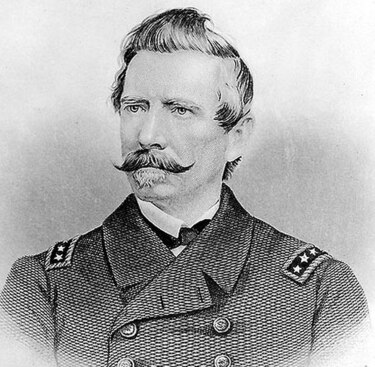
| Raphael Semmes |
Lincoln used General-in-Chief Winfield Scott's Anaconda Plan of blockading the Southern coast to harm the Southern economy. The blockade was loose at first, but became tighter as the war progressed. The number of blockade runners who evaded capture went from about nine out of ten at the beginning to about half near the end. It's likely that part of the blockade's effectiveness was from reducing the number of blockade runners willing to risk getting their ships seized by the blockade. About 8,000 ships successfully ran the blockade during the four years the war lasted, compared with about 20,000 ships during the four years before the blockade. Also, blockade-running ships were small and built for speed, not capacity, and when pursued, they sometimes jettisoned some of their cargo. Confederate blockade runners were captured as prisoners of war, but British blockade runners were released because Lincoln wanted to avoid a war with Britain. Blockade runners who avoided the blockade often brought luxury items instead of the food and weapons that Southerners needed most to get enough of a profit to offset the risk of running the blockade. However, Grant's victory at Vicksburg allowed the Union to capture 60,000 Confederate rifles, mostly Enfields, that were successfully imported by blockade runners and were superior to the rifles used by Grant's infantry.
Bullock went to Liverpool and signed contracts for two steam/sail cruisers that became the CSS Alabama and the CSS Florida. The US consul at Liverpool, Thomas H. Dudley, knew that at least one ship was intended for use as a commerce raider for the Confederacy. Bullock forged papers claiming that the ship, called the Oreto, was owned by a merchant of Palermo. Britain's Foreign Enlistment Act forbade the construction and arming of a ship on British territory for use by a foreign belligerent power. Bullock evaded the act by sailing the Oreto, without arms, to the Bahamas and arming it with weapons from another ship. The ship was renamed the CSS Florida. She destroyed 38 Union ships before the Union navy destroyed the Florida at Bahia, Brazil in October, 1864. Bullock managed to send another ship to the Azores on a "trial run" from which it never returned. The ship, renamed the CSS Alabama, was piloted by Raphael Semmes, who previously piloted the CSS Sumter. For the next two years the Alabama captured or destroyed 64 Union ships before the Alabama was sunk by the USS Kearsarge off the coast of Cherbourg. Bullock also bought a fast steamer loaded with 11,000 Enfield rifles, 400 barrels of gunpowder, several cannons and ammunition, and ran the ship through the blockade to Savannah. The steamer was then converted into the ironclad ram CSS Atlanta. About 20 Confederate privateers captured two dozen prizes.
The five-gun steam sloop CSS Sumter, piloted by Raphael Semmes, captured or burned 18 Union ships. Semmes then piloted the CSS Alabama. The CSS Alabama and the CSS Florida sank so many dozens of Union ships that, after the war, President Grant demanded that the United Kingdom pay the Alabama Claims for all the damage done to Union shipping.
Commodore Silas Stringham put together a flotilla of seven ships with 141 guns to attack a fort guarding Hattaras Inlet off the coast of North Carolina. Beyond this inlet lay the Albemarle and Pamlico sounds, inland seas with rail and canal connections to the interior. Benjamin Butler commanded two transports carrying 900 soldiers and marines. The flotilla's rifled cannon destroyed the partially finished fort.
The USS Massachusetts shelled a half-completed fort on Ship Island, which is midway between New Orleans and Mobile on the Mississippi. The Federals occupied the fort and island as a base for the Gulf blockade squadron for a campaign to capture New Orleans.
Union Flag Officer Samuel du Pont had ships sail in an oval pattern while firing on a fort at Port Royal, South Carolina, forcing Confederates to fire at moving targets. Union forces occupied the region. Ten thousand contrabands were freed and provided with education and used as free labor for growing cotton. Port Royal was the best harbor on the South Atlantic coast. Robert Smalls, a slave who worked on ships, sailed the steamship Planter past Confederate guns to the Union navy.
In April 1862, siege guns on an island at the mouth of the Savannah River battered down Fort Pulaski, giving the Federals control of the entrance to Savannah.
Ambrose E. Burnside commanded 16 gunboats mounting 64 guns, which defeated the mosquito fleet commanded by Confederate Henry A. Wise and neutralized the Confederate shore batteries. The Union gained control of Roanoke Island, North Carolina. Federals then captured Elizabeth City and all the North Carolina ports on the sounds, including New Berne and Beaufort with their rail connections to the interior. Beaufort became another base for the blockade fleet.
When the war began the Union had a much better navy than the Confederacy. However, Confederate Secretary of the Navy Stephen R. Mallory and Commanders Raphael Semmes and and James D. Bulloch were good at improvising. Mallory converted revenue cutters and steamboats into gunboats. He invented "torpedoes" (mines) that, by the end of the war, sank 43 Union warships. The world's first combat submarine, the CSS Hunley, sank three times before sinking a blockade ship off the coast of Charleston. The CSS Hunley then sank for a fourth and last time.
By April 1862, every Confederate Atlantic coast harbor of any importance except for Charleston, South Carolina and Wilmington, North Carolina were controlled by the Union.
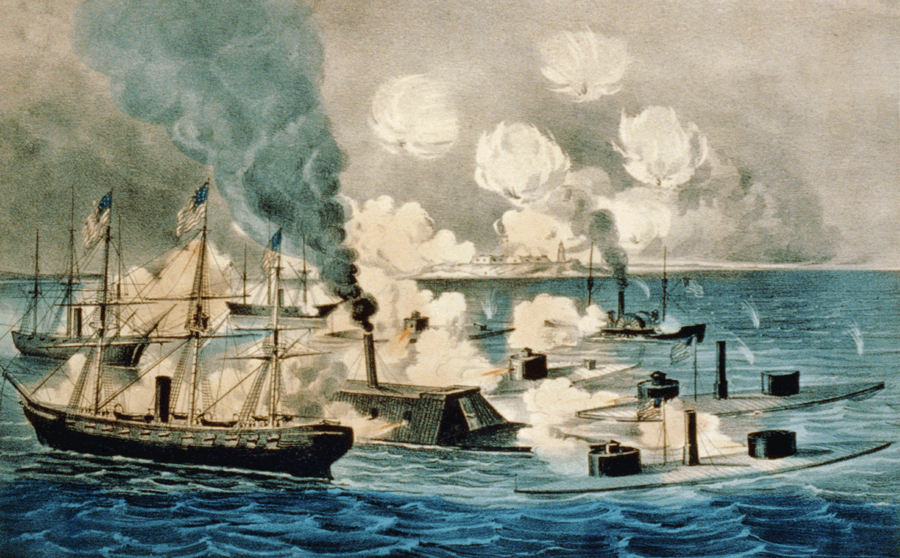
|
| CSS Virginia v. USS Monitor |
One major threat to the Union blockade happened when Mallory had Confederates dredge up a ship called the Merrimack and cover it with iron plating. The renamed CSS Virginia had weak engines and a slow speed. The Union inventor John Ericsson invented a low-lying Union ironclad called the Monitor. The Monitor had a revolving turret with two eleven-inch guns. On March 8, 1862, the CSS Virginia fought against five Union ships armed with 219 guns guarding the mouth of the James River at Hampton Roads. The Union ships included the steam-powered Minnesota and Roanoke and the sailing ships St. Lawrence, Congress and Cumberland. The Virginia sank two Union ships, the Cumberland and the Congress, and the Minnesota ran aground. The Virginia was damaged, with two guns knocked out, every fitting on the deck and part of her smokestack shot away, and her ram wrenched off. The Virginia and the Monitor fought each other at Hampton Roads, Virginia on March 9, 1862. The two hour battle ended in a draw, and the Union blockade continued. For the next two months the ironclads avoided combat. The Virginia became stranded during McClellan's Peninsula Campaign and was blown up by her crew. The Monitor sank in a gale off Cape Hatteras at the end of 1862. Future ironsides, like the Monitor, had low profiles, speed and maneuverability, revolving gun turrets and a few heavy caliber guns.
On August 5, 1864 David Farragut led 14 wooden ships and four Monitors past the largest of three forts guarding the entrance to Mobile Bay. The Confederates had scattered mines across the channel that were called torpedoes. They weren't the same as modern torpedoes, but they did sink ships, including one of Farragut's Monitors with a crew of more than 90. Farragut shouted, "Damn the torpedoes! Full speed ahead." The rest of Farragut's ships got safely past the mines and pounded into submission a rebel flotilla led by the CSS Tennessee. The Union captured the three Confederate forts and shut down Mobile Bay to blockade runners, although Confederates still controlled the city of Mobile.
In January 1865 Fort Fisher was captured by the Union, completing the Union blockade. Instead of masonry, the fort was built of sand and dirt over a log framework. It was 25 feet thick and sodded with marsh grass to absorb shot and shell like a pillow. It was armed with 47 guns to guard the mouth of the Cape Fear River. Admiral David D. Porter assembled a fleet of almost 60 ships plus troop transports to carry 6,500 soldiers to attack the fort. The attack was led by Benjamin Butler, who had a ship loaded with 215 tons of gunpowder explode near the fort. The explosion did no damage. Butler then bombarded the fort, damaging only a few of its guns, and then called off the attack.
Grant relieved Butler of his command and replaced him with General Alfred Terry, who led an infantry of 8,000 men. The fleet opened a barrage that fired 800 tons of shot and shell, knocking out the fort's guns, and cut the wires to the "torpedo" mines. An infantry of 4,500 attacked the north face of the fort while 2,000 sailors and marines attacked the seaward side. At the cost of more than a thousand casualties Terry's troops captured the fort and its 2,000 man garrison, cutting off supplies to Lee's army.

|
| Jefferson Davis |
In the eastern military theater, the July 1861 First Battle of Bull Run or Battle of First Manassas was the first major battle of the war. Union General Irvin McDowell planned to lead his 30,000 soldiers on a flank attack on Confederate commander Pierre G. T. Beauregard's 20,000 Confederates at Manassas Junction, Virginia. Union commander Robert Patterson was supposed to prevent Joseph Johnston's 11,000 Confederates in the Shenandoah Valley from reinforcing Beauregard. However, Patterson failed to block Johnston's Confederates. Confederate Colonel Nathan "Shanks" Evans slowed the Federals long enough for Johnston's reinforcements to arrive. Soldiers on both sides lacked training and experience, and many Union soldiers were near the end of their 90-day enlistments. Confederates were pushed across the Warrenton Turnpike Bridge up the slopes of Henry House Hill. Troops led by Thomas "Stonewall" Jackson stopped the Union assault, and from then on were known as the Stonewall Brigade. Many Union soldiers fled the battle. The result was a Confederate victory. Nathaniel P. Banks replaced Patterson.
Part of the confusion of battle was caused by the fact that uniforms weren't standardized at the beginning of the war. Union soldiers saw other soldiers wearing blue uniforms at Henry House Hill and held their fire, only to find out that they were Confederates. Not all Confederates wore grey at the time.
Lincoln appointed George B. McClellan to lead the Army of the Potomac. McClellan built and drilled a large army but was afraid to use it. He wrote, "By some strange operation of magic I seem to have become the power of the land." However, McClellan kept claiming that the enemy was two to three times as large as it really was. Pinkerton's detective agency also inflated the size of Confederate armies. McClellan wanted a soft war that would allow the preservation of slavery, and made racist remarks about blacks. He called Lincoln "a well meaning baboon" and "the original gorilla." When Lincoln and Seward went to visit McClellan's home, McClellan sent a message that he had gone to bed. McClellan once mistook a log painted by Confederates to look like a cannon for a real cannon. McClellan's critics called the log a "Quaker gun." McClellan always wanted to prepare, but was afraid to act.
McClellan ordered General Charles P. Stone to make a "slight demonstration" on the Maryland side while other Unionists marched upriver on the Virginia side to threaten the Confederate flank to dislodge Confederates from Leesburg, Virginia. Stone assigned Colonel Edward Baker to cross the river to a 100-foot bank called Ball's Bluff. Baker was killed, and his army was defeated. Baker was a friend of Lincoln's.

|
| George B. McClellan |
Republican Congressman Benjamin Wade established the Joint Committee on the Conduct of the War. Stone was accused of treason and imprisoned without trial, and with no evidence to support the charge.
In March through July of 1862, Union General George McClellan launched the Peninsula Campaign in an attempt to capture the Confederate capital of Richmond. McClellan was blocked by Confederate General John Magruder's defense of the Warwick Line and attempted a siege of Yorktown. At the Battle of Williamsburg and the Battle of Drewry's Bluff, Confederate General Joseph Johnston slowly retreated. There were heavy casualties on both sides at the Battle of Seven Pines, and Johnston was wounded and replaced by Confederate General Robert E. Lee. Lee's Confederates drove back McClellan's soldiers during the Seven Days Battles.
McClellan moved his army down the Chesapeake Bay to the mouth of the Rappahannock River, between Joseph E. Johnston and Richmond. Lincoln wanted McClellan to attack the Confederate army instead of trying to capture a location. Johnston moved from Manassas to a more defensible position behind the Rappahannock. Davis opposed Johnston's retreat, especially because Johnston had to destroy huge stockpiles of supplies that couldn't be brought over muddy roads. Newspaper correspondents found more Confederate Quaker guns in Centreville. Also, there were only 45,000 Confederates on the Manassas-Centreville line, half the number claimed by McClellan. The position wasn't as impregnable as McClellan had imagined. McClellan landed at Fort Monroe at the tip of the peninsula surrounded by the York and James rivers.
Quartermaster-General Montgomery Meigs assembled 400 ships and barges to transport more than 100,000 men, 300 cannon, 25,000 animals and a large supply of equipment to the peninsula. Lincoln demoted McClellan from General in Chief to Commander of only the Army of the Potomac. Stonewall Jackson's 4,200 Confederates were defeated by Banks' 9,000 Federals at Kernstown, which is south of Winchester. Lincoln thought that Jackson's army was larger than it was and cancelled the transfer of Banks' divisions and ordered Irvin McDowell's 35,000 men to remain in northern Virginia to guard the capital.

|
| Robert E. Lee |
McClellan's 55,000 troops approached Confederate defensive lines near Yorktown, where Confederate John Magruder's 13,000 troops were dug in behind the Warwick River. Magruder had his infantry march in circles and fire artillery to make it appear that his army was larger than it was. Lincoln wrote to McClellan, "you must act." However, McClellan wrote to his wife that Lincoln "had better come & do it himself." Magruder's defenses were weak, but McClellan was afraid to attack. However, after a month, McClellan's siege guns forced Joe Johnston to retreat up the peninsula. Confederate James Longstreet attacked the Federals near Williamsburg long enough to inflict 2,200 Union casualties while receiving 1,700 Confederate casualties. This battle delayed McClellan's army long enough for Johnston's Confederates to escape with their artillery and wagons.
The Norfolk Navy Yard was destroyed by Confederates to avoid capture. The Monitor and five Union gunboats went up the James River, but were attacked and damaged by Confederate batteries at Drewry's Bluff. This Union defeat saved the Confederate capital of Richmond from invasion.
Before his death from friendly fire at the Battle of Chancellorsville, Thomas "Stonewall" Jackson was Lee's right hand man. He was known for speed and striking power. In his Shenandoah Valley Campaign in 1862 he marched his 17,000 man Stonewall Brigade in a zigzag path 350 miles in one month, fought and won five battles against three separate Union armies with a combined strength of 33,000, using mobility and secrecy to achieve numerical superiority at the point of contact. He tied up 60,000 Union troops for a month to keep them from reinforcing McClellan's army when it besieged Richmond. He also blocked the Union's plans by keeping McDowell from reinforcing McClellan and thwarting Frémont's plan for invading eastern Tennessee. His policy was to "always mystify, mislead, and surprise the enemy."

|
| Stonewall Jackson |
Battles won by Stonewall Jackson during his Valley Campaign are:
- Battle of McDowell (May 8, 1862): Confederate victory.
- Battle of Front Royal (May 23, 1862): Confederate victory.
- First Battle of Winchester (May 25, 1862): Confederate victory.
- Battle of Cross Keys (June 8, 1862): Confederate victory in the first of the "twin battles" preventing Union armies from uniting.
- Battle of Port Republic (June 8, 1862): Confederate victory in the second of the "twin battles" preventing Union armies from uniting.
Lincoln planned to have Irvin McDowell's corp march to cover McClellan's right wing. Lee ordered Stonewall Jackson, reinforced to 17,000 men by a division led by Richard S. Ewell, to attack McDowell's army in the Shenandoah Valley to prevent it from reinforcing McClellan. Jackson defeated a Union army half the size of his that was led by John C. Frémont at the hamlet of McDowell. Jackson's cavalry, led by Turner Ashby, kept up a feint toward Strasburg, deceiving Union commander Banks. Jackson's Confederates defeated a Union army half the size at Front Royal. Banks retreated from Strasburg to his base at Winchester. 15,000 rebels attacked 6,000 Federals, and Banks was forced to retreat to the Potomac. Ashby's soldiers plundered and looted 9,000 rifles, food and medical equipment, and took 2,000 prisoners. Lincoln ordered Frémont and McDowell to stop Jackson, which made his diversion a success, relieving pressure on Richmond. McDowell sent James Shields' division to attack Jackson, but Jackson quickly escaped southward through Strasburg before Shields and Frémont could attack. Ashby's cavalry burned four bridges to slow Union pursuit. Ashby later died in battle.
On June 8, Frémont's troops attacked Confederates at Cross Keys. Even though the Federals outnumbered Ewell's division by 11,000 to 6,000, they had no success. Jackson's army of 15,000 was outnumbered by the combined Union armies, but the armies of Frémont and Shields were separated by an unfordable river, and Jackson held the only bridge. At the Battle of Port Republic Jackson's 7,000 to 8,000 man army was held off by Shield's two brigades of 3,000 bluecoats for three hours. By the time Jackson's superior numbers defeated the Federals, Jackson's army was too damaged to fight Frémont again, so Jackson retreated to Brown's Gap in the Blue Ridge.
At the May 31 Battle of Seven Pines or Fair Oaks, the Chickahominy River rose because of rain, and the bridges between the northern and southern sides of McClelland's army were flooded by torrential showers. McClellan placed more than half his army on the north side to protect his base of supplies. Confederate Joe Johnston attacked the weaker left flank of McClellan's army south of the Chickahominy River. Johnston's army was reinforced by North Carolina troops to nearly 75,000 men, giving Johnston's army a numerical edge over the wing of McClellan's army south of the river. The Confederate assaults, although poorly coordinated, succeeded in driving back the IV Corps of the Union army's left flank back to the village of Seven Pines. Supported by the III Corps and Maj. Gen. John Sedgwick's division of Maj. Gen. Edwin V. Sumner's II Corps (which crossed the rain-swollen river on Grapevine Bridge), the Union army's right flank halted a Confederate attack at Fair Oaks. Additional Union reinforcements forced Confederates to yield the ground they had won on the first day. Both sides claimed victory. Although the battle was tactically inconclusive, it was the largest battle in the Eastern Theater up to that time (and second only to Shiloh in terms of casualties thus far, about 11,000 total). Gen. Joe Johnston was seriously wounded during the action, and command of the Confederate army devolved temporarily to Maj. Gen. G.W. Smith. Davis then chose Robert E. Lee to replace Johnston.
Lee had Confederates reinforce trenches and fortifications near Richmond. His critics called him "the king of spades." While Lee was a good tactician, his army had the highest casualty rate of any army, North or South. He believed in an offensive-defensive strategy for victories. In each of the Seven Days Battles the Confederates had a higher proportion of casualties compared with McClellan's army. Subsequent battles fought by Lee's Army of Northern Virginia also had high casualty rates.
Confederate Jeb Stuart's cavalry found that the right flank of McClellan's army was unprotected. Stuart's cavalry rode around the Union army, capturing 170 Union soldiers as well as horses, mules and wagonloads of supplies. Stuart's cavalry used an improvised bridge, which it burned to prevent pursuit, and returned to Richmond.
The Seven Days Battles were a series of battles over seven days from June 25 to July 1, 1862, near Richmond, Virginia. Confederate General Robert E. Lee drove the invading Union Army of the Potomac, commanded by Maj. Gen. George B. McClellan, away from Richmond and into a retreat down the Virginia Peninsula.
Lee planned to have Jackson's army attack the flank of Porter's corps at the same time that three divisions from Richmond attacked the front. This meant that, while Lee concentrated 60,000 Confederates against 30,000 of Porter's Federals on the north of the Chickahominy, the 75,000 Federals south of the river could attack the 27,000 Confederates guarding Richmond. Lee gambled that McClellan would be too timid to make the attempt. Lee's assumption was correct, as McClellan continued to believe that he was outnumbered everywhere. Lee attacked near the end of June. Jackson failed to show up, and Confederate A. P. Hill's attack on a Union army entrenched at Beaver Dam Creek near Mechanicsville resulted in 1,500 Confederate casualties and only 360 Union casualties.
Even after winning a victory, McClellan ordered Porter to withdraw to a strong position at Boatswain's Swamp near Gaines' Mill. McClellan also shifted his base and supplies to the James River on the south side of the peninsula. McClellan had to give up his siege guns to do this, as they could only be moved by rail, and there was no rail to move them to the James River. Lee's plan was to have the 55,000 Confederates led by A. P. Hill, Longstreet and Jackson attack Porter's 35,000-man Union army at Mechanicsville. However, Jackson was still slow from exhaustion. Confederate John Bell Hood led an attack on the center of Porter's army, causing it to collapse. However, this Confederate victory came at a high cost. Union casualties included 2,800 captured and 4,000 killed or wounded. Confederate casualties were 9,000. McClellan again thought that he was outnumbered and telegraphed Union Secretary of War Stanton, "You have done your best to sacrifice this army."
As McClellan retreated toward the James River, Lee planned to have nine Confederate divisions converge using six different roads and attack McClellan's army at Savage Station. Lee wanted Magruder to attack from the west while Jackson attacked from the north. However, Jackson spent the day rebuilding a bridge instead of fording the river. Magruder's attack was repulsed, but McClellan's army continued to withdraw.
Lee planned to send seven divisions near the city of Glendale. Only Hill and Longstreet managed to get their men into action. Jackson took a nap. Confederates had a higher casualty rate, but McClellan's army continued to withdraw.
The Union army moved to a strongly defended position at Malvern Hill. The 5,500 Confederates killed were twice the Union number. Still, McClellan continued his retreat, moving to Harrison's Landing on the James River.
Union General Pope moved east to fight Lee's army. Pope gave an address saying, "I come to you out of the West, where we have always seen the backs of our enemies." This statement won him few friends, but Lincoln and McClellan planned to unite Pope's 50,000 north of Richmond with McClellan's 100,000 from the peninsula. Pope's army threatened a Confederate rail junction at Gordonsville, so Lee ordered Jackson's 12,000 Confederates to join 13,000 from A. P. Hill. The Confederates could use interior lines to reinforce Jackson, whereas it took McClellan longer to move reinforcements to Pope. At Cedar Mountain, Union General Nathaniel Banks was outnumbered two to one, but attacked by surprise to force Jackson's Confederates to withdraw. Confederate A. P. Hill led a counterattack that forced the Federals to retreat until Union reinforcements pushed Jackson's Confederates back to Gordonsville.
In the August 1862 Second Battle of Bull Run or Second Manassas, Union General John Pope was defeated by Confederates Stonewall Jackson and James Longstreet.
Lee's 55,000 Confederates faced Pope's army at the Rappahannock River. Pope was waiting for reinforcements from McClellan. Lee had Jackson's army cut Union rail communications deep in the rear of Pope's army. Jackson's Confederates followed the rail to Pope's main supply base at Manassas and then took what supplies they could and put a torch to the rest.
Herman Haupt had built the supply bases. It was said that he could build bridges faster than the Confederates could burn them down. Within four days, Haupt repaired the rail cut by Confederates.
One of Pope's divisions, including the brigade that would later be called the Iron Brigade, engaged in a fierce firefight with the Stonewall Brigade. Both brigades had among the highest casualty rates. Pope threw his army piecemeal at the Stonewall Brigade, which was entrenched at an unfinished railroad. Pope's 32,000 Federals attacked Jackson's 22,000 Confederates. Reinforcements from McDowell and Porter were supposed to arrive, but Porter did nothing and was later court-martialled for it. McDowell's troops did little. However, Longstreet also failed to reinforce Jackson's army at first. Pope thought that Confederates were retreating and attacked, only to be met with fierce resistance. Then Longstreet attacked the Federals with five divisions and artillery. The Federals fell back to Henry House Hill and then retreated to Washington. They fought one more battle at Chantilly on the way.
Lee then invaded Maryland but was defeated at the September 1862 Battle of Antietam or Sharpsburg by McClellan's Union army. The battle was a narrow victory for the Union in that Lee was forced to retreat, but the fact that McClellan failed to pursue Lee led to his removal by Lincoln. McClellan was risk-averse and Lincoln said that he had "the slows" before sacking him in November 1862.
Lee's army marched through Frederick, Maryland, and Lee proclaimed that he would "aid you in throwing off this foreign yoke" in an attempt to liberate it, and was met with a cool reception from the pro-Union part of Maryland. A Union garrison known as the Railroad Brigade guarded the B & O Railroad and the Chesapeake and Ohio Canal, blocking a route for Lee's army to get supplies and ammunition. Lee moved on to Harper's Ferry with almost two-thirds of his army, yet again dividing his army in an attempt to capture the 12,000 bluecoats guarding the arsenal. Lee thought that McClellan would be overly cautious again, but McClellan's army, reinforced to 80,000 men, moved upon Lee's 50,000 Confederates, which McClellan estimated to number 110,000. A Confederate dropped Lee's battle plan, wrapped around three cigars, and McClellan was made aware from it that he could attack the four parts of Lee's army before they united. However, McClellan hesitated for 18 hours, giving Lee time to reunite his army. A pro-Confederate citizen of Maryland told Stuart about the lost orders, and Lee was made aware that the Federals knew about it. Two Union corps fought D. H. Hill's Confederates at Turner's Gap. The Confederates were attempting to block the South Mountain passes and took heavy losses until reinforced by Longstreet. This gave Confederates an extra day. A Union corps under William B. Franklin smashed through Crampton's Gap, but arrived too late to prevent Confederates led by Jackson from capturing Harper's Ferry.
The armies of McClellan and Lee clashed near Sharpsburg, Maryland and Antietam Creek. McClellan's 60,000 Union soldiers faced around 25,000 to 30,000 Confederates. McClellan was too cautious to succeed in attacking Lee's armies before they could unite. McClellan failed to coordinate attacks on the right, which went forth in three stages instead of simultaneously. This allowed Lee to shift troops from other areas to meet the attacks. Burnside was slow because he tried to lead troops over a well-defended bridge instead of having his soldiers wade across nearby fords with little opposition. Burnside's tardiness allowed Lee to shift a division from the Confederate right to the embattled left.
Joseph Hooker's Union 1st Corps led the attack at dawn down the Hagerstown Pike and drove Jackson's soldiers away from a cornfield and the pike. Lee sent reinforcements from D. H. Hill to the center and Longstreet's corps to the right. These shattered Hooker's corps until the Union 12th Corps launched a second northern assault. This attack penetrated the Confederate position at Dunkard Church before being driven back with heavy losses. A third wave led by "Bull" Sumner's 2nd Corps broke through the rebel line in the West Woods until Lee shifted a division from Burnside's bridge and another division from Harper's Ferry. The counterattack drove Sumner's troops back. One of the wounded was Oliver Wendell Holmes, Jr.
Two of Sumner's divisions attacked Confederates at a sunken road called Bloody Lane because of the high number of casualties. Union soldiers prevailed. McClellan was so intimidated by the carnage that he refused to send Franklin's 6th Corps to reinforce Union soldiers there.
A brigade of Georgians led by Robert A. Toombs spent the morning shooting at Burnside's troops at a bridge. Two of Burnside's regiments crossed the bridge with heavy losses, and other Union soldiers crossed at fords in the river. Three of Burnside's divisions drove Confederates back to Sharpsburg. McClellan and Porter refused to send Porter's 5th Corps to reinforce Burnside. However, A.P. Hill's division reinforced Confederate troops, who forced the Federals to retreat. Several of Hill's soldiers wore captured Union blue uniforms, causing Union soldiers to hold their fire. After very high casualties on both sides, Lee retreated back to Virginia.
Bragg's Confederate invasion of Kentucky and Lee's attempt to liberate Maryland both ended in failure. The Union victory at Antietam, while narrow, gave Lincoln an opportunity to issue his Emancipation Proclamation.
McClellan, as usual, claimed that he would need more soldiers and supplies before he could attack Lee's army again. Halleck said, "It requires the lever of Archimedes to move this inert mass." Lincoln replaced McClellan with Burnside.
At the December 1862 battle at Fredericksburg, Virginia, Union General Ambrose E. Burnside attempted to use pontoon boats to cross the Rappahannock River and capture the Confederate capital of Richmond, but the pontoon boats arrived late. Burnside then attacked the heavily fortified ridge west of Richmond known as Marye's Heights. Burnside's soldiers had more than twice as many casualties as Lee's army and lost the battle.
Burnside moved the 110,000-man Union army to Falmouth, across the Rappahannock from Fredericksburg. Burnside sent an unclear request for pontoons without specifying when and where they were needed. Lee had his 75,000 Confederates dug in on the hills south of the Rappahannock by the time pontoons arrived.
On December 11, 1862, Union engineers laid three pontoon bridges at Fredericksburg and three more bridges a few miles south of it. On December 13 Burnside's left wing, commanded by William B. Franklin, assaulted the Confederate right, led by Jackson. The Union right attacked Longstreet's Confederates at Marye's Heights. If Franklin's attack succeeded, troops could be shifted to more than probe Longstreet's position. However, Franklin failed to push ahead with his 50,000 men.
Federals attacked Jackson's troops on Prospect Hill. A division of Pennsylvanians commanded by George Gordon Meade penetrated Confederate defences. Franklin failed to send troops to exploit this attack, and Confederates sent reinforcements to counterattack. Franklin never got half his men into action and did not renew the attack, even after being ordered to do so by Burnside. On the Union right, ravines, a marsh and a drainage ditch channeled Union soldiers toward a sunken road fronted by a half-mile long stone fence at the base of the hill. There were almost 13,000 Union casualties, most of them at the base of the stone wall at the base of Marye's Heights. Confederates had fewer than 5,000 casualties. A torrential rain turned a Union march along the Rappahannock into a "Mud March." Confederate pickets held up a sign reading, "This way to Richmond." Lincoln replaced Burnside with Joseph Hooker.
At the April through May 1863 Battle of Chancellorsville, Virginia, Lee had only 60,000 near the Rappahannock, while Hooker had twice as many. Lee divided his smaller army and won a surprising victory, but Stonewall Jackson died of friendly fire from North Carolina soldiers.
Hooker replaced corrupt quartermasters, improved food and cleaned the camps and hospitals. 10,000 Union soldiers headed south to cut Lee's supply lines. 70,000 Union soldiers crossed fords near Lee's left flank, while 40,000 Union soldiers feigned an advance at Fredericksburg. The 70,000 Union soldiers arrived at Chancellorsville in a forest called the Wilderness. When Lee's army approached, Hooker ordered his army back to a defensive position. Stuart told Lee that the right flank of Hooker's army was "in the air" or undefended. A local resident guided Jackson's soldiers to a path through the forest used for hauling charcoal for an iron-smelting furnace. Jackson's 30,000 infantry and artillery made a 12-mile march while Lee remained with only 15,000 to confront Hooker's main force. Hooker couldn't get information from his cavalry after he sent it on a raid. Even though two of Daniel Sickles' 3rd Corps divisions attacked the tail of Jackson's column, Hooker ignored the threat. Oliver O. Howard, who commanded the 11th Corps holding the Union right, was told by pickets of activity by Jackson, but Hooker thought it was to cover a retreat. Jackson's attack forced the Union army to retreat for two miles. The moonlit battle resulted in friendly fire casualties. One of them was Jackson, who was killed by accident by North Carolina Confederates. A wound led to pneumonia, and Jackson died eight days later. John Sedgwick, Union commander of the 6th Corps, hurled his three divisions at Marye's Heights. On the third try they succeeded in carrying the heights. Hooker appeared to be stunned into inaction, and then ordered a withdrawal northward. Lee sent reinforcements to attack Sedgwick, leaving only 25,000 Confederates under Stuart facing 75,000 Union soldiers. Sedgwick repelled an attack by 21,000 Confederates, but Hooker gave up, forcing Sedgwick to retreat over the Rappahannock. The result was a victory for Lee's much smaller army. However, the victory was costly. Confederates suffered 13,000 casualties, or 22 percent of their force. The Union had 17,000 casualties, or 15 percent of their force.
Eight Monitors failed to take Charleston. While they could take a lot of punishment, they had limited offensive power. Confederates fired 2,200 shots scoring 440 hits. Only one Monitor sank, but most of the rest had damaged gun turrets and got off only 140 shots.
Lee reorganized his army into three infantry corps and six cavalry brigades for a total of 75,000 men. A. P. Hill commanded the 3rd Corps while Jackson's old 2nd Corps went to Richard Ewell. Ewell captured 3,500 men at Union garrisons at Winchester and Martinsburg.
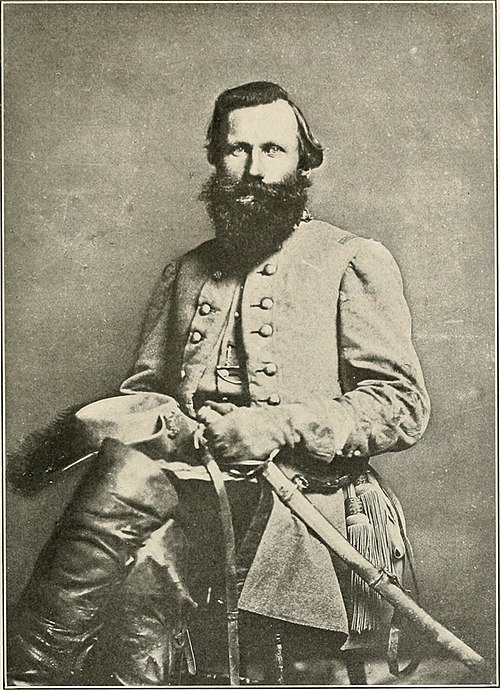
|
|
Confederate cavalry General James Ewell Brown "Jeb" Stuart |
On June 9, 1863 the Union cavalry crossed the Rappahannock and found that Lee's army was invading the north for the second time. Hooker went north but avoided Lee's army and on June 28 was replaced by Maj. Gen. George Gordon Meade, who moved his army north to protect Washington, D.C., from invasion. Lee's army crossed the Potomac River and reached the Susquehanna River in Pennsylvania. Lee's cavalry commander, Gen. Jeb Stuart, went on a roundabout raid to gather supplies. Unfortunately for Stuart's plan, the Union army's movement was underway, and his proposed route was blocked by columns of Federal infantry, forcing him to veer farther to the east than either he or General Lee had anticipated. This prevented Stuart from linking up with Ewell as ordered and deprived Lee of the use of his prime cavalry force, the "eyes and ears" of the army. Lee, without the intelligence he expected to get from Stuart, ordered his army to Gettysburg. Lee's army captured and enslaved Pennsylvania blacks.
Lee attempted to replenish supplies for his army from the farms in Pennsylvania. In an attempt to win support in the North, Confederates paid for goods they confiscated with Confederate money. Lee forbade pillaging, but his army destroyed Thaddeus Stevens' ironworks, wrecked railroad property, levied forced requisitions of money from merchants and banks and seized clothing, shoes, horses, cattle and food, giving Confederate IOUs in return. In Chambersburg, Confederates opened shops with axes until given the keys. To a farm woman who protested the seizure of all her hogs and cattle Longstreet said, "Yes, madam, it's very sad-very sad; and this sort of thing has been going on in Virginia more than two years- very sad."
When a scout told Lee that the Army of the Potomac was near, Lee tried to unite his scattered army. He recalled Ewell's division from York and Carlisle, and Confederate A. P. Hill set his division under Maj. Gen. Henry Heth to Gettysburg to "get those shoes." Two brigades of Union cavalry led by John Buford were waiting for the rebels. Buford sent for John Reynolds Union infantry to join him. Buford slowed the Confederate advance until the infantry of the Union I and XI Corps under Maj. Gen. John F. Reynolds arrived. Reynolds was killed in action. General Howard's 11th Corps clashed with Ewell's 2nd Corps. 24,000 Confederates faced 19,000 Federals. The right flank of Howard's army collapsed when attacked by Ewell's and Hill's Confederates. Howard's 11th Corps retreated to Cemetary Hill a half mile to the south. The Union 1st Corps also retreated to the hill. Union artillery and Howard's reserve division stopped the Confederate advance.
Union General Winfield Scott Hancock arrived and laid out a strong defensive line from Cemetary and Culp's hills and extending along Cemetary Ridge toward Little Round Top. Three more Union corps arrived during the night. The line occupied high ground that was easy to defend and allowed convex interior lines that made it easy to shift troops as needed. Longstreet thought that the Union position was too strong to attack, but Lee ordered one anyway.
On July 2, 1863, Lee launched a heavy assault commanded by Lieut. Gen. James Longstreet on the Union left flank. Longstreet's two divisions were joined by a division from Hill. Ewell was to demenstrate against the Union right. The Union left wasn't where Longstreet expected it to be because Dan Sickles, commander of the Union 3rd Corps, made an unauthorized move of his two divisions to higher ground at a salient with its apex in a peach orchard and its left anchored by boulders called Devil's Den, just below Little Round Top. Both sides were caught by surprise by Sickle's move.
Fierce fighting raged at Devil's Den, Little Round Top, the wheatfield, the peach orchard, and Cemetery Ridge as Longstreet's men closed in on the Union position. Using their shorter interior lines, Union II Corps commander Maj. Gen. Winfield S. Hancock and others moved reinforcements from three other corps to blunt Confederate advances. On Longstreet's front two Union regiments, the 20th Maine and the 1st Minnesota, held off Confederate attacks. Sickle's move left the round tops unguarded. If Confederates got artillary there, they could have posed a major threat. Meade's chief of engineers Gouverneur K. Warren persuaded the 5th Corps commander to send a brigade to Little Round Top in time to meet the Confederate attack there. At the far left of this brigade was the 20th Main, commanded by Colonel Joshua L. Chamberlain. When his soldiers ran out of ammunition, Chamberlain had his soldiers use bayonets. Scores of surprised Confederates were captured. Sickles lost ground at the peach orchard, but the Union held Little Round Top.
An Alabama brigate threatened the center of Cemetary Ridge. Union Winfield Scott Hancock's 2nd Corps occupied this position. Hancock ordered 262 men to charge 1,600 Alabamans to slow them down until reinforcements could arrive. Only 47 of them came back alive.
To the north, the shift of Union troops to meet Longstreet's attack gave Ewell an opportunity, but his troops had little success when darkness fell. The Union armies lost Sickle's salient, but controlled the rest. By shifting troops and reinforcing where needed, the Union kept control of Cemetary Ridge and the Round Tops.
On July 3, 1863, fighting resumed at the extreme Union right on Culp's Hill as units of the Union 12th Corps regained trenches abandoned to the Confederates the previous day after a seven hour firefight. Lee ordered Longstreet to lead a charge at the Union center with Pickett's division and two of Hill's, fewer than 15,000 men. They were to advance three-quarters of a mile across open fields and assault a dug-in infantry supported by artillery. Longstreet thought the charge was hopeless and called that day "one of the saddest of my life." At 1 p.m. about 150 artillery guns on each side exchanged fire for two hours. The rebels aim was high, so Union soldiers behind stone walls and breastworks suffered little. At about 3 p.m. Pickett's three divisions were joined by six from Hill on their left and two others in reserve. Henry J. Hunt, who was in charge of Union artillery, had ordered Union guns to be silenced to lure Confederates into attacking. These guns began firing again against Confederates led by Pickett. Vermont, New York and Ohio regiments fired on the flanks of Pickett's Charge, while other Yankees fired on the center of it. Of the 14,000 Confederates who followed Pickett, only half returned. Confederate General Lewis A. Armistead led two or three hundred Virginians and Tennesseans to breach the first Union line. Armistead was wounded and died with his hand on a cannon. Pickett's half hour charge was a failure, but Meade chose not to counterattack. When ordered to reform his men after the attack by Lee, Pickett replied, "I have no division." Lee withdrew his army from Gettysburg and retreated back to Virginia. After the twin Union victories at Vicksburg and Gettysburg, Confederate chief of ordinance Josiah Gorgas wrote, "today absolute ruin seems to be our portion. The Confederacy totters to its destruction."
A Union cavalry wrecked the Confederate pontoon bridge over the Potomac, and Confederate engineers tore down warehouses to build a new bridge while waiting for an attack that never came.
At Gettysburg, 93,921 Union soldiers defeated 71,699 Confederates during a three-day battle. Union casualties were 23,049, Confederate casualties were 28,063. Gettysburg was Lee's greatest defeat. Lincoln was angry with Meade for allowing Lee's army to escape, even though the result was a major victory for the Union. Lincoln wrote to Meade "… my dear general, I do not believe you appreciate the magnitude of the misfortune involved in Lee's escape. He was within your easy grasp, and to have closed upon him would, in connection with our other late successes, have ended the war…." Lincoln never sent this message to his general.
In his Gettysburg Address Lincoln said:
Four score and seven years ago our fathers brought forth on this continent, a new nation, conceived in Liberty, and dedicated to the proposition that all men are created equal.
Now we are engaged in a great civil war, testing whether that nation, or any nation so conceived and so dedicated, can long endure. We are met on a great battle-field of that war. We have come to dedicate a portion of that field, as a final resting place for those who here gave their lives that that nation might live. It is altogether fitting and proper that we should do this.
But, in a larger sense, we can not dedicate — we can not consecrate — we can not hallow — this ground. The brave men, living and dead, who struggled here, have consecrated it, far above our poor power to add or detract. The world will little note, nor long remember what we say here, but it can never forget what they did here. It is for us the living, rather, to be dedicated here to the unfinished work which they who fought here have thus far so nobly advanced. It is rather for us to be here dedicated to the great task remaining before us — that from these honored dead we take increased devotion to that cause for which they gave the last full measure of devotion — that we here highly resolve that these dead shall not have died in vain — that this nation, under God, shall have a new birth of freedom — and that government of the people, by the people, for the people, shall not perish from the earth.
Union soldiers realized that the war was about not only freedom in America but the fate of liberty throughout the world. At a time when other countries were ruled by kings and queens, an Ohio corporal wrote to his wife,
If I do get hurt I want you to remember that it will be not only for my Country and my Children but for Liberty all over the World that I risked my life, for if Liberty should be crushed here, what hope would there be for the cause of Human Progress anywhere else?
In 1862 there were about half a dozen anti-black riots in the North. The worst of them was in Cincinnati, where the replacement of Irish dockworkers by blacks led to attacks on black neighborhoods. In Brooklyn a mob of Irish-Americans tried to burn down a tobacco factory where two dozen black women and children were working. Even though the war created labor shortages, threats of violence prevented the War Department from using carloads of contrabands to help harvest crops. The contrabands had to be returned down South. A Democratic newspaper headline read, "Shall the Working Classes be Equalized With Negroes?"
The New York City draft riots (July 13–16, 1863) were violent disturbances in Lower Manhattan caused by working-class discontent among mainly Irish immigrants with new laws passed by Congress that year to draft men to fight in the ongoing American Civil War. Striking longshoremen were replaced by black stevedores protected by police, and Irishmen blamed blacks for the draft. The protests turned into a race riot against African Americans by Irish American rioters. President Abraham Lincoln diverted several regiments of militia and volunteer troops after the Battle of Gettysburg to control the city. More than a hundred people died during the riot, many of them blacks who were lynched. The military did not reach the city until the second day of rioting, by which time the mobs had ransacked or destroyed numerous public buildings, two Protestant churches, the homes of various abolitionists or sympathizers, many black homes, and the Colored Orphan Asylum at 44th Street and Fifth Avenue, which was burned to the ground.

|
| Black Union soldiers |
The emancipation of slaves became a growing issue throughout the war. At first, some Union Generals thought they were supposed to return escaped slaves to their masters. However, doing so increasingly seemed like helping the enemy. Slavery was a strength for the South, but it could be turned into a weakness. For every slave who grew food for the enemy, a Southern white man could be spared to fight against the Union. General Sherman was not against slavery when the war began, but he was strongly opposed to secession. He said he was tired of Southerners asking him to use his army to chase after their runaway slaves, and then said they deserved to lose their slaves because of secession. On March 13, 1862 Congress passed a law forbidding Union generals from returning escaped slaves to their masters. Congress passed confiscation laws in August 1861 and July 1862 as attempts at emancipation, but they only applied to the confiscation of slaves directly involved in the war effort. Generals John C. Frémont and David Hunter went beyond this in emancipating slaves. At the time Lincoln said that "To lose Kentucky is nearly the same as to lose the whole game" and revoked what he saw as premature attempts at emancipation. Benjamin Butler, a lawyer and a general, said that escaped slaves were contraband and could be seized as enemy property. He freed three slaves who had been working on enemy fortifications and escaped to Butler's lines at Fortress Monroe, Virginia. The administration approved of Butler's contraband policy, and thousands of contrabands thereafter gained their freedom. Not all of the contrabands were covered by confiscation laws, as some them were not working for the Confederate war effort when they escaped. The British set a precedent for this policy by freeing American slaves who joined the British. Slaves themselves made emancipation an issue by joining the nearest Union army, seeking their freedom. Abolitionists organized freedmen's aid societies to send teachers and labor superintendents to promote education and free labor for blacks in the South Carolina sea islands controlled by the Union.
At first the North's war goal was to save the Union. Frederick Douglass said, "To fight against slaveholders, without fighting against slavery, is but a half-hearted business, and paralyzes the hand engaged in it ... Fire must be met with water. War for the destruction of liberty must be met with the destruction of slavery." He said, "The very stomach of this rebellion is the negro in the form of a slave. Arrest that hoe in the hands of the negro, and you smite the rebellion in the very seat of its life." In a November 27, 1861 letter to Jesse Root Grant, Ulysses Grant wrote that if the Confederacy "cannot be whipped in any other way than through a war against slavery, let it come to that."
Union General George McClellan, after his failed Peninsula campaign, wrote to Lincoln, "A declaration of radical views, especially upon slavery, will rapidly disintregrate our present armies." Lincoln was moving in the opposite direction. After three unsuccessful attempts to persuade the border states to accept emancipation, Lincoln thought that the fact that no easy victory was possible meant that emancipation could be justified by military necessity. Lincoln said, "We must free the slaves or be ourselves subdued" to "strike at the heart of the rebellion." According to the historian James B. McPherson, it's likely that Lee's victory over McClellan during the Seven Days Battles made emancipation a Union war goal by lengthening the war. A long war pushed Republican moderates to agree with the radicals on the need for emancipation.
Lincoln made failed attempts at colonizing emancipated slaves in Central America and an island near Haiti. Lincoln hoped that combining emancipation with colonization would recuce racist fears of emancipation among whites. The Central American project failed because of opposition from Nicaragua and Honduras. Would be colonizers on the island got smallpox and some died of starvation. The 368 survivors out of the 453 who went there were returned to the US by a naval vessel. These failures ended attempts at colonization. Many blacks were born in the US and thought they had a right to be here.
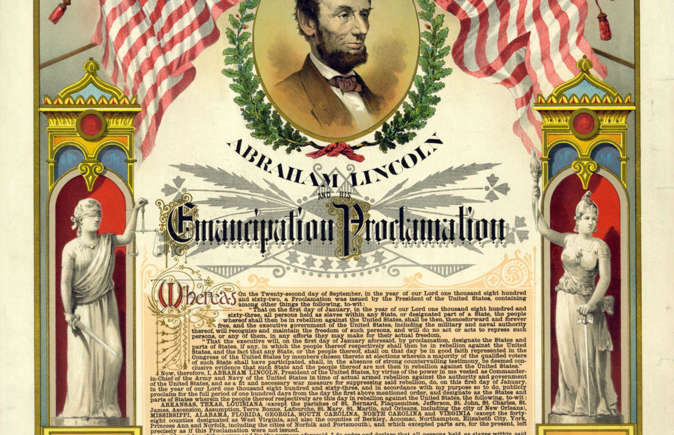
|
| Emancipation Proclamation |
Lincoln later mentioned his own Emancipation Proclamation to members of his cabinet. On August 22, 1862, Lincoln wrote a letter to Horace Greeley's New York Tribune that was aimed at convincing the border states to accept emancipation as necessary to save the Union. Lincoln's letter to Greeley ended with his "personal wish that all men, everywhere could be free." Seward advised him to wait for a victory, as to do otherwise would seem like the "last shriek" on retreat. Lincoln therefore waited until after the Union victory at Antietam to issue his preliminary Emancipation Proclamation on September 22, 1862, and his final Emancipation Proclamation on January 1, 1863. Lincoln said at the time, "if my name ever goes into history it will be for this act, and my whole soul is in it." As a military measure, it only freed slaves in territory controlled by the enemy at that date. It didn't affect the four border states. With the progress of Union arms, millions of slaves gained their freedom by joining the nearest Union army. Frederick Douglass wrote, "We shout for joy that we live to record this righteous decree." Garrison called it "an act of immense historic consequence." General-in-Chief Halleck said, "Every slave withdrawn from the enemy is the equivalent of a white man put hors de combat." Karl Marx wrote, "Never has such a gigantic transformation taken place so rapidly." According to Marx, "Workingmen of Europe feel sure that as the American War of Independence initiated a new era of ascendancy for the middle class, so the American Antislavery War will do for the working classes." McClellan called the proclamation an "accursed doctrine" and "infamous." Democrats called the Proclamation "another advance in the Robespierrian highway of tyranny and anarchy." Democrats gained a net of 34 seats in Congress during the 1862 elections, and Democrats won other elections in New York, New Jersey, Illinois and Indiana. However, Republicans gained a net of five seats in the US Senate, and retained a 25 vote majority in the US House of Representatives. Booker T. Washington, one of the slaves emancipated by Lincoln's Proclamation described it as follows:
As the great day drew nearer, there was more singing in the slave quarters than usual. It was bolder, had more ring, and lasted later into the night. Most of the verses of the plantation songs had some reference to freedom.... [S]ome man who seemed to be a stranger (a United States officer, I presume) made a little speech and then read a rather long paper-the Emancipation Proclamation, I think. After the reading we were told that we were all free, and could go when and where we pleased. My mother, who was standing by my side, leaned over and kissed her children, while tears of joy ran down her cheeks. She explained to us what it all meant, that this was the day for which she had been so long praying, but fearing that she would never live to see.
The newly elected Democratic legislatures of Indiana and Illinois passed resolutions calling for an armistice and a peace conference. They demanded a retraction of the "wicked, inhuman and unholy" Emancipation Proclamation. Governor Richard Yates of Illinois and Governor Oliver P. Morton of Indiana shut down the legislatures of their states to support emancipation.
Even though Lincoln's Emancipation Proclamation didn't apply to Tennessee, the Union held portions of Louisiana and Virginia or the border states Lincoln tried, without success, to convince the four border states to follow his gradual plan based on compensated emancipation and colonization. From March to July, 1862 Lincoln made "earnest and successive appeals to the border states to favor compensated emancipation." Lincoln said that the "friction and abrasion" of war would cause the loss of their slaves and that they should get compensated for it while there was still time. In his December 1, 1862 address to Congress he said,
The dogmas of the quiet past, are inadequate to the stormy present. The occasion is piled high with difficulty, and we must rise — with the occasion. As our case is new, so we must think anew, and act anew. We must disenthrall ourselves, and then we shall save our country.
Fellow-citizens, we cannot escape history. We of this Congress and this administration, will be remembered in spite of ourselves. No personal significance, or insignificance, can spare one or another of us. The fiery trial through which we pass, will light us down, in honor or dishonor, to the latest generation. We say we are for the Union. The world will not forget that we say this. We know how to save the Union. The world knows we do know how to save it. We — even we here — hold the power, and bear the responsibility. In giving freedom to the slave, we assure freedom to the free — honorable alike in what we give, and what we preserve. We shall nobly save, or meanly lose, the last best hope of earth. Other means may succeed; this could not fail. The way is plain, peaceful, generous, just — a way which, if followed, the world will forever applaud, and God must forever bless.
Only the District of Columbia accepted Lincoln's gradual plan. All four border states rejected it.
Lincoln wanted to arm emancipated slaves as soldiers. Most of Lincoln's generals opposed the idea. The exception was General Ulysses S. Grant. Before the war Grant's wife Julia owned four slaves. Grant bought one slave before choosing to free him for personal reasons, not because he thought slavery was wrong. However, Grant agreed with Lincoln that arming slaves as soldiers weakened the enemy and strengthened the Union. As Grant said in his August 23, 1863 letter to Lincoln,
I have given the subject of arming the negro my hearty support. This, with the emancipation of the negro, is the heaviest blow yet given the Confederacy. ... by arming the negro we have added a powerful ally. They will make good soldiers and taking them from the enemy weakens him in the same proportion they strengthen us. I am therefore most decidedly in favor of pushing this policy to the enlistment of a force sufficient to hold all the South falling into our hands and to aid in capturing more.
Lincoln then asked Frederick Douglass to enlist emancipated slaves for the Union army. Douglass said that it was hard to find recruits because blacks weren't paid the same as whites. Lincoln explained that most of his Generals opposed arming emancipated slaves, but said that blacks would get equal pay, and in time they did. Almost 180,000 emancipated slaves fought in the Union army, and another 18,000 fought in the Navy. Douglass said, "Once let the black man get upon his person the brass letters, US; let him get an eagle on his button, and a musket on his shoulders and bullets in his pocket, and there is no power on earth which can deny that he has earned the right to citizenship."
Black soldiers were led by white abolitionists. The 1st South Carolina Volunteers were led by Thomas Wentworth Higginson, who took his regiment on a raid and wrote, "No officer in this regiment now doubts that the key to the successful prosecution of the war lies in the unlimited employment of black troops." Governor Andrews of Massachusetts enlisted the 54th and 55th of Massachusetts.
In his August 26, 1863 letter to Conkling Lincoln replied to those who said he should end his Emancipation Proclamation:
But negroes, like other people, act upon motives. Why should they do anything for us if we will do nothing for them? If they stake their lives for us, they must be prompted by the strongest motive, even the promise of freedom. And the promise, being made, must be kept.
In his April 4, 1864 letter to Albert G. Hodges Lincoln explained his path to emancipation as follows:
I am naturally anti-slavery. If slavery is not wrong, nothing is wrong. I can not remember when I did not so think, and feel. And yet I have never understood that the Presidency conferred upon me an unrestricted right to act officially upon this judgment and feeling. It was in the oath I took that I would, to the best of my ability, preserve, protect, and defend the Constitution of the United States. I could not take the office without taking the oath. Nor was it my view that I might take an oath to get power, and break the oath in using the power. I understood, too, that in ordinary civil administration this oath even forbade me to practically indulge my primary abstract judgment on the moral question of slavery. I had publicly declared this many times, and in many ways. And I aver that, to this day, I have done no official act in mere deference to my abstract judgment and feeling on slavery. I did understand however, that my oath to preserve the constitution to the best of my ability, imposed upon me the duty of preserving, by every indispensable means, that government - that nation - of which that constitution was the organic law. Was it possible to lose the nation, and yet preserve the constitution? By general law life and limb must be protected; yet often a limb must be amputated to save a life; but a life is never wisely given to save a limb. I felt that measures, otherwise unconstitutional, might become lawful, by becoming indispensable to the preservation of the constitution, through the preservation of the nation. Right or wrong, I assumed this ground, and now avow it. I could not feel that, to the best of my ability, I had even tried to preserve the constitution, if, to save slavery, or any minor matter, I should permit the wreck of government, country, and Constitution all together. When, early in the war, Gen. Frémont attempted military emancipation, I forbade it, because I did not then think it an indispensable necessity. When a little later, Gen. Cameron, then Secretary of War, suggested the arming of the blacks, I objected, because I did not yet think it an indispensable necessity. When, still later, Gen. Hunter attempted military emancipation, I again forbade it, because I did not yet think the indispensable necessity had come. When, in March, and May, and July 1862 I made earnest, and successive appeals to the border states to favor compensated emancipation, I believed the indispensable necessity for military emancipation, and arming the blacks would come, unless averted by that measure. They declined the proposition; and I was, in my best judgment, driven to the alternative of either surrendering the Union, and with it, the Constitution, or of laying strong hand upon the colored element. I chose the latter. In choosing it, I hoped for greater gain than loss; but of this, I was not entirely confident. More than a year of trial now shows no loss by it in our foreign relations, none in our home popular sentiment, none in our white military force, - no loss by it any how or any where. On the contrary, it shows a gain of quite a hundred and thirty thousand soldiers, seamen, and laborers. These are palpable facts, about which, as facts, there can be no cavilling. We have the men; and we could not have had them without the measure.
And now let any Union man who complains of the measure, test himself by writing down in one line that he is for subduing the rebellion by force of arms; and in the next, that he is for taking these hundred and thirty thousand men from the Union side, and placing them where they would be but for the measure he condemns. If he can not face his case so stated, it is only because he can not face the truth.
I add a word which was not in the verbal conversation. In telling this tale I attempt no compliment to my own sagacity. I claim not to have controlled events, but confess plainly that events have controlled me. Now, at the end of three years struggle the nation's condition is not what either party, or any man devised, or expected. God alone can claim it. Whither it is tending seems plain. If God now wills the removal of a great wrong, and wills also that we of the North as well as you of the South, shall pay fairly for our complicity in that wrong, impartial history will find therein new cause to attest and revere the justice and goodness of God.
In an interview with Alexander Randall and Joseph Mills on August 19, 1864 Lincoln said:
There have been men who have proposed to me to return to slavery the black warriors of Port Hudson & Olustee to their masters to conciliate the South. I should be damned in time & in eternity for so doing. The world shall know that I will keep my faith to friends & enemies, come what will. My enemies say I am now carrying on this war for the sole purpose of abolition. It is & will be carried on so long as I am President for the sole purpose of restoring the Union. But no human power can subdue this rebellion without using the Emancipation lever as I have done.
Many Northern Democrats opposed emancipation. According to a Democratic newspaper editorial, "tens of thousands of white men must bite the dust to allay the negro mania of the President." European aristocrats hoped that the Civil War would show that democracies couldn't last. However, the working men of England praised Lincoln's Emancipation Proclamation. Most Europeans opposed slavery, and emancipation ended any chance the Confederacy had of getting support from England or France. Jefferson Davis called Lincoln's Proclamation and enlistment of freed slaves as Union soldiers "the most execrable measure recorded in the history of guilty man" and referred to blacks as an "inferior race."
Even before the Emancipation Proclamation went into effect, an August 21, 1862 general order came from Confederate army headquarters for the execution of any officer of black troops. Some black prisoners of war were shot "while attempting to escape." A Confederate colonel whose regiment captured a squad of black soldiers in Louisiana wrote, "I then ordered every one shot, and with my Six Shooter I assisted in the execution of the order." A North Carolina Confederate wrote to his mother that captured black soldiers were bayoneted or burnt.
According to historian James McPherson, proslavery propagandists claimed they were fighting for "freedom" and "equality." Many years before George Orwell's 1984 an 1856 editorial in the The Richmond Enquirer claimed that "Freedom is not possible without slavery." Another Southerner claimed that a war to defend slavery would "perpetuate and diffuse the very liberty for which Washington bled, and which the heroes of the Revolution achieved." A Southern newspaper editor said that slavery was "of all others the best adapted to the freedom and equality of the whites." One Southerner said that the "liberty loving people of the South" were motivated by the spirit of 1776. They wanted to raise "the standard for Liberty and Equality for white men." In an 1854 speech at Peoria Lincoln remarked on those who wanted "liberty of making slaves of other people."
On November 1, 1864, Maryland adopted a new constitution, making Maryland the first Union slave state to abolish slavery since the beginning of the war. When Maryland chose emancipation Lincoln spoke at a Maryland sanitary fair on April 18, 1864. Lincoln said that everyone is for liberty, they just don't agree on how to define it. He then thanked the people of Maryland for ending the wolf's definition of liberty by voting for emancipation.
Of the border states Maryland, Missouri and West Virginia began emancipation before the Thirteenth Amendment was ratified. Kentucky and Delaware waited until the Amendment was ratified on December 6, 1865.
About 3.5 million slaves were freed by Lincoln's Emancipation Proclamation. By December 1865, all 4 million slaves had gained their freedom.

|
| US Grant |
The Battle of Mill Springs was fought in Wayne and Pulaski counties in Kentucky on January 19, 1862. Confederate Brig. Gen. Felix Zollicoffer advanced west into Kentucky to strengthen control in the area around Somerset and made Mill Springs his winter quarters. Union Brig. Gen. George H. Thomas, ordered to break up the army of Maj. Gen. George B. Crittenden (Zollicoffer's superior), sought to drive the Confederates across the Cumberland River. His force arrived at Logan's Crossroads on January 17, 1862, where he waited for Brig. Gen. Albin Schoepf's troops from Somerset to join him. The Confederate force under Crittenden attacked Thomas at Logan's Crossroads at dawn on January 19. Unbeknownst to the Confederates, some of Schoepf's troops had arrived as reinforcements. The Confederates achieved early success, but Union resistance rallied, and Zollicoffer was killed. A second Confederate attack was repulsed. Union counterattacks on the Confederate right and left were successful, forcing them from the field in a retreat that ended in Murfreesboro, Tennessee.
Unionists in eastern Tennessee burned bridges and attacked Confederate outposts. William G. Brownlow, an eastern Tennessee Unionist, vowed to "fight the Secession leaders till Hell freezes over, and then fight them on the ice." In retaliation, the Confederacy imposed martial law, executed five bridge burners, arrested Brownlow and imprisoned hundreds of Unionists. Halfway through the war, 30,000 east Tennesseans fought for the Union.
James B. Eads built seven shallow-draft gunboats for river work. They were flat-bottomed, wide-beamed and paddle-wheeled, with their machinery and crew quarters protected by a sloping casemate sheathed in iron armor up to 2.5 inches thick. They carried 13 guns. Because the casemates were designed by Samuel Pook, the boats were known as "Pook's turtles."
At Columbus, Kentucky, Confederate General Leonidas K. Polk fortified the heights with 140 heavy guns. The Confederates also fortified several other forts down from the Mississippi to Memphis. The Confederate forts protecting the Tennessee and Cumberland rivers were only partially finished and poorly sited. The ironworks at Clarksville on the Cumberland were important to the Confederacy, and Nashville on the same river was a major producer of gunpowder and the main supply depot for Confederate armies.
Confederate Albert Sydney Johnston's Western Military Department stretched from the Appalachians to the Ozarks. He had about 70,000 troops on his 500-mile line, facing half again as many Federals. Henry W. Haleck had replaced Frémont as commander of the Department of Missouri. East of the Cumberland River was Don Carlos Buell's Department of the Ohio.
Ulysses S. Grant was under Halleck's command. Grant described a lesson he never forgot when he approached an enemy camp. As Grant said, "my heart kept getting higher and higher until it felt to me as though it were in my throat. I would have given anything then to have been back in Illinois, but I had not the moral courage to know what to do; I kept right on." When Grant reached the enemy, he had already decamped. Grant realized that the enemy colonel "had been as much afraid of me as I had been of him. This was a view of the question I had never taken before, but it was one I never forgot."
At the Battle of Belmont, Grant's army won an initial victory, but Confederate reinforcements stopped Grant's attack.
In February 1862, transports protected by four of Foote's ironclads and three wooden gunboats landed Grant's 15,000 troops several miles below Fort Henry. Since the fort's nine guns were no match for twice the number of guns from the Union flotilla, the Confederate commander sent its 2,500-man garrison to Fort Donelson. Union Flag Officer Andrew Foote shelled Confederate Fort Henry even before Grant got there. Confederate General Lloyd Tilghman was forced to surrender the fort to Grant. Grant's three wooden gunboats then destroyed a railroad bridge connecting Albert Sidney Johnston's forces at Columbus from those at Bowling Green. Union gunboats continued down the river to Muscle Shoals, Alabama, capturing or destroying nine Confederate vessels, including a steamboat converted to an ironclad that was then used by the Union Navy.
Confederates put John Floyd in charge of Fort Donelson. Floyd was a wanted man in the North because of fraud and the transfer of Union arms to Southern arsenals as Buchanan's Secretary of War. Foote's four Union ironclads and two wooden gunboats couldn't reduce Confederate Fort Donelson, as it was built better than Fort Henry. Two batteries of twelve heavy guns dug into the side of a bluff on the Cumberland battered Union ships. Floyd's division commanders were Gideon Pillow and Simon Bolivar Buckner. Union General John A. McClernand's division on the right was driven back. Confederate Pillow persuaded Floyd to have Confederate troops retreat into Fort Donelson. Grant ordered an attack, and Union troops recovered lost ground. Confederates saw that there was no path to victory. Floyd escaped at night with 1,500 Virginia troops. Pillow escaped across the Cumberland on a skiff. Nathan Bedford Forrest also escaped, along with 700 troops. Buckner was left to surrender the fort. When Confederates asked about terms for surrender, Grant wrote, "No terms except an unconditional and immediate surrender can be accepted. I propose to move immediately on your works."
Confederates were forced to evacuate Nashville, Tennessee and Columbus, Kentucky. All of Kentucky and most of Tennessee came under Union control. The Southern diarist Mary Boykin Chesnut wrote, "Bad news is killing me."
The Battle of Pea Ridge (also known as the Battle of Elkhorn Tavern), fought during March 7–8, 1862, took place near Leetown, northeast of Fayetteville, Arkansas. Federal forces, led by Brig. Gen. Samuel R. Curtis, moved south from issouri, driving Confederate forces into northwestern Arkansas. Maj. Gen. Earl Van Dorn had launched a Confederate counteroffensive, hoping to recapture northern Arkansas and Missouri. Confederate forces met at Bentonville and became the most substantial Rebel force, by way of guns and men, to assemble in the Trans-Mississippi. Van Dorn led 16,000 troops, including three regiments of Indians, against Samuel R. Curtis' 11,000 Union men south of Pea Ridge. Van Dorn attempted to attack Curtis' army from the rear, but Union scouts, including "Wild Bill" Hickok, alerted Curtis, who had his army turn to face the enemy's attack. The Confederate McCulloch died. However, Union infantry to the right and three miles to the east, outnumbered by more than two to one, gave ground to attacking Confederates at Elkhorn Tavern. Confederates ran short of ammunition and were defeated by Union infantry made up of Germans and led by Franz Sigel. Against the odds, Curtis held off the Confederate attack on the first day and drove Van Dorn's force off the battlefield on the second. By defeating the Confederates, the Union forces established Federal control of most of Missouri and northern Arkansas.
In April 1862, Near Shiloh Church and Pittsburg Landing, Grant's army was attacked by a larger Confederate army led by Albert Sidney Johnston and P. G. T. Beauregard. Grant and Sherman thought that Confederates wouldn't attack their five divisions there, even though Union soldiers could hear the sound of Confederate gunfire. The divisions of Sherman and Benjamin M. Prentiss were the first to be attacked. Sherman was wounded twice and had three horses shot out from under him. Lew Wallace's Union division got lost and arrived too late for the first day of the battle. Soldiers on both sides fled in terror. Albert Sidney Johnston died during the battle, and was replaced by Beauregard. Grant's soldiers were forced to slowly retreat, although a group of Northern soldiers led by Prentiss fought from a sunken road that Confederates called a "hornet's nest." Prentiss' 4,500 men stopped attacks by 18,000 Confederates. They surrendered the following morning after buying time for reinforcements to arrive. The next morning Grant's army was reinforced by soldiers from Don Carlos Buell's army and Lew Wallace's division. The result was a Union victory. Beauregard's army retreated to Corinth.
At first there news reports that Union soldiers were bayoneted in their tents and false reports that Grant was drunk again. When Lincoln heard these reports about Grant he said, "I can't spare this man; he fights." It took time for the North to realize that Shiloh was a significant victory.
The Battle of Island Number Ten was an engagement at the New Madrid or Kentucky Bend on the Mississippi River – forming the border between Missouri and Tennessee – during the American Civil War, lasting from February 28 to April 8, 1862. Island Number Ten, a small island at the (Tennessee) base of a tight double turn in the river, was held by the Confederates from the early days of the war. It was an excellent site to impede Union efforts to invade the South by the river, as ships had to approach the island bows on and then slow to make the turns. For the defenders, however, it had an innate weakness in that it depended on a single road for supplies and reinforcements. If an enemy force managed to cut that road, the garrison would be isolated and eventually be forced to surrender.

|
| Union Flag Officer Andrew H. Foote |
Union forces began the siege in March 1862, shortly after the Confederate Army abandoned its position at Columbus, Kentucky. The Union Army of the Mississippi under Brigadier General John Pope made the first probes, coming overland through Missouri and occupying the town of Point Pleasant, Missouri, almost directly west of the island and south of New Madrid. Pope's army then moved north and soon brought siege guns to bear on New Madrid. The Confederate commander, Brig. Gen. John P. McCown decided to evacuate the town after only one day of heavy bombardment, moving most of his troops to Island No. 10, abandoning his heavy artillery and most of his supplies.
Two days after the fall of New Madrid, Union gunboats and mortar rafts sailed downstream to attack Island No. 10. Confederates left a garrison of 7,000 men and 52 big guns at the island. Over the next three weeks, the island's defenders and forces in the nearby supporting batteries were subjected to a steady bombardment by Foote's flotilla of seven ironclads and ten mortar boats, without much effect. At the same time, the Union forces at New Madrid were digging a canal with the aid of contrabands across the neck of land east of the town to bypass Island No. 10. Several transports were sent to the Army of the Mississippi, when the canal was finished, which provided the army with a way to cross the river and attack the Confederate troops on the Tennessee side.
Pope persuaded Flag Officer Andrew Hull Foote to send a gunboat past the batteries to assist him in crossing the river by keeping off any Southern gunboats and suppressing Confederate artillery fire at the point of attack. The USS Carondelet, under Commander Henry Walke, slipped past the island on the night of April 4, 1862. This was followed by the USS Pittsburgh, under Lieutenant Egbert Thompson, two nights later. With the support of these two gunboats, Pope was able to move his army across the river and trap the Confederates opposite the island, who by now were trying to retreat. Outnumbered at least three to one, the Confederates realized their situation was hopeless and decided to surrender. At about the same time, the garrison on the island surrendered to Flag Officer Foote and the Union flotilla.

|
| Rear Admiral David G. Farragut |
New Orleans was taken by US Army forces on April 25, 1862, by Captain David Farragut and Commander David Dixon Porter. Farragut's fleet included eight steam sloops, one sailing sloop, 14 gunboats and 19 mortar schooners. Transports carried 15,000 troops commanded by Benjamin Butler. Two brick fortifications, Fort Jackson and Fort St. Philip guarded the approach to New Orleans and were armed with 126 guns in addition to a mosquito fleet of a dozen small gunboats and two unfinished ironclads. A defensive chain holding a boom of hulks stretched across the river between the forts. Union gunboats Pinola and Itasca finally opened a gap in the chain. Seventeen of Farragut's warships steamed upriver and were fired upon by 80 or 90 guns. Farragut's ships replied with twice as many. Fort Jackson and Fort St. Philip received a continuous bombardment from the Union fleet and surrendered. Federal infantry occupied New Orleans soon after, and Butler ruled the city for the Union. Farragut then sailed upriver and received the surrender of Baton Rouge and Natchez.
The Confederate diarist Mary Boykin Chesnut wrote, "Battle after battle-disaster after disaster. ... New Orleans gone, and with it the Confederacy. Are we not cut in two?"
In June 1862 at Memphis, four rams designed by Charles Ellot and five Union ironclads destroyed Confederate ships and won Memphis for the Union. Charles Ellet died during the battle, and his son Charles Jr. died a year later. His son Alfred survived.
The Confederate ironclad CSS Arkansas was commanded by Isaac Newton Brown. It crippled the Union ship Carondelet and one of Ellet's rams. The Arkansas was later blown up by Confederates to avoid capture.
Halleck then had the Union army slowly advance toward Corinth, frequently entrenching. Beauregard evacuated Corinth. Jefferson Davis was angered by the evacuation and replaced Beauregard with Braxton Bragg. Halleck then ordered Buell's 40,000-man Army of the Ohio to advance from Corinth to Chattanooga. Confederate guerrillas cut his supply lines frequently, and Buell's belief in a soft war precluded levying the civilian population for supplies or retribution against those who sheltered guerrillas. Nathan Bedford Forrest's cavalry captured the Union garrison at Murfreesboro, wrecked the railroad and escaped. Forrest then wrecked three bridges south of Nashville. Then, Confederate John Hunt Morgan's cavalry block the railroad north of Nashville by pushing flaming boxcars into an 800-foot tunnel, causing the timbers to burn and the tunnel to cave in. This cut Buell's army off from its base at Louisville. Buell didn't allow his army to forage, and Lincoln thought that, like McClellan, he had "the slows."
Daniel McCallum, the head of the US Military Rail Roads, managed 2,000 miles of railroads built, acquired and maintained in conquered portions of the South. The Confederacy had fewer railroads than the North, and the railroads they did have used three different gauges. However, Sherman said that "Railroads are the weakest things in war" because of enemy attacks on Union railroads.

|
| Confederate Braxton Bragg |
Confederate Braxton Bragg sent his army by rail on a 776-mile journey to Chattanooga. Confederate Kirby Smith attacked Richmond, Kentucky. 6,500 Union soldiers were driven back. Smith occupied Lexington and planned to set up a Confederate government at Frankfort. Bragg's army marched from Chattanooga into Kentucky. Halleck continued to message Buell, trying to encourage him to move more quickly. Buell's 60,000-man army opposed 40,000 Confederates from the armies of Bragg and Smith, but one-third of the Union army was made up of new troops with no combat experience. Buell sent one division in a feint toward Smith's army at Frankfort while marching the remainder of his army toward Bragg's main army in Bardstown. Confederate Bishop Leonidas Polk led Confederates at Bardstown in Bragg's absence. As Polk's army was outnumbered two-to-one, he retreated and requested reinforcements. On October 8, 1862 Bragg ordered Polk to have his 16,000 Confederates attack Buell's army at Perryville, thinking wrongly that the main part of Buell's army was at Frankfort. The rebels attacked new recruits, who retreated. A combination of wind and topography (acoustic shadow) prevented most of Buell's army from hearing the conflict. Buell planned to order an assault the following morning, but by then Bragg realized that he was outnumbered three-to-one and retreated. Neither side won, but Southern hopes for winning Kentucky for the Confederacy were dashed. Lincoln replaced Buell with William S. Rosecrans.
Price's 15,000 Confederates defeated a small Union force guarding the railroad town of Iuka in northern Mississippi. Grant ordered two divisions under General Edward Ord to travel east from Corinth and ordered two more divisions under Rosecrans to attack from the south in an attempted pincer movement against Price's Confederates. Price attacked Rosecrans before Ord arrived. The Union soldiers inflicted more casualties than they received, but Price's army escaped during the night before Ord's army could reinforce.
Price joined Van Dorn for a combined strength of 22,000 to attack 21,000 Union soldiers at Corinth commanded by Rosecrans. After initial success, a Union counterattack forced Price and Van Dorn to flee.
Grant ordered a division from western Tennessee to attack the retreating armies of Price and Van Dorn from the front while Rosecrans army attacked from the rear. But Rosecrans, although a skillful fighter, was once again slow in pursuit. After a fight at a bridge, Price and Van Dorn escaped again, but their plans in Mississippi and Kentucky were failures.
As part of Grant's first attempt to capture Vicksburg, Grant launched an invasion southward along the Mississippi Central Railroad. Grant's 40,000-man army advanced to Oxford with a forward base at Holly Springs. In front, Pemberton entrenched 20,000 men along the Yalabusha River at Grenada. In the rear was Union political general John A. McClernand, who wanted to lead an attack on Vicksburg separate from Grant. Halleck told Grant that he had full command of all troops in his department. Halleck also had the divisions formed by McClernand formed into two corps commanded by McClerland and Sherman. McClernand protested to Lincoln, to no avail. Lincoln sided with Halleck and Grant. Grant and Sherman planned to launch coordinated attacks on Vicksburg in an attempt to force Pemberton to divide his outnumbered armies. Forrest's cavalry delayed orders from Grant, including a note to McClernand on his armies departure. If McClernand had known about the note sooner, he would have taken command due to seniority. Because of the delay, Sherman took command.
Forrest's 2,000 man cavalry gained soldiers from Confederate guerrillas and tore up 50 miles of railroad and telegraph line, captured or destroyed large amounts of equipment and caused 2,000 Union casualties. The rebels only lost about 500 men, who were easily replaced.
The Holly Springs Raid (December 20, 1862) saw Earl Van Dorn lead Confederate cavalry against a Union supply depot at Holly Springs, Mississippi. The mounted raiders achieved complete surprise, capturing the Federal garrison and destroying $1.5 million of supplies intended for Ulysses S. Grant's army. In the following days, Van Dorn's troopers moved north along the Mississippi Central Railroad almost to Bolivar, Tennessee, destroying track and bridges, before escaping into northern Mississippi. The damage inflicted by the Holly Springs Raid, together with the harm caused by Nathan Bedford Forrest's West Tennessee Raids forced Grant's Union army to withdraw to Memphis. Grant had his army forage for food and live off the land, confiscating food from Confederate farms. At the time Sherman punished soldiers who foraged for food, since he had been taught to do so at West Point. He learned from Grant that an army could live off the land if it kept on the move, and remembered this on his March to the Sea.
Because Confederate cavalries damaged telegraph lines, Sherman didn't know about Grant's withdrawal. Sherman got two-thirds of his 32,000 men to an assault on the bluffs at Chickasaw Bayou. The 14,000 dug in Confederates were in a well defended area. There were 1,800 Union casualties and 200 Confederate casualties. Sherman had met a bloody repulse in December 1862 and was temporarily relieved of his command. He was superseded by General John McClernand, a political officer who was almost universally despised in regular Army circles.
Samuel R. Curtis' Union force advanced toward Little Rock, but Confederate Thomas C. Hindman drove the Federals back almost to Missouri. Then two Union divisions reinforced James G. Blunt. On December 7, 1862 Hindman attacked Blunt's army at Prairy Grove and was forced to retreat by three converging divisions. By September 1863 Blunt's army controlled three-fourths of Arkansas, including Little Rock.
At the December 31, 1862, to January 2, 1863 Battle of Stones River, Union General William S. Rosecrans' 42,000 man Army of the Cumberland moved from Nashville to Murfreesboro to face Confederate Bragg's 34,000 man Army of Tennessee. Confederate cavalry leaders Forrest, Morgan and Joseph Wheeler raided Union supplies and ammunition. At Stones River at dawn 13,000 Confederates attacked and drove Rosecran's army back three miles. Rosecrans rushed reinforcements to his right. Fierce resistance on the Union right center was led by Philip Sheridan, who had his troops up by 4:00 a.m. The Union line was bent into the shape of a jackknife, with the hinge at a patch of woods along a railroad and a turnpike known as the Round Forest. Bragg ordered Confederates led by John C. Breckinridge to attack the Round Forest. Union troops held firm. Bragg thought he had won a victory. When a Union division captured a hill east of Stones River, Bragg ordered an attack. Fifty-eight Union guns on high ground repelled the attack and inflicted 1,500 Confederate casualties in an hour. The Union army received reinforcements from Nashville, and Bragg retreated behind the Duck River. This was the second time in three months that Bragg declared a victory and was then forced to retreat.
McClernand was under orders from Ulysses S. Grant to push down the Mississippi and open an assault on the river fortress of Vicksburg. He allocated 10,000 men to an expedition and requested gunboat support from fleet commander David D. Porter. Porter, however, loathed McClernand and refused to provide support unless Sherman led the infantry assault himself. Additionally, Porter insisted on personal command of the support flotilla. A 10,000-man operation became a 33,000-man operation, supported by fifty transports and nine gunboats (Baron DeKalb, Cincinnati, Louisville, Glide, Rattler, Black Hawk, Lexington, Monarch, and New Era) and the whole affair personally planned and led by the three top commanders in the theater.
On January 9-11, 1863, the Battle of Arkansas Post, also known as the Battle of Fort Hindman, was a combined land-river assault by Union forces on the Confederate Fort Hindman, which loomed over a bend in the Arkansas River near the town of Arkansas Post. Confederate ships used the Fort as a base to launch raids on Northern shipping, culminating in the capture of the Blue Wing, a supply ship laden with munitions meant for General William T. Sherman's command. Union commanders decided to deal with the threat in their rear in the first week of 1863. River gunboats pounded the fort as the infantry made a slogging assault overland. Outnumbered and outgunned, nearly 5,000 Confederates, approximately one-fourth of the Confederate force in Arkansas, surrendered on January 11, 1863.
From May through July, 1863 Grant made a second attempt at capturing Vicksburg. Grant went down the Mississippi to Milliken's Bend and made four attempts to flank Vicksburg by water and move his army to the east bank of the Mississippi in order to attack John C. Pemberton's Confederates. Each attempt to change the course of the river proved to be a failure. Grant then planned to move his army down the west bank of the Mississippi while sending a fleet past the batteries. The fleet would then be used to ferry Grant's army across the river and attack Vicksburg from the southeast.
Grant marched the Army of the Tennessee down the west side of the Mississippi River. On April 16, Rear Adm. David Dixon Porter sneaked his Union fleet past the Confederate batteries at Vicksburg to meet up with Grant. As the boats rounded De Soto Point, each vessel was hit by Confederate fire. Vicksburg's gunners fired 525 rounds and scored 68 hits but sank only one of the three transports and none of the eight gunboats. A few nights later Grant ran six more transports past the batteries and got five of them through. On April 29, 1863, Union troops attempted to cross the Mississippi at Grand Gulf. The Union fleet bombarded Confederate defenses for five hours, but Grant's troops were repulsed. Grant moved farther south to a crossing point at Bruinsburg. On April 30, infantrymen of the Twenty-fourth and Forty-sixth Indiana Regiments stepped ashore on Mississippi soil.
Grierson's raid occurred from April 17 to May 2, 1863. Grant sent Union cavalry leader Benjamin Grierson's 1,700 man brigade to tear up Confederate supply lines and distract Confederate attention from Grant's infantry by means of a raid through the heart of Mississippi. Grierson's cavalry killed or wounded 100 Confederates and captured 500 while receiving only two dozen casualties. It tore up fifty miles of three different railroads supplying Pemberton's army, burned scores of freight cars and depots, and rode to Baton Rouge. Grierson sent smaller units in false directions to evade the enemy. Because of Grierson's raid and a feigned attack by one of Sherman's divisions, Grant's crossing of the Mississippi was unopposed. Sherman's and Grant's combined army of 40,000 Union soldiers faced 30,000 Confederates scattered in various detachments. Grant chose to attack Joseph Johnston's army at Jackson first, and then attack Pemberton's Confederates at Vicksburg. Grant's army foraged for food as they had done after Van Dorn's raid at Holly Springs.
Pemberton, thinking that Sherman was about to attack, withdrew 3,000 Confederates, which allowed 23,000 bluecoats to overwhelm the 6,000 Confederates guarding Fort Gibson. Major General John A. McClernand's troops defeated the smaller rebel force at Fort Gibson on May 1, 1863. Pemberton ordered Brigadier General John Gregg and his 3,000 to 4,000-strong brigade from Jackson to Raymond. On May 12, 1863 a portion of Grant's army consisting of Major General James B. McPherson's 10,000 to 12,000-man XVII Corps moved northeast towards Raymond. The weight of superior Union numbers eventually began to crack the Confederate line, and Gregg decided to disengage. On May 14, 1863 Sherman's and Grant's corps defeated the 6,000 entrenched Confederates at Jackson. Sherman's army wrecked railroad facilities and burned founderies, arsenals, factories, machine shops and homes.
On May 16, Grant encountered Pemberton's army, and they exchanged fire at Champion's Hill. 29,000 Federals made up of Mclernand's and McPherson's corps fought 20,000 Confederates. The result was 3,800 Confederate casualties and 2,400 Union casualties. They clashed again on May 17 at the Big Black River. The Confederates lost 1,750 men, mostly prisoners, and the Union had only 200 casualties. Both battles resulted in Union victories and forced the Confederates to retreat to their fortifications at Vicksburg.
In 17 days Grant's army marched 180 miles, won five battle and inflicted 7,200 Confederate casualties while receiving 4,300 Union casualties.
On May 19, 1863, Sherman's assault focused on the Stockade Redan, named for a log stockade wall across the Graveyard Road connecting two gun positions. Here, the Twenty-seventh Louisiana Infantry, reinforced by Col. Francis Cockrell's Missouri Brigade, manned the rifle pits. Sherman's men were slowed by the ravines and obstructions in front of the redan. The Thirteenth United States Infantry planted its colors on the redan but could advance no further. Sherman's men pulled back.
On May 22, 1863, Union artillery bombarded the city's defenses. At 10 a.m. the guns fell silent and Union infantry advanced on a three-mile front. Sherman attacked again down the Graveyard Road, Maj. Gen. James B. McPherson's Corps moved against the center along the Jackson Road, and Maj. Gen. John A. McClernand's Corps attacked to the south at the Second Texas Lunette and the Railroad Redoubt, where the Southern Railroad crossed Confederate lines. Surrounded by a ditch 10 feet deep and walls 20 feet high, the redoubt offered enfilading fire for rifles and artillery. After intense hand-to-hand fighting, Federals breached the Railroad Redoubt, capturing a handful of prisoners. The victory, however, was the only Confederate position captured that day.
Confederate General Richard Taylor sent three brigades to reinforce Pemberton. On June 7, 1863 one of Taylor's brigades attacked the Union garrison at Millikan's Bend. The garrison was guarded by two regiments of untrained black Union soldiers armed with old muskets. However, they fought well and, with the aid of two gunboats, drove off the enemy. Assistant Secretary of War Dana wrote about "The bravery of the blacks." However, as part of the South's no quarter policy, some captured blacks were killed, and others were sold as slaves.
Grant decided on a siege of Vicksburg. Pemberton's defenders suffered from shortened rations, exposure to the elements, and constant bombardment from Grant's army and navy gunboats. Reduced in number by sickness and casualties, the garrison of Vicksburg was spread dangerously thin. Civilians were hard hit.
On June 25, 1863, Union sappers followed Grant's orders to dig tunnels and set explosives under the Confederate works. They detonated a mine with 2,200 pounds of black powder, causing a huge explosion. After more than 20 hours of hand-to-hand fighting in the 12-foot deep crater left by the blast, Union regiments were unable to advance and withdrew back to their lines.
On July 3–4, 1863, Grant and Pemberton met between their lines. Grant insisted on an unconditional surrender, but Pemberton refused. Later that night, Grant reconsidered and offered to parole the Confederate defenders. On July 4, the 47-day siege of Vicksburg was over.
Nathaniel P. Banks army and Farragut's warships laid seige to Port Hudson. Even though Union soldiers outnumbered Confederates by 20,000 to 7,000, strong defences resulted in high Union casualties for each of two assaults. Confederates were forced to surrender by starvation.
By then, other Confederate sites along the Mississippi had been captured. David Farragut had captured New Orleans (April 25, 1862), Union General Pope had captured Island Number Ten (February 28 - April 8, 1862) and Union General Banks had captured Port Hudson (May 22 – July 9, 1863). The fall of Vicksburg completed Union control of the Mississippi, splitting the Confederacy in two.
Sherman surrounded Johnston's Confederates at Jackson and cut Johnston's communications. Johnston retreated across the Pearl River.
Union General Rosecrans had four northern infrantry corps and one cavelry corps go through gaps in the Cumberland foothills south of Murfreesboro. Rosecrans confused Bragg with feints and attacked Confederate flanks in the Duck River Valley. In early July 1863 Bragg retreated to Chattanooga. The Union had gained control over middle Tennessee. The Army of the Cumberland had driven the enemy 80 miles at a cost of only 570 casualties.
Union General Burnside's army moved through mountain passes in four columns, and outnumbered Confederates abandoned Knoxville to Burnside on September 3, 1863. Bragg evacuated Chattanooga on September 8 and withdrew to northern Georgia. A Confederate deserter wrote, "we are done gon up the Spout."
Davis ordered Longstreet to go with two of his divisions to Georgia. Rosecrans feinted a crossing of the Tennessee River above Chattanooga, which Bragg expected, and sent his 60,000 man army in three columns through mountain gaps south of Chattanooga. Bragg sent fake deserters to spread rumors of Confederate retreat. However, several Confederate commanders failed to attack Rosecrans' three columns of soldiers individually. Rosecrans concentrated his army in the valley of West Chickamauga Creek. Bragg's army was reinforced by a division of Longstreet's led by Confederate John Bell Hood. Yankee cavalry with repeating carbines slowed the advance of Bragg's troops. Union George H. Thomas' corps moved to strengthen the Union left. On September 19, 1863 the Battle of Chickamauga began.
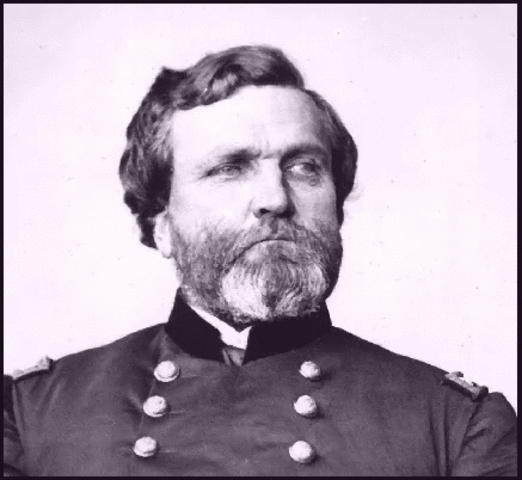
|
| George H. Thomas |
Rosecrans sent reinforcements to Thomas, who slowed Confederate advance on the Union left. Bragg had Longstreet command the left and Leonidas Polk command the right. Polk's divisions made little progress. Rosecrans tried to move reinforcements to close a gap that didn't exist, creating a real gap that Longstreet's veterans from the Army of Northern Virginia exploited. Longstreet's Confederates rolled up the right of Rosecrans army, which retreated toward Chattanooga. George H. Thomas and Gordon Granger stopped the Confederate advance, earning Thomas the title "Rock of Chickamauga."
Even though Chickamauga was a Confederate victory, it came at the cost of 20,000 casualties, or 30 percent of Bragg's effectives. Bragg chose not to follow up on his victory, which allowed the Federals to keep control of Chattanooga.
Bragg hoped to starve the Federals in Chattanooga. Confederates planted artillery at Lookout Mountain to the south and infantry to the east at Missionary Ridge and to the west on river roads. This left only a difficult wagon road through the Cumberlands. Lincoln thought that Rosecrans was "confused and stunned like a duck hit on the head." Stanton had Lincoln send the 11th and 12th Corps from the Army of the Potomac to Rosecrans, led by Joseph Hooker. Lincoln also created the Division of the Mississippi with Grant in charge. Grant replaced Rosecrans with Thomas to lead the Army of the Cumberland. Grant arrived in Chattanooga on October 23 and had his forces open a "cracker line" to bring in supplies from the river and road west of Chattanooga. Sherman's 17,000 soldiers from the Army of the Tennessee were joined by 20,000 led by Hooker from the Army of the Potomac to reinforce Thomas' 35,000 infantry Army of the Cumberland.
Four Confederate corps commanders wanted Bragg to be replaced, but Davis didn't like any of the possible replacements. He ordered Longstreet's 15,000 Confederates to try to retake Knoxville.
Grant thought that it would be suicidal for soldiers to charge the triple line of trenches at Missionary Ridge. He thought that Thomas' soldiers were demoralized from Chickamauga, so he ordered Thomas' Army of the Cumberland to threaten the Confederate center while Sherman's troops from the Army of the Tennessee and Hooker's troops from the Army of the Potomac attacked the Confederate flanks. Hooker led a successful attack on Lookout Mountain, sending most of three divisions against three Confederate brigades and, with surprisingly light casualties, drove Bragg's defenses to pull back to Missionary Ridge. Sherman's four divisions had little success against Confederates led by Patrick Cleburne, the Irish Confederate. Thomas sent his 23,000 men, four divisions to charge at the well defended center of Missionary Ridge. Mountainous areas were often dangerous to attack, but soldiers led by Thomas found that Confederates stripped so many resources away from a mountainous area that it proved to be the path to yet another Union victory by Grant. Davis replaced Bragg with Joseph Johnston.
On November 29, 1863 Longstreet's attack on Knoxville was repulsed. Between the capitals Lee tried to turn the right of Meade's army, and Meade then tried to turn the right of Lee's army. Confederates had twice as many casualties as the Union at 4,000. The Southern diarist Mary Boykins Chesnut wrote of "gloom and unspoken despondency hang[ing] like a pall everywhere."
Confederate naval envoy Bulloch wanted to buy Laird rams, armor plated vessels for carrying turrets for nine-inch guns and a seven foot iron spike attached to the prow to pierce wooden ships below the water line. The Palmerstone ministry decided to detain the rams to avert war with the Union. Bulloch hoped to get help from France, which had invaded Mexico and overthrown the government of Benito Juarez in an attempt to make Hapsburg Archduke Ferdinand Maximilion the ruler of Mexico. However, Louis Napoleon chose not to help the Confederacy.
The Meridian campaign or Meridian expedition took place from February 14, 1864 – February 20, 1864, from Vicksburg, Mississippi to Meridian, Mississippi, by the Union Army of the Tennessee, led by Sherman. Sherman captured Meridian, Mississippi, inflicting heavy damage to it. The campaign is viewed by historians as a prelude to Sherman's March to the Sea (Savannah campaign) in that a large swath of damage and destruction was inflicted on central Mississippi as Sherman marched across the state and back.

|
| Agar (Coffee Mill) Gun |
Lincoln then brought Grant, Sherman, Sheridan, Thomas and other western generals out east to win the war. The plan was for Grant to maximize the North's advantages in manpower and resources with battles of attrition against Lee's army and attack the Confederacy from multiple directions so they couldn't reinforce. Sherman's March to the Sea was important to this. Sheridan controlled the same Shenandoah Valley that was controlled previously by Stonewall Jackson. Grant also ordered Banks to capture Mobile and prevent Confederates from reinforcing Johnston. Butler was to advance up the James River and cut the railroad between Richmond and Perersburg, while Sigel was to move up the Valley and cut Lee's communications. Lincoln, Grant, Sherman and Sheridan were determined to fight until victory.
The Lincoln administration ordered Banks to seize the Red River region in Louisiana before capturing Mobile, all of which was bungled. Confederate Richard Taylor drove Banks' army from Sabine Crossroads to Pleasant Hill. Banks' army repelled Confederates at Pleasant Hill, but the Red River was low, threatening Union gunboats above the rapids at Alexandria. The Union army built wing dams to float the gunboats through the rapids, but Banks' retreat allowed 15,000 Confederates to reinforce Johnston's army. Also, 10,000 soldiers that Banks had borrowed from Sherman's army were never returned to it.
Butler's 30,000 men steamed up the James River between Richmond and Petersburg, which were guarded by only 5,000 Confederates. However, Butler advanced slowly, giving Beauregard time to move reinforcements from the Carolinas. Confederates attacked near Drewry's Bluff. After high casualties on both sides Confederates entrenched, leaving Butler's army, in the words of Grant, "as if it had been in a bottle strongly corked."
Sigel's Union army advanced up the Valley to capture Staunton, which was the source of supplies for Lee's army. However, Sigel's 6,500 men were defeated by 5,000 Confederates led by John C. Breckenridge at New Market. Sigel was then removed from command.
On April 1864 Confederate General Nathan Bedford Forrest captured Fort Pillow. His soldiers killed black and eastern Tennessee Union soldiers as they tried to surrender. Confederates viewed eastern Tennesseans as traitors to the Confederate cause since Tennessee was a Confederate state, and hated black Union soldiers because of emancipation.
Before the war, Forrest was a slave owner and a slave trader. After the war, he helped start the Ku Klux Klan. Since the Thirteenth Amendment didn't apply to prisoners, he profited from the convict leasing system. After the Civil War, several Southern states passed vagrancy laws that created an easy way to imprison and then enslave blacks through the convict leasing system.

|
| Gatling Gun |
The Confederate No Quarter policy extended beyond the Fort Pillow massacre. On July 30, 1864 in Petersburg, Virginia, about five hundred black soldiers, wounded, surrendered, or trapped, fell in a no-quarter rampage by Confederates. Many such massacres of US Colored Troops were documented, including at Simpsonsville, Kentucky, and Saltville, Kentucky (where wounded black soldiers were taken from their hospital beds and summarily executed) and at the Battle of Poison Springs in Arkansas. Meanwhile, the slave trade in Confederate States continued through the war. In 1933 a formerly enslaved man named William Sellers was interviewed in Shippenberg, Pennsylvania, and he recalled another wartime atrocity: Mr. Sellers tells of an incident which has been indelibly marked upon his memory. A group of negro slaves were being taken to Richmond to be sold at public auction. The arrival of Union troops necessitated that the slaves be held over at Madison, where they were placed in the Madison jail. When it was discovered that the Union troops would raid Madison and set free the slaves in the jail, the jail was set afire and it blazed away, burning with it the colored women and children.
By 1864 almost all of manufacturing, arms production and exports were from the North. The Southern share of exports fell from two-thirds to almost nothing between 1860 and 1864. Because of the blockade and food shortages many southern plantations switched from growing cotton to growing food.
The Union invented Spencer and Henry repeating rifles. The Gatling gun was a rapid-firing multiple-barrel firearm invented in 1861 by Richard Jordan Gatling. It is an early machine gun and a forerunner of the modern electric motor-driven rotary cannon. Twelve of the guns were purchased personally by Union commanders and used in the trenches during the Siege of Petersburg, Virginia (June 1864-April 1865). Eight other Gatling guns were fitted on gunboats. The gun was not accepted by the American Army until 1866. The Agar (Coffee Mill) gun was another forerunner of the machine gun.
Grant's overland campaign included the highest casualty rates of the war. Still, the percentage of casualties was the same for both sides, with 35,000 casualties to Lee's smaller army. Lee's army had been driven south about 80 miles, with his communications cut with the rest of the South, and his army pinned in the defense of Richmond and Petersburg. Lee's army lost its famed mobility. Lee told Jubil Early, "We must destroy this army of Grant's before it gets to the James River. If he gets there it will become a siege, and then it will be a mere question of time." Grant had the two-to-one advantage in manpower needed to seize and hold enemy territory, although Lee made the cost of Grant's aggression as high as possible through defensive tactics.
On May 5–7, 1864 Lee chose to wait till Grant's army was in the Wilderness of scrub oaks and pines, as Grant's superiority in numbers would count for less there than in an open field. Grant's 70,000 men fought 40,000 Confederates. The next morning, Grant's Union army drove the Confederates back almost a mile to a clearing. Longstreet's reinforcements stopped the Union advance and drove the Union army back to its starting point. One of Longstreet's brigadiers knew of the roadbed of an unfinished railroad that wasn't on any map. Four of Longstreet's brigades used it to attack and roll up Northern regiments. However, Longstreet was injured by friendly fire from Confederates. Combat raged near the road intersection as a forest fire ignited Union breastworks. Confederate General John B. Gordon led an attack that forced Union troops back about a mile. A brigadier rode up to Grant after Lee attacked both flanks and predicted the worst. Grant replied, "I am heartily tired of hearing what Lee is going to do. Some of you always seem to think he is suddenly going to turn a double somersault, and land in our rear and on both of our flanks at the same time. Go back to your command, and think what we are going to do ourselves, instead of what Lee is going to do."
Even though Grant's army received 17,500 casualties, exceeding Confederate casualties by 7,000, he advanced during the night around Lee's right to Spotsylvania, putting Grant closer to Richmond than Lee. Instead of another retreat, the Union army went about 12 miles south.
Sheridan's 10,000 horsemen destroyed 20 miles of railroad, a quantity of rolling stock and three weeks' supply of rations for Lee's army. Sheridan's cavalry outnumbered Stuart's by about two-to-one and had rapid-fire carbines. On May 11, 1864 Stuart's cavalry was defeated at Yellow Tavern, and Stuart was mortally wounded.
From May 8 through May 21, 1864 at Spotsylvania, both armies constructed trenches, breastworks, artillery emplacements, traverses and the branches of felled trees (abatis). A Union attack on Lee's left by Winfield Scott Hancock's 2nd Corps was too slow, giving Lee time to shift two divisions to counter the attack. Grant sent five divisions to attack Lee's center-left without success, as the divisions Lee shifted were from his right. Farther toward the center was a salient known as the Mule Shoe due to its shape. Union Colonel Emery Upton led twelve regiments to charge Confederate defensive works. They rounded up about a thousand prisoners, but reinforcements were too slow, and the Yankees fell back when attacked by Confederate reinforcements. Grant wrote, "I propose to fight it out on this line if it takes all summer."
Lee mistook Union wagon movements as a sign of another flanking attack, so he moved 22 guns for a response. Hancock attacked a salient that had been guarded by those guns at dawn. Confederates tried to move the guns back just in time for Union troops to capture them. 15,000 bluecoats advanced a half mile beyond Confederate trenches and captured most of the Stonewall Brigade. Hancock's corps split Lee's army in two. Confederates counterattacked. The Union 5th and 9th Corps attacked the left and right of the Confederate line with little success. The 6th Corps reinforced Hancock's right. For 18 hours, the armies fought at a salient called the Bloody Angle. Mud from the rain and blood from the dead and wounded filled the trenches. Long after the battle, the soldiers remembered what one called "the horrors of Spotsylvania."
After disengaging from the stalemate at Spotsylvania Court House, Grant moved his army to the southeast, hoping to lure Lee into battle on open ground. He lost the race to Lee's next defensive position south of the North Anna River, but Lee needed to figure out Grant's intention and initially prepared no significant defensive works. On May 23, the Union 5th Corps under Maj. Gen. Gouverneur K. Warren forded the river at Jericho Mills, and a Confederate division from the corps of Lt. Gen. A.P. Hill was unable to dislodge its beachhead. The 2nd Corps under Maj. Gen. Winfield S. Hancock stormed a small Confederate force at "Henagan's Redoubt" to seize the Chesterfield Bridge crossing on the Telegraph Road, but did not advance further south across the river.
That night, Lee and his engineers devised a scheme for defensive earthworks in the shape of an inverted "V" that could split the Union army when it advanced and allow the Confederates to use interior lines to attack and defeat one wing, preventing the other wing from reinforcing it in time. The Union army initially fell into this trap. As Hancock's men failed to carry the Confederate works on the eastern leg of the V on May 24, a brigade under the drunken Brig. Gen. James H. Ledlie was repulsed from an ill-conceived assault against a strong position at Ox Ford, the apex of the V. Unfortunately for the Confederates, Lee was disabled with heart issues, and none of his subordinates were able to execute his planned attack.
Grant ordered the Army of the Shenandoah, led by David Hunter, to move southward down the Valley and destroy railroads and the Confederate supply depot at Lynchburg and the James River Canal. Sheridan was to move two cavalry divisions west to destroy railroads and link up with Hunter. Grant planned to seize Petersburg with its hub of railroads.
Hunter's supply wagons were frequently attacked by guerrillas led by John Singleton Mosby and others, and had his army forage for food and burn and loot civilian property. A Union soldier wrote, "Many of the women look sad and do much weeping over the destruction that is going on. We feel that the South brought on the war and the State of Virginia is paying dear for her part." However, Hunter's army lacked ammunition because of Confederate guerrillas. When Lee ordered Confederates led by Jubil Early to attack, Hunter retreated into West Virginia.
Grant's army temporarily wrecked all three of Richmond's railroads, although they were repaired. Jubil Early's Confederates, after driving Hunter from Lynchburg, defeated Federals at the Monocacy River and marched to Washington, D. C. Grant sent the 6th Corps to defend the capital. At Fort Stevens Oliver Wendell Holmes, Jr. saw a tall visitor with a stovepipe hat peering over the parapet where bullets were whizzing by. He yelled, "get down, you damned fool, before you get shot!" Holmes didn't recognize that he was yelling at Lincoln, who got down. Early gave up his attack, and his Confederates pillaged, burned and demanded money from Union areas. Grant put Sheridan in charge of the newly created Army of the Shenandoah to attack Early.
Grant was too aggressive at Cold Harbor (May 31-June 12, 1864) in that he gave Lee's Confederates too much time to entrench before ordering an attack. Grant tried attacks on Lee's flanks and an assault on the middle, without success. When Grant moved 25 miles south to a railroad junction near the North Anna River, Lee got there first and entrenched his army. After some skirmishes Grant moved 20 miles south across the Pamunkey River to find Confederates entrenched behind Topopotomy Creek. Grant reached Cold Harbor, and Sheridan's cavalry and Union infantry defeated a Confederate cavalry led by Fitzhugh Lee. The two armies entrenched across a seven mile line reaching from the Totopotomy to the Chickahominy Rivers. With reinforcements on both sides, 59,000 Confederates faced 109,000 Federals. At this point Confederate casualties during Grant's overland campaign were 25,000, and Union casualties were 44,000. Lee's defensive tactics made Union victory costly. The Confederates were entrenched behind a zig-zag of lines within lines and works within works. Union casualties were 7,000, and Confederate casualties were fewer than 1,500. Grant said, "I regret this assault more than any one I have ever ordered."
On June 11-12, 1864 Confederate Wade Hampton's 5,000 man cavalry attacked Sheridan's 7,000 man cavalry at Trevilian Station. Casualties were about 20 percent on each side, the bloodiest cavalry fight of the war. Sheridan's cavalry tore up some railroad track, damage that was repaired by Confederates.
From June 9, 1864 to March 25, 1865 Grant kept the pressure on Lee's army, pinning it to an area from Richmond to Petersburg. Since most supplies for Richmond and Lee's army went through Petersburg, Grant waged nine months of trench warfare around Petersburg to block these supplies.
On June 15–18, 1864 the Union 18th Corps, led by William F. "Baldy" Smith cautiously approached Petersburg, which was guarded by only 2,500 Confederates led by Beauregard. Petersburg had ten miles of 20 foot thick breastworks and trenches fronted by 15 foot ditches and linking with 55 artillery redans bristling with cannon. Smith hesitated because of the defensive line, not knowing that only a handful of Confederates defended them. When Union forces went forward at sundown they easily captured more than a mile of line and 16 guns. Smith believed rumors that Lee was sending reinforcements and failed to push on. The next day the armies were reinforced by two Confederate divisions and two Union corps. 48,000 Federals seized more of Beauregard's lines but did not achieve a breakthrough. Beauregard pulled his line near the outskirts of Petersburg. A few attacks were attempted, but after Cold Harbor soldiers wanted to avoid more carnage. Democrats called Grant a "butcher."
During the siege of Petersburg Union Colonel Henry Pleasants of the 48th Pennsylvania relayed an idea he got from miners. They suggested using explosives against Confederate defenses. The plan was approved by Burnside. Pleasants' regiment excavated a 511 foot tunnel with four tons of gunpowder. Meade and Grant authorized Burnside to explode the mine and attack through it. At the Battle of the Crater on July 30, 1864, Union miners exploded a mine across from Union Major General Ambrose E. Burnside's 9th Corps sector, blowing a gap in the Confederate defenses of Petersburg, Virginia. The explosion blew a hole 170 feet long, 60 feet wide and 30 feet deep. James H Ledlie was chosen to lead the attack by drawing straws, but he was drunk. Instead of being a decisive advantage to the Union, unit after unit charged into and around the crater, where most of the soldiers milled in confusion at the bottom of the crater and became easy targets for Confederates to fire upon. Grant considered this failed assault "the saddest affair I have witnessed in this war. Such an opportunity for carrying fortifications I have never seen and do not expect again to have."

|
| William T. Sherman |
Sherman turned the flank of Joe Johnston's Confederate army to Atlanta. The Confederate government then replaced Joe Johnston with John Bell Hood. Hood had a more aggressive style than Johnston, but Sherman defeated his army. Hood then tried to create a diversion in Tennessee. Sherman split his army in two, and sent half of it, led by John Schofield at the Battle of Franklin and by George H. Thomas at the Battle of Nashville, to pursue Hood. Hood's army was destroyed at both battles, and the rest of Sherman's army continued its March to the Sea.
Of Confederates, Sherman said he "would not coax them, or meet them half-way, but make them so sick of war that generations would pass away before they would again appeal to it." Sherman was asked if he could lead a march through Georgia. Sherman said that he could "make Georgia howl." He said, "We are not only fighting hostile armies, but a hostile people, and must make old and young, rich and poor, feel the hard hand of war." Sherman led three armies, George Thomas' 60,000 man Army of the Cumberland, James B. McPherson's 25,000 man Army of the Tennessee, and John M. Schofield's 13,000 man Army of the Ohio.
Joe Johnston's 50,000 Confederates (soon to be reinforced to 65,000) were on Rocky Face Ridge flanking the railroad 25 miles south of Chattanooga. Sherman had Thomas and Schofield threaten Johnston's army from the left while McPherson swung to the right and through mountain gaps to hit the Confederate railroad at Resaca. Snake Creek Gap was almost unguarded, but Johnston retreated to Resaca. Once again McPherson's army swung southward, crossed the Oostanaula River and threatened Johnston's railroad supply line. Johnston's Confederates retreated to Cassville. Confederates tore up railroad tracks supplying Sherman's army, but those were quickly repaired.
Of the Confederate leaders, it was mostly Johnston who was cautious and Hood who was more aggresive, but the opposite was true when Johnston ordered an attack that was cancelled by Hood because he thought that Union cavalry indicated a full scale Union attack. As a result, Confederates retreated another ten miles to a line overlooking a railroad and the Etowah River through Allatoona Pass.
A sharp clash took place near New Hope Church followed by weeks of skirmishing and sniping. Confederate Leonidas Polk was killed. Confederates entrenched along Kennesaw Mountain.
Sherman ordered the garrison commander at Memphis to send 8,000 men to attack Confederate Nathan Bedford Forrest. Forrest's smaller force defeated the Federals at Brice's Crossroads. Sherman then ordered 14,000 Federals to attack Forrest at Tupelo. Casualties were high and included Forrest, who was injured.
Sherman ordered an attack on Johnston's well defended Confederates at Kennesaw Mountain. The result was 3,000 Union casualties and only one-fifth as many Confederate casualties.
The 200,000 population city of Atlanta was a major prize for Sherman's army. As Jefferson Davis said, the fall of Atlanta would "open the way for the Federal Army to the Gulf on the one hand, and to Charleston on the other, and close up those rich granaries from which Lee's armies are supplied. It would give them control of our network of railways and thus paralyze our efforts."
Sherman turned the flank of Johnston's army most of the way to Atlanta. Davis replaced Johnston with John Bell Hood. Sherman had McPherson swing to the left to cut Atlanta's last rail link to the upper South. Thomas' Army of the Cumberland crossed Peachtree Creek. Five Union divisions drove an equal number of rebels back. Hood then attacked McPherson's Army of the Tennessee. Heavy casualties were inflicted on Hood's army, but McPherson was killed and replaced by Oliver O. Howard. Howard swung around the Confederate left to tear up the one remaining railroad out of Atlanta. A corps of Hood's Confederates was repulsed and entrenched at Ezra Church crossroads. For these three battles, Hood's Confederates suffered 15,000 casualties compared with 6,000 Union casualties. Civilians fled Atlanta.
Sherman sent a letter to the mayor of Atlanta demanding that he evacuate the city before Sherman's army burned it. The mayor replied that the order was inhumane. Sherman said that "war is cruelty and you cannot refine it." Atlanta was evacuated and burned. From Atlanta to Savannah, Sherman's army would march to the nearest plantation, divide spoils with emancipated slaves, and burn the rest. The chimneys of burned-down plantations were called Sherman sentinels. Sherman's army created a miles-wide path of destruction. It twisted railroad tracks, destroyed factories and infrastructure, burned and foraged for enough food to feed an army. Sherman's army was followed by emancipated slaves.
George H. Thomas led 60,000 Union soldiers against John Bell Hood's 40,000 Confederates. Hood tried to get between 30,000 Federals led by Schofield at Pulaski and the 30,000 Federals at Nashville. Schofield was made aware of this and fell back to the Duck River at Columbia. Hood sent Forrest's cavalry to attack the Union army's rear, so Schofield rushed two divisions to the rear of his army at Spring Hill. Schofield then pulled his army back to the Harpeth River at Franklin. The Union army was dug in with heavy artillery. Confederate artillery and some of their infantry were further behind. In spite of this, and over the protests of his generals, Hood ordered a frontal attack. Out of the 22,000 Confederates who fought, 7,000 were casualties, three times the Union total. Hood's army moved to Nashville.
At Nashville Thomas ordered one division to pin down Hood's right while three Union infantry corps and his cavalry attacked Hood's left. Hood's 25,000 rebels were attacked by 50,000 Federals. The next day Hood's Confederates fell back to a new line. Two Union infantry corps and dismounted Union cavalrymen using rapid-fire carbines attacked the Confederate left. The result was another Union victory. About half the 40,000 Confederates who made up the remnants of Hood's army retreated to Tupelo, Mississippi and on January Friday 13 of 1865 Hood resigned.
Sherman's army was attacked by Wheeler's Confederate cavalry at Ebeneezer Creek. Union General Jefferson C. Davis was part of Sherman's army. Previously, he killed Union General "Bull" Nelson, but orders for his arrest were lost in the fog of war. Davis didn't like emancipated slaves slowing the Union army, so he pulled up a bridge. Wheeler's Confederates killed some former slaves, and others ran into the creek and drowned. Newspapers reported this, and the Secretary of War, Edwin Stanton went to Georgia to ask Sherman about it. Sherman was angered at Stanton for interfering with his army but then asked emancipated slaves what they wanted. They said they wanted land. So, to get Stanton to back off, Sherman issued Special Field Order No. 15, which allowed forty acres to emancipated slaves. Sherman said he would also try to get army mules for them. General Rufus Saxton, who commanded Union forces on the South Carolina Sea Islands, supervised the settlement of 40,000 freedmen on the land designated by Sherman's field order. President Andrew Johnson later revoked the field order, and blacks who were given land along the Sea Islands were forced out.

|
| Spencer Repeating Rifles |
Sherman's army completed its March to the Sea and the city of Savannah. Sherman's army then marched through the Carolinas, burning and foraging as it went. Sherman's army destroyed more in South Carolina than elsewhere, viewing it as the heart of secession. Sherman said, "My aim then was to whip the rebels, to humble their pride, to follow them to their inmost recesses, and make them fear and dread us." Confederate War Department clerk John B. Jones called Sherman's march "a crisis such as not been experienced before." Mary Chesnut wrote, "The deep waters are closing over us." However, while the South was running out of everything, immigration replaced Northern losses. Also, most of the destruction of war happened in the South. Lincoln said, "We are gaining strength, and may, if need be, maintain the contest indefinitely."
Confederate Joseph E. Johnston thought that it would be impossible for Sherman's army to cross through the swamps in tidewater South Carolina in winter. Although the roads there were underwater, Sherman organized battalions of soldiers and freedmen to cut down trees and saplings to corduroy the roads, build bridges and construct causeways. Confederate General William Hardee said that the Salkehatchie River was impassible. Sherman's bummers built miles of bridges and crossed them. South Carolina's capital city of Columbia was evacuated by Confederate authorities. Then the city was burned by Sherman's bummers and by Confederates who burned cotton bales so that Sherman's army couldn't seize them. Supplies of liquor were also a factor in the burning. Some of Sherman's soldiers started fires while others tried to put them out.
The two wings of Sherman's army marched to Goldsboro, North Carolina. Johnston's 17,000 men attacked one wing of Sherman's army near Bentonville. The attack was repulsed, and Johnston's Confederates withdrew.
Sherman is known for saying that war is hell. He did say words to that effect, although memories of the exact words differ. He did say that "Its glory is all moonshine; even success the most brilliant is over dead and mangled bodies, with the anguish and lamentation of distant families."
US Lt. Gen. Ulysses S. Grant placed Maj. Gen. Philip Sheridan in command of the Army of the Shenandoah in August 1864, ordering him "to put himself south of the enemy and follow him to the death" and to turn "the Shenandoah Valley [into] a barren waste ... so that crows flying over it for the balance of this season will have to carry their provender with them." Sheridan said, "The people must be left nothing but their eyes to weep with over the war." The Valley was important both because it was an invasion route to the North and because it supplied food for Confederate armies. Just over two months later, Sheridan delivered a series of defeats to the Confederates and wrested their control of the region. Sheridan's army left much of the Shenandoah Valley in ashes, making it unable to sustain Confederate armies. Grant gave Sheridan three principal directives: beat Early, destroy the Valley's resources and, above all, avoid defeat. Sheridan moved with caution early in the campaign, maneuvering and skirmishing in the lower Valley, avoiding a major battle. He took this time to organize and mold his new Army of the Shenandoah, about 40,000 strong. Lt. Gen. Jubal Early, commanding the Confederate Army of the Valley, sensed that Sheridan might be overly cautious. Early dispersed his smaller army of about 15,000 to threaten the Potomac corridor.
Moving to cut off Early's army south of Winchester, Sheridan's Federals collided with Mosby's Rangers. Soon, the US and Confederate armies faced off along the Berryville Turnpike in the Battle of Berryville, September 3 and 4. The Federals held their ground, and after Early's withdrawal, Sheridan resumed his drive toward Winchester.
Grant had cut the railroad linking Petersburg to the port at Wilmington, North Carolina. This forced Lee to lengthen his lines and protect wagon trains, so Lee recalled one division from the Valley. After learning from Quaker Unionist Rebecca Wright about this withdrawal, and that Early had dispersed his forces to raid the B&O Railroad and had removed infantry and artillery from nearby Winchester, Virginia (an important town and transportation center that changed hands 75 times in the war), Sheridan showed Grant his offensive plan. Grant approved, simply telling him: "Go in!" Sheridan attacked Early's camp at Opequon Creek just outside the town. The US Army of the Shenandoah's 37,000-man force went west toward Winchester, Virginia, intending to destroy the 15,000-man Confederate Army of the Valley under Lt. Gen. Jubal Early. Union cavalry rapid-firing carbines played a role. Sheridan's chief of staff wired, "We have just sent them whirling through Winchester." At the Third Battle of Winchester on September 19, 1864, Early's army suffered crippling casualties, losing one-fourth of his army, but survived to retreat to Fisher's Hill.
Retreating from Winchester, Early got his army into the defensive works of Fisher's Hill. For the second time in four days, Sheridan used the Army of the Shenandoah's superior strength and firepower to decisively beat Early. Sheridan sent two corps to make a feint at Early's entrenched line while a third hit the Confederate left. Federal soldiers climbed mountain paths up the hill and swarmed into the earthworks as Confederates hastily abandoned their lines at the Battle of Fisher's Hill, September 22, 1864. Sheridan hit Early in an early-morning flanking attack, routing the Confederates with moderate losses. Early retreated to Waynesboro, Virginia. With Early damaged and pinned down, the Valley lay open to the Union. Because of Sherman's capture of Atlanta, Lincoln's re-election now seemed assured. Sheridan moved slowly down the Valley, conducting a scorched earth campaign that would presage Sherman's March to the Sea in November. The goal was to deny the Confederacy the means of feeding and supplying its armies in Virginia, and Sheridan's army ruthlessly burned crops, barns, mills, and factories. "The Burning," as it came to be called, was part of a Federal strategy to hasten the end of the war. Sheridan said that his army "destroyed over 2,000 barns filled with wheat, hay and farming implements, over seventy mills filled with flour and wheat; have driven in front of the army over 4,000 head of stock, and have killed and issued to the troops not less than 3,000 sheep."
After burning much of the Valley, Sheridan pulled his army back north. Early's army cautiously pursued. Annoyed with the Confederate horsemen nipping at his heels, Sheridan countered with his own cavalry. Called the "Woodstock Races," because Federal cavalry chased their opponents as far south as Woodstock, the Battle of Toms Brook on October 9, 1864 did irreparable damage to the morale of Early's cavalry.
After The Burning, many Federal soldiers felt confident that the Confederates posed no further threat in the Valley. Meanwhile, Early had received reinforcements and pondered how he could successfully attack a much larger Federal force. A skirmish at Hupp's Hill, north of Strasburg, followed on October 13, 1864.
In a surprise attack, Early smashed two-thirds of the Union army, but his troops were hungry and exhausted and fell out of their ranks to pillage the Union camp. Sheridan, in a ride from Winchester, managed to rally the 6th Corps, cavalry and his remaining troops and utterly rout Early's men, and the Confederates lost everything they had gained in the morning. The Federals captured about 1,000 prisoners, recaptured the 18 guns they had lost that morning and captured 23 more guns. The Federal victory at the Battle of Cedar Creek on October 19, 1864, ended Confederate resistance in the Shenandoah Valley. Coming just three weeks before the presidential election, news of the victory boosted morale in the Northern states and helped carry Abraham Lincoln to a landslide reelection.
The fact that Confederates enslaved black prisoners of war led to a breakdown in the prisoner-of-war exchange program. The result was increased overcrowding in bad prisoner-of-war camps, North and South. The worst of these camps was in Andersonville, Georgia, where thousands of Union soldiers died of starvation and disease. Andersonville inspired the phrase "deadline." Any prisoner of war who walked beyond the Andersonville deadline would be shot on sight. Some prisoners of war walked beyond the deadline on purpose, to be relieved of their suffering. Henry Wirz, who was in charge of the prison camp, was the one Confederate who was hanged after the war. Bad prison camps, North and the South, became much worse when the prisoner exchange program ended because Confederates refused to exchange black Union prisoners of war for white Southern prisoners of war. The prisoner of war camp in Elmira, New York was called "hellmira" by Confederates because of harsh conditions there. Andersonville was remembered for both its size and its high casualty rate, although some smaller prison camps had higher casualty rates. Salisbury prison camp had a 34 percent mortality rate, compared with a 29 percent mortality rate at Andersonville. Elmira, a Northern prison camp, hat a 24 percent mortality rate. Grant wrote, "It is hard on our men held in Southern prisons not to exchange them, but it is humanity to those left in our ranks to fight our battles." In October 1864 Lee proposed a prisoner exchange that Grant agreed to on the condition that black Union prisoners of war be treated the same as whites. Lee refused to do so. In January 1865 Confederates finally agreed to exchange blacks prisoners of war the same as whites, and the prisoner of war exchange resumed.
General Burnside arrested Vallandigham at his home in Dayton, Ohio on May 1, 1863 after Vallandigham gave a speech at Mount Vernon, Ohio condeming the war. Lincoln commuted Vallandigham's sentence from prison to banishment. Vallandigham was escorted to Confederate General Bragg's army in Murfreesboro.
On July 17, 1863 two Union representatives, journalist James R. Gilmore and Colonol James Jaquess, met in Richmond to talk about conditions for peace. The two Union representatives said that reunion, abolition and amnesty were the conditions for peace. Davis said, "We are fighting for INDEPENDENCE, and that, or extermination, we will have."
Lincoln's ten percent plan, issued on December 8, 1863, would have allowed Confederates to take an oath of loyalty to the Union. When ten percent of the of the number of voters as of 1860 in a Confederate state had taken such an oath, they could set up a government that could allow the state to rejoin the Union. Radical Republicans wanted a Wade Davis bill that would have required that a majority of the population of a Confederate state take an oath of loyalty and have a military governor to rejoin the Union. Lincoln pocket vetoed the bill.
1864 was an election year, and Lincoln was running for president against Northern Democrat George B. McClellan. McClellan was Lincoln's least favorite General, in that he had "the slows." As a Northern Democrat, he ran on a Copperhead Peace Party platform written by Clement Vallandigham. If McClellan had won he would have been forced by his party platform to stop the war and allow what was left of the Confederacy, including slavery, to survive. At first, Northerners saw the high casualty rate from Grant's battles of attrition but didn't see that those casualties would lead to Appomattox and Union victory. Grant accepted the two to one casualty rate needed to win. The South could win by not losing, whereas the North had the more difficult task of seizing and holding enemy territory in order to win. Many Northerners called Grant a "butcher." The North was in despair, and Lincoln told an army officer that he would be "badly beaten" in the election. He wrote a memorandum to his cabinet members reading, "This morning, as for some days past, it seems exceedingly probable that this Administration will not be re-elected. Then it will be my duty to so co-operate with the President elect, as to save the Union between the election and the inauguration; as he will have secured his election on such ground that he can not possibly save it afterwards." The race issue was very much part of the politics of the day, and the Northern Democrats' campaign literature included a pamphlet called N word Doodle Dandy, a very racist version of Yankee Doodle Dandy. In the 19th century Democrats sometimes called themselves "the white man's party," although the two parties would later switch sides on such issues. Sherman's army made "Sherman neckties" of railroad tracks around Atlanta before capturing the city. Sherman sent a wire to Washington reading, "Atlanta is ours, and fairly won." Sherman's capture of Atlanta and the soldier vote won the election for Lincoln and ended the South's last chance at winning a political victory. The Southern diarist Mary Boykin Chesnut wrote, "Since Atlanta I have felt as if all were dead within me, forever. We are going to be wiped off the earth." McClellan repudiated disunion and wrote, "The Union is the one condition of peace-we ask no more." However, McClellan did not demand the abolition of slavery. While 19 Northern states allowed soldiers to vote in the field, Democratic legislatures in Illinois, Indiana and New Jersey blocked soldiers from those states from voting unless they were furloughed and returned home to vote. A large majority of soldiers voted for Lincoln. Sherman sent a telegram dated December 22, 1864 that read: "I beg to present you, as a Christmas gift, the city of Savannah, with 150 heavy guns and plenty of ammunition, and also about 25,000 bales of cotton."
The Hampton Roads Conference was a peace conference held between the United States and representatives of the Confederate States on February 3, 1865, aboard the steamboat River Queen in Hampton Roads, Virginia, to discuss terms to end the American Civil War. President Abraham Lincoln and Secretary of State William H. Seward, representing the Union, met with three commissioners from the Confederacy: Vice President Alexander H. Stephens, Senator Robert M. T. Hunter, and Assistant Secretary of War John A. Campbell. Lincoln offered to compensate slaveowners for the emancipation of slaves, which neither Republicans in Congress nor Confederates were willing to agree to. The only item the two sides agreed on was a prisoner exchange.
"Broken eggs cannot be mended," Lincoln observed in a reply to August Belmont, a leading Democratic Party organizer and financier in New York, who had forwarded to the president the comments of an angry Louisiana slaveholder who wanted restoration of the Union "as it was."
The Lincoln administration did political arm-twisting and log-rolling, granting political favors to get Congress to pass the 13th Amendment on January 31, 1865. Republicans and spectators cheered, and cannons boomed a 100-gun salute. Some wept for joy. States ratified the Amendment over the next several months. Northern states repealed laws limiting the rights of free blacks. Blacks were allowed to be witnesses in federal courts and deliver mail. Streetcars were desegregated in Washington, D. C., and Black Codes were repealed. Northern states removed restrictions on black voting rights starting in 1868.
In 1865 Union General E. R. S. Canby invaded southern Alabama through Mobile while James H. Wilson took 13,000 troopers armed with repeating carbines from Tennessee to destroy a munitions complex at Selma and seize Montgomery. Wilson's cavalry burned, smashed or blew up cotton, railroads, bridges, rolling stock, factories, nitre works, rolling mills, arsenals and a navy yard, and captured Montgomery. Mobile fell to Canby's infantry in April, 1865.
Patrick Cleburne, an Irish Confederate, was the first to suggest that slaves be armed as soldiers. During the last few weeks of its existence, the Confederate Congress narrowly passed a bill allowing slaves to join the army. The bill did not offer freedom as an incentive to enlist, and only allowed slaves to enlist with the consent of their masters. Even this weak bill, supported by Robert E. Lee, passed only narrowly, by a 9–8 vote in the Senate. President Jefferson Davis signed the law on March 13, 1865, but went beyond the terms in the bill by issuing an order on March 23 to offer freedom to slaves so recruited. The emancipation offered, however, was reliant upon a master's consent. The few Virginia slaves recruited by the bill never saw combat. Howell Cobb of Georgia wrote in January 1865 that:
You cannot make soldiers of slaves, nor slaves of soldiers... The day you make soldiers of [Negroes] is the beginning of the end of the revolution. If slaves will make good soldiers our whole theory of slavery is wrong – but they won't make soldiers.
In his March 4, 1865 Second Inaugural Address, Lincoln said:
Fellow-Countrymen:
At this second appearing to take the oath of the Presidential office there is less occasion for an extended address than there was at the first. Then a statement somewhat in detail of a course to be pursued seemed fitting and proper. Now, at the expiration of four years, during which public declarations have been constantly called forth on every point and phase of the great contest which still absorbs the attention and engrosses the energies of the nation, little that is new could be presented. The progress of our arms, upon which all else chiefly depends, is as well known to the public as to myself, and it is, I trust, reasonably satisfactory and encouraging to all. With high hope for the future, no prediction in regard to it is ventured.
On the occasion corresponding to this four years ago all thoughts were anxiously directed to an impending civil war. All dreaded it, all sought to avert it. While the inaugural address was being delivered from this place, devoted altogether to saving the Union without war, insurgent agents were in the city seeking to destroy it without war seeking to dissolve the Union and divide effects by negotiation. Both parties deprecated war, but one of them would make war rather than let the nation survive, and the other would accept war rather than let it perish, and the war came.
One-eighth of the whole population were colored slaves, not distributed generally over the Union, but localized in the Southern part of it. These slaves constituted a peculiar and powerful interest. All knew that this interest was somehow the cause of the war. To strengthen, perpetuate, and extend this interest was the object for which the insurgents would rend the Union even by war, while the government claimed no right to do more than to restrict the territorial enlargement of it. Neither party expected for the war the magnitude or the duration which it has already attained. Neither anticipated that the cause of the conflict might cease with or even before the conflict itself should cease. Each looked for an easier triumph, and a result less fundamental and astounding. Both read the same Bible and pray to the same God, and each invokes His aid against the other. It may seem strange that any men should dare to ask a just God s assistance in wringing their bread from the sweat of other men's faces, but let us judge not, that we be not judged. The prayers of both could not be answered. That of neither has been answered fully. The Almighty has His own purposes. Woe unto the world because of offenses; for it must needs be that offenses come, but woe to that man by whom the offense cometh. If we shall suppose that American slavery is one of those offenses which, in the providence of God, must needs come, but which, having continued through His appointed time, He now wills to remove, and that He gives to both North and South this terrible war as the woe due to those by whom the offense came, shall we discern therein any departure from those divine attributes which the believers in a living God always ascribe to Him? Fondly do we hope, fervently do we pray, that this mighty scourge of war may speedily pass away. Yet, if God wills that it continue until all the wealth piled by the bondsman s two hundred and fifty years of unrequited toil shall be sunk, and until every drop of blood drawn with the lash shall be paid by another drawn with the sword, as was said three thousand years ago, so still it must be said the judgments of the Lord are true and righteous altogether.
With malice toward none, with charity for all, with firmness in the right as God gives us to see the right, let us strive on to finish the work we are in, to bind up the nation s wounds, to care for him who shall have borne the battle and for his widow and his orphan, to do all which may achieve and cherish a just and lasting peace among ourselves and with all nations.
Frederick Douglass called Lincoln's speech "a sacred effort."
Davis sent Duncan F. Kenner to offer to emancipate slaves in return for support from Britain and France. On March 14, 1865 Lord Palmerston of Britain told Kenner that Sherman's March indicated that the South still had no guarantee of winning its independence, and refused to recognize the Confederacy.
Lee's 55,000 Confederates were starved into surrendering to Grant's 120,000-man army during Grant's siege of Petersburg. Many Confederates deserted as defeat drew near. By early 1865, Union forces cut off the last road into town from the south and threatened the last open railroad. Confederate corps commander John B. Gordon led an attack on Fort Stedman, but was defeated with nearly 5,000 Confederate casualties compared with 2,000 Union casualties. What was left of Lee's army attempted one last battle as the Union Army commanded by Major General Philip Sheridan defeated a Confederate force from the Army of Northern Virginia commanded by Major General George Pickett at the Battle of Five Forks on April 1, 1865.
Lee's army attempted to join with Johnston's army at Danville, but Sheridan's cavalry and three infantry corps cut the Danville railroad, forcing Lee to move to Lynchburg. At Saylor's Creek, the Union army captured 6,000 Confederates and destroyed much of their wagon train. Near Appomattox Courthouse, Lee's army was outnumbered by five or six to one. Some Confederates wanted to continue guerrilla warfare in the countryside, but Lee said no to that. Even though Lee said he "would rather die a thousand deaths," he admitted defeat and surrendered his army to Grant at the home of Wilmer McLean in Appomattox on April 9, 1865. Lee shook hands with Grant's military secretary Ely Parker, a Seneca Indian and said, "I am glad to see one real American here." Ely replied, "We are all Americans." Grant sent three days' rations for the 25,000 Confederates and allowed them to keep their horses and return to their farms and families. Years later, in his memoirs, Grant said:
I felt like anything rather than rejoicing at the downfall of a foe who had fought so long and valiantly and had suffered so much for a cause, though that cause was, I believe, one of the worst for which a people ever fought, and one for which there was the least excuse.
and
As time passes, people, even in the South, will begin to wonder how it was possible that their ancestors ever fought for or justified institutions which acknowledged the right of property in man.
Richmond was evacuated. Confederate government officials took trains to Danville with gold from the Confederate treasury and all the archived records they could carry. Everything of military value that was left in Richmond was burned. Among the Union troops who marched into Richmond was the black 25th Corps. Mobs took over and flames spread. Lincoln arrived at Petersburg and told Admiral David D. Porter, "Thank God I have lived to see this. It seems to me that I have been dreaming a horrid dream for four years, and now the nightmare is gone. I want to see Richmond." Porter took Lincoln to Richmond, and Lincoln sat in the same study that Davis was in forty hours before. Lincoln walked the streets of Richmond and was surrounded by cheering blacks saying, "Glory to God!, Glory! Glory! Glory!" and "Bless the Lord! The great Messiah! I knowed him as soon as I seed him! He's been in my heart four long years. Come to free his children from bondage." When a black man bowed Lincoln said, "Don't kneel to me. That is not right. You must kneel to God only, and thank him for the liberty you will enjoy hereafter."
When Richmond, the Confederate capital, was captured, the Philadelphia Press black journalist T. Morris Chester wrote,
I visited Yesterday (Tuesday) several of the slave jails, where men, women, and children were confined, or herded, for the examination of purchasers. The jailors were in all cases slaves, and had been left in undisputed possession of the buildings. The owners, as soon as they were aware that we were coming, opened wide the doors and told the confined inmates they were free.
The poor souls could not realize it until they saw the union army. Even then they thought it must be a pleasant dream, but when they saw Abraham Lincoln they were satisfied that their freedom was perpetual. One enthusiastic old negro woman exclaimed: 'I know that I am free, for I have seen Father Abraham and felt him.'
When the President returned to the flag-ship of Admiral Porter, in the evening, he was taken from the wharf in a cutter. Just as he pushed off, amid the cheering of the crowd, another good old colored female shouted out, "Don't drown, Massa Abe, for God's sake!"
In 1865 a black Union soldier recognized his former master among a group of prisoners and said, "Hello, massa; bottom rail on top this time!"
Historians including James McPherson, James Ford Rhodes and the Southern born David Potter said that Lincoln's leadership was the reason why the North won the Civil War. As Potter said, "If the Union and the Confederacy had exchanged presidents with one another, the Confederacy might have won its independence."
In Louisiana Union General Banks established by military fiat a labor system in which he promised that blacks would get good treatment, but their wages were withheld until the end of the year and largely went toward food and other expenses. The result was a labor system not much different from slavery.
Lincoln, toward the end of his life, worked to get the Thirteenth Amendment through a Congress that failed to pass it the first time. The Thirteenth Amendment banned slavery for everyone except prisoners. Lincoln called it a "king's cure" for the evil of slavery. On June 19, 1865 (the Juneteenth) Union General Gordon Granger rode to Galveston, Texas to let the last Confederate slaves know of their freedom. However, the last slaves in Kentucky and Delaware, both border states, were not covered by the Emancipation Proclamation and had not chosen to free slaves. Slaves in those two states had to wait until the Thirteenth Amendment was ratified on December 1865 for their freedom.
In his April 11, 1865 speech Lincoln edged, in his gradual way, in the direction of a right to vote for blacks. Whether blacks should have a right to vote was controversial even in the North. Only six Northern states allowed black men to vote at all, even with restrictions. Lincoln said,
It is also unsatisfactory to some that the elective franchise is not given to the colored man. I would myself prefer that it were now conferred on the very intelligent, and on those who serve our cause as soldiers.
John Wilkes Booth heard Lincoln's speech and called it n-word citizenship shortly before assassinating Lincoln at Ford's Theater. Booth was a white supremacist Southern actor who wanted to avenge the South. So when Lincoln went to see the play My American Cousin, Booth shot Lincoln on April 14, 1865, four days after Lee's army surrendered at Appomatox Court House. Lincoln died the next morning. William Seward was shot by an accomplice of Booth's but survived. Jefferson Davis was captured in Georgia on May 10, 1865 and imprisoned at Fort Monroe for two years until released without trial.
Mark Twain said that the Civil War
uprooted institutions that were centuries old, changed the politics of a people, transformed the social life of half the country, and wrought so profoundly upon the entire national character that the influence cannot be measured short of two or three generations.