1970s and 1980s
|
|
O, let America be America again — The land that never has been yet — And yet must be — the land where every man is free. — Langston Hughes
Those who would give up essential liberty to purchase a little temporary safety-deserve neither liberty nor safety. — Benjamin Franklin
Power concedes nothing without a demand. It never did and it never will. — Frederick Douglass
I had always hoped that this land might become a safe & agreeable Asylum to the virtuous & persecuted part of mankind, to whatever nation they might belong. — George Washington, in a 1788 letter he wrote to Adrian Van der Kemp
|
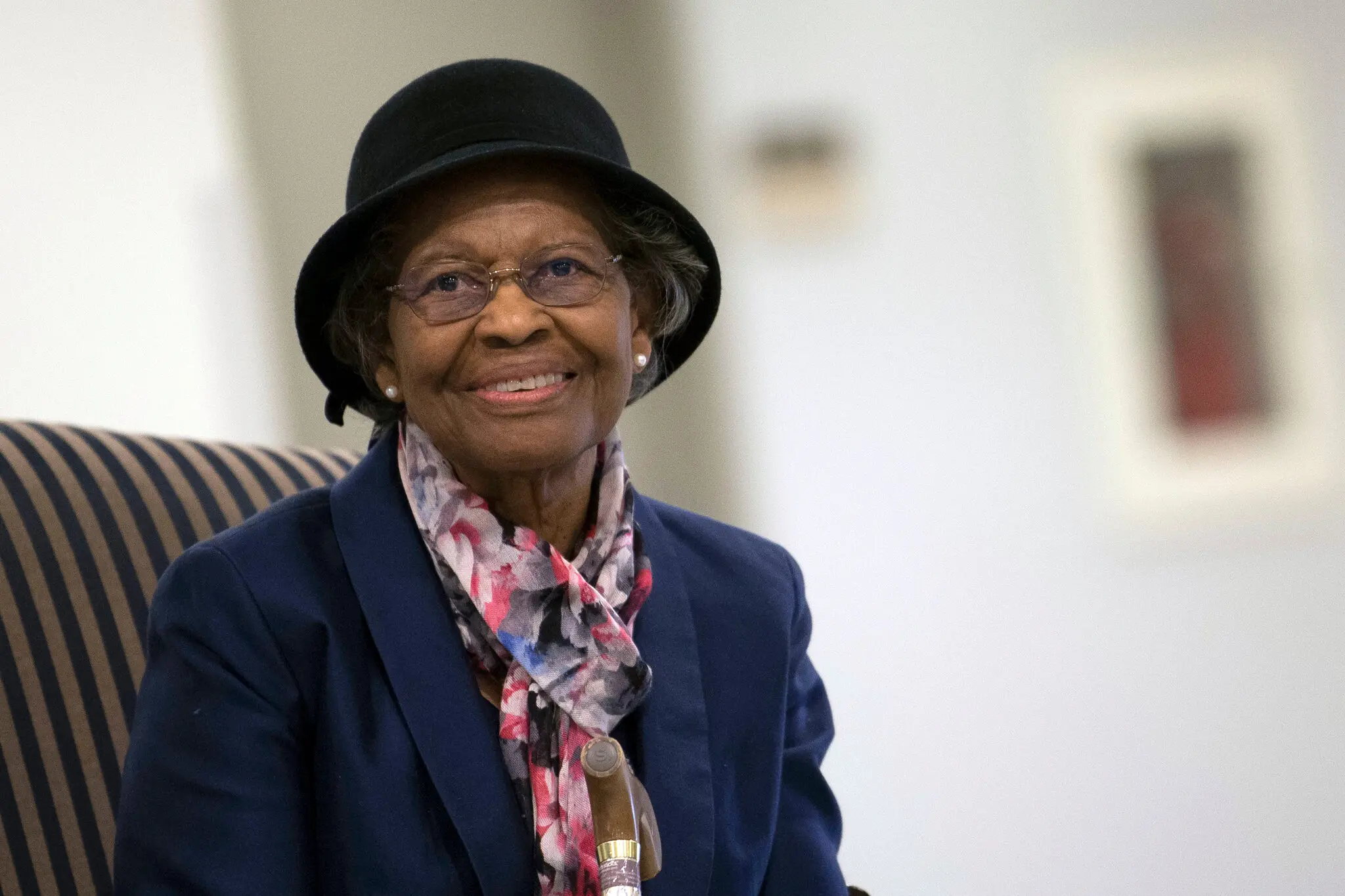
| Gladys West |
Gladys West was a mathematician at the US Naval Weapons Laboratory whose modeling of the Earth's shape played a critical role in the development of GPS, the global satellite mapping system that pilots, firefighters and drivers use to get where they're going. She led a group of mathematicians in using an IBM 7030 - known as Stretch, one of the most powerful computers of its time - to calculate the precise shape of Earth, accounting for gravitational variations, tidal forces and the curvature of oceans. Government scientists developing GPS in the early 1970s then incorporated those calculations into the mathematical framework of the still widely used World Geodetic System, which enables GPS satellites to pinpoint precise locations on the planet's surface. "We don't realize that when we use our cellphones or a more sophisticated GPS receiver, that the orbit being calculated reflects all of that knowledge," Bradford Parkinson, the Air Force colonel who led the development of GPS, said in an interview. "The better that knowledge is, the better we know where satellites are, the better we know where we are."

|
| Richard Nixon |
Richard Nixon became President in 1969. The Apollo 11 program put a man on the moon in July, 1969. Nixon signed legislation that established the Environmental Protection Agency (EPA) and the Occupational Safety and Health Administration (OSHA). Nixon established a policy of détente with the Soviet Union and China that led to mutual, verifiable reductions in nuclear weapons through a series of SALT (Strategic Arms Limitation Treaty) agreements. He went to China and opened relations with that country. He escalated the war in Indochina but then ended it in 1973. Nixon's Department of Justice enforced desegregation of schools and enforcement of civil rights laws. Nixon's wage and price controls failed to help the economy. The Economic Stabilization Act of 1970 gave Nixon legislative cover for his actions. In August 1971 Richard Nixon delinked the dollar from gold. When Nixon refused to spend the money Congress had appropriated — a policy known as impoundment — Congress acted to protect its power: The Congressional Budget and Impoundment Control Act of 1974 passed the House with only six "no" votes; it passed the Senate without a single vote in opposition. Inflation got worse when Nixon pressured the Fed to keep rates low, despite signs that the economy was overheating, to help his reelection campaign. Nixon, facing political repercussions from rising unemployment, exerted pressure on then–Fed Chair Arthur Burns to ease monetary policy.
In 1970 President Richard Nixon signed legislation creating the EPA. Rachel Carson's book Silent Spring raised awareness of environmental problems. The burning Cuyahoga River in Cleveland, Ohio, in 1969 led to a national outcry and criminal charges against major steel companies. The US Justice Department in late 1970 began pollution control litigation in cooperation with the new EPA. Congress enacted the Federal Water Pollution Control Act Amendments of 1972, better known as the Clean Water Act (CWA). Congress amended the Federal Insecticide, Fungicide, and Rodenticide Act (FIFRA) in 1972, requiring the EPA to measure every pesticide's risks against its potential benefits. In 1974 Congress passed the Safe Drinking Water Act, requiring EPA to develop mandatory federal standards for all public water systems, which serve 90 percent of the US population. In October 1976, Congress passed the Toxic Substances Control Act (TSCA) which, like FIFRA, related to the manufacture, labeling and usage of commercial products rather than pollution. This act gave the EPA the authority to gather information on chemicals and require producers to test them, gave it the ability to regulate chemical production and use (with specific mention of PCBs), and required the agency to create the National Inventory listing of chemicals. Arsenic, benzene, forever chemicals (PFAS) and other chemicals cause a need to balance corporate profits against harm to lives and health from contaminated air and water.
In 1973 the US Supreme Court held that women have a right to abortion. The Court divided the pregnancy period into three trimesters. During the first trimester, the decision to terminate the pregnancy was solely at the discretion of the woman. After the first trimester, the state could "regulate procedure." During the second trimester, the state could regulate (but not outlaw) abortions in the interests of the mother's health. After the second trimester, the fetus became viable, and the state could regulate or outlaw abortions in the interest of the potential life except when necessary to preserve the life or health of the mother. The decision was later overturned by the Court's 2022 Dobb's v. Jackson Women's Health Organization decision.
In October 1973, the Organization of Arab Petroleum Exporting Countries (OAPEC) announced that it was implementing a total oil embargo against countries that had supported Israel at any point during the 1973 Yom Kippur War, which began after Egypt and Syria launched a large-scale surprise attack in an ultimately unsuccessful attempt to recover the territories that they had lost to Israel during the 1967 Six-Day War.
In an effort that was led by Faisal of Saudi Arabia, the initial countries that OAPEC targeted were Canada, Japan, the Netherlands, the United Kingdom, and the United States. This list was later expanded to include Portugal, Rhodesia, and South Africa.
In March 1974, OAPEC lifted the embargo, but the price of oil had risen by nearly 300 percent. Prices in the United States were significantly higher than the global average. After it was implemented, the embargo caused an oil crisis, or "shock," with many short- and long-term effects on the global economy as well as on global politics.
 |
| Moon Landing |
Nixon was forced to resign in 1974 because of the Watergate scandal. As part of Watergate, pro-Nixon "plumbers" broke into the Democratic National Committee and wiretapped phones. The DNC was in the Watergate Office Building. Nixon used the CIA, the FBI and the IRS as political weapons, and had the IRS audit the taxes of Nixon's enemies. Nixon feared that Daniel Ellsberg would release more damaging information about him after Ellsberg leaked the Pentagon Papers to the New York Times, and had Howard Hunt and Gordon Liddy break into Ellsberg's psychiatrist's office, looking for information to discredit him. Attorney General John Mitchell had a secret fund of hundreds of thousands of dollars to be used against the Democratic Party for forging letters, leaking false news items to the press and stealing campaign files. Gulf Oil, ITT , American Airlines and other corporations made illegal campaign contributions. Secretary of State Henry Kissinger had illegal wiretaps placed on the phones of four journalists and 13 government officials, and information on them disappeared from FBI files. Nixon asked for a census of Jewish Americans serving in government because he believed they were unpatriotic. Nixon used $10 million of public money on his private homes at San Clemente and Key Biscayne for "security."He also illegally took a $576,000 tax deduction for some of his papers.
The "Saturday Night Massacre" was a series of resignations over the dismissal of special prosecutor Archibald Cox that took place in the United States Department of Justice during the Watergate scandal in 1973. The events followed the refusal by Cox to drop a subpoena for the Nixon White House tapes at President Richard Nixon's request. During a single evening on Saturday, October 20, Richard Nixon ordered Attorney General Elliot Richardson to fire Archibald Cox; Richardson refused and resigned effective immediately. Nixon then ordered Deputy Attorney General William Ruckelshaus to fire Cox; Ruckelshaus refused and also resigned. Nixon then ordered the third-most-senior official at the Justice Department, Solicitor General Robert Bork, to fire Cox. Bork carried out the dismissal as Nixon asked.
The US Supreme Court ruled that Nixon had to hand over tapes of his conversations to Congress. As a result, Nixon resigned and Gerald Ford became President.

|
| Gerald Ford |
Ford became Nixon's vice president when the previous vice president, Spiro Agnew, resigned because of a scandal seperate from Watergate. In 1973, Agnew was investigated by the United States Attorney for the District of Maryland on suspicion of criminal conspiracy, bribery, extortion, and tax fraud. Agnew took kickbacks from contractors during his time as Baltimore county executive and governor of Maryland. The payments had continued into his time as vice president, but had nothing to do with the Watergate scandal, in which he was not implicated. After months of maintaining his innocence, Agnew pleaded no contest to a single felony charge of tax evasion and resigned from office. Nixon replaced him with House Republican leader Gerald Ford. Agnew spent the remainder of his life quietly, rarely making public appearances and blaming Zionists for forcing him out of office.
President Ford chose to pardon Nixon. The Nixon pardon was unpopular. Ford was widely mocked for promoting WIN (Whip Inflation Now) buttons. Ford presided over the worst economy in the four decades since the Great Depression, with growing inflation and a recession. Ford signed the Helsinki Accords, which marked a move toward détente in the Cold War. With the collapse of South Vietnam nine months into his presidency, US involvement in the Vietnam War essentially ended.
|
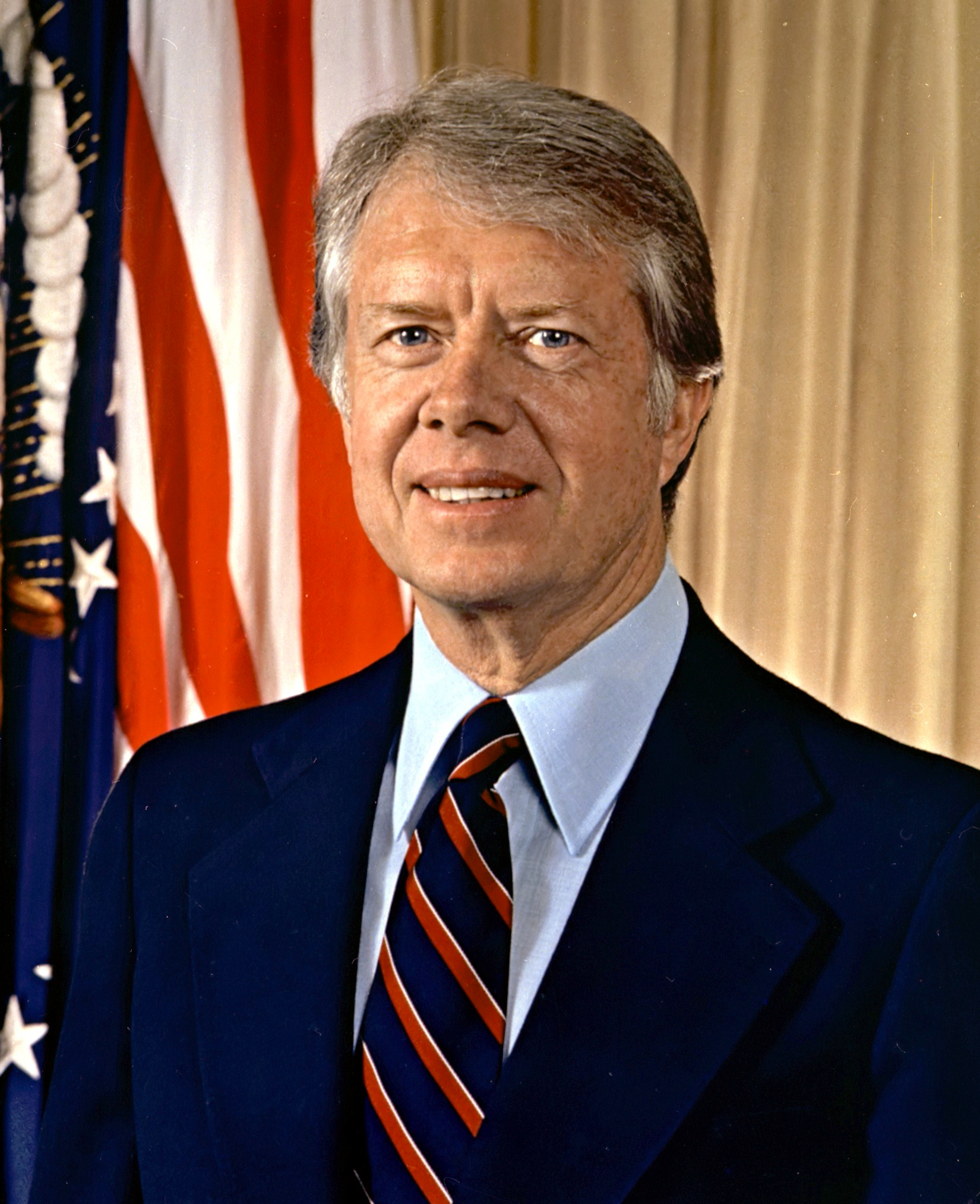
| Jimmy Carter |
Jimmy Carter was a peanut farmer and a nuclear engineer who promised a more ethical form of government. However, the economy was afflicted with what the British called "stagflation," or a combination of economic stagnation and inflation. Also, the Iranian hostage crisis was an issue. Carter called for restraint, as he feared that any overly aggressive move could result in the deaths of the hostages. Late-night comedians mocked his calls for restraint. In 1977 he obtained two treaties between the United States and Panama that gave the latter control over the Panama Canal at the end of 1999 and guaranteed the neutrality of that waterway thereafter. Carter signed the Refugee Act of 1980, which allows refugees fleeing persecution and harm to live in America. Carter allowed many Asian refugees to come to America, although 62 percent of Americans disapproved. During the Mariel boatlift of 1980 Fidel Castro allowed people from prisons and mental institutions to be among those who fled Cuba, although they were only a small part of the total number of refugees. In 1979, in Vienna, Carter and Soviet leader Leonid Brezhnev signed a new bilateral strategic arms limitation treaty (SALT II) intended to establish parity in strategic nuclear weapons delivery systems between the two superpowers on terms that could be adequately verified. Carter removed the treaty from consideration by the Senate in January 1980, however, after the Soviet Union invaded Afghanistan. He also placed an embargo on the shipment of American grain to the Soviet Union and pressed for a US boycott of the 1980 Summer Olympics due to be held in Moscow.
The Camp David summit with Egyptian President Anwar Sadat and Israeli Prime Minister Menachem Begin led to the peace treaty between Egypt and Israel, for which Sadat and Begin won the Nobel Peace Prize in 1978. The agreement provided for the establishment of full diplomatic and economic relations on condition that Israel return the occupied Sinai Peninsula to Egypt. After leaving office he worked for Habitat for Humanity, which helps people who need homes.
The inflation rate climbed higher each year he was in office, rising from 6 percent in 1976 to more than 12 percent by 1980; unemployment remained high at 7.5 percent; and volatile interest rates reached a high of 20 percent or more twice during 1980. Both business leaders and the public at large blamed Carter for the nation's economic woes, charging that the president lacked a coherent strategy for taming inflation without causing a painful increase in unemployment. The faltering economy was partly due to the energy crisis that had originated in the early 1970s as a result of the country's overdependence on foreign oil.
Carter promoted solar energy, opposed unnecessary dams and river diversion projects, and released a prescient report on climate change. The Alaska National Interest Lands Conservation Act and other legislation protected over 100 million acres of Alaskan wildlife and ensured subsistence hunting and fishing rights for rural Alaska Natives on these lands.
The Iran hostage crisis began on November 4, 1979, when 66 Americans, including diplomats and other civilian personnel, were taken hostage at the Embassy of the United States in Tehran, with 52 of them being held until January 20, 1981. The incident occurred after the Muslim Student Followers of the Imam's Line stormed and occupied the building in the months following the Iranian Revolution. With support from Ruhollah Khomeini, who had led the Iranian Revolution and would eventually establish the present-day Islamic Republic of Iran, the hostage-takers demanded that the United States extradite Iranian king Mohammed Reza Pahlavi, who had been granted asylum by the Carter administration for cancer treatment. Notable among the assailants were Hossein Dehghan (future Minister of Defense of Iran), Mohammad Ali Jafari (future Commander-in-Chief of the Islamic Revolutionary Guard Corps), and Mohammad Bagheri (future Chief of the General Staff of the Iranian Armed Forces). The hostage crisis was a pivotal episode in the history of Iran–United States relations, formally sparking the ongoing Iran–United States conflict. After 444 days, it came to an end with the signing of the Algiers Accords between the Iranian and American governments; Iran's king had died in Cairo, Egypt, on July 27, 1980.
A drop in oil production in the wake of the Iranian revolution led to an energy crisis in 1979. Although the global oil supply only decreased by approximately four percent, the oil markets' reaction raised the price of crude oil drastically over the next 12 months, more than doubling it to $39.50 per barrel. The sudden increase in price was connected with fuel shortages similar to the 1973 oil crisis.
In 1980, following the onset of the Iran–Iraq War, oil production in Iran fell drastically. Iraq's oil production also dropped significantly, triggering economic recessions worldwide. Oil prices did not return to pre-crisis levels until the mid-1980s.
Oil prices after 1980 began a steady decline over the next 20 years, except for a brief uptick during the Gulf War, which then reached a 60 percent fall-off in the 1990s. Mexico, Nigeria, and Venezuela's major oil exporters expanded their production during this time. The Soviet Union became the largest oil producer in the world, and oil from the North Sea and Alaska flooded the market.
Political analysts cited the standoff as a major factor in the downfall of Carter's presidency, culminating in his landslide loss in the 1980 presidential election. The hostages were formally released into American custody one day after the Algiers Accords were signed, just minutes following the first inauguration of Ronald Reagan.
In 1979 the worst nuclear meltdown in history occurred at the Three Mile Island nuclear reactor. A partial meltdown of the Unit 2 reactor happened near Harrisburg, Pennsylvania.
Argentina's "Dirty War" was a campaign between the late 1970s and early '80s that lasted eight years. The perpetrators' goal was to rid the country of those who opposed the military dictatorship of the time. During this period, an estimated 30,000 people were abducted, tortured or killed. Many babies and children were kidnapped, particularly to rehome them with families who supported the dictatorship. These people were called "los desaparecidos," meaning "the disappeared." Many thousands were killed in death flights, a practice initiated by Admiral Luis María Mendía, usually after detention and torture. Typically they were drugged into a stupor, loaded into an aircraft, stripped, and dropped into the Río de la Plata or the Atlantic Ocean. The government of Chile also killed political prisoners with death flights.
In 1977, 14 mothers whose children had disappeared set out to protest against the government, marching peacefully in the Plaza de Mayo in Buenos Aires. They wore white scarves or nappies on their heads, all embroidered with the names of their missing children. Over time, this protest movement grew, despite the kidnappings and murders of many protesters.
A year before Mr. Carter became president, Secretary of State Henry Kissinger gave the green light to the Argentine generals to carry out these horrors. "If there are things that have to be done," he told them, "you should do them quickly." But Mr. Carter sharply reversed that policy. He cut economic aid to Argentina and publicly condemned the regime. In a 1984 editorial titled "Thank You, Jimmy," the English-language Buenos Aires Herald wrote, "It was Jimmy Carter's government that did more than any other group of people anywhere for the cause of human rights in Argentina."

|
| Ronald Reagan |
In 1981 Ronald Reagan became President. Inflation fell from 13.5 percent in 1980 to 4.1 percent in 1988, largely because the Federal Reserve raised interest rates. The Tax Reform Act of 1986 reduced taxes, especially for the rich. It reduced the top tax rate from 50 percent to 28 percent. Attempts to reduce inflation worsened the recession at first, but then the economy recovered. At first, Reagan put Anne Gorsuch in charge of the EPA in an attempt to destroy it. When this attempt became unpopular Reagan replaced Gorsuch with William Ruckelshaus, who was admired and respected by EPA personnel. Gorsuch was accused of mismanaging the EPA Superfund, among other issues. Reagan opposed civil rights laws. He opposed the Civil Rights Act of 1964, and said that the Voting Rights Act of 1965 "humiliates the South." However, after his veto of one civil rights bill was overridden he signed another civil rights bill. By abandoning his most unpopular positions, Reagan could focus on his most popular position, which was anticommunism. Reagan told Gorbachev to "tear down this wall" (the Berlin Wall) during the Cold War. Reagan also hastened the end of what he called the Evil Empire through increased military spending. The Soviet Union collapsed due to economic problems, although Reagan's military spending helped to hasten its demise. Reagan funded an anti-missile system that critics called "Star Wars." Ronald Reagan and democrat Tip O'Neill worked out a compromise plan for saving Social Security that made some people wait longer to claim full benefits but also added more funding for Social Security.
Reagan's presidency began on a dramatic note when, after the inaugural ceremony, he announced at a luncheon that Iran had agreed to release the remaining American hostages. The timing of Iran's decision led to suspicions, which were never substantiated, that the Reagan campaign had made a secret deal with the Iranians to prevent the Carter administration from unveiling a so-called "October surprise'-the release of the hostages in October 1980, before election day. Then, on March 30, 1981, a deranged drifter named John W. Hinckley, Jr., fired six shots from a .22-calibre revolver at Reagan as he left a Washington, D.C., hotel. One of the bullets entered Reagan's chest, puncturing a lung and lodging one inch from his heart; another critically wounded Press Secretary James Brady. Rushed to George Washington University Hospital for emergency surgery, Reagan joked with doctors as he was being wheeled into the operating room: "I hope you're all Republicans."
In August 1981, 13,000 members of the national union of air traffic controllers, the Professional Air Traffic Controllers Organization (PATCO)-one of the few unions to endorse Reagan in the 1980 election-walked off their jobs, demanding higher pay and better working conditions. As federal employees, the PATCO members were forbidden by law to strike, and Reagan, on the advice of Transportation Secretary Drew Lewis, refused to negotiate and gave them 48 hours to return to work. Most of the striking controllers ignored the ultimatum and were promptly fired.
Paul Volcker Jr. was the chairman of the Federal Reserve from 1979 to 1987. During his tenure as chairman, Volcker was widely credited with having ended the high levels of inflation seen in the United States throughout the 1970s and early 1980s through measures known as the Volcker shock. Inflation emerged as an economic and political challenge in the United States during the 1970s. The monetary policies of the Federal Reserve board, led by Volcker, were widely credited with curbing the rate of inflation and expectations that inflation would continue. US inflation, which peaked at 14.8 percent in March 1980, fell below 3 percent by 1983. The Federal Reserve board led by Volcker raised the federal funds rate, which had averaged 11.2 percent in 1979, to a peak of 20 percent in June 1981. The prime rate rose to 21.5 percent in 1981 as well, which helped lead to the 1980–1982 recession, in which the national unemployment rate rose to over 10 percent.
The combination of the Fed's tight money policies and the expansive fiscal policy of the Reagan Administration (large tax cuts and a major increase in military spending) produced large federal budget deficits and significant macroeconomic imbalances in the US economy. The combination of growing federal debt and high interest rates led to a substantial rise in federal net interest costs.
Following the so-called "supply-side" economic program he propounded in his campaign, Reagan proposed massive tax cuts-30 percent reductions in both individual and corporate income taxes over a three-year period-which he believed would stimulate the economy and eventually increase revenues from taxes as income levels grew. At the same time, he proposed large increases in military expenditures ($1.5 trillion over a five-year period) and significant cuts in "discretionary" spending on social-welfare programs such as education, food stamps, low-income housing, school lunches for poor children, Medicaid (the major program of health insurance for the poor), and Aid to Families with Dependent Children (AFDC). In 1981 Congress passed most of the president's budget proposals, though the tax cut was scaled back slightly, to 25 percent.
The results of his economic program, which became known as Reaganomics, were mixed. A severe recession in 1982 pushed the nation's unemployment rate to nearly 11 percent, the highest it had been since the Great Depression. Bankruptcies and farm foreclosures reached record levels. The country's trade deficit increased from $25 billion in 1980 to $111 billion in 1984. In addition, the huge increases in military spending, combined with insufficient cuts in other programs, produced massive budget deficits, the largest in the country's history; by the end of Reagan's second term, the deficits would contribute to a tripling of the national debt, to more than $2.5 trillion. In order to address the deficit problem, Reagan backed away from strict supply-side theories to support a $98.3 billion tax increase in 1982. By early 1983 the economy had begun to recover, and by the end of that year unemployment and inflation were significantly reduced; they remained relatively low in later years. Economic growth continued through the remainder of Reagan's presidency, a period that his supporters would hail as "the longest peacetime expansion in American history." Critics charged that the tax cuts and the fruits of economic growth benefited mainly the wealthy and that the gap between rich and poor had grown wider.
Reagan cut the budgets of many government departments and relaxed or ignored the enforcement of laws and regulations administered by the Environmental Protection Agency (EPA), the Department of the Interior, the Department of Transportation, and the Civil Rights Division of the Department of Justice, among other agencies. After the administration and Congress reduced regulations governing the savings and loan industry in the early 1980s, many savings institutions expanded recklessly through the decade and eventually collapsed, requiring bailouts by the federal government that cost taxpayers some $500 billion.
The behavior of the Soviet Union strained relations-especially in December 1981, when the communist government of Poland, under intense pressure from Moscow, imposed martial law on the country to suppress the independent labor movement Solidarity; and in September 1983, when the Soviets shot down a Korean airliner en route from Alaska to Seoul as it strayed over strategically sensitive territory on Sakhalin Island. All 269 people aboard were killed, including 61 Americans. Reagan's massive military spending program, the largest in American peacetime history, was undoubtedly another factor, though some observers argued that the buildup-through the strain it imposed on the Soviet economy-was actually responsible for a host of positive developments in Reagan's second term, including a more accommodating Soviet position in arms negotiations, a weakening of the influence of hard-liners in the Soviet leadership, making possible the glasnost ("openness") and perestroika ("restructuring") policies of moderate Soviet leader Mikhail Gorbachev after 1985, and even the dissolution of the Soviet Union itself in 1990–91.
Reagan and Gorbachev met for the first time in November 1985, in Geneva, to discuss reductions in nuclear weapons. At a dramatic summit meeting in Reykjavík, Iceland, in October 1986, Gorbachev proposed a 50 percent reduction in the nuclear arsenals of each side, and for a time it seemed as though a historic agreement would be reached. Although the summit ended in failure owing to differences over SDI, it was followed up in December 1987 by a treaty eliminating intermediate-range nuclear forces (INF) on European soil. The INF Treaty was the first arms-control pact to require an actual reduction in nuclear arsenals rather than merely restricting their proliferation.
In keeping with Reagan's belief that the United States should do more to prevent the spread of communism, his administration expanded military and economic assistance to friendly Third World governments battling leftist insurgencies, and he actively supported guerrilla movements and other opposition forces in countries with leftist governments. This policy, which became known as the Reagan Doctrine, was applied especially in Latin America. During the 1980s the United States supported military-dominated governments in El Salvador in a bloody civil war with the Farabundo Martí National Liberation Front (Frente Farabundo Martí para la Liberación Nacional; FMLN), providing the country with some $4 billion in military and economic aid and helping to organize and train elite units of the Salvadoran army. In Nicaragua, following the overthrow of the Somoza dictatorship by the Sandinista National Liberation Front (Frente Sandinista de Liberación Nacional; FSLN) in 1979, the Sandinista government strengthened its ties to Cuba and other countries of the socialist bloc, a move that the Reagan administration regarded as a threat to the national security of the United States. In 1981 Reagan authorized $20 million to recruit and train a band of anti-Sandinista guerrillas, many of whom were former supporters of Somoza, to overthrow the Sandinista government. Numbering about 15,000 by the mid-1980s, the "Contras," as they came to be called, were never a serious military threat to the Sandinistas, though they did cause millions of dollars in damage to the Nicaraguan economy through their attacks on farms and cooperatives, infrastructure, and other civilian targets. Using its influence in international lending agencies such as the World Bank, the United States was able to block most Nicaraguan loan requests from 1982, and in 1985 the administration declared a trade embargo. These measures, combined with Contra attacks and the Sandinista's own mismanagement, effectively undermined the Nicaraguan economy by the end of the 1980s.
The federal government settled a lawsuit with American Telephone & Telegraph Company (AT&T), prompting the breakup of one of the largest and most powerful monopolies of the 19th and 20th centuries. The January 8, 1982 divestiture of the Bell Operating Companies was initiated in 1974 when the United States Department of Justice filed United States v. AT&T, an antitrust lawsuit against AT&T. Effective January 1, 1984, ownership of the Bell System's many local operating companies were transferred into seven independent Regional Bell Operating Companies (RBOCs), or "Baby Bells." Also, two companies that were previously partially owned by AT&T became independent of it. These companies began to merge into larger, more powerful regional providers and finally into once-again national networks, albeit controlled by several major players rather than just one. It was Judge Harold H. Greene who presided over the 1984 dismemberment of AT&T.
South Africa imposed a policy of apartheid, which meant that the white minority attempted to seize the vast majority of South African land for themselves and force the black majority onto tiny homelands. Apartheid era Bantustans were Transkei, Bophuthatswana, Ciskei, Venda, Gazankulu, KaNgwane, KwaNdebele, KwaZulu, Lebowa, and QwaQwa. Reagan viewed the white South African government as an opponent of communism, and initially opposed sanctions against South Africa over its apartheid policy. The Comprehensive Anti-Apartheid Act of 1986 imposed sanctions against South Africa and stated five preconditions for lifting the sanctions that would essentially end the system of apartheid, which the latter was under at the time. Most of the sanctions were repealed in July 1991, after South Africa took steps towards meeting the preconditions of the act, with the final vestiges of the act being repealed in November 1993. South African whites still own much of the land and farms, and the majority black government is trying to slowly, carefully allow the black majority to have more land.
On May 13, 1985, a confrontation between Philadelphia police and the radical black liberation group MOVE turned deadly. Police dropped a bomb on the group's row house, igniting a fire that killed 11 people, including children, and destroyed 65 homes. The MOVE Bombing was a rare instance of domestic aerial bombing by law enforcement in US history.
On January 1986 the Challenger space shuttle exploded 73 seconds after liftoff. All seven of the people on the shuttle died. The cause was the failure of two rubber O-rings to seal a joint between the two lower segments of the right-hand solid rocket booster. The O-rings didn't work in cold temperatures. The problem was known before the launch but ignored, causing the disaster.
The Iran–Contra scandal centered around arms trafficking to Iran between 1981 to 1986, facilitated by senior officials of the Ronald Reagan administration. As Iran was subject to an arms embargo at the time of the scandal, the sale of arms was deemed illegal. The administration hoped to use the proceeds of the arms sale to fund the Contras, an anti-Sandinista rebel group in Nicaragua. Under the Boland Amendment, further funding of the Contras by legislative appropriations was prohibited by Congress, but the Reagan administration figured out a loophole by secretively using non-appropriated funds instead. The administration's justification for the arms shipments was that they were part of an attempt to free seven US hostages being held in Lebanon by Hezbollah, an Islamist paramilitary group with Iranian ties connected to the Islamic Revolutionary Guard Corps. The idea to exchange arms for hostages was proposed by Manucher Ghorbanifar, an expatriate Iranian arms dealer. Some within the Reagan administration hoped the sales would influence Iran to get Hezbollah to release the hostages. The Iran Contra scandal was managed by Oliver North. Even though sales of arms were supposed to be banned by sanctions, North sold arms to Iran and used the money to fund the Contras in Nicaragua. A supply plane that was carrying arms to the Contras was shot down by the Sandanista government, and the pilot was captured. Government officials lied about this at first. North's assistant Fawn Hall used a paper shredder to shred related documents. Reagan was forced to admit his role in the scandal on television.
In 1986 unknown terrorists bombed a discotheque in West Berlin, killing a US servicman. The identity of the terrorists was not discovered, but Reagan blamed Libyan dictator Muammar Gaddafi and bombed Tripoli. Gaddafi was not injured, but around 100 civilians were killed, including Gaddafi's adapted daughter.
In 1988, Reagan vetoed the Civil Rights Restoration Act, which was designed to overturn the effects of the Supreme Court's 1984 decision in Grove City College v. Bell. That ruling had narrowed the scope of civil rights laws like Title IX, Title VI, and Section 504 so that only the specific program receiving federal funds (not the whole institution) had to comply with anti-discrimination rules. The bill restored the broader, institution-wide interpretation. Reagan objected to it on the grounds that it expanded federal regulatory power too far, including into private organizations and businesses with only indirect federal funding ties. Congress disagreed and overrode his veto by a wide bipartisan margin in both the House and Senate, and the Civil Rights Restoration Act became law in March 1988. However, Reagan signed another civil rights bill that prevented housing discrimination against families with children.
During World War II the top tax rate was around 90 percent. At first Democrats and then Republicans from Reagan to Trump lowered the top rate, benefitting especially the rich.
The United States and a coalition of Caribbean countries invaded the island nation of Grenada at dawn on October 25, 1983. Codenamed Operation Urgent Fury by the US military, it resulted in military occupation within a few days. In 1979 Prime Minister Eric Gairy was overthrown by Maurice Bishop, a socialist. The invasion was triggered by strife within the People's Revolutionary Government, which led to the house arrest and execution of Bishop, and to the establishment of the Revolutionary Military Council, with Hudson Austin as chairman. Following the invasion there was an interim government appointed, and then general elections held in December 1984.
The invasion drew criticism from many countries. British Prime Minister Margaret Thatcher privately disapproved of the mission, in part because she was not consulted in advance and was given very short notice of the military operation, but she supported it in public. On October 28, 1983, three days after the invasion, the U.N. Security Council by a vote of 11 to one attempted to pass a resolution "deeply deploring" the invasion, calling it a "flagrant violation of international law" (the United States vetoed the resolution). The United Nations General Assembly condemned it as "a flagrant violation of international law" on November 2, 1983, by a vote of 108 to 9.
The invading force consisted of the 1st and 2nd battalions of the US Army's 75th Ranger Regiment, the 82nd Airborne Division, and elements of the former Rapid Deployment Force, US Marines, US Army Delta Force, Navy SEALs, and a small group Air Force TACPs from the 21st TASS Shaw AFB ancillary forces, totaling 7,600 troops, together with Jamaican forces and troops of the Regional Security System (RSS). The invaders quickly defeated Grenadian resistance after a low-altitude assault by the Rangers and 82nd Airborne at Point Salines Airport on the island's south end, and a Marine helicopter and amphibious landing at Pearls Airport on the north end. Austin's military government was deposed. An advisory council was designated by Sir Paul Scoon, Governor-General of Grenada, to administer the government until the 1984 elections.
The invasion date of October 25 is now a national holiday in Grenada, called Thanksgiving Day, commemorating the freeing of several political prisoners who were subsequently elected to office.
On October 23, 1983, two truck bombs were detonated at buildings in Beirut, Lebanon, housing American and French service members of the Multinational Force in Lebanon (MNF), a military peacekeeping operation during the Lebanese Civil War. The attack killed 307 people: 241 US and 58 French military personnel, six civilians and two of the attackers.
Early that Sunday morning, the first suicide bomber detonated a truck bomb at the building serving as a barracks for the 1st Battalion 8th Marines (Battalion Landing Team – BLT 1/8) of the 2nd Marine Division, killing 220 marines, 18 sailors and three soldiers, making this incident the deadliest single-day death toll for the United States Marine Corps since the Battle of Iwo Jima in World War II and the deadliest single-day death toll for the United States Armed Forces since the first day of the Tet Offensive in the Vietnam War. Another 128 Americans were wounded in the blast. Thirteen later died of their injuries, and they are counted among the number who died. An elderly Lebanese man, a custodian/vendor who was known to work and sleep in his concession stand next to the building, was also killed in the first blast. The explosives used were later estimated to be equivalent to as much as 12,000 pounds of TNT.
Minutes later, a second suicide bomber struck the nine-story Drakkar building, a few kilometers away, where the French contingent was stationed. Fifty-five paratroopers from the 1st Parachute Chasseur Regiment and three paratroopers of the 9th Parachute Chasseur Regiment were killed and 15 injured. It was the single worst French military loss since the end of the Algerian War. The wife and four children of a Lebanese janitor at the French building were also killed, and more than twenty other Lebanese civilians were injured.
A group called Islamic Jihad claimed responsibility for the bombings and said that the aim was to force the MNF out of Lebanon. According to Caspar Weinberger, then United States Secretary of Defense, there is no knowledge of who did the bombing. Some analysis highlights the role of Hezbollah and Iran, calling it "an Iranian operation from top to bottom." There is no consensus on whether Hezbollah existed at the time of bombing. The attacks eventually led to the withdrawal of the international peacekeeping force from Lebanon, where they had been stationed following the Palestine Liberation Organization (PLO) withdrawal in the aftermath of Israel's 1982 invasion of Lebanon.
The savings and loan crisis of the 1980s and 1990s (commonly dubbed the S&L crisis) was the failure of approximately a third of the savings and loan associations (S&Ls or thrifts) in the United States between 1986 and 1995. These thrifts were banks that historically specialized in fixed-rate mortgage lending. The Federal Savings and Loan Insurance Corporation (FSLIC) closed or otherwise resolved 296 thrifts from 1986 to 1989, whereupon the newly established Resolution Trust Corporation (RTC) took up these responsibilities. The two agencies closed 1,043 banks that held $519 billion in assets. The total cost of taxpayers by the end of 1999 was $123.8 billion with an additional $29.1 billion of losses imposed on the thrift industry. The crisis was caused by interest rates that rose dramatically in the late 1970s and early 1980s, causing the value of S&Ls' long-term fixed-rate mortgages to plummet. Also, the Keating Five scandal involved a group of senators who pressured the Federal Home Loan Banking Board to disregard suspicious activities at the Lincoln Savings and Loan Association. The crisis led to the failure of nearly a third of the nation's S&Ls and resulted in a $160 billion bailout funded by taxpayers. The Financial Institutions Reform, Recovery, and Enforcement Act of 1989 was brought to establish the Resolution Trust Corporation to wind down all remaining insolvent thrifts. The law also brought more stringent capital regulations for thrifts and an increase in supervisory resources.